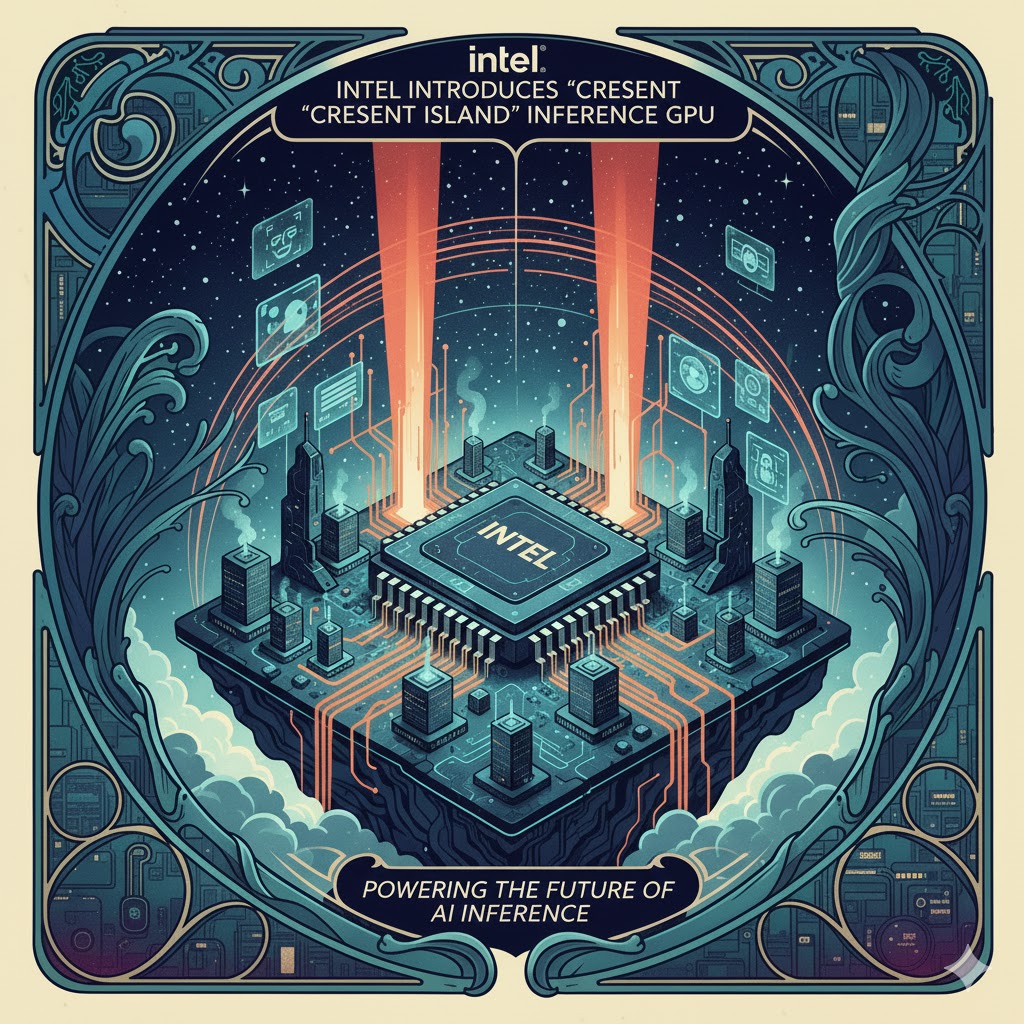

What’s new: Intel announced Crescent Island, an inference‑focused GPU using the Xe3P architecture and 160 GB LPDDR5X memory, due for sampling in late 2026newsroom.intel.comtomshardware.com.
Impact:
- Inference focus: AI workloads are shifting from huge training runs to continuous real‑time inference, which demands energy‑efficient, low‑latency processinghpcwire.com. Intel CTO Sachin Katti says Crescent Island aims to deliver the best “tokens per dollar” for inferencereuters.com.
- Competitive market: The AI inference GPU sector could grow to $75 billion by 2033ainvest.com. Intel must compete with Nvidia and AMD, whose upcoming GPUs use faster HBM4 memoryainvest.com. Intel also trails in software ecosystems, a gap it must close to entice developers.
- Funding and alliances: The U.S. has awarded Intel $8.9 billion for domestic chip productionainvest.com, and Nvidia has invested $5 billion, giving it a 4 % stake in Intelreuters.com. These funds could speed development but reveal complex interdependencies between competitors.
- Energy implications: Using LPDDR5X memory should lower power draw compared to high‑bandwidth memory, although throughput may sufferhpcwire.com. As inference workloads proliferate, energy‑efficient hardware will become essential to manage data‑centre emissions.
Takeaway: Crescent Island underscores Intel’s bid to reclaim relevance by targeting the rapidly expanding inference market with a cost‑ and energy‑efficient GPU. Its success will depend on software support, customer demand for efficiency over raw bandwidth, and navigating rival alliances.

AI Systems Performance Engineering: Optimizing Model Training and Inference Workloads with GPUs, CUDA, and PyTorch
As an affiliate, we earn on qualifying purchases.
As an affiliate, we earn on qualifying purchases.
As an affiliate, we earn on qualifying purchases.

GEEKOM A9 Mega AI Workstation Desktop PC, Ryzen AI Max+ 395 for Local LLM
- Limited Supply of Ryzen AI Max+ 395: First to feature this high-performance chip
- Exclusive 126 TOPS AI Performance: Unlocks advanced local large language models
- 3-Year Industry-Grade Warranty: Includes comprehensive coverage and reliability
As an affiliate, we earn on qualifying purchases.
As an affiliate, we earn on qualifying purchases.

Edge AI Performance on NVIDIA Jetson: Mastering Orin Nano and TensorRT for Real-Time Computer Vision and Robotics Projects (Edge AI Mastery: Building Intelligent IoT and TinyML Applications)
As an affiliate, we earn on qualifying purchases.
As an affiliate, we earn on qualifying purchases.






![Huawei’s AI Strategy: Dominating AI As Frontier AI Lab With Noah’s Ark, Pangu Ecosystem [In-Depth Analysis, 2026] - Klover.ai](https://thorstenmeyerai.com/wp-content/uploads/2026/09/huawei-s-ai-strategy-dominating-ai-as-frontier-ai-lab-with-noah-s-ark-pangu-ecos-featured-260x140.jpg)