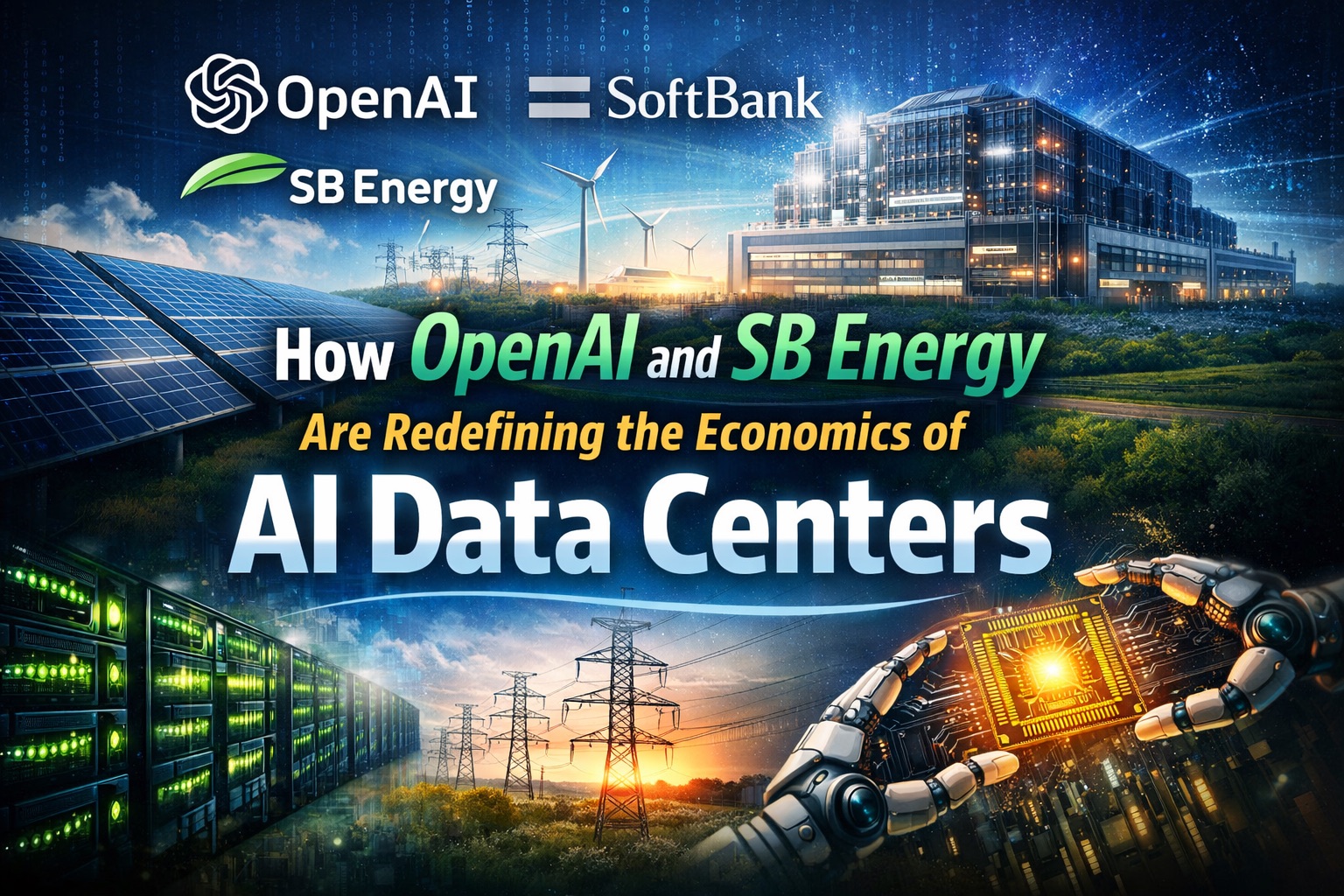

The race to artificial intelligence supremacy is no longer just about algorithms—it is about energy, land, and infrastructure economics. With OpenAI and SoftBank investing a combined $1 billion into SB Energy, the Stargate initiative signals a structural shift in how AI compute is built, priced, and scaled.
Traditional data centers were designed for web services and enterprise software. AI-native data centers, by contrast, are energy-first systems. Massive GPU clusters consume unprecedented levels of electricity, making power availability the primary constraint on AI growth.
SB Energy’s role as developer and operator of Stargate facilities introduces a vertically integrated model where energy generation, storage, and compute live in one system. The flagship 1.2 GW facility in Texas demonstrates the scale required to support next-generation foundation models.
For OpenAI, this model reduces dependency on volatile energy markets and legacy colocation providers. For SoftBank, it represents a long-term infrastructure play similar to telecommunications or railroads—assets that gain strategic value as demand compounds.
The result is a new economic baseline: AI compute priced not by server racks, but by megawatts. This shift may ultimately lower training costs while increasing the barrier to entry for smaller competitors.
Stargate and the Coming Explosion in GPU Demand
The Stargate program is often framed as an infrastructure story, but its ripple effects will be felt most strongly in the global GPU supply chain.
Each gigawatt-scale AI data center requires tens of thousands of advanced accelerators. This demand reinforces NVIDIA’s dominance while intensifying competition among hyperscalers for priority access to next-generation chips.
Unlike consumer GPU cycles, Stargate-class deployments create multi-year, non-cyclical demand. GPUs are no longer discretionary upgrades—they are fixed infrastructure inputs similar to turbines in a power plant.
This sustained demand reshapes markets beyond data centers. Enterprise AI workstations, research clusters, and edge-AI systems increasingly mirror hyperscale architectures, blurring the line between “cloud” and “on-prem.”
For developers and enterprises, this means compute scarcity may persist—even as AI tools become more accessible. Stargate does not eliminate the GPU bottleneck; it formalizes it as a strategic resource.

AI Systems Performance Engineering: Optimizing Model Training and Inference Workloads with GPUs, CUDA, and PyTorch
As an affiliate, we earn on qualifying purchases.
As an affiliate, we earn on qualifying purchases.
What Stargate Means for Cloud Credits and Startup AI Strategy
For startups, Stargate represents a paradox: unprecedented AI power, but increasingly centralized control.
As OpenAI expands its own compute backbone, cloud credits become more than promotional tools—they are gatekeeping mechanisms. Access to large-scale training increasingly depends on partnerships rather than capital alone.
This dynamic accelerates the shift toward multi-cloud and hybrid strategies. Startups optimize for inference efficiency, model fine-tuning, and workload portability, rather than raw training scale.
The implication is clear: the future favors teams that design AI products to be compute-aware, not compute-hungry. Stargate raises the ceiling for what’s possible, but it also narrows the path to independence.

A Survey on Coordinated Power Management in Multi-Tenant Data Centers
As an affiliate, we earn on qualifying purchases.
As an affiliate, we earn on qualifying purchases.
Why Edge AI and Desktop AI Still Matter in a Stargate World
Despite the scale of Stargate, AI’s future is not cloud-only. Edge and desktop AI remain essential counterweights to hyperscale dominance.
Latency-sensitive applications, privacy-critical workloads, and offline systems cannot depend exclusively on centralized infrastructure. As data centers grow larger, local inference becomes more valuable, not less.
Developers increasingly prototype locally, validate models on workstations, and deploy optimized versions at the edge. This hybrid workflow mirrors the early days of cloud computing—centralized power paired with local autonomy.
Stargate strengthens this trend by making large-scale training expensive and centralized, while inference becomes distributed and efficient. The AI ecosystem is bifurcating into training giants and inference specialists.

Apple 2026 MacBook Pro Laptop with Apple M5 Pro chip with 15-core CPU and 16-core GPU: Built for AI, 14.2-inch Liquid Retina XDR Display, 24GB Unified Memory, 1TB SSD, Wi-Fi 7; Space Black
FAST RUNS IN THE FAMILY — The 14-inch MacBook Pro with the M5 Pro or M5 Max chip…
As an affiliate, we earn on qualifying purchases.
As an affiliate, we earn on qualifying purchases.
The AI Infrastructure Reading List Everyone Should Follow
Understanding Stargate requires literacy beyond software. AI is now an infrastructure discipline, blending energy systems, hardware engineering, and economic strategy.
Key themes every reader should track:
- Power-first data center design
- GPU supply chain geopolitics
- AI workload orchestration
- Energy-aware model training
- Post-labor economic implications
The Stargate initiative is not just an OpenAI project—it is a signal that AI has entered the same strategic category as electricity, oil, and telecommunications.
Those who understand this shift early will shape not only technology, but policy, labor, and capital allocation for decades to come.

Lenovo ThinkPad P16s Gen 4 21QR0024US 16" Touchscreen Copilot+ PC Mobile Workstation – WUXGA – AMD Ryzen AI 7 PRO 350-32 GB – 512 GB SSD – English Keyboard – Black
With 32 GB of memory, you can run numerous programs simultaneously without any degradation in performance
As an affiliate, we earn on qualifying purchases.
As an affiliate, we earn on qualifying purchases.