
For years, “European alternative to Palantir” was a conference-panel phrase. In the last ninety days it became a procurement category.
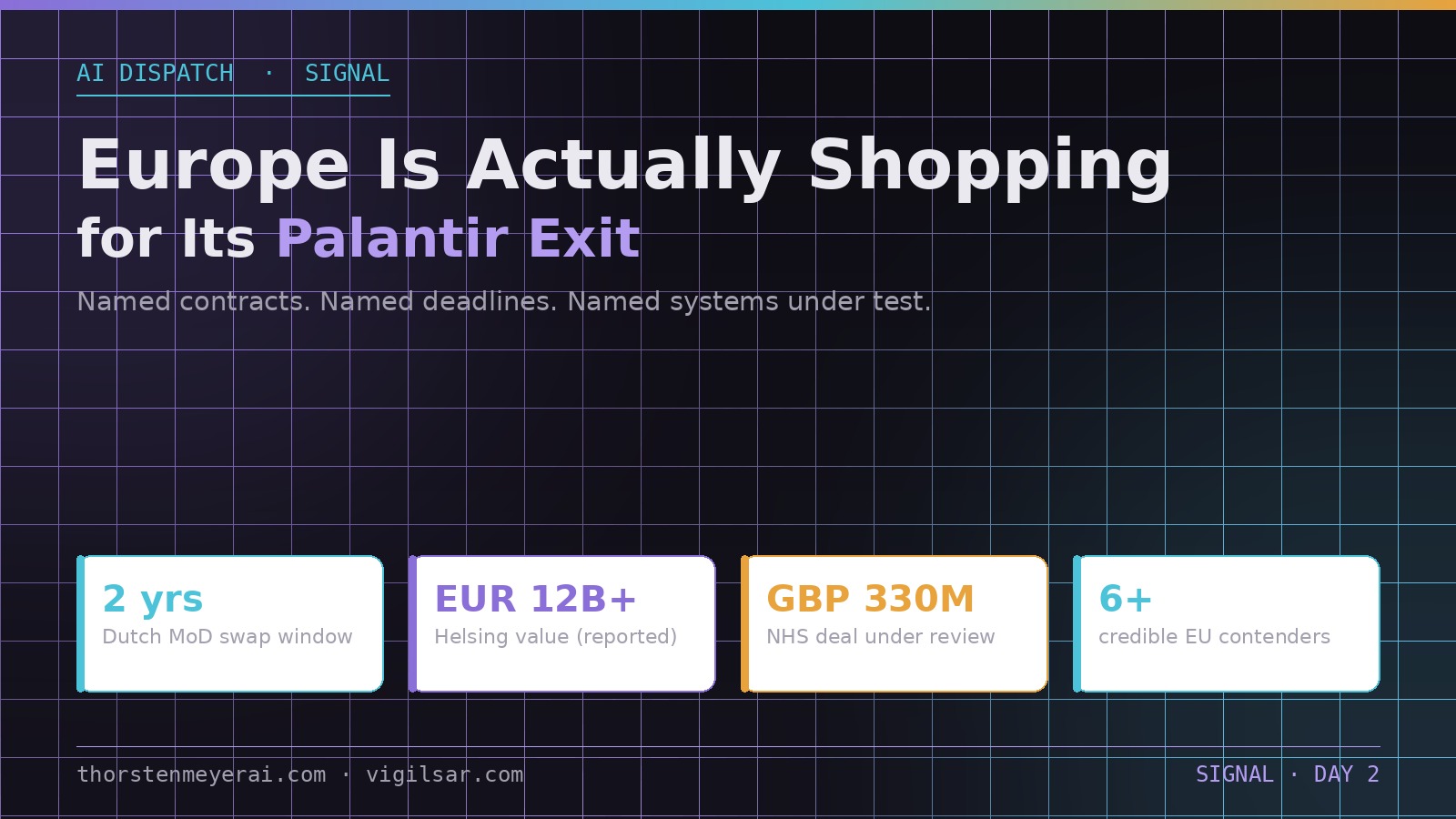
The evidence is no longer rhetorical. Germany’s domestic intelligence agency (BfV) awarded its large-scale data-analysis contract to France’s ChapsVision in May — explicitly over Palantir, whose lobbying for the German security market has been aggressive and public. The Bundeswehr has ruled Palantir out of its military cloud projects on data-security grounds. The Dutch defense ministry told parliament in early June it wants a “fully fledged alternative” within two years. A UK parliamentary committee called public-sector reliance on Palantir an “unacceptable weakness” and urged review of the NHS’s £330 million deal. And France is testing Arcadia, a mesh-networked, NATO-interoperable battlefield AI system built on the earlier Artemis/Athea work — a direct sovereign answer to Palantir’s Maven.
Three data points make a line. Five make a market.
Europe Is Actually Shopping
for Its Palantir Exit
Same-day-verified market pulse · from conference-panel phrase to procurement category in ninety days
How sentiment became procurement
The contender field — honestly assessed
STEELMAN: WHY PALANTIR KEEPS WINNING ANYWAY
Mature, integrated, combat-proven at alliance scale — and switching costs in intelligence tooling are brutal. No European contender today offers the full bundle; several governments funding alternatives still run Palantir somewhere in the stack. The Dutch two-year timeline exists precisely because rip-and-replace carries real operational risk.
The signal: named contracts, named deadlines, named systems under test — demand has moved from sentiment to procurement. Supply is credible but fragmented; expect consolidation and consortiums, because buyers now want the bundle without the flag. Decided in the next 24 months.

Computer Security – ESORICS 2025: 30th European Symposium on Research in Computer Security, Toulouse, France, September 22–24, 2025, Proceedings, Part II (Lecture Notes in Computer Science)
As an affiliate, we earn on qualifying purchases.
As an affiliate, we earn on qualifying purchases.
What changed
Two things, in sequence. First, NATO adopted Palantir’s Maven Smart System in March 2025 and had it operationally deployed across the alliance within months — which concentrated an uncomfortable amount of alliance-critical intelligence tooling in one US vendor precisely as transatlantic political relations turned volatile. Second, in March 2026 Palantir loudly publicized Maven’s role in operations against Iran — a marketing decision that reportedly landed badly with European defense ministries already anxious about routing their most sensitive military data through systems controlled by a company so closely aligned with Washington’s political currents.
The sovereignty logic mirrors the constellation story from this morning’s SAR briefing: a capability you rent from a foreign vendor is a capability that can be repriced, deprioritized, or conditioned when interests diverge. Europe spent the last two years internalizing that lesson for launch, cloud, and imaging. Exploitation software is simply the next layer up — and arguably the most sensitive one, because it’s where all the other layers’ data converges.
Strategic Coordination Among U.S. Military Platforms in Operation Epic Fury: A Network Analysis of Open-Source Data
As an affiliate, we earn on qualifying purchases.
As an affiliate, we earn on qualifying purchases.
The contender field, honestly assessed
The bench is more real than the skeptics claim and thinner than the boosters imply:
ChapsVision (France) is the one with fresh contract wins — its ArgonOS analysis platform already serves France’s DGSI and now the German BfV, integrating with Germany’s police information network through Rola Security Solutions. Helsing (Germany) is the money magnet: reportedly valued above €12 billion, AI-native, but oriented toward weapons systems and battlefield decision-making rather than Foundry-style institutional data fusion. Athea/Arcadia (France) carries the state-backed battlefield-AI mantle into NATO interoperability testing. Systematic (Denmark) already has NATO adoption for its SitaWare command-and-control line. Italy’s Octostar claims Palantir-rivaling ambitions but no marquee contract yet, and Finland’s ICEYE is migrating up-stack from imagery into AI-driven analysis — the constellation owner building its own exploitation layer, exactly the pattern this morning’s dispatch predicted. Ukraine’s battle-tested DELTA system rounds out the field as proof that a non-US situational-awareness stack can work under the hardest conditions on earth.
The steelman for staying with Palantir deserves its space: the product is mature, integrated, combat-proven at alliance scale, and switching costs in intelligence tooling are brutal — data models, analyst training, and inter-agency workflows all resist migration. The Dutch two-year timeline exists precisely because ripping out entrenched exploitation software carries genuine operational risk. No European contender today offers Foundry’s breadth, and pretending otherwise is how sovereignty projects end up as expensive failures. Several European governments — France and Greece included — still run Palantir somewhere in their stack even while funding its replacement.

Battlefield Pacific: Book Four of the Red Storm Series
As an affiliate, we earn on qualifying purchases.
As an affiliate, we earn on qualifying purchases.
The signal, compressed
The demand side has moved from sentiment to procurement: named contracts (BfV–ChapsVision), named deadlines (Netherlands, two years), and named systems under test (Arcadia). The supply side is credible but fragmented — six-plus contenders, each covering a slice of what Palantir bundles. The predictable next phase is consolidation pressure and consortium-building, because no single European vendor currently matches the bundle, and the buyers now officially want the bundle without the flag.
For anyone building in the ISR exploitation space — my own corner of this market at vigilsar.com — the read is simple: the door European governments spent years politely holding closed is now formally open. What walks through it will be decided in the next twenty-four months.
Sources: heise online (BfV–ChapsVision award, May 2026); Cybernews / Tweakers (Dutch MoD statement, June 2026, and UK committee findings); cryptobriefing.com (Arcadia testing, Maven adoption timeline, June 2026); The Wald Brief (European contender field, May 2026); Eurowire (Helsing profile and valuation, reported figures).
![DeskFX Free Audio Effects & Audio Enhancer Software [PC Download]](https://m.media-amazon.com/images/I/41fXbDohyuS._SL500_.jpg)
DeskFX Free Audio Effects & Audio Enhancer Software [PC Download]
- Audio Transformation: Enhance sound from speakers and headphones
- Sound Quality Improvement: Adjust audio with various effects
- Audio Control: Manage sound through hardware settings
As an affiliate, we earn on qualifying purchases.
As an affiliate, we earn on qualifying purchases.