
Yesterday’s briefing ended on a claim: whoever owns the software that reads the sensor owns the value of the constellation above it.

Get business pricing on tech for your team
- Business-only prices and quantity discounts
- Tax-exempt purchasing
- Multiple users, one account, clear invoices
Today I start acting on it, in public.
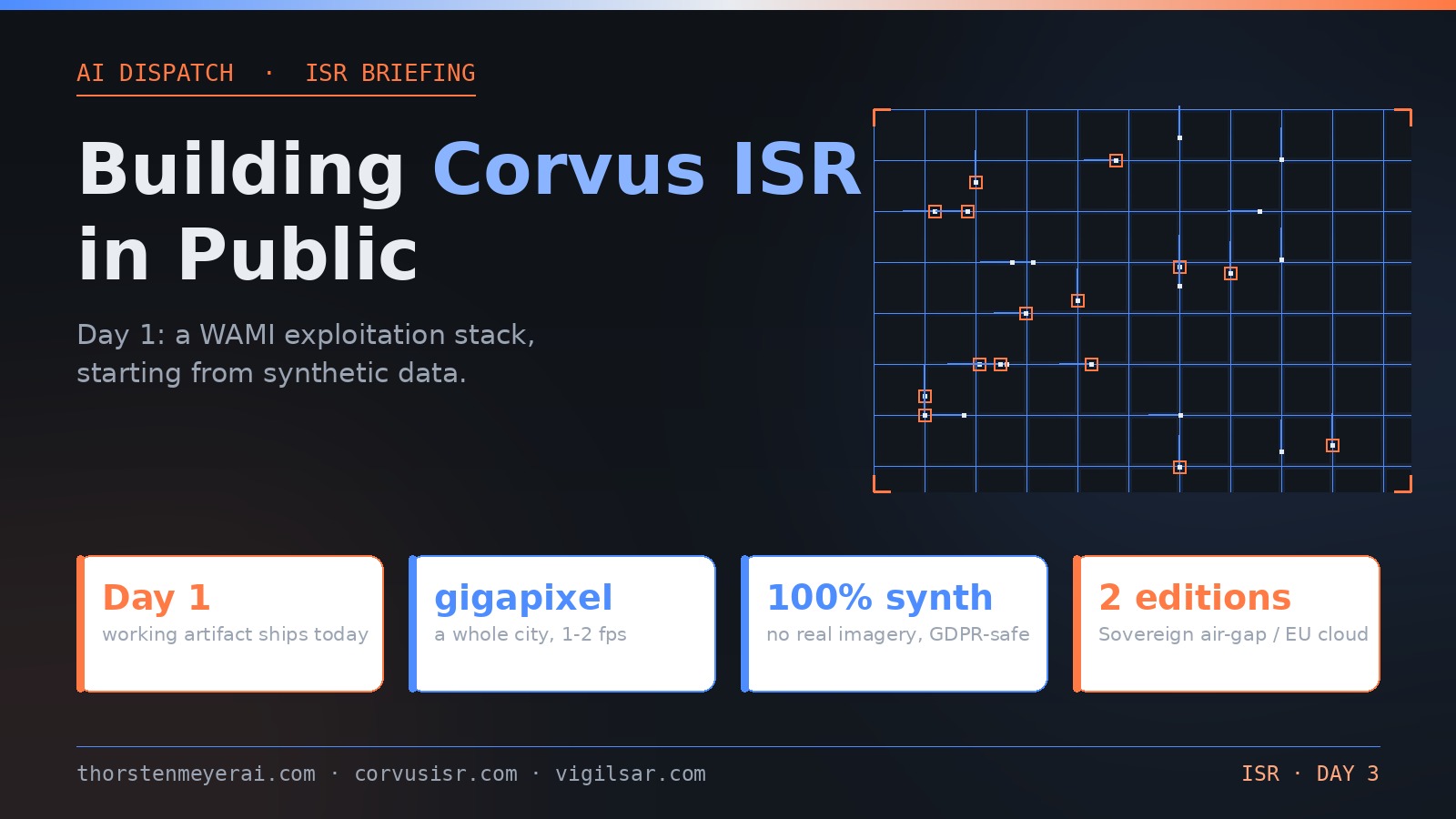
Corvus ISR is a new product I’m building — an exploitation stack for wide-area motion imagery (WAMI), the most analyst-hostile sensor class in the ISR world. This dispatch is Day 1 of a build-in-public series: the reasoning, the architecture bets, the working code as it lands, and the mistakes as they happen. Alongside this article ships the first working artifact — a synthetic WAMI scene with live detection and tracking, running in your browser. It’s small, it’s simplified, and it’s real.
CORVUS ISR · synthetic WAMI scene — live detect & track
BUILD IN PUBLIC · DAY 1 ARTIFACTWhy WAMI is the right problem
Most people have never seen wide-area motion imagery, because almost nobody is allowed to. A WAMI sensor is an airborne camera array that images an entire city at once, continuously — gigapixel-class frames (the well-known ARGUS-IS demonstrator produced 1.8-gigapixel imagery) at a rate of one or two per second, for hours. Every vehicle, every moving thing, across tens of square kilometers, recorded persistently.
The physics is spectacular. The economics are absurd — in the bad direction. A single WAMI sortie produces data volumes that make satellite imagery look like a rounding error, and the standard operating model has been to fly the sensor, store the haystack, and task a room of analysts to scrub backwards through it after something happens. WAMI is the purest expression of the problem this week’s dispatches keep circling: collection outran exploitation years ago, and the gap is widest exactly where the sensor is most powerful.
That’s the market logic. Sensors are proliferating — aerostats, long-endurance drones, and manned platforms all carry WAMI-class payloads now — while the exploitation software layer remains thin, largely US-controlled, and largely closed. After yesterday’s Signal, I don’t need to re-argue what European buyers currently think about depending on US-controlled analysis software. The door is open. Corvus ISR is my attempt to walk through it at the sensor class where the exploitation gap is most extreme.
wide-area motion imagery (WAMI) surveillance system
As an affiliate, we earn on qualifying purchases.
As an affiliate, we earn on qualifying purchases.
Why start from synthetic data
Here’s the strategic choice that makes a one-person-plus-agents build viable at all: Corvus starts life on fully synthetic WAMI.
Real WAMI data is restricted, classified, or prohibitively expensive — and even when a sample dataset can be had, building a public product demo on surveillance footage of real people’s real movements is a governance minefield, especially under European law. Synthetic data dissolves all of it at once:
Legally clean. No real persons, no real vehicles, no GDPR data subjects, no export-controlled imagery. The demo below can run on a public webpage precisely because every pixel is generated.
Infinitely labeled. Synthetic scenes come with perfect ground truth for free — every object’s position, identity, and track is known by construction. That’s the training and benchmarking substrate real WAMI can never cheaply provide, and it’s how detector and tracker quality can be measured honestly instead of anecdotally.
Deliberately hard. Scene generation is a difficulty dial: traffic density, occlusion, sensor jitter, frame-rate starvation, contrast collapse. You can manufacture the failure cases that matter before ever touching operational data.
The obvious objection — synthetic-to-real transfer is never free, and a system that only works on its own simulator is a toy — is correct, and it’s why the roadmap treats synthetic as the first substrate, not the only one. But the sequence matters: build the exploitation pipeline, benchmark it against perfect ground truth, then earn the right to real data. Not the reverse.
As an affiliate, we earn on qualifying purchases.
What Corvus ISR is
The product thesis in three lines: a WAMI exploitation stack that detects, tracks, and indexes everything that moves in a wide-area scene, turns it into a queryable motion database, and does it on infrastructure the customer controls.
That last clause is the positioning, and it ships as a two-edition strategy from day one: a Sovereign edition built for air-gapped deployment — no external dependencies, no telemetry, runs where the data legally has to live — and a Governed edition for EU-jurisdiction cloud operation with the audit and compliance surface European institutional buyers require. Same core, two custody models. If this week’s dispatches have a thesis, it’s that this distinction — who holds the keys, in which jurisdiction — is now the primary axis European ISR buyers procure on. Corvus is designed for that axis rather than retrofitted to it.
The build method is the same one that runs the rest of my portfolio: agentic coding sessions against a phased specification, on my own local-first infrastructure, with the working increments published as they land. That’s not a gimmick — it’s the demonstration. A market where one operator with an agent fleet can stand up a credible exploitation MVP is a market whose incumbent cost structures are about to be repriced. More on that meta-trend in today’s Signal column.
As an affiliate, we earn on qualifying purchases.
Day 1 artifact: the synthetic scene, live
The artifact accompanying this dispatch is the first public slice of the pipeline: a browser-native synthetic WAMI scene — a procedurally generated road network with a few hundred independently moving vehicles, a simulated sensor with adjustable coverage, and a first-pass exploitation layer running live: motion detection with bounding boxes, persistent track IDs, and trail histories, with the load dialable so you can watch the tracker degrade honestly as density climbs.
It is deliberately minimal. There is no deep learning in this slice — detection here is geometric, because the point of Day 1 is the harness: scene, sensor, detector, tracker, and truth all talking to each other in one loop with measurable output. Models come later; plumbing comes first. Anyone who has built production ML knows which of those two is actually hard.
As an affiliate, we earn on qualifying purchases.
The honest bull and bear on this bet
Bear case first, because it’s substantial: WAMI is a narrow market with deep-pocketed incumbents, real customers move at procurement speed (slow), operational data access is gated by exactly the sovereignty walls the product celebrates, and synthetic-first can become synthetic-forever if the real-data bridge never materializes. A one-builder product in defense tech also faces the credibility question every small vendor faces: institutions buy roadmaps and support guarantees, not just software.
Bull case: the exploitation gap is real and publicly acknowledged, European procurement has just demonstrated — with named contracts — that it will now pay for sovereign alternatives, WAMI exploitation is a software problem where incumbent advantage is thinnest, and building in public with synthetic data creates something incumbents can’t easily match: verifiable, benchmarkable, openly demonstrated capability that a procurement officer can evaluate without a security clearance.
Both cases are live. That’s what makes it worth building in public — the record will show which one wins.
Next in the series: the scene generator’s difficulty dials, and first tracking-quality numbers against synthetic ground truth. Product home: corvusisr.com · related ISR work: vigilsar.com.
Sources: public WAMI background including the DARPA ARGUS-IS demonstrator (1.8-gigapixel wide-area sensor, public reporting); market and procurement context per this week’s SAR briefing and Signal column sources (ICEYE/Bundeswehr, BfV–ChapsVision, Dutch MoD statements, May–June 2026).
Halloween Picks
halloween
As an affiliate, we earn on qualifying purchases.