The individual releases got their headlines. The cadence didn’t — and the cadence is the signal.

Get business pricing on tech for your team
- Business-only prices and quantity discounts
- Tax-exempt purchasing
- Multiple users, one account, clear invoices
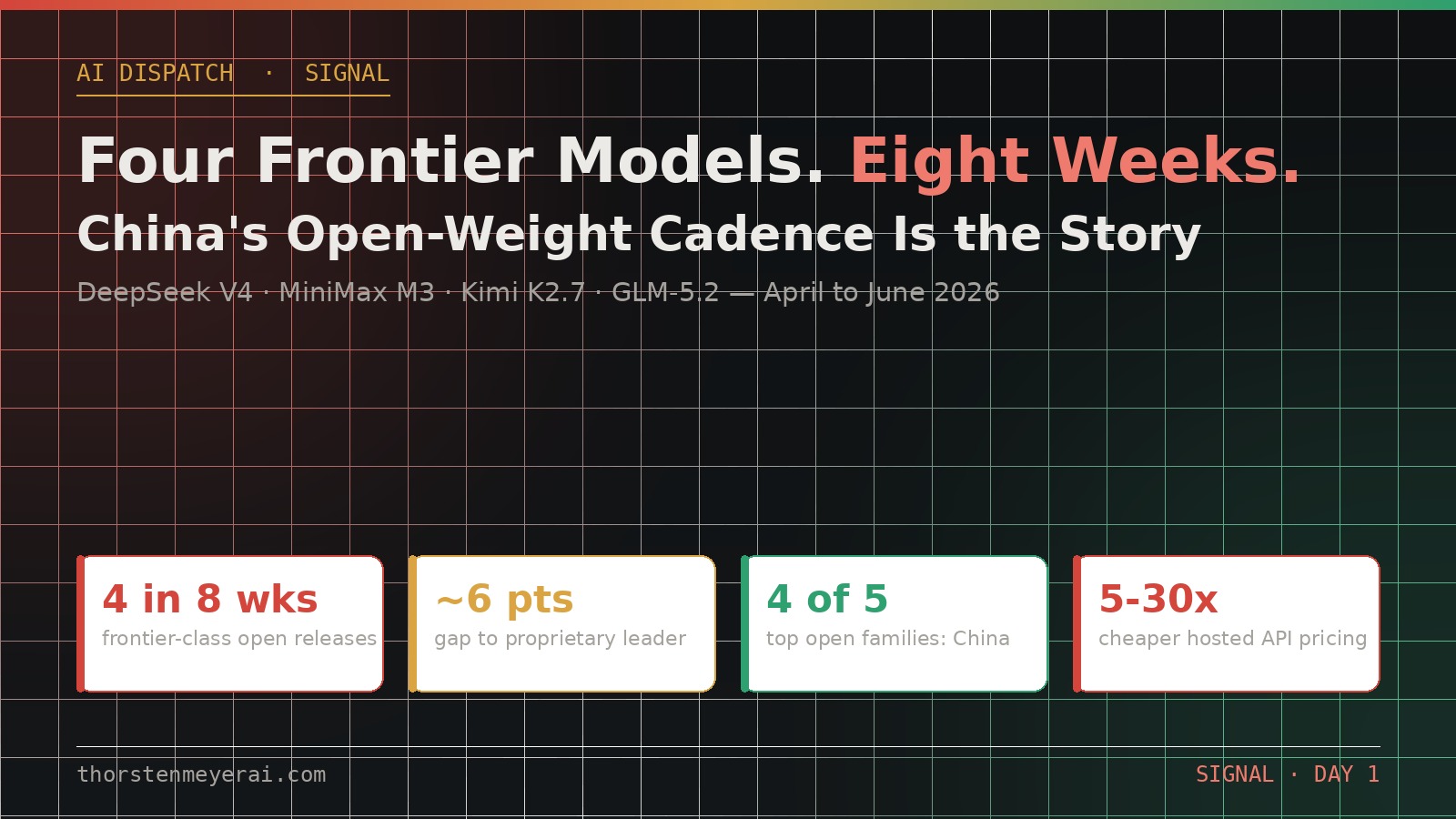
Between late April and mid-June 2026, Chinese labs shipped four frontier-class open-weight models in roughly eight weeks: DeepSeek V4 on April 24, MiniMax M3 on June 1, and Kimi K2.7-Code and GLM-5.2 within days of each other in mid-June. Every one of them downloadable, most under MIT-class licenses, all priced far below Western frontier APIs when bought hosted.
That’s not a wave. That’s a production line.
Four Frontier-Class Open Models in Eight Weeks
China’s Release Cadence Is the Story
Same-day-verified market pulse · July 13, 2026
The production line — spring 2026
The board this week — BenchLM overall score, July 2026
Gift & complication — the European read
The gift
Frontier-adjacent capability, permissive licenses, weeks-long refresh cycle. This cadence is what makes serious on-premises AI economically thinkable in 2026.
The complication
Still a dependency — geopolitical, not technical. Hosted Chinese APIs fall under Chinese data law; many Western agencies won’t touch the weights at all. Licensing generosity is a policy, not a law of nature.
The signal: if your infrastructure strategy assumes open models improve slowly, it’s already wrong. If it assumes the current licensing generosity is permanent, it’s unhedged.
As an affiliate, we earn on qualifying purchases.
The scoreboard as of this week
BenchLM’s July rankings put DeepSeek V4 Pro at the top of the Chinese field with an overall score of 87 — six points behind the current proprietary leader at 93, and the only open-weight model within striking distance of the closed frontier. Behind it, the depth is the real story: GLM-5.1 at 83, Kimi K2.6 at 81, Qwen’s strongest row at 79. Two years ago the Chinese open field was one lab deep. Today it’s four — DeepSeek, Z.ai, Moonshot, Alibaba — each with a distinct bet:
DeepSeek owns the price floor: V4 Pro packs 1.6 trillion total parameters but activates only 49 billion per pass, with a 1M-token context, and its API pricing anchors the cheap end of the market. Z.ai’s GLM-5.2 holds the open-weight intelligence crown on Artificial Analysis’s independent index. Moonshot’s Kimi line is tuned for long-horizon agent stability — K2.7-Code cuts thinking tokens roughly 30% versus its predecessor, directly attacking the cost of long agent runs. Alibaba’s Qwen family is the broadest and the one most people actually self-host, with compact variants that run on a single GPU.
Meanwhile the Western open-weight bench has thinned. Meta’s flagship open effort stalled, and the strongest genuinely open-source (not just open-weight) release — Ai2’s Olmo 3 — trails the Chinese leaders on raw capability. By mid-2026, four of the five most capable open-weight model families come from Chinese labs.
As an affiliate, we earn on qualifying purchases.
Why this matters for European deployments
For anyone building sovereign or local-first AI in Europe — my own DojoClaw fleet included, which runs on Qwen daily — this cadence is a strategic gift with a complication attached.
The gift: the capability tax on self-hosting keeps collapsing, and it’s collapsing fast, refreshed every few weeks rather than every year. Combined with permissive licenses and 1M-token contexts, the open Chinese frontier is what makes serious on-premises AI economically thinkable at all in 2026.
The complication: it’s still a dependency — just a different one. Weights alone can’t phone home, but a meaningful set of Western enterprises and agencies won’t touch Chinese-origin models regardless, and hosted Chinese APIs process prompts under Chinese data law, which is disqualifying for exactly the regulated workloads where sovereignty matters most. US federal agencies have banned the DeepSeek app on government devices — the downloadable weights remain legal and widely used, a distinction much of the coverage blurs.
And a steelman for the skeptics: a release cadence this hot is partly a strategic response to US export controls — efficiency breakthroughs forced by hardware scarcity — and partly a land-grab for the world’s default AI substrate. Neither motive guarantees the window stays open. Licensing terms can change with the next release; so can Beijing’s export posture.
As an affiliate, we earn on qualifying purchases.
The signal, compressed
Open-weight capability is now refreshed on a weeks-long cycle, driven almost entirely from China, with the gap to the closed frontier down to single digits on the broad benchmarks. If your infrastructure strategy assumes open models improve slowly, it’s already wrong. If it assumes the current licensing generosity is permanent, it’s unhedged.
More on that second problem — how long the window stays open, and what to do before it doesn’t — in a full dispatch later this week.
Sources: BenchLM Chinese LLM rankings (July 2026); Artificial Analysis Intelligence Index v4.1 via Lushbinary; release dates and specs via kilo.ai model feed, Lushbinary, and GEO Toolbox comparison (July 2026); Western open-field context via Understanding AI and Tech Insider; US agency app restrictions via GEO Toolbox.
As an affiliate, we earn on qualifying purchases.
Halloween Picks
halloween
As an affiliate, we earn on qualifying purchases.