This is the most politically sensitive part of the disruption map, because it involves people’s careers rather than companies’ revenue lines. It also requires more precision than the usual “AI will take jobs” framing, which tends to be both alarmist and imprecise at the same time.
The honest answer is: the entry-level knowledge work pipeline is being restructured, not eliminated — but the restructuring is real, it is already underway, and pretending otherwise does not help the people inside it.
ThorstenmeyerAI.com · Analysis · April 2026
The arbitrage is over
How Claude for Word kills the economic case for offshore document review. The LPO model was built on one assumption: human reading is cheaper than software alternatives at scale. That assumption no longer holds — and the pricing anchor has moved permanently.
The scale of what has shifted
The cost stack: what clients now compare
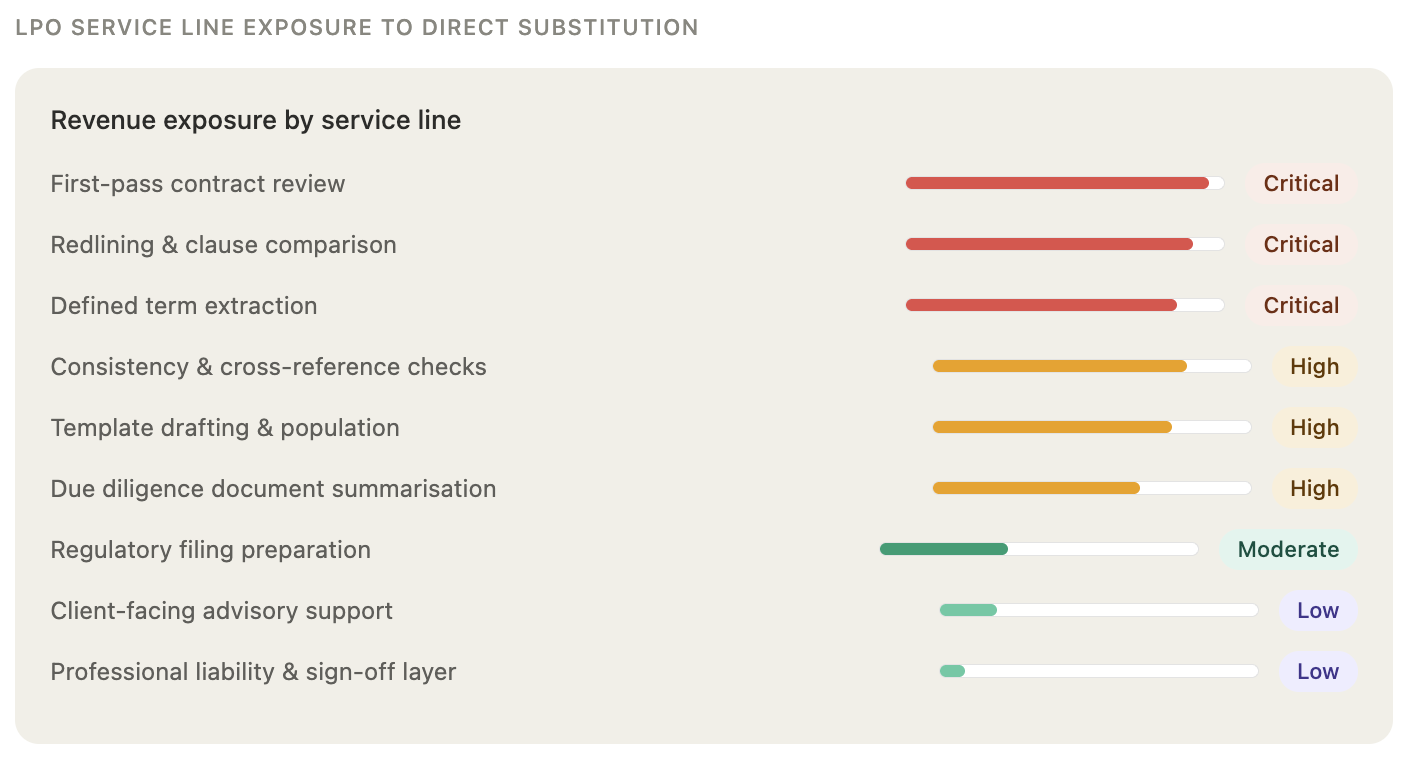
LPO service line exposure to direct substitution
The e-discovery precedent: what rate compression looks like
Where LPOs can hold ground
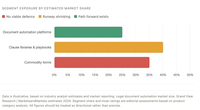
Data is illustrative, based on industry reporting and market analysis. LPO market size: HfS Research / NelsonHall estimates 2024. Offshore review rates: Thomson Reuters Legal Tracker benchmarks. E-discovery adoption: RAND Institute for Civil Justice studies on technology-assisted review. Rate compression figures are directional and should not be treated as precise benchmarks.
What paralegals and junior associates actually do
To understand the exposure, you have to be clear about the task composition of these roles. A paralegal at a corporate law firm spends a significant portion of their time on things that are directly in Claude for Word’s strike zone: reviewing contracts against a checklist, extracting defined terms, flagging non-standard provisions, running consistency checks, preparing first drafts from templates, summarising documents for senior review, and working through comment threads. These are not peripheral tasks — they are the core billable output of the role in many practice areas.
Junior associates do a version of the same thing at higher complexity. A first or second-year associate on an M&A deal is likely spending real hours on due diligence review, first-pass drafting from precedents, and preparing comparison memos on redlined drafts. These are the tasks that Claude for Word is explicitly designed to accelerate.
Neither role is purely mechanical — both involve judgment, client communication, professional development, and tasks that require contextual understanding that models still handle unevenly. But the mechanical layer of both roles is large, it is billable, and it is now under direct pressure.
The hiring signal arrives before the headcount signal
The first place this shows up is not in layoffs. It shows up in hiring freezes and reduced intake classes, which are quieter and easier to attribute to market conditions rather than technology. A firm that previously hired twelve first-year associates to handle a document-heavy practice may find that eight can cover the same volume with AI assistance. The four positions that disappear never get posted. Nobody gets fired. The restructuring is invisible in the aggregate employment data but very visible to the law school graduating class trying to find seats.
This pattern has already played out in other parts of the knowledge economy. When spreadsheet modelling became faster, finance teams did not shed analysts overnight — they just stopped expanding at the rate that transaction volume would historically have implied. The ratio of humans to output shifted. The same ratio shift is coming to document-heavy legal work, and Claude for Word accelerates the timeline.
The apprenticeship problem is the deeper issue
The most serious structural consequence is one that rarely gets discussed in the technology coverage: junior roles in law and knowledge work have never been purely about output. They are the apprenticeship layer of a profession. You spend three years reading contracts obsessively not just because the firm needs someone to read contracts, but because reading thousands of contracts is how you develop the judgment to eventually negotiate them.
If the mechanical reading layer is handled by AI, junior lawyers do less of it. That is the efficiency gain. But it is also a reduction in the repetitions that build professional pattern recognition. A junior associate who has personally worked through five hundred non-disclosure agreements has a different intuition about what is off-market than one who has reviewed the AI’s output on five hundred non-disclosure agreements. The knowledge may be present in both cases. The instinct may not be.
Law firms are going to have to think carefully about how they deliberately rebuild the apprenticeship function that the efficiency gain quietly removes. The ones that do not will discover the problem in about eight years when their mid-level associates lack the judgment foundation that partners previously took for granted.
The paralegal role bifurcates rather than disappears
The paralegal market is likely to split rather than contract uniformly. On one side: paralegal work that is primarily about document processing, extraction, and routine drafting faces real volume compression. Not elimination, but the demand for large teams of people doing first-pass review work will decrease as firms get comfortable with AI-assisted workflows.
On the other side: paralegals who operate closer to client-facing work, case management, regulatory coordination, and the institutional knowledge layer of a practice are in a different position. These roles require continuity, relationship management, and contextual judgment that does not compress as cleanly. They were already differentiated from the pure document layer; that differentiation is now more valuable.
The paralegal entering the profession today is well-advised to think about which side of that split they are building toward. Specialisation in technology-adjacent paralegal functions — managing AI-assisted workflows, handling the quality control and exception layer, developing expertise in AI tool governance within a firm — is a real career path that did not exist three years ago.
Knowledge work staffing agencies face a structural pricing problem
Firms that place contract document review attorneys, temporary paralegals, or project-based knowledge workers for large-volume matters are in a difficult position. Their model depends on clients paying a per-hour or per-document rate for human attention. When the client has access to AI-assisted review at marginal cost, the anchor for what that human attention is worth shifts downward.
This is not hypothetical — it happened in e-discovery. Contract review rates for document review attorneys compressed significantly as technology-assisted review became standard. The same compression is moving upstream into contract work, and the staffing agencies that built their business on volume placement for document-heavy matters are going to feel it in their bill rates before they feel it in placement volume.
Where junior talent should actually position itself
The career advice that flows from this is uncomfortable but not nihilistic. The roles that are most exposed are the ones where the primary value delivered is reading speed and mechanical consistency. The roles that remain durable are the ones where the value delivered is judgment, accountability, client trust, and the ability to direct AI effectively toward a specific outcome.
That last point is underappreciated. The ability to write a precise, well-scoped instruction to a legal AI tool — one that captures the client’s specific risk posture, flags the right exceptions, and produces output a senior lawyer can actually use — is a real skill. It is not the same skill as reading contracts for eight hours. It is arguably a higher-order skill. Junior knowledge workers who develop it early will be more valuable to their organisations than those who resist the tools and continue to pitch their value as reading speed.
The uncomfortable corollary is that this skill is also a smaller-headcount skill. You need fewer people who are good at directing AI than you previously needed people who were good at doing the underlying task manually. The efficiency gain is real. The demand destruction at the entry level is also real. Both things are true simultaneously, and the honest conversation about workforce transition in knowledge work has to hold both at once rather than resolving the tension prematurely in either direction.
The timeline is not a cliff, but it is not slow either
Institutional adoption of legal AI tools has historically been slower than the technology warranted — risk aversion, data security concerns, and the conservative culture of law firms all act as brakes. Claude for Word operates within the Microsoft security framework firms already trust, which removes one of the most significant adoption barriers. The fact that it outputs tracked changes rather than silent edits removes another. The friction that previously kept these tools at arm’s length from core workflows is systematically lower for this product than for its predecessors.
That means the timeline for meaningful workforce impact is probably shorter than previous technology transitions in legal suggested. Not months. But not a decade either. The firms that are thoughtful about it now — building AI governance policies, redesigning their associate development programmes, being honest with junior staff about how their roles are changing — will handle the transition better than the ones that wait until the pressure is undeniable.
The ones waiting for undeniable pressure are going to find it arrives faster than they planned for.

The AI Teammate: A PRACTICAL GUIDE TO WORKING WITH AI IN SOFTWARE DEVELOPMENT
As an affiliate, we earn on qualifying purchases.
As an affiliate, we earn on qualifying purchases.
AI Contract Review & Redlining: A Comprehensive Guide: Clause Risk Detection, Negotiation Playbooks, and AI-Assisted Redlines for Faster, Safer Deal Cycles
As an affiliate, we earn on qualifying purchases.
As an affiliate, we earn on qualifying purchases.

Contract Negotiation Handbook: Software as a Service
As an affiliate, we earn on qualifying purchases.
As an affiliate, we earn on qualifying purchases.
Typography for Lawyers 1st (first) edition
As an affiliate, we earn on qualifying purchases.
As an affiliate, we earn on qualifying purchases.