
How does Claude for Word affect document outsourcing and legal process outsourcing companies?
Listen free for 30 days with Audible
Thousands of audiobooks and originals — cancel anytime.
Start your free trialAs an affiliate, we earn on qualifying purchases.
Synthesized industry analysis regarding AI’s disruption of outsourcing sectors
This is where the disruption is most structural, because LPOs and document outsourcing operations are not selling software — they are selling human attention at scale. And human attention applied to document reading is precisely what Claude for Word replaces most directly.
ThorstenmeyerAI.com · Analysis · April 2026
The arbitrage is over
How Claude for Word kills the economic case for offshore document review. LPOs were never in the software business. They were in the human attention business. And Claude for Word just made human attention at scale the most expensive way to read a contract.
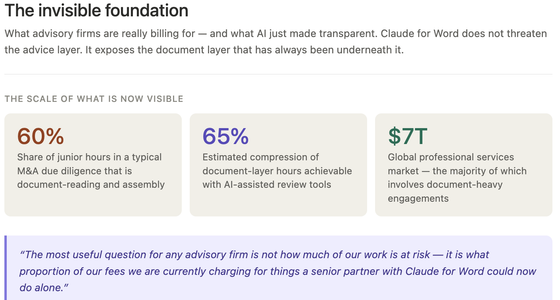
The structural shift in numbers
The pricing anchor has permanently moved
LPO hub exposure by geography
| Location | Typical rate | Primary advantage | AI exposure |
|---|---|---|---|
| Bangalore / Hyderabad | $22–$38/hr | Volume cost arbitrage | Critical |
| Manila / Cebu | $20–$35/hr | English fluency + cost | Critical |
| Cape Town / Johannesburg | $35–$55/hr | Time zone + common law | High |
| Warsaw / Kraków | $40–$65/hr | EU law + language depth | Moderate |
| Belfast / Glasgow | $55–$80/hr | Common law + accountability | Moderate |
| Claude for Word (Team plan) | ~$0 marginal | Instant, in-document, tracked | New anchor |
Where LPOs can hold ground
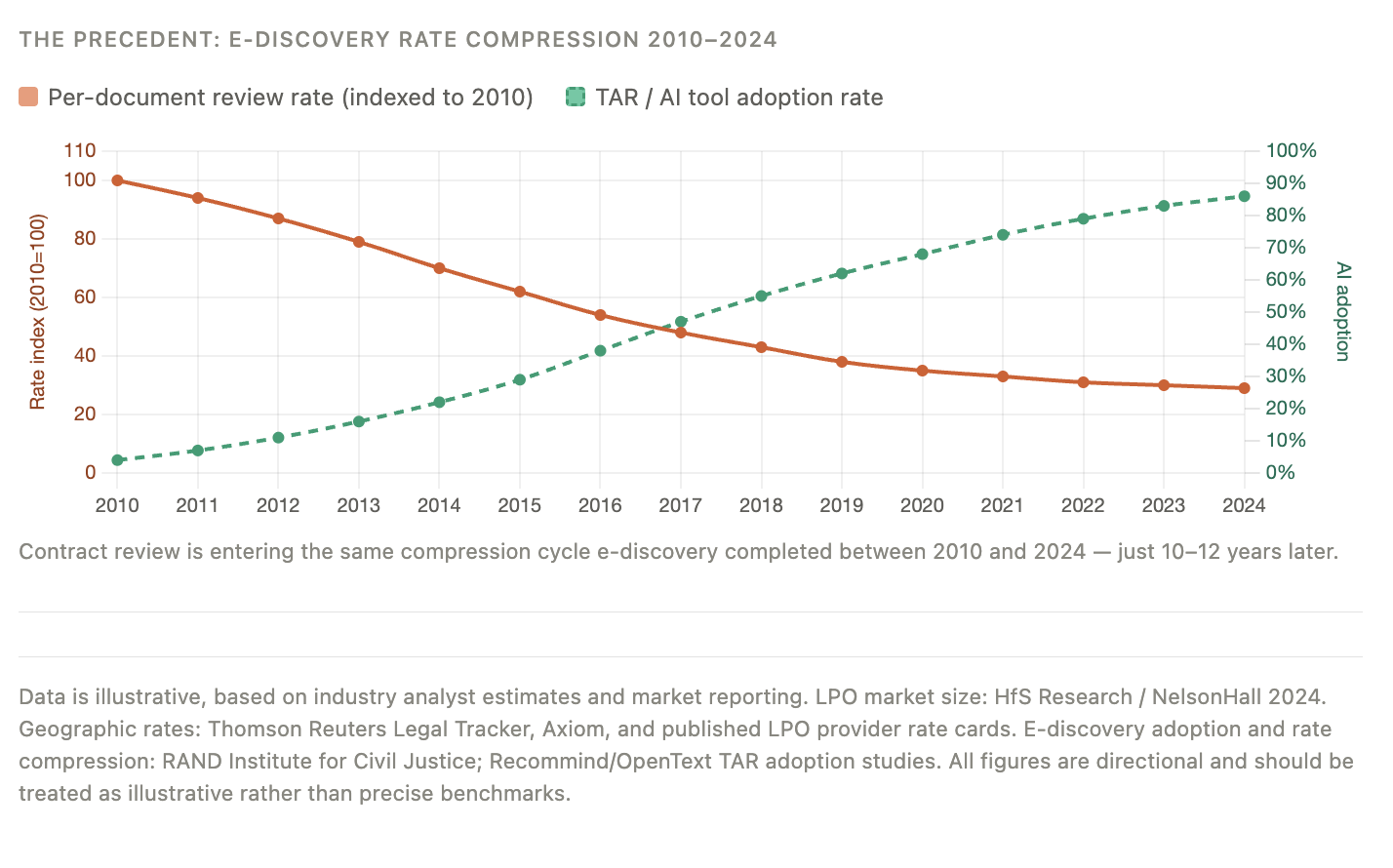
The precedent: e-discovery rate compression 2010–2024
Contract review is entering the same compression cycle e-discovery completed between 2010 and 2024 — just 10–12 years later.
Data is illustrative, based on industry analyst estimates and market reporting. LPO market size: HfS Research / NelsonHall 2024. Geographic rates: Thomson Reuters Legal Tracker, Axiom, and published LPO provider rate cards. E-discovery adoption and rate compression: RAND Institute for Civil Justice; Recommind/OpenText TAR adoption studies. All figures are directional and should be treated as illustrative rather than precise benchmarks.
The economic model that built LPOs is the one under pressure
Legal process outsourcing grew as a cost arbitrage play. A firm in New York or London could send first-pass contract review, due diligence document sets, or regulatory filing preparation to lower-cost teams in India, South Africa, or the Philippines and get results back overnight at a fraction of the onshore rate. The value proposition was simple: same cognitive task, cheaper human execution.
Claude for Word does not offer cheaper human execution. It offers near-zero marginal cost execution with no overnight delay, no timezone coordination, no project management overhead, and output that lands directly in the document the lawyer is already working in. For the specific tasks that form the bulk of LPO revenue — first-pass review, redlining, consistency checking, clause flagging — the substitution is uncomfortably direct.
Where the substitution is sharpest
The highest-risk LPO service lines are the ones closest to mechanical reading: identifying which documents in a due diligence data room contain change-of-control provisions, flagging non-standard clauses against a playbook, extracting defined terms, checking cross-reference consistency, running a final proofread against a style guide. These tasks have always been describable as instructions. When tasks can be described as instructions, they can be given to a model.
A mid-size M&A transaction might generate 800 documents requiring first-pass review. An LPO team might take a week. Claude for Word, operating on a trained playbook with firm-specific prompts, compresses that dramatically — not to perfection, but to a standard that a senior lawyer can verify rather than produce from scratch. That changes the staffing calculation for the firm even if it does not eliminate the LPO relationship entirely.
The quality argument is weakening, not disappearing
LPOs responded to early AI pressure by arguing quality. Trained reviewers catch nuance that models miss, they understand client-specific risk posture, they carry accountability. That argument still has real weight — but it is losing ground with each model generation, and Claude for Word’s tracked-change output makes the comparison more direct than ever. When a lawyer can see exactly what the model changed and why, the verification burden feels more like reviewing a junior associate’s work than auditing a black box. That perception shift matters commercially even if the underlying capability gap hasn’t fully closed.
The second-order effect on pricing
Even where LPOs are not directly replaced, they face a pricing problem. If a firm knows that Claude for Word can produce a credible first pass on a contract stack in an hour, the negotiating position for what an LPO charges for the same work changes. The LPO is no longer setting price against the cost of an onshore lawyer doing the work — it is setting price against the marginal cost of a model doing it. That is a much lower anchor.
This is already happening in adjacent markets. E-discovery vendors and document review platforms have watched per-document review costs compress steadily as AI-assisted review became standard. LPOs are entering that same compression cycle, just a few years later.
Where LPOs can hold ground
The operations that will survive this are the ones that move up the value chain faster than the model moves up the capability curve. That means several things in practice.
Accountability and professional liability is the clearest differentiator. A model cannot be named in a malpractice claim. An LPO staffed with qualified lawyers operating under a professional services agreement can. For regulated industries, high-stakes transactions, or matters where a client needs someone to stand behind the work product, that distinction remains commercially meaningful.
Jurisdiction-specific and language-specific depth is another moat. Claude for Word operates well in English on common law contract structures. An LPO with genuine expertise in civil law jurisdictions, local regulatory frameworks, or documents in languages other than English is offering something the general-purpose model cannot replicate by default — at least not yet.
Client-embedded knowledge is a third. An LPO that has worked with a client for five years, knows their standard playbook, their risk appetite, their counterparty preferences, and their internal escalation logic is not just doing document reading. They are operating as an extension of the client’s legal function with accumulated institutional context. That is harder to commoditise than a single-document review task.
Finally, volume operations with human oversight may find a new shape rather than disappearing. The LPO that can position itself as the validation and quality control layer on top of AI-generated first passes — catching the errors, handling the edge cases, providing the sign-off — is offering something the model cannot provide for itself. The workflow shifts from reading to auditing, which is a different skill mix and a different pricing conversation, but it is still a viable one.
The honest prognosis
LPOs built primarily on volume document review with limited value-add above the reading layer are facing a structural contraction. Not a cliff — institutional inertia, client relationships, and the genuine gaps in current model capability buy time. But the direction of travel is clear, and the companies that treat this as a temporary competitive threat rather than a structural shift in what the market is willing to pay for human document attention will find themselves behind the curve when the pricing pressure arrives in earnest.
The ones that move now — building out the accountability layer, the jurisdiction depth, the client-embedded expertise — have a real window. The model is commoditising the mechanical work. The question for every LPO is whether they have built anything above the mechanical layer worth keeping.
As an affiliate, we earn on qualifying purchases.
As an affiliate, we earn on qualifying purchases.
As an affiliate, we earn on qualifying purchases.
As an affiliate, we earn on qualifying purchases.
NFL season / tailgating Picks
team gear
As an affiliate, we earn on qualifying purchases.