
By Thorsten Meyer

Get business pricing on tech for your team
- Business-only prices and quantity discounts
- Tax-exempt purchasing
- Multiple users, one account, clear invoices
For a year the export-control fight was about one thing: the chips. Who can buy the best GPUs, who can’t, and how tightly the door swings. This week the fight moved to a component almost nobody outside a datacenter has ever thought about — the small optical part that turns electrical signals into pulses of light so data can cross a datacenter at the speed of light — and in doing so it revealed where the real chokepoints of the AI buildout actually sit.
Let me read this one carefully, because the headline version — “US bans Chinese datacenter tech” — is wrong in three specific ways that matter, and the parts the coverage skips are the parts worth your attention.
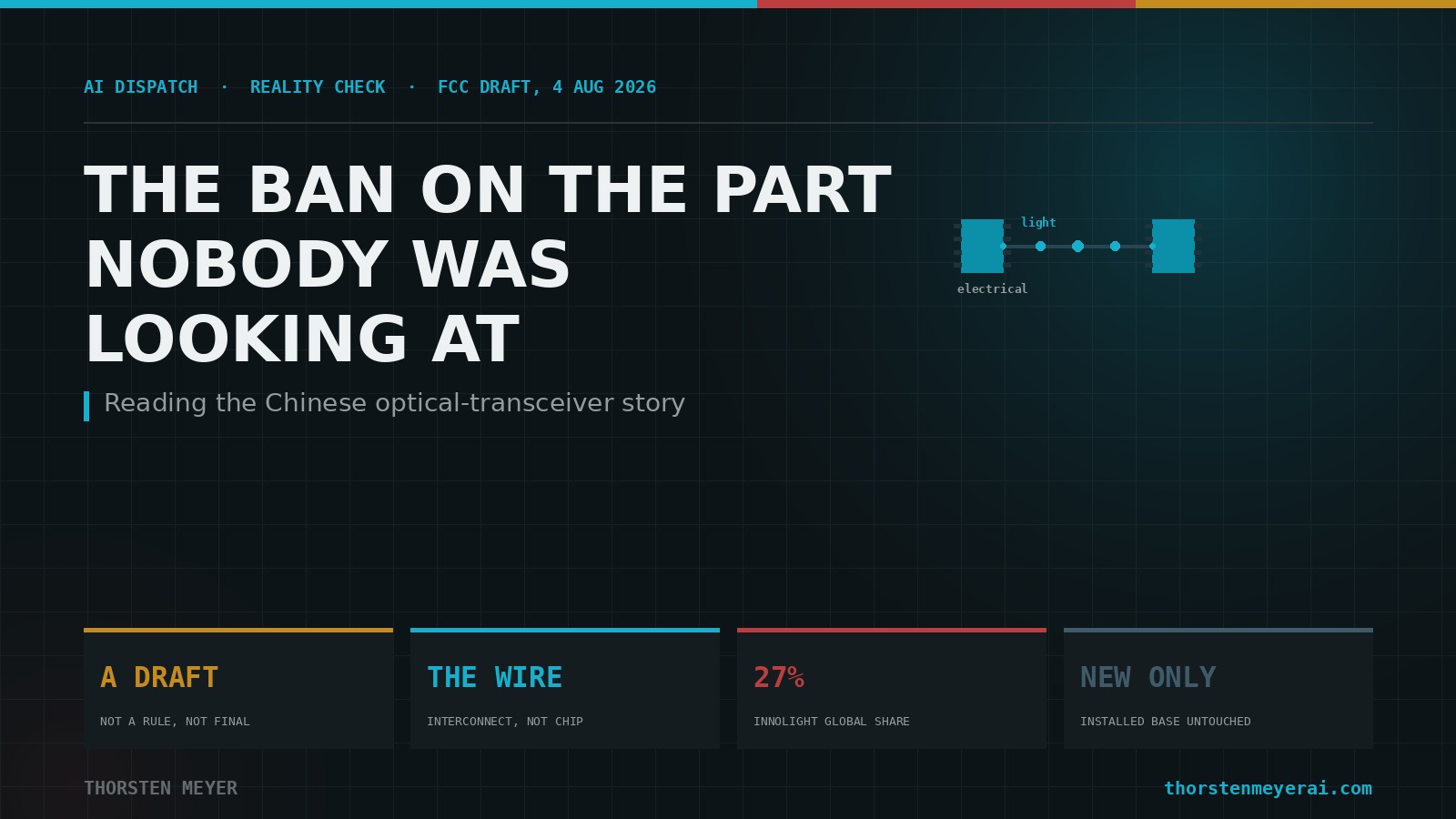
A drafted FCC measure would bar imports of new Chinese optical transceivers — the small parts that turn signals into light inside a datacenter. The headline says “US bans Chinese datacenter tech.” It’s wrong in three specific ways.
▲ A draft, not a rule · could be modified or shelved“US bans Chinese datacenter tech” is wrong in three ways that change what the story actually means.
The transceiver is the interconnect — the layer that sets the real bottleneck of modern inference. The US isn’t moving on the compute here. It’s moving on the nervous system that wires the compute together.
- Restricts what US tech is sold to China
- Targets the compute
- The fight everyone has been watching
- Restricts what Chinese gear is imported into the US
- Targets the interconnect / network fabric
- Confirms the wire is now as contested as the chip
Read one way it has a hole you can see through. Read the other way it’s coherent.
Production is the product, and capacity doesn’t teleport. Four frictions stand between the draft and reality.
as strategically contested as the compute. But it’s a draft, and the base is already installed.
What is actually being reported
On 4 August, Reuters reported that the Trump administration is drafting a measure, through the Federal Communications Commission, to bar imports of new models of Chinese optical transceivers — the devices that move data over fiber inside datacenters. The stated aim is protecting US AI infrastructure from data theft, malware, and service disruption. Officials reportedly hope to publish it this year, at which point it would take effect.
The market reaction was immediate and told you exactly who wins on paper: US-based optical suppliers jumped hard — Applied Optoelectronics up around 16 percent, Coherent up 13, Lumentum up 11, Corning up 8 — while the Chinese incumbent at the center of the story, Zhongji Innolight, faced the obvious threat. Innolight holds roughly a 27 percent share of the global datacenter transceiver market and, by one account, generates about 90 percent of its revenue outside China, with the US market alone reportedly around 62 percent of its total. It was added to the Pentagon's list of alleged Chinese military-linked companies in June, which often precedes tougher action.
That is the news. Now the three corrections.
optical transceiver for data centers
As an affiliate, we earn on qualifying purchases.
As an affiliate, we earn on qualifying purchases.
Correction one: it is a draft, not a rule
The single most important word in the entire story is drafting. This is a proposed, unpublished measure, and the sources themselves stressed that the FCC could still modify or shelve it. Nothing here is final, nothing here is in effect, and the history of pre-publication regulatory trial balloons is that a meaningful fraction never launch in the form first reported — or at all.
The stock moves treated a draft as a done deal, which is worth noting on its own: a double-digit one-day repricing of an entire component sector on a report of a measure that does not yet exist is exactly the compressed, interpretation-driven reaction I have been writing about. The market did not price new facts about optical transceivers. It priced a headline about a draft.
Chinese optical transceiver modules
As an affiliate, we earn on qualifying purchases.
As an affiliate, we earn on qualifying purchases.
Correction two: this is not a chip export control, and the distinction is the whole point
The lazy reading files this under "the GPU export-control fight, next round." It is a different legal mechanism entirely, and the difference is genuinely important.
GPU controls run through the Commerce Department's export-control regime — restricting what US technology can be sold to China. This measure runs through the FCC's equipment-authorization and Covered List system — restricting what Chinese equipment can be imported into the US and connected to domestic infrastructure. It is the same mechanism the FCC has used against Chinese-made drones, routers, and certain robotic devices over the past year, not the mechanism that governs advanced chips. The two are complementary tools pointed at the same rivalry, but conflating them misreads both the legal footing and the likely path. This is import authorization, not export licensing, and it targets the network fabric rather than the compute.
Why does that matter to you specifically? Because the transceiver is the interconnect — the exact layer I argued in the hardware piece is the real bottleneck of modern inference, where chip-to-chip latency, not raw flops, sets the ceiling. The US is not moving to control the compute here. It is moving to control the nervous system that wires the compute together. That is a meaningful widening of what counts as strategic infrastructure, and it confirms the thesis that the interconnect has become as contested as the chip.
fiber optic transceivers for servers
As an affiliate, we earn on qualifying purchases.
As an affiliate, we earn on qualifying purchases.
Correction three: the installed base is untouched — and that is the real story
Here is the angle almost no coverage addresses, and it is the one that actually reframes the whole thing. A ban on new Chinese transceivers does nothing to the millions already installed.
The US cloud and AI operators spent enormously on this hardware through 2025 and into 2026, and a large share of what they bought came from Chinese suppliers — because those suppliers had the scale, the price, and the high-speed product availability the buildout demanded. Chinese vendors account for something like 70 percent of global transceiver shipments. Which means an immense volume of Chinese optical modules is already sitting in US datacenters right now, wired into the network fabric, entirely unaffected by any ban on new imports.
So if the genuine concern is the one officials stated — data theft, malware, service disruption from Chinese hardware inside sensitive infrastructure — a forward-looking import ban addresses the future while leaving the existing exposure exactly where it is. The security rationale and the security remedy do not line up. What the measure cleanly does accomplish is redirect the flow of future orders toward US suppliers. Read it as security policy and it has a large hole in it. Read it as industrial policy — reshoring a strategic component category to domestic champions — and it is coherent. I think the second reading is the more honest one.
As an affiliate, we earn on qualifying purchases.
The part that makes an "immediate ban" unlikely
There is a hard practical reason this will not snap into place overnight, and it is the same lesson from the hardware piece: production is the product, and capacity does not teleport.
Coherent and Lumentum make genuinely competitive technology, but by multiple accounts they lack the scale to replace Chinese supply in the near term. Optical transceivers are also not an interchangeable commodity — they require extensive testing and compatibility validation against a given datacenter's switches, DSPs, and network architecture. You cannot simply swap vendors on a Friday. And there is a detail that ought to give any drafter pause: Innolight is reportedly a major transceiver supplier to NVIDIA and Google. A ban written too broadly would land not only on the Chinese incumbent but on the American champions of the buildout it is meant to protect. That tension is exactly why the FCC's reported plan grants exemptions to select non-Chinese suppliers, and why an immediate, comprehensive ban is improbable even if something eventually publishes.
Meanwhile the Chinese side has already been routing around the risk for a while — Innolight, Eoptolink, and others have stood up production in Thailand, precisely to keep serving overseas markets as trade tensions rose. A ban scoped to Chinese origin runs straight into a supply chain that has been quietly de-nationalizing its manufacturing footprint for exactly this scenario. And on the same days as the US reporting, Chinese optical shares actually rallied on domestic news that co-packaged optics — the next-generation approach that integrates the optics directly with the switch silicon — entered mass production. The technology is not standing still while the policy is drafted.
The dispatch in one line
A drafted, unpublished FCC measure would bar imports of new Chinese optical transceivers — the interconnect layer, not the chips — through import authorization, not export control. It confirms that the network fabric is now as strategically contested as the compute, which validates the interconnect-as-bottleneck thesis. But it is a draft, not a rule; it leaves the enormous installed base of Chinese hardware exactly where it sits; and the domestic suppliers who rallied on the news lack the near-term scale to replace what would be banned. Read as security policy it has a hole you can see through. Read as industrial policy it makes sense. And as always, the supply chain it targets has already spent a year moving to higher ground.
Sources: Reuters exclusive (4 August 2026) on the drafted FCC measure, via Yahoo Finance, AOL, Slashdot, and Tom's Hardware; market-reaction figures from optical-component coverage the same day; Counterpoint Research for Innolight's ~27% market share; Foundation for American Innovation on revenue concentration and domestic-supplier scale; Caixin Global on overseas capacity shifts and the co-packaged-optics development; ROC Telecom analysis on the installed-base and legal-mechanism distinctions. The measure is a draft that could be modified or shelved; figures are point-in-time and several are single-source estimates. This is journalism and analysis, not legal or investment advice. Point-in-time as of 8 August 2026.
Fall Picks
fall essentials
As an affiliate, we earn on qualifying purchases.