
By Thorsten Meyer

Get business pricing on tech for your team
- Business-only prices and quantity discounts
- Tax-exempt purchasing
- Multiple users, one account, clear invoices
The architecture-preview story is the interesting half of today’s Qwen release. This is the blunt half. Underneath the clever engineering of Qwen3.8-Flash-Next is a plainer strategic fact: Alibaba shipped a cheap, capable, openly-licensed model, and it did so to win developer share in a price war that Chinese labs are, right now, winning. The technology is the reason it works. Distribution is the reason it matters.
Let me separate the naming, lay out the strategy the cheap model actually serves, and then be honest about what the download charts do and don’t prove.
First, the naming
There’s some understandable confusion, so let me clear it. The open-weight release is Qwen3.8-Flash-Next — the architecture preview I wrote about separately. Its served, priced, commercial face shows up in coverage simply as Qwen3.8-Flash, offered through Alibaba’s API and work platform. Different outlets used the two names loosely, and Alibaba positions the served version as a lower-priced offering meant to drive global adoption of its wider Qwen line. So treat “Flash” and “Flash-Next” as the commercial and open faces of the same efficiency push, not two unrelated models. The strategy is the same regardless of which name you saw.
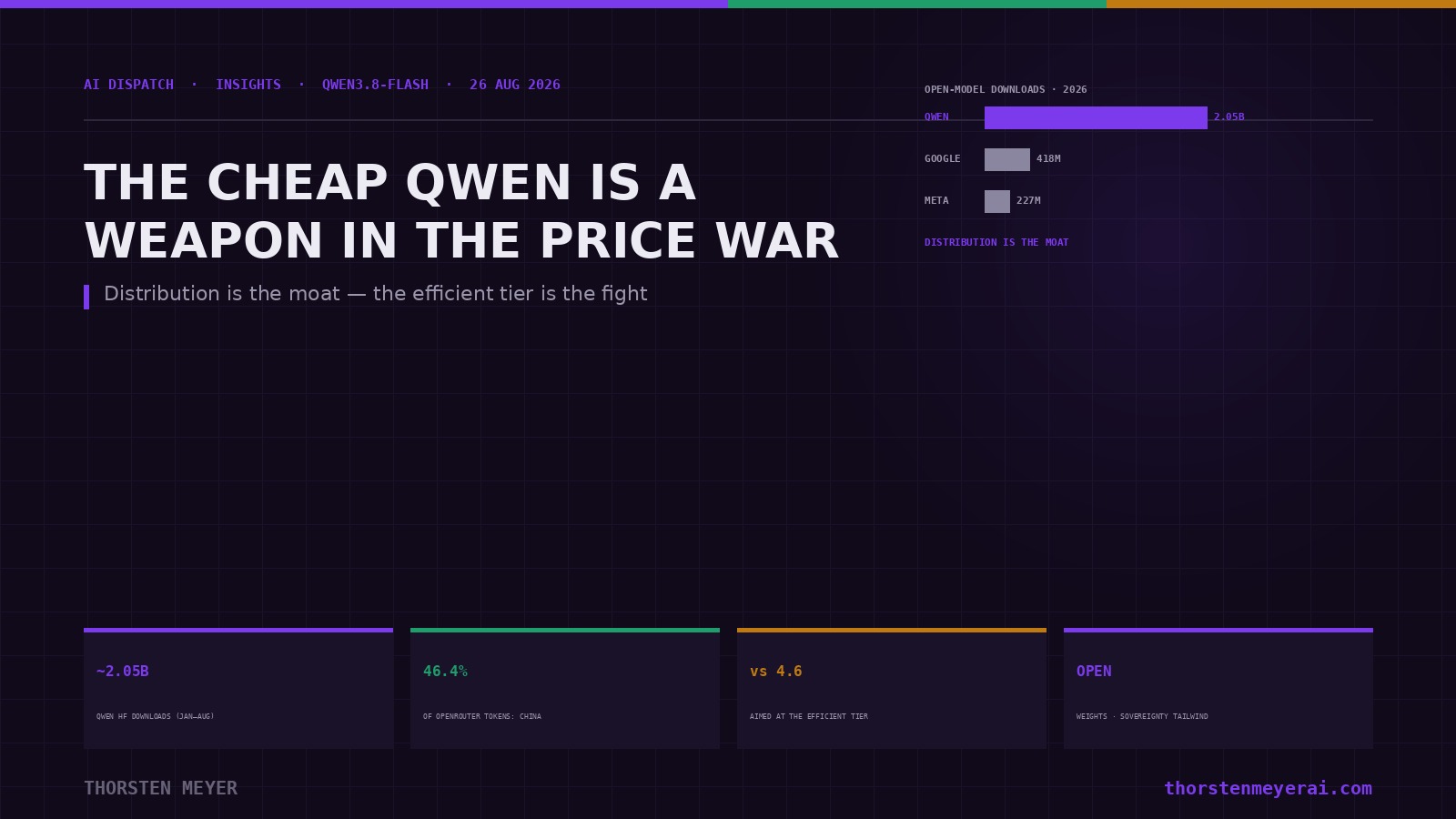
The technology is the reason it works. Distribution is the reason it matters. Alibaba aimed a cheap, openly-licensed model at the efficient tier — the fight Chinese labs are winning.
Open-model downloads on Hugging Face, Jan–Aug 2026. When a lab with this reach ships a cheap capable model, it isn’t finding an audience — it’s pushing a new default to one it owns.
As an affiliate, we earn on qualifying purchases.
The strategy the cheap model serves
Alibaba's own framing, per Bloomberg, is unambiguous: this is a lower-priced platform aimed at driving adoption of its marquee AI globally, positioned as competitive with the latest releases from rivals — including Anthropic's Opus 4.6 and DeepSeek's V4-Flash. Read that lineup carefully, because it's the whole story. The competitive set Alibaba chose isn't "the absolute frontier at any price." It's the efficient tier — the cheap, capable models that cost-sensitive builders actually deploy at scale. That's the fight Qwen wants, because that's the fight the Chinese open-weight labs are winning.
This is the pattern I keep coming back to across everything I've written this month: the 2026 model war is being decided on the efficiency frontier, not on raw parameter count or top-line benchmark bragging rights. GLM shipped a cheap multimodal agent model. DeepSeek shipped V4-Flash. Moonshot's Kimi K3 and Qwen's own Max are undercutting the US labs on price and access. Qwen3.8-Flash is another shot in that same barrage — and the barrage is coordinated enough, in effect if not intent, to be reshaping where developers actually go.
affordable AI development platform
As an affiliate, we earn on qualifying purchases.
As an affiliate, we earn on qualifying purchases.
Distribution is the real moat
Here's the number that should reframe how you read this. Qwen isn't fighting for distribution — it already has it, at a scale that's easy to underestimate. By one August 2026 tally, Qwen models were downloaded around 2.05 billion times on Hugging Face between January and August, ahead of Google's roughly 418 million and Meta's 227 million over the same window; Alibaba's own broader claim runs past three billion downloads in six months. Whatever the exact figure, the order of magnitude is the point: Qwen is, by download volume, one of the most-adopted open-model families on earth.
That changes what a release like this is. When a lab with that much reach ships a cheap, capable, openly-licensed model, it isn't hoping to find an audience — it's pushing a new default to an audience it already owns. Distribution beats invention, as I keep arguing; Qwen has both, and the cheap Flash tier is how it converts reach into entrenchment. A developer who standardizes on Qwen because it's cheap and good today is a developer who stays on Qwen4 tomorrow.
As an affiliate, we earn on qualifying purchases.
The meter connection
There's a thread here that ties directly to the other big story of the week. Chinese-origin models now handle around 46.4% of the tokens routed through OpenRouter, up from about 11% a year ago — nearly half the traffic on the largest neutral model gateway, flowing to open models from labs like Qwen, DeepSeek, GLM, and Kimi. And OpenRouter, the meter over exactly that flow, was just acquired by Stripe.
Sit with the combination. The cheap open Chinese models are winning the developer routing layer, and the metering-and-billing layer over that routing just consolidated into a Western payments giant. Whoever counts the tokens owns the spend relationship; a rising share of the tokens being counted now come from Chinese open-weight models. Those two facts are going to keep colliding, and the collision is more interesting than any single benchmark table. The efficient-open-model wave and the meter that prices it are on a path toward each other.
As an affiliate, we earn on qualifying purchases.
The honest bear case
I'd be cheerleading if I stopped at the flywheel, so here's the counterweight.
It's an adoption play and a preview, not a proven flagship. Alibaba is selling a preview of where Qwen4 is going, not a trophy for beating the frontier today. The served model is pitched at the efficient tier precisely because that's where it competes; on the hardest frontier evals, the top closed models still lead. Cheap-and-good-enough is a genuine and often winning strategy — but it's a different claim from "best," and the coverage blurs them.
Download counts are not production, and not revenue. Two billion downloads is a staggering reach number and a weak economics number. It tells you how many people pulled the weights, not how many run them in production, pay for the API, or would stick if a better-priced option appeared next week. Reach is real leverage; it is not the same as a moat, and a price war has no loyal customers by definition.
And the geopolitics are a live, unsettled variable. Nearly half of a major gateway's traffic running on Chinese-origin models is, to some, an efficiency win and, to others, a supply-chain and policy concern — that's a genuine contested question I'm not going to resolve here, only flag. Export controls, procurement rules, and data-governance debates could reshape this picture quickly, in either direction. The download charts describe today; they don't lock in tomorrow.
The part that's mine to make
Through my own lens — open-weight, sovereignty-minded, running my own inference — this release is a tailwind with an asterisk, and I want to be precise about both.
The tailwind: an efficient, capable, openly-licensed model from a lab with enormous reach is exactly what makes a local-first, sovereign stack viable. Every cheap-and-good open model that ships lowers the cost of not renting your intelligence from a handful of closed frontier labs. That's the sovereignty case getting materially stronger, month over month, and Qwen is one of its biggest engines.
The asterisk, and it's the same one as always: "open" and "sovereign" are not the same as "free of dependency." Standardizing your operation on Qwen means depending on a foreign lab's release cadence, license terms, and strategic priorities — a different dependency than depending on OpenAI or Anthropic, but a dependency all the same. And "cheap to run" still means hosting a 125B-class model on real hardware. The honest sovereign posture isn't "Chinese open models set me free"; it's "the efficient open-model wave gives me options, and the discipline is to keep more than one, own the layer I can, and never let any single lab — American or Chinese — become the thing I can't route around."
Where I land
The cheap Qwen is a weapon, and it's aimed well: at the efficient tier where the real 2026 fight is happening, backed by distribution most labs would kill for, riding a broader wave of Chinese open models that already move nearly half the tokens on the biggest neutral gateway. That's a genuinely strong position, and it's why I take Qwen seriously as infrastructure rather than as a headline.
The discipline is to hold the two halves of this release together: the architecture preview is the substance, and the price war is the strategy, and neither is a reason to switch off your judgment. Reach isn't revenue, cheap isn't best, open isn't dependency-free, and a download chart isn't a moat. Hold those, and the picture is still impressive — a lab winning the layer that matters most for people who build, on the axis that matters most in 2026. Watch the meter, watch the efficiency frontier, and keep your options open. That's the whole game right now.
Analysis and opinion from a builder, founder, and post-labor economist running a local-first inference operation. The strategic framing draws on verified reporting: Alibaba's positioning of Qwen3.8-Flash as a lower-priced adoption play competitive with Opus 4.6 and DeepSeek V4-Flash (Bloomberg); Qwen download figures (~2.05B on Hugging Face Jan–Aug, ahead of Google and Meta; 3B+ over six months per Alibaba); and Chinese-origin models at ~46.4% of OpenRouter-routed tokens alongside Stripe's acquisition of OpenRouter. Naming (Flash vs Flash-Next) reflects commercial vs open faces of the same release and is used loosely across sources. Benchmark and adoption figures are as reported and pending independent verification. This is analysis, not investment advice. Point-in-time as of 26 August 2026.
Columbus Day / Indigenous Peoples' Day Picks
long weekend sales
As an affiliate, we earn on qualifying purchases.