
For eighteen months, Europe’s local-first AI movement — my own infrastructure included — has run on an assumption almost nobody scrutinized: the best open weights keep coming. Every few weeks, another frontier-class model appears on a public hub under a permissive license, and the whole economic case for sovereign, self-hosted AI quietly compounds.
Monday’s Signal documented the cadence: four frontier-class open releases in eight weeks, four of the top five open-weight families now Chinese. It ended with a warning that the licensing generosity is a policy, not a law of nature, and promised a closer look at how long the window stays open.
The news cycle then did me the favor of making the question urgent. In the past four weeks, both superpowers visibly put their hands on the doors.
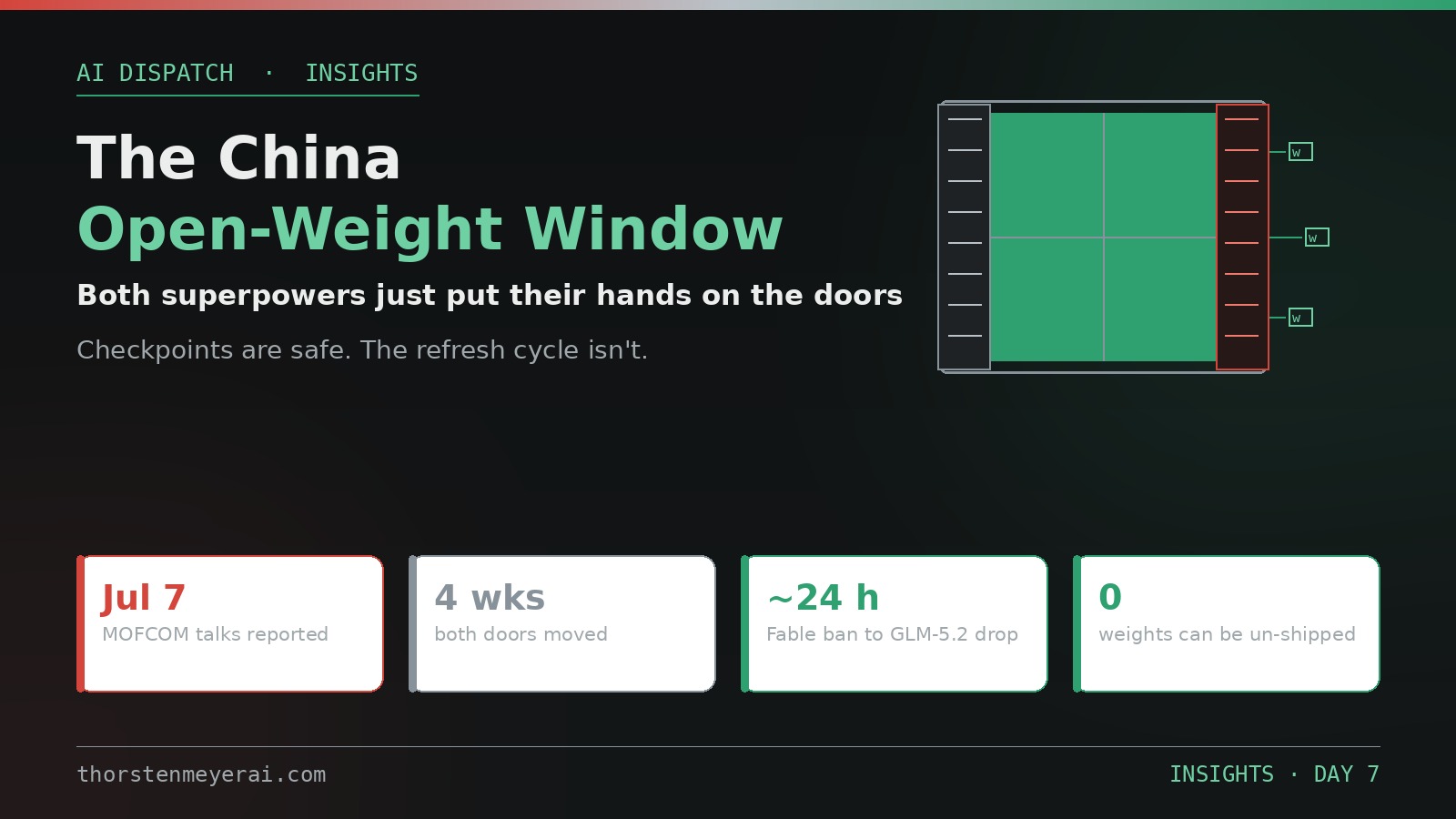
The China Open-Weight Window
Both Superpowers Just Put Their Hands on the Doors
The load-bearing assumption under Europe’s local-first economics is being stress-tested — on both sides, in the same month
Two doors, one month
The American door: gating became a regime
- Jun 2: EO 14409 — classified benchmarks, 30-day pre-release window
- Jun 12–13: export controls on two deployed Anthropic frontier models — trigger reported, not independently confirmed; company disputed; later lifted
- Jun 26: GPT-5.6 Sol ships behind customer-by-customer government approval
- The temporariness taught its own lesson about US supply reliability (CEPA)
The Chinese door: hinges of a subtler design
- May: Supreme People’s Court journal roundtable on tiered open-source governance
- Jun: Manus acquisition unwound; sweeping cross-border investment rules
- Jul 7: MOFCOM talks reported — incl. unreleased and open-weight models; discussions, not decree
- Tiering already visible: Qwen 3.6 open, Qwen 3.7 Max API-only
THE STRUCTURAL ASYMMETRY
The US can gate its closed models; it cannot gate published weights. Every gated American model makes the ungatable open alternative relatively more attractive — a feedback loop that is now official-policy-shaped. Beijing’s version inverts it: keep the mid-tier open for soft power, move the frontier behind the counter.
Five moves while the width is known
The verdict: existing checkpoints are safe — the refresh cycle isn’t. The practical question for 2027 is not “will GLM-5.2 vanish?” but “will GLM-6 ship open at launch?” Watch launch mode, not launch benchmarks. The window’s width will be announced in a launch post, not a policy paper.
As an affiliate, we earn on qualifying purchases.
The American door: gating became a working regime in June
Three US actions in a single month turned frontier-model gating from a talking point into operating procedure.
June 2: Executive Order 14409, covered in Friday’s dispatch — classified capability benchmarks, NSA designation of covered frontier models, a voluntary 30-day pre-release government window, all hardening August 1.
June 12–13: the Commerce Department invoked export controls against Anthropic’s two most advanced models, Claude Fable 5 and Mythos 5, barring access by foreign nationals globally — a first-of-its-kind action against deployed commercial AI models. Reported details deserve careful handling: the cited trigger was a jailbreak technique whose severity was not independently confirmed, the controls reportedly reached even Anthropic’s own foreign-national employees, and the company publicly disputed the proportionality of recalling a widely deployed commercial model over a narrow finding. The controls were subsequently lifted after a weeks-long standoff, restoring global access. Reported neutrally: whatever one concludes about the merits, the episode demonstrated that Washington can and will gate a closed frontier model mid-deployment — and, as the Center for European Policy Analysis noted, the temporariness of the action taught non-US governments its own lesson about the reliability of American AI supply.
June 26: OpenAI previewed GPT-5.6 Sol under a staggered, customer-by-customer government-approval process, with roughly twenty organizations in the initial tranche.
The structural point matters more than any single action: the US can gate its closed models; it cannot gate published weights. When GLM-5.2 launched roughly twenty-four hours after the Fable controls, Chinese labs received a geopolitical marketing argument on a silver platter — the open ecosystem’s pitch effectively became our models don’t come with a kill switch. Every gated American model makes the ungatable open alternative relatively more attractive. That feedback loop is now official-policy-shaped, and it went almost entirely undiscussed in the June coverage.
As an affiliate, we earn on qualifying purchases.
The Chinese door: the July 7 report, read honestly
Then came the counter-move. On July 7, Reuters reported exclusively that China’s Ministry of Commerce spent the past month in talks with Alibaba, ByteDance, and Z.ai about restricting overseas access to the country’s most advanced AI models — explicitly including models not yet released, and explicitly including open-weight releases. Also canvassed, per the report: penalties under national-security law for leaking or stealing AI technology, and new restrictions on who may fund domestic AI startups. Scope undecided; possibly future models only. None of the named parties commented.
Internet reaction promptly split into “the window is slamming” and “debunked Reuters hype.” Both readings fail the sourcing. This is reporting on policy discussions with named participants — not a decree, and not nothing. And it doesn’t stand alone. A May roundtable of Chinese legal experts, summarized in an official Supreme People’s Court journal, discussed tiered open-source AI governance — a framework in which frontier-tier models might ship API-first, with weights arriving late or never, while lower tiers stay open. The tiering is already visible in market behavior: Alibaba kept Qwen 3.6 open under Apache 2.0 while placing its strongest model, Qwen 3.7 Max, behind an API. Add the forced unwinding of Meta’s $2 billion Manus acquisition and June’s sweeping cross-border investment rules, and a pattern of keeping homegrown AI at home is unmistakable — discussions or not.
The catalysts are worth naming because they predict the policy’s shape. Chinese commentary and the Reuters sourcing converge on anxiety about advanced cyber-capable models — the same class of concern that drove Washington’s June actions, mirrored. And the distillation war cuts both ways: Anthropic told US senators in June that Alibaba ran the largest known distillation attack on its models via tens of thousands of unauthorized accounts (Alibaba has not, to my knowledge, conceded the characterization). Beijing can read that story in reverse — once Chinese models lead, open weights become the thing being distilled from. Great powers converge on gating for the same reason: it’s what you do when you believe you’re ahead.

Evals for AI Engineers: Systematically Measuring and Improving AI Applications
As an affiliate, we earn on qualifying purchases.
As an affiliate, we earn on qualifying purchases.
Steelman both futures
Why Beijing keeps the window open: open weights are not charity; they’re industrial strategy. A US-China commission analysis describes it as a reinforcing loop — open models become the global default substrate, which drives adoption of Chinese standards, tooling, and talent, which feeds the domestic ecosystem US chip controls tried to starve. Subsidized inference and aggressive pricing serve the same play. Closing the window would burn China’s single most effective soft-power instrument in technology at the exact moment it’s working — and the loudest beneficiaries of the June US gating own goals were Chinese labs. Rational Beijing keeps shipping.
Why Beijing narrows it anyway: national-security symmetry is politically irresistible once Washington normalizes gating; the tiered framework lets China keep the soft-power benefits at the mid-tier while protecting the frontier; and the same logic that makes a cyber-capable model worrying in Washington makes it worrying in Beijing. Narrowing isn’t closing — it’s keeping the shop open while moving the best merchandise behind the counter.
The honest probability mass sits on the second scenario, and the May legal groundwork suggests it’s being built deliberately rather than debated abstractly.
As an affiliate, we earn on qualifying purchases.
What “narrower” would actually mean
Not retroactive disappearance. GLM-5.2’s MIT-licensed checkpoints are on disks and mirrors worldwide; published weights cannot be un-shipped, and no plausible policy pretends otherwise. What narrows is the refresh cycle — the weeks-long capability updates Monday’s Signal documented, which are precisely what Europe’s self-hosting economics now lean on. The practical question for 2027 is not “will GLM-5.2 vanish?” It’s “will GLM-6 ship open at launch?” — and its siblings at Alibaba, Moonshot, and DeepSeek. Watch launch mode, not launch benchmarks.
What Europe should do while the width is known
Five moves, in rising order of effort. Archive now: the current open generation is MIT/Apache-licensed — mirroring weights, tokenizers, and full inference stacks is legal, cheap, and irreversible insurance; do it this quarter, not after a policy announcement. Qualify now: benchmark and validate the current generation against your actual workloads while comparison is easy — public, replicable evaluation being exactly the instrument Friday’s dispatch argued Europe should own. Route for survivability: hybrid architectures with a router in front — my Bifröst pattern — were an economic argument on Monday; they’re a resilience argument today, because a stack that assumes any single door stays open now carries policy risk on both sides. Price the dependency honestly: Thursday’s German dispatch made the layer argument — Europe’s compute and operations layers are becoming sovereign while the model layer remains an import, whether from Toronto, Paris, or Hangzhou. The July 7 report is what it looks like when an import dependency acquires a foreign policy. Fund the domestic model layer accordingly: not because European models must win benchmarks, but because a fallback tier you control converts “window closes” from crisis to inconvenience.
The verdict
The window is open, wider than it has ever been, and for the first time both superpowers are visibly measuring its frame. The American door demonstrated in June that it can swing shut on closed models mid-deployment — and swing back open, which reassured no one. The Chinese door is, per credible reporting, being fitted with hinges of a subtler design: tiers, not slams.
For Europe, the strategic error would be to treat this as a spectator sport between superpowers. The open-weight window is the load-bearing assumption under the continent’s entire local-first, sovereign-AI economics — this publication’s included. Assumptions that load-bearing get stress-tested deliberately, before someone else tests them for you. Archive, qualify, route, and watch what mode GLM-6 ships in. The window’s width will be announced in a launch post, not a policy paper.
Sources: Reuters exclusive via explainx.ai analysis, ASPI weekly brief, TNW, and yellow.com (MOFCOM talks, July 7–10, 2026); Supreme People’s Court journal roundtable on tiered open-source governance (May 2026, via Reuters); digitalapplied.com June gating chronology (EO 14409, Fable 5/Mythos 5 export controls and Anthropic’s disputing statement, GPT-5.6 Sol approval rollout — trigger details reported, not independently confirmed); Medium open-weights retrospective (Qwen 3.7 Max tiering, Meta Muse Spark closure, June 2026); USCC “Two Loops” report on China’s open-AI industrial strategy (March 2026); ASPI/Lawfare (distillation letter, grey-market access ecosystem); CEPA on supply-reliability effects of the temporary controls.