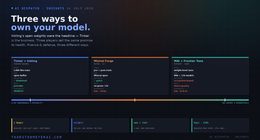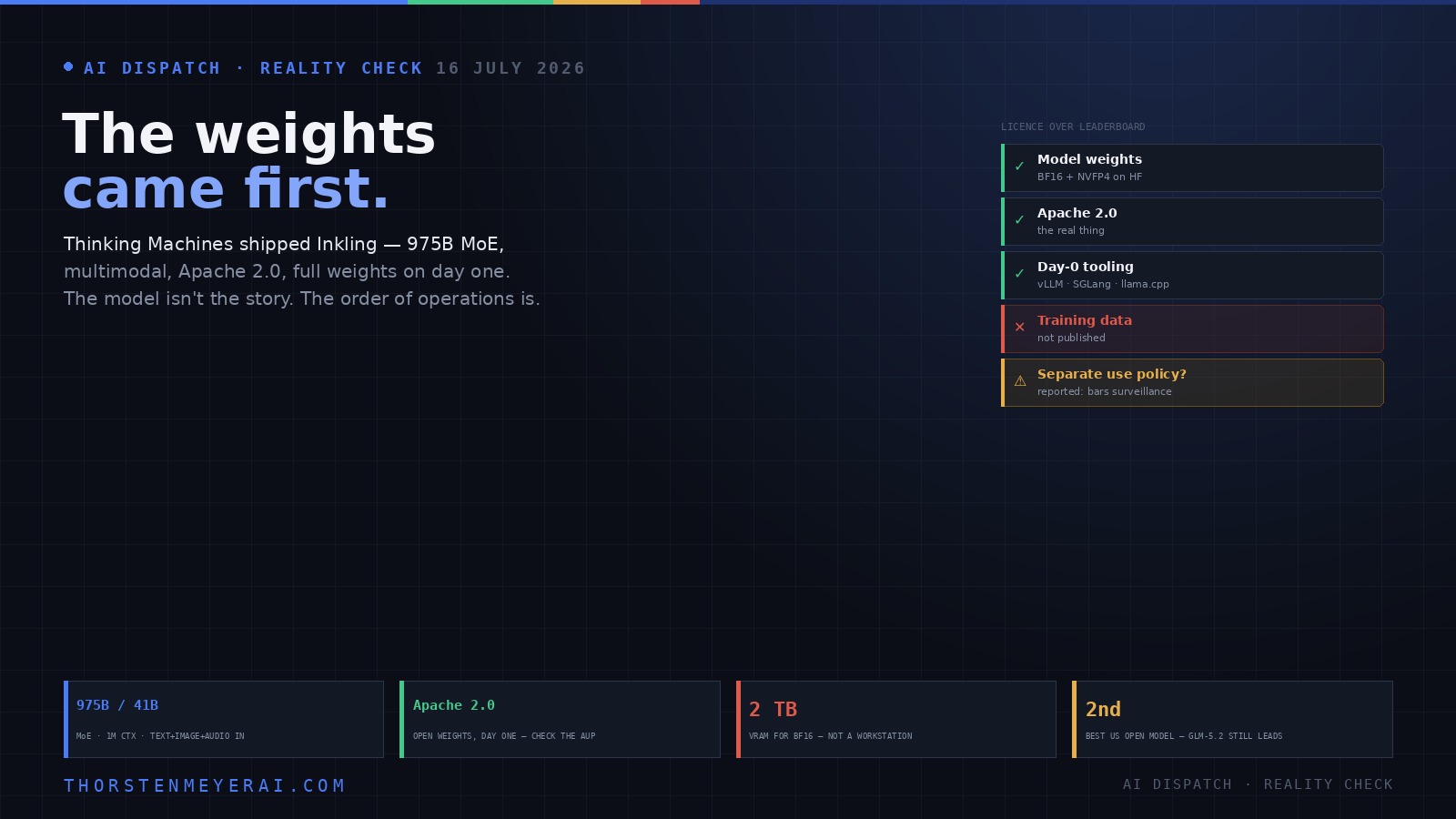
Mira Murati’s lab shipped its first foundation model yesterday. The model is not the story.
The story is the order of operations. Thinking Machines Lab — seventeen months old, founded by OpenAI’s former CTO, staffed with people who built ChatGPT — did not release a closed API and dangle open weights as a someday-maybe. The full weights landed first, on Hugging Face, under Apache 2.0, with day-zero support in transformers, vLLM, SGLang, and llama.cpp.
And then the lab said the quiet part out loud in its own announcement: Inkling is not the strongest model available today, closed or open.
That combination — open first, and honest about not winning — is the actual news. It’s also a direct answer to the question this publication has spent the week circling: what does it cost to own your model instead of renting it? Here’s the honest read, including the parts the launch coverage skipped.
The weights came first: what Inkling actually signals
Mira Murati’s lab shipped its first foundation model — and the model isn’t the story. The order of operations is: full weights, Apache 2.0, day one, before any closed API. Plus a rare concession — the lab says it’s not the strongest model available, open or closed.
- AIME 2026 97.1%
- GPQA Diamond 87.2%
- MCP Atlas (Nemotron 44.7%) 74.1%
- VoiceBench · open-weight audio frontier 91.4%
- FORTRESS adversarial · best open 78.0%
- ForecastBench · calibration 61.1
- HLE text-only (GLM-5.2 40.1%) 29.7%
- SWE-bench Pro (GLM-5.2 62.1%) 54.3%
- Terminal-Bench 2.1 (GLM-5.2 82.7%) 63.8%
- SWE-bench Verified (Fable 5 95.0%) 77.6%
- Design Arena · 2nd open, behind GLM-5.2 ~10th
A 0.2 → 0.99 effort setting trades reasoning tokens against cost & latency, so you get a curve, not a point. On Terminal-Bench 2.1 it reportedly matches Nemotron 3 Ultra at ~⅓ the tokens. Peak score is a vanity metric when you serve millions of calls; the cost curve is what ships. (Bonus: its chain of thought compressed on its own during RL — nobody rewarded it; efficiency did.)
Pitched as the Western alternative to Chinese open weights (censorship-resistance training is the differentiator). But GLM-5.2 still wins on agentic/reasoning and Kimi K2.6 often on multimodal: best American open model, second in the open field. The irony — post-training was bootstrapped on synthetic data from Kimi K2.5.
BF16 needs ≥2 TB aggregate VRAM (8× B300 / 16× H200). NVFP4 still needs ≥600 GB. Not a workstation model — a 512 GB fleet falls just short. “Open” ≠ “runnable.” Mitigations: 1-bit GGUFs (~74% acc.), hosted eval routes, and Inkling-Small (12B active) — the release local-first builders actually want.
Open weights used to be a consolation prize. Inkling is a strategic open release — Apache 2.0, natively multimodal, honestly marketed, published complete on day one, optimized for deployment rather than headlines (the model isn’t the product; the fine-tuning platform is). It doesn’t need to win every benchmark for that to matter. The frontier is learning that owning the base beats renting the API — arriving now from the inside. For the sovereignty buyer: ① a real Western hedge against being switched off · ② verify the use policy before you build · ③ check the VRAM, then benchmark vs GLM-5.2 & Kimi K2.6 on your task.
What Inkling is
The specifications, plainly. Inkling is a Mixture-of-Experts transformer with 975 billion total parameters and 41 billion active — a 66-layer decoder-only backbone routing each token to 6 of 256 experts, plus 2 shared experts always on. It supports a 1-million-token context window and was pretrained on 45 trillion tokens of text, images, audio, and video.

It is natively multimodal on input — text, images, and audio in, text out — with an encoder-free design: audio arrives as dMel spectrograms, images as 40×40 pixel patches through a lightweight hierarchical MLP, everything projected into one shared space and processed jointly. That’s not a vision adapter bolted onto a language model; the multimodal components were trained from scratch.
Alongside it came a preview of Inkling-Small: 276B total, 12B active, which — thanks to an improved pre-training recipe — matches or beats its larger sibling on a surprising number of benchmarks. Full weights follow once testing completes. Hold that thought; it matters more than the flagship for most readers here.
The training details are unusually candid for a launch post: a hybrid optimizer (Muon for the large matrices, Adam for everything else), trained on NVIDIA GB300 systems, then over 30 million reinforcement-learning rollouts during which reasoning performance climbed log-linearly from 0.264 to 0.356 on a held-out aggregate. One delicious wrinkle: the post-training bootstrap ran on synthetic data generated by open-weight models including Kimi K2.5 — a Chinese model. More on that irony shortly.
As an affiliate, we earn on qualifying purchases.
Read the licence before the leaderboard
This publication’s rule from yesterday’s briefing was licence over leaderboard, so start there.
The headline is genuinely good: Apache 2.0, confirmed on the model card and the Hugging Face repository. That’s the real thing — freedom to download, modify, commercialize, and keep. As one ecosystem observer put it, a company can fine-tune Inkling, inspect the weights, deploy on its own infrastructure, and keep using the model even if its relationship with Thinking Machines changes. For anyone who watched a frontier model get switched off worldwide by government directive last month, that sentence is the whole value proposition.
But two asterisks belong on it, and the launch coverage mostly waved them through.
First: open weights are not open source. The weights are Apache 2.0; the training data and the full training pipeline are not published. That’s the industry norm, and it’s fine — but the distinction should be stated rather than blurred.
Second, and more consequential: at least one outlet reports that Thinking Machines maintains a separate Model Acceptable Use Policy covering the parameters, related materials, and modified versions — treating acquisition or use as acceptance — and that it prohibits, among other things, surveillance, deception, and fully automated decision-making affecting individuals’ rights. If accurate, that sits in real tension with the “true open source” framing: Apache 2.0 imposes no such restrictions, and a separate policy layered on top raises live questions about scope and enforceability that a serious buyer must resolve before building on it. I have not verified the AUP text directly, and I’d treat this as the single most important thing to check on the model card yourself before committing. A skeptic on X put the general point sharply on launch day: show the reproducible local benchmarks — and show the licence.
For readers building in ISR, geospatial, or public-safety domains, that clause — if it reads as reported — is not a footnote. It’s a go/no-go.

LOCAL LLM DEPLOYMENT: Training, Fine-Tuning, & Offline Inference: The Complete Developer’s Guide to Building, Training, and Running Private Open-Source AI Offline (with full source code)
As an affiliate, we earn on qualifying purchases.
As an affiliate, we earn on qualifying purchases.
The honest scorecard
Thinking Machines deserves credit for a methodological choice: where possible, they used externally reported scores from Artificial Analysis rather than only self-run numbers. These are still vendor-published tables, so treat them as claims pending independent replication — but the shape is informative, and it’s refreshingly unflattering in places.
Where Inkling is genuinely strong: AIME 2026 at 97.1%, GPQA Diamond at 87.2%, MCP Atlas at 74.1% (a big lead over Nemotron 3 Ultra’s 44.7%), and the audio stack — VoiceBench 91.4%, MMAU 77.2%, AudioMC 56.6% — which puts it at the open-weight frontier for speech. On FORTRESS, a benchmark testing refusal of weapons-and-violence requests alongside benign look-alikes, it posts the strongest adversarial score among the open-weight models compared (78.0%) while keeping benign refusals low (95.9%) — genuinely good safety engineering, and notable because the same table shows some closed models trading that balance badly in the other direction.
Where it’s mid-pack or behind: text-only Humanity’s Last Exam at 29.7% against GLM-5.2’s 40.1%; SWE-bench Pro at 54.3% against GLM-5.2’s 62.1%; Terminal-Bench 2.1 at 63.8% against GLM-5.2’s 82.7% and GPT-5.6 Sol’s 89.5%. On Design Arena’s blinded human web-dev evaluation it lands around tenth overall — second among open-weight models, behind GLM-5.2.
The most-quoted independent read came from researcher Nathan Lambert, who called the benchmarks a clear step up from Nemotron Ultra and the best American open model, while noting it trails GLM-5.2 on agentic tests and Kimi K2.6 on multimodal work. That is roughly where the evidence sits: the best open-weight model to come out of the United States, and not the best open-weight model in the world.
machine learning model license management
As an affiliate, we earn on qualifying purchases.
As an affiliate, we earn on qualifying purchases.
The dial nobody’s talking about
The most underrated feature isn’t on the leaderboard at all: controllable thinking effort, a dial from 0.2 to 0.99 that trades reasoning tokens against speed and cost. Sweep it and you get a curve rather than a point — and on Terminal-Bench 2.1, Inkling reportedly matches Nemotron 3 Ultra’s score at roughly one third of the tokens.
That’s the right frame for anyone who has actually run a model in production. Peak benchmark score is a vanity metric when you’re serving millions of calls; the binding constraints are cost and latency, and low latency is what makes iterative, collaborative workflows feel usable at all. A model that lets you choose your point on the cost curve — from inside the harness, per task — is worth more to a real deployment than two points on HLE. Emphasizing the curve over the peak is a quietly serious argument, and it’s the same argument this publication has been making about hybrid routing all week.
There’s a lovely technical footnote here too: over the course of RL training, Inkling’s chain of thought compressed on its own — dropping articles and connectives into a terse, telegraphic style while staying comprehensible and reaching the same answers. Nobody rewarded that directly; token efficiency alone produced it. Cognition reported a similar emergent effect training SWE-1.7.
AI development software for programmers
As an affiliate, we earn on qualifying purchases.
As an affiliate, we earn on qualifying purchases.
The epistemics bet
The section of the announcement most relevant to readers of this publication is the one about epistemics — the lab’s word for calibration, instruction-following, and censorship resistance.
They trained for calibrated confidence using RL against proper scoring rules on resolved real-world questions, and added abstention-aware rewards so that answering only pays off when the model is likely to be right — making “I don’t know” or a hedged guess the optimal policy when the model lacks information. They paired a rubric grader with a claims grader that performs agentic web search to verify each factual assertion, specifically because rubric-only grading rewards models that spray plausible facts hoping something sticks.
The results show up in forecasting: on ForecastBench without search, Inkling’s Brier index of 61.1 ties Gemini 3.1 Pro and beats GPT-5.5 (59.1) and Claude Opus 4.8 (54.6), with Grok 4.3 marginally ahead at 61.7. (Fine print: those numbers came from a different checkpoint than the released one — the lab says so plainly.)
Why this matters more than a benchmark peak: a model confident about everything, including its own confabulations, forces you to check every output — which destroys the productivity it promised. A model that knows when it doesn’t know is usable in domains where information is conflicting and hard to verify. Optimizing for that instead of for leaderboard maximalism is a real editorial choice, and the right one.
They also trained the model to answer directly on topics subject to censorship, and had Cognition evaluate it on a propaganda-and-censorship eval, where it showed strong non-compliance patterns. Which brings us to the elephant.
The China question — and the irony inside it
Read the coverage and the subtext is unmissable: Inkling is being positioned as the Western alternative to Chinese open-weight labs. The celebratory posts said it out loud — best open-weight model outside China, the new best American model. The censorship-resistance training is not an accident of engineering priorities; it’s a differentiator aimed squarely at Qwen, GLM, Kimi, and DeepSeek, whose weights are excellent, permissively licensed, and — for some buyers, in some jurisdictions — politically complicated.
And yet. On the agentic and reasoning benchmarks that matter most for coding work, GLM-5.2 still wins. On multimodal, Kimi K2.6 often wins. The best American open model is, on the evidence of its own launch table, second place in the open field. The West has closed the gap to one lab, not overtaken the field.
The irony that makes this worth writing down: Inkling’s post-training was bootstrapped on synthetic data from open-weight models including Kimi K2.5. The American answer to Chinese open weights was, in part, taught by Chinese open weights. That’s not a gotcha — it’s how an open ecosystem is supposed to work, and it’s precisely the argument for open weights as a public good. But it does complicate any triumphal framing, and the people writing “America takes the throne” posts should sit with it.
The reality check: open weights you probably can’t run
Now the part that punctures the enthusiasm, and the part this publication’s readers will feel most directly.
Inkling’s BF16 checkpoint requires at least 2 terabytes of aggregate VRAM — reference configurations are eight NVIDIA B300s or sixteen H200s. The quantized NVFP4 checkpoint brings that down to at least 600 GB, which still means four B300s or eight H200s. This is not a model you evaluate on a workstation. It is not a model that fits on a high-end local-inference fleet, either — a 512 GB machine falls just short of even the quantized floor.
“Open weights” and “runnable weights” are not the same claim, and the gap between them is where a lot of sovereignty rhetoric quietly dies. Three honest mitigations: Unsloth’s dynamic 1-bit GGUFs reportedly retain roughly 74% of top-1 accuracy at 86% smaller, which makes local experimentation possible at real quality cost; the hosted routes (Tinker, Databricks, Together, Fireworks, Modal, Baseten) let you evaluate before you buy hardware; and — most importantly — Inkling-Small at 12B active is the release that actually matters for local-first builders, which is why the preview-now-weights-later sequencing is slightly frustrating.
The lesson generalizes: when a lab publishes a trillion-parameter model under Apache 2.0, check the VRAM before you celebrate the licence.
The business model is the point
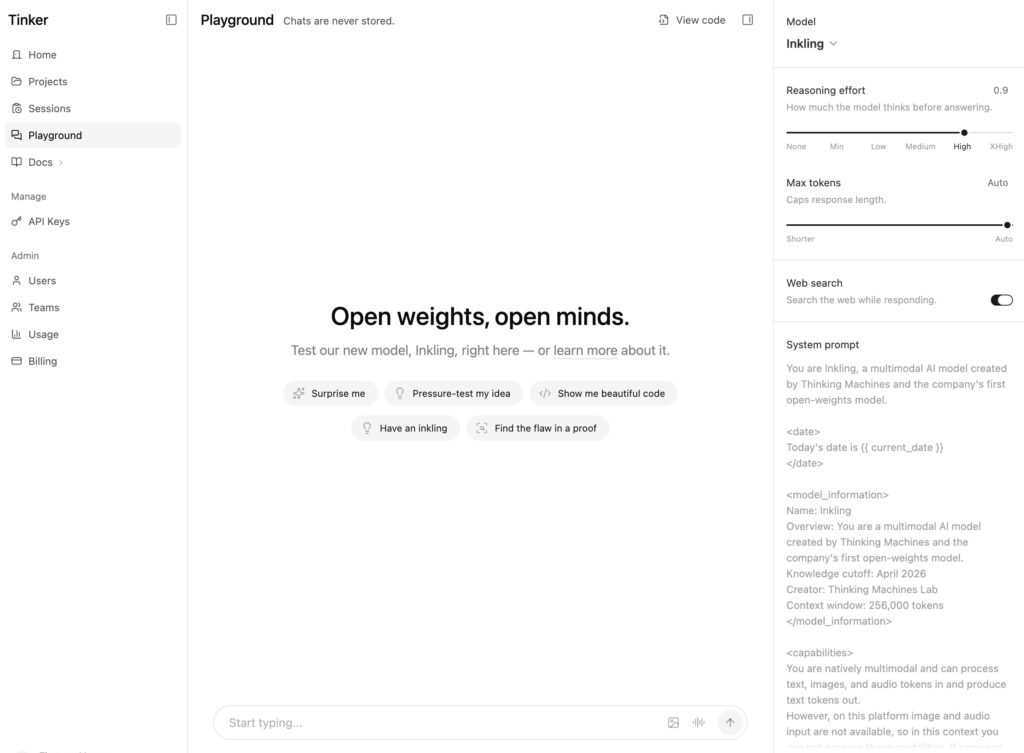
Why give away a model that cost a fortune to train? Because the model isn’t the product — Tinker is.
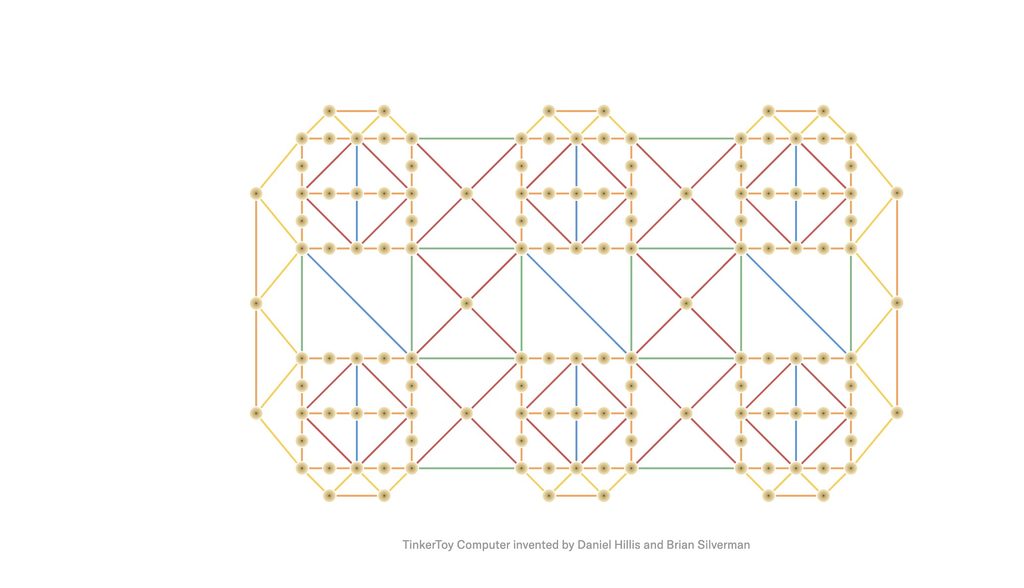
Thinking Machines sells a fine-tuning platform. Inkling is the base model that platform customizes, and every downloaded checkpoint is a funnel into it. The launch even included a self-referential demo: asked to fine-tune itself, Inkling wrote its own training job on Tinker, ran it, and evaluated the result — producing a model that never uses the letter “e.” Cute, and also a precise advertisement for the actual business.
Which puts this in direct conversation with the Forge trilogy. Mistral Forge sells sovereignty as a managed program: deep pre-training on your data, embedded engineers, enterprise pricing, a sticky commitment. Thinking Machines sells sovereignty as an open base plus a customization platform: take the weights, adapt them, run them anywhere, keep them if you leave. Two answers to the same question, with genuinely different reversibility profiles — and Thinking Machines’ answer is the lighter, more portable one. Whether it’s the deeper one is exactly what a controlled proof-of-concept is for.
The take
The weights came first. That’s the signal, and it’s bigger than the benchmarks.
Open-weight releases used to be consolation prizes — the thing you shipped when you couldn’t compete at the frontier, or the thing you promised and quietly didn’t do. Inkling is a strategic open release: a well-executed, honestly-marketed, Apache-2.0, natively multimodal base model from a US frontier lab, published complete on day one, with an efficiency dial and a calibration story that suggest the team optimized for deployment rather than for headlines. It doesn’t need to win every benchmark for that strategy to matter. It needs to be good enough that open weights read as a serious product decision — and it clears that bar.
For the European sovereignty buyer, three things follow. One: a genuinely permissive Western multimodal base is a real addition to the shortlist, and a real hedge against being switched off. Two: verify the acceptable-use policy against your use case before you build — the Apache 2.0 headline may not be the whole legal picture, and if you’re in surveillance-adjacent work it may be disqualifying. Three: check the VRAM, and then benchmark it against GLM-5.2 and Kimi K2.6 on your task, not on a spider chart — because on today’s evidence, the best open-weight model in the world still isn’t American.
The frontier labs are learning that owning the base is worth more than renting the API. That’s the same lesson this publication has drawn from Forge, from the export-control freeze, and from every kill-switch that’s been flipped this year. It’s just arriving now from an unexpected direction: the inside.
Sources: Thinking Machines Lab — Inkling announcement and product page (July 15, 2026), Inkling model card, Hugging Face repository (Apache 2.0, BF16/NVFP4 checkpoints); Hugging Face ecosystem blog; VentureBeat, TechCrunch, BenchLM, LinkLoot, XenoSpectrum, NewsCord launch coverage; Nathan Lambert and launch-day reaction via X. All benchmark figures are as published by Thinking Machines (some drawn from Artificial Analysis) and await independent replication; forecasting and HLE numbers reflect a pre-release checkpoint by the lab’s own note. The separate Model Acceptable Use Policy is reported by XenoSpectrum and has not been independently verified here — check the model card directly before relying on it. Analysis and framing are the author’s; not investment advice.