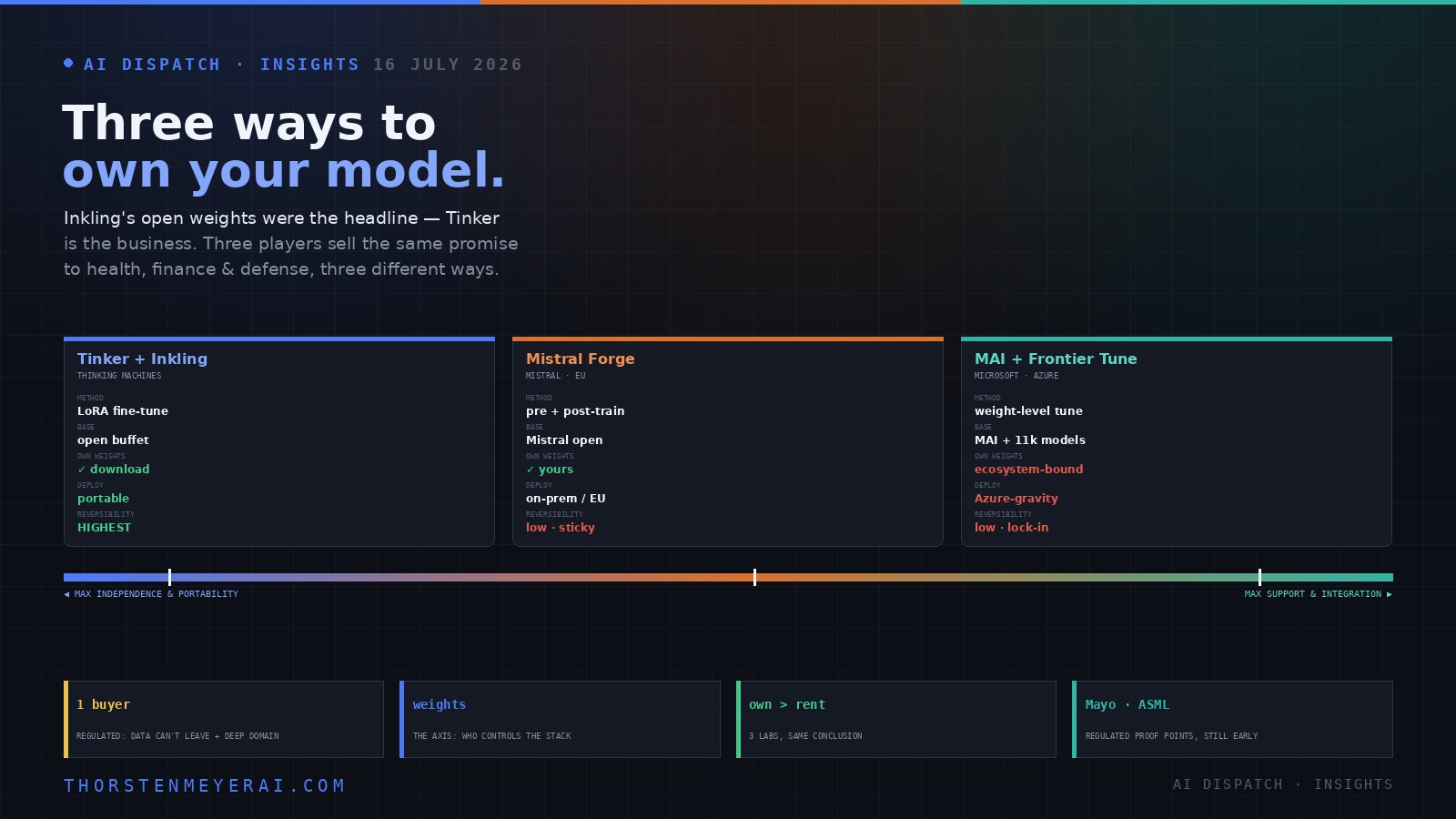

Inkling’s open weights were the headline. Tinker is the business.

Get business pricing on tech for your team
- Business-only prices and quantity discounts
- Tax-exempt purchasing
- Multiple users, one account, clear invoices
Thinking Machines didn’t release a trillion-parameter model out of generosity — it released the base that its fine-tuning platform customizes, and every downloaded checkpoint is a funnel into that platform. Which means the interesting question isn’t “how good is Inkling?” It’s “who should pay to customize a model, and whose platform should they use to do it?”
Because three serious players are now selling the same promise to the same buyer — build a model that’s yours, not a rented API — and they’ve chosen three genuinely different ways to deliver it. For a health system, a bank, or a defense contractor, the differences aren’t marketing. They’re the whole decision.
Three ways to own your model: Tinker vs Forge vs Frontier Tuning
Inkling’s open weights were the headline; Tinker is the business. Three serious players now sell the same promise to the same buyer — a model that’s yours, not a rented API — in three different ways. For health, finance & defense, the differences are the whole decision.
For the regulated, defense or health buyer it reduces to one question: what do you most need to control — the weights, the jurisdiction, or the integration? None is strictly best; they’re bets on what you value. The meta-signal: three of the most sophisticated players independently concluded the future enterprise product isn’t a model you rent — it’s one you own and adapt, with your institutional knowledge as the moat. Tinker = portability & open base · Forge = depth & EU sovereignty · Microsoft = lineage & integration. The only wrong move left is renting a generic model and hoping.
The buyer everyone’s chasing
Start with who this is actually for, because it isn’t most companies. The customization pitch lands hardest in exactly the places where a generic API is a non-starter: regulated and high-consequence verticals — healthcare, financial services, defense, pharma, legal, semiconductor design.
Three things make these buyers different. Their data can’t leave — HIPAA, GDPR, the EU AI Act, or classification rules turn “send it to a US API” into a compliance violation, not a preference. Their domain reshapes reasoning — a model needs to think in ICD codes, Basel III, or radar signatures, not just retrieve documents about them. And their procurement asks about lineage — risk officers want to know who owns the resulting weights, whether customer data leaks into a vendor’s future training, and whether a model their production pipeline depends on can be deprecated out from under them. As one analyst put it, the next phase won’t be won by the model that solves the hardest math problem; it’ll be won by the platform that makes risk officers, procurement teams, and developers comfortable enough to put agents into production.
All three contenders are aiming at that buyer. Here’s how they differ.
As an affiliate, we earn on qualifying purchases.
Tinker + Inkling: the researcher’s route, weights in your hands
Thinking Machines’ Tinker is a training API built on a deliberately minimal idea: expose four low-level functions — compute a gradient, step the optimizer, sample, save state — and let you control every aspect of training while they run the GPU cluster. It uses LoRA (training a small adapter rather than rewriting all the weights), which their research argues matches full fine-tuning for most purposes at a fraction of the compute.
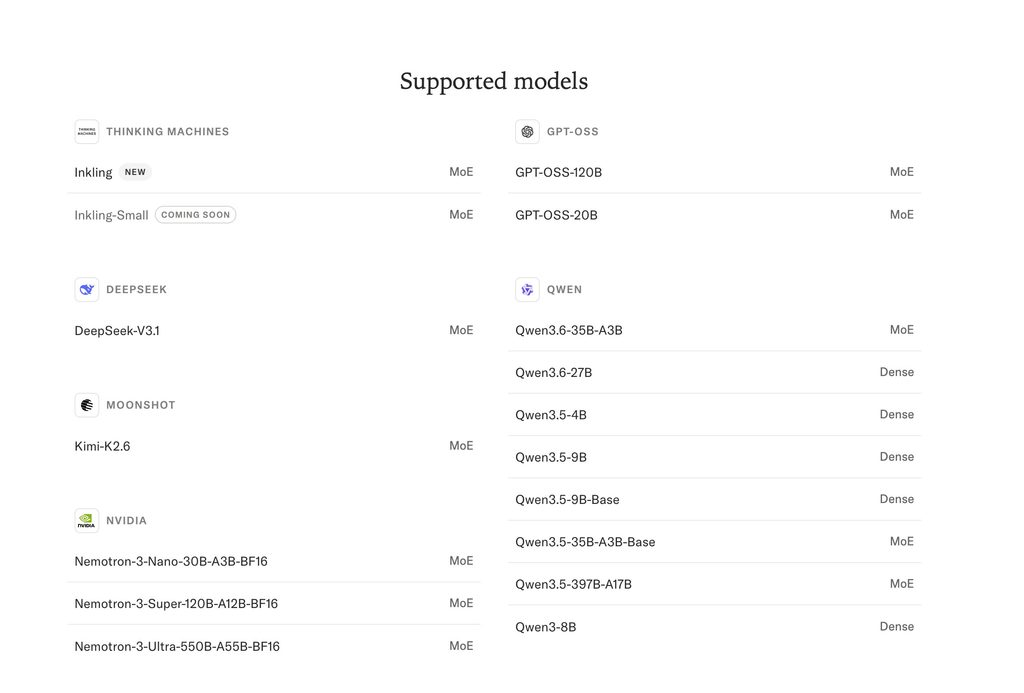
Two properties make it distinctive for this audience. First, it’s an open-model buffet: Tinker fine-tunes not just Inkling but Qwen, GPT-OSS, DeepSeek, Kimi, and Nemotron — you pick the base by licence and capability. Second, and decisively: you can download your weights. There’s an API endpoint for it, and Thinking Machines states plainly that your data is used only to train your models, never theirs. That combination — open base, LoRA, exportable checkpoint — is the most portable of the three offerings. You can tune on Tinker and then run the result on your own infrastructure, keeping it even if your relationship with the vendor ends.
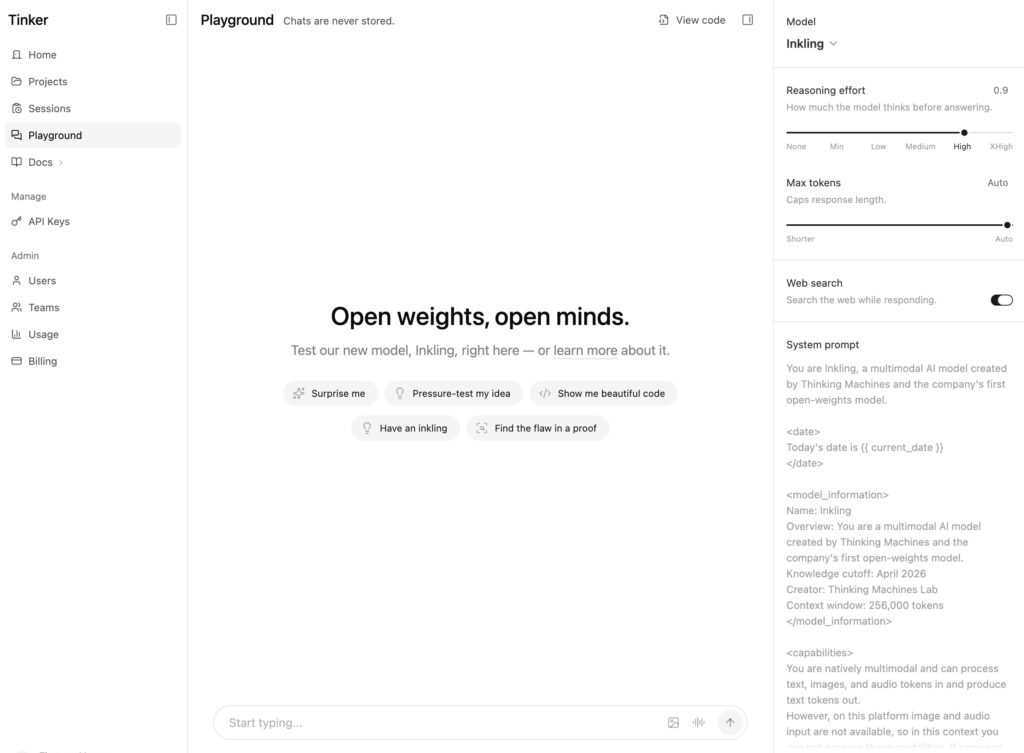
The catch is who it’s built for. Tinker’s own framing is “researchers and developers,” and its testimonials are from Berkeley, Princeton, and Stanford labs. It hands you control and expects you to bring the ML competence — datasets, eval design, RL environments. It is the most flexible and the least hand-held. For a research-heavy defense lab or a technically deep enterprise team, that’s ideal. For a hospital IT department, it’s a lot of rope.
enterprise AI model deployment tools
As an affiliate, we earn on qualifying purchases.
As an affiliate, we earn on qualifying purchases.
Mistral Forge: the managed sovereign program
Forge is the opposite posture: not an API you drive, but a managed, full-lifecycle program you commission. It goes further up the stack than fine-tuning — domain-adaptive pre-training on your internal data, then post-training (SFT, DPO, RLHF), dense or MoE, deployed on-prem, in-region, or air-gapped, with Mistral’s forward-deployed engineers embedded alongside your team.
Its wedge is European sovereignty, and for regulated EU buyers it’s a clean story: train on your data, in your jurisdiction, with a non-US vendor; when training runs on your clusters, Mistral sees nothing, and the resulting model belongs to you. That’s not abstract — Gartner pegs European sovereign-cloud spending at $12.6 billion for 2026, up 83% year over year, because the law requires certain data to stay within EU borders. Forge’s headline adopters (ASML, ESA, Ericsson, Singapore’s HTX) and use cases (code modernization, industrial adaptation, cybersecurity, quant research) all share one trait: data too sensitive or too specialized for a generic API.
The trade is depth for commitment. Forge is heavier, pricier (enterprise “contact us”), stickier, and — as its own critics at Futurum note — assumes a data maturity most enterprises don’t have; 42% of organizations still spend over half their time just wrangling data. It’s the deepest of the three, and the one you should reach for last, not first.
on-premise AI model hosting solutions
As an affiliate, we earn on qualifying purchases.
As an affiliate, we earn on qualifying purchases.
Microsoft MAI + Frontier Tuning: customization inside the platform
Microsoft’s answer, unveiled at Build 2026, is different again: seven first-party MAI models (led by MAI-Thinking-1, a ~1T-total/35B-active MoE) plus Frontier Tuning — the ability to tune the weights yourself, delivered inside Azure AI Foundry alongside 11,000+ other models and a unified governance control plane.
Microsoft’s pitch to the regulated buyer is built on three things younger labs can’t easily match. Enterprise-grade data lineage: MAI is trained from scratch with no distillation from other labs and on commercially licensed data — a “clean provenance” story aimed squarely at buyers facing legal scrutiny over training data. Integration: the tuned model plugs directly into the tools people already use — Foundry, GitHub Copilot, Windows — with billing, observability, and governance in one console. And economics: Microsoft claims a Frontier-Tuned MAI model matched GPT-5.5-class quality at roughly 10× lower cost on a partner’s tasks, with a similar efficiency win on an Excel-tuned model. Their message to the buyer is pointed: you don’t rent intelligence from a shared model that learns from everyone; only you control the resulting model, and it becomes your moat.
The clearest signal of where this is headed is the Mayo Clinic partnership — Microsoft and Mayo co-developing a frontier healthcare model on de-identified clinical data, to be deployed inside Mayo’s hospital system. That’s the regulated-vertical playbook in its most ambitious form. Microsoft’s real advantage here isn’t the benchmark; it’s that it has sold into regulated environments for decades and understands enterprise procurement in a way younger labs are still learning.
The catch is the mirror image of Tinker’s. Microsoft’s route is the most supported and the most integrated — and the least portable. Even its Anthropic-in-Foundry option runs on Anthropic-managed infrastructure rather than native Azure regional compute, which means data residency isn’t automatic; unified billing is not unified infrastructure. Gravity toward the Microsoft ecosystem is the price of the convenience.
regulated industry AI model management
As an affiliate, we earn on qualifying purchases.
As an affiliate, we earn on qualifying purchases.
The axis that actually separates them
Line the three up and the real differentiator isn’t quality or even price — it’s how much of the model, and the stack, you end up controlling.
| Tinker + Inkling | Mistral Forge | Microsoft MAI + Frontier Tuning | |
|---|---|---|---|
| What it is | Low-level training API on open bases | Managed full-lifecycle program | First-party models + tuning in Azure |
| Method | LoRA fine-tuning | Pre-training + post-training | Frontier Tuning (weight-level) |
| Base model | Open buffet (Inkling, Qwen, DeepSeek…) | Mistral open-weight checkpoints | MAI (+ Foundry’s 11,000 models) |
| Own the weights? | Yes — download them | Yes — model belongs to you | Tuned model yours; ecosystem-bound |
| Deploy anywhere? | Yes — fully portable | On-prem / EU / air-gap | Azure-gravity |
| Sovereignty story | Portability + open base | EU jurisdiction, non-US vendor | Clean lineage + Azure governance |
| Built for | Researchers, deep ML teams | Data-mature regulated enterprises | Azure enterprises, regulated verticals |
| Hand-holding | Least (you drive) | Most (embedded engineers) | Most (platform-integrated) |
| Reversibility | Highest | Low (sticky program) | Low (ecosystem lock-in) |
Read the “reversibility” row as the spine. Tinker maximizes your independence and asks for your competence in return. Forge maximizes depth and sovereignty and asks for commitment and data maturity. Microsoft maximizes support and integration and asks you to live in its ecosystem. None is strictly best; they’re bets on what you value.
Who else is playing this game
Three isn’t the whole board. The “customize an open base” pattern now has several credible routes worth a regulated buyer’s shortlist. Mistral itself offers a lighter path than Forge — its open-weight models fine-tuned via mistral-finetune, Unsloth, or Hugging Face TRL, servable on European sovereign infra (OVH, Scaleway, Hetzner) at roughly $1–2 per million training tokens versus 12–25× that for GPT-class API tuning. The Chinese open-weight labs — Qwen, GLM, Kimi, DeepSeek — are permissively licensed, frontier-adjacent, and fully self-hostable, which for some buyers is the whole game and for others a geopolitical non-starter. And the hyperscaler platforms (AWS Bedrock, Google Vertex) offer managed fine-tuning across many bases, trading portability for operational convenience much as Azure does. The through-line across all of them is the same shift: from renting a fixed model to owning an adapted one.
The take
For the regulated, defense, or health buyer, the decision reduces to a single honest question: what do you most need to control — the weights, the jurisdiction, or the integration?
If you need maximum independence and portability, and you have the ML muscle to use it, Tinker + Inkling (or Tinker + any open base) is the most flexible route, and the only one that hands you exportable weights from an open buffet. If you need deep domain adaptation under EU sovereignty and can commit to a program, Forge goes furthest — for the narrow set of organizations mature enough to wield it. If you’re already an Azure shop and value clean data lineage, governance, and integration over portability, Microsoft’s Frontier Tuning meets you where your compliance stack already lives — and the Mayo partnership shows it’s serious about the hardest verticals.
The meta-signal matters more than any single winner. Three of the most sophisticated players in AI have independently concluded that the future enterprise product isn’t a model you rent — it’s a model you own and adapt, with your institutional knowledge as the moat. That’s the same conclusion this publication has drawn from Forge, from the export-control freeze, and from every kill-switch flipped this year. The customization layer is where enterprise AI is being decided — and the only wrong move left is renting a generic model and hoping.
Sources: Thinking Machines Lab — Tinker product page, docs, and FAQ (LoRA, supported open models, downloadable checkpoints, data handling); Microsoft AI — Build 2026 MAI keynote and “hill-climbing machine” post (seven MAI models, Frontier Tuning, ~10× efficiency claims, Mayo Clinic partnership, zero-distillation lineage) and Microsoft Learn Foundry docs; Mistral AI and Futurum, Emelia, BuildMVPFast, Tensoria coverage of Forge (full-lifecycle training, EU sovereignty, ASML/ESA/HTX adopters, the data-maturity critique); Gartner sovereign-cloud figure via trade coverage. All vendor performance and efficiency claims are self-reported and await independent replication; regulated-sector deployments (Mayo, the bank pilots) are early. Analysis and framing are the author’s; not investment or legal advice.
Halloween Picks
halloween
As an affiliate, we earn on qualifying purchases.