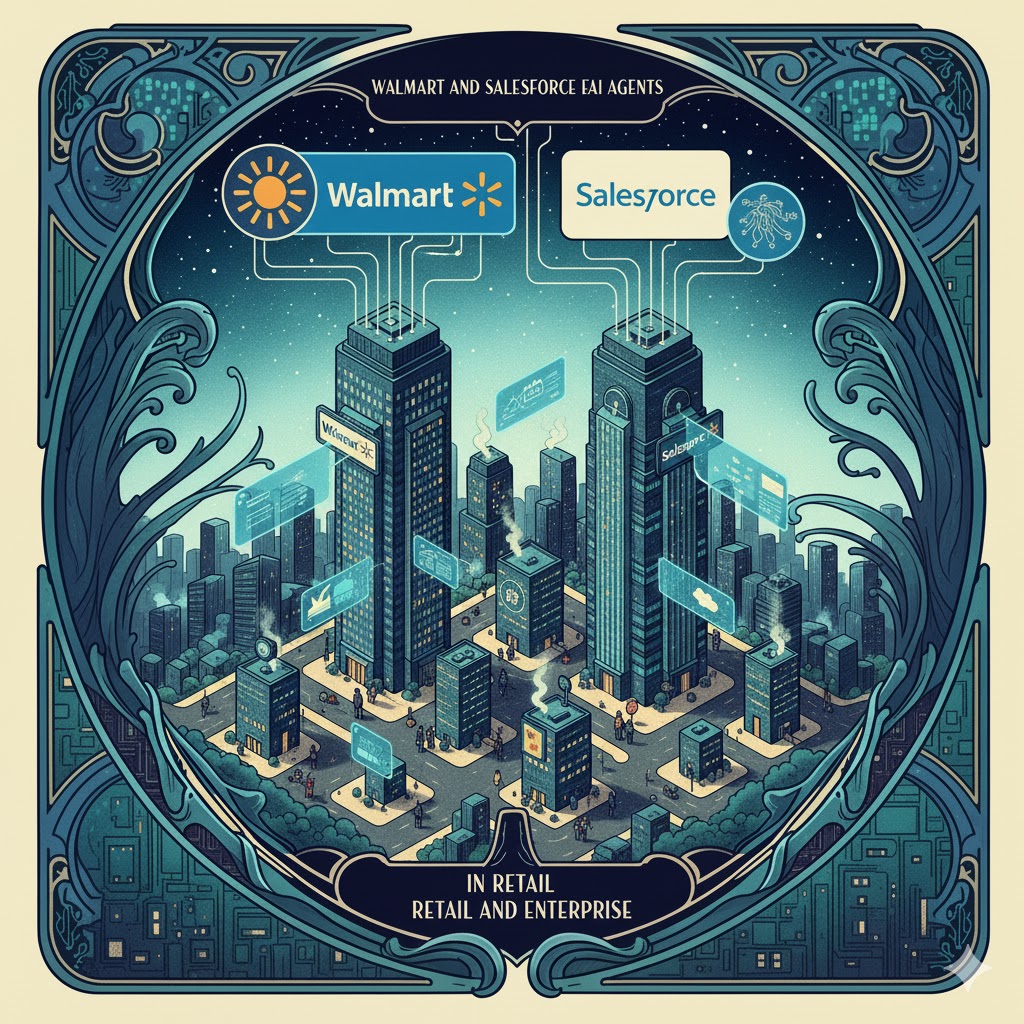

Two major companies made dual announcements on October 14, 2025, underscoring how generative AI is being woven into commerce and enterprise workflows. Walmart unveiled a partnership with OpenAI to enable Instant Checkout via ChatGPT for Walmart and Sam’s Club customers, embedding shopping directly into conversations. On the same day, Salesforce launched Agentforce 360 in collaboration with OpenAI and Anthropic – a platform for deploying AI agents across business workflows. These moves highlight a shift toward agent-based commerce and productivity, and signal broader implications for industry players like Amazon and Microsoft. Below, we break down each announcement and analyze the strategic context.
Walmart Brings Instant Checkout to ChatGPT
Walmart is integrating OpenAI’s ChatGPT into its shopping experience, allowing customers to chat, get personalized recommendations, and complete purchases via the chatbot. Walmart’s new partnership with OpenAI will let customers and Sam’s Club members shop directly within ChatGPT using the AI chatbot’s Instant Checkout featurereuters.com. In practical terms, this means a shopper can simply describe what they need – “Plan my week’s groceries” or “Find a gift under $50” – and ChatGPT will recommend items and process the order end-to-end, without the user ever visiting a website. Walmart describes this as an “AI-first shopping” experience: customers can plan meals, restock household essentials, or discover new products “simply by chatting”, and “Walmart will take care of the rest,” handling payment and fulfillment on the backendcorporate.walmart.comcorporate.walmart.com. By linking their Walmart or Sam’s Club accounts to ChatGPT, shoppers get a seamless checkout within the chat interface, effectively turning the bot into a personal shopping assistant.
Walmart’s strategy here is to make retail more proactive and frictionless. Doug McMillon, Walmart’s CEO, noted that e-commerce has long been driven by search boxes and product lists – a paradigm “about to change.” “There is a native AI experience coming that is multimedia, personalized and contextual,” McMillon said, emphasizing Walmart’s push toward a “more enjoyable and convenient future” through its own AI assistant (nicknamed “Sparky”) and partnerships like this one with OpenAIretailtouchpoints.com. Walmart calls this vision “agentic commerce,” where AI evolves from a passive tool to an active shopping agent that learns customers’ preferences, anticipates needs, and removes friction from everyday purchasescorporate.walmart.com. In other words, instead of customers having to search and scroll, the AI can proactively help them find what they want and place the order, almost as if a virtual personal shopper were at their service.
This move also keeps Walmart competitive in an AI-driven retail landscape. Investors responded positively – Walmart’s stock jumped nearly 5% on the announcementreuters.commorningbrew.com – reflecting confidence that Walmart is staying ahead of tech trends. Notably, Walmart is joining a growing ecosystem of retailers in OpenAI’s ChatGPT Instant Checkout program. Shopify and Etsy partnered with OpenAI a month prior to sell via ChatGPTreuters.commorningbrew.com, and Walmart’s integration will go live later in the fall, covering both Walmart’s catalog and Sam’s Club offeringsretailtouchpoints.com. By embedding its catalog into ChatGPT, Walmart aims to capture customers wherever they seek shopping advice – even if that’s in a chat with an AI. It’s a defensive and offensive play: defensive in closing the gap with Amazon’s early AI shopping efforts (Amazon had a head start with its own generative AI shopping assistant, code-named “Rufus”reuters.com), and offensive in setting a new bar for convenience in retail. “We are running towards that future… with Sparky and through partnerships including this important step with OpenAI,” McMillon saidretailtouchpoints.com, signaling Walmart’s determination to lead in AI-powered retail.
AI chatbot for grocery shopping
As an affiliate, we earn on qualifying purchases.
As an affiliate, we earn on qualifying purchases.
Salesforce Launches Agentforce 360 for AI-Powered Workflows
On the same day, Salesforce – the enterprise software giant – announced Agentforce 360, a platform to deploy AI agents across an organization’s departments and applications. In partnership with OpenAI and Anthropic, Salesforce is integrating some of the most advanced AI models (including OpenAI’s latest GPT-5 and Anthropic’s Claude models) directly into its ecosystemreuters.com. The goal is to infuse generative AI into everyday business workflows in a trusted, enterprise-grade way. “Agentforce 360 connects humans, agents, and data on one trusted platform,” CEO Marc Benioff explained, “helping every employee and every company achieve more than they ever thought possible.”technologymagazine.com
Agentforce 360 was globally launched as a culmination of a year-long transformation at Salesforcereuters.com. The platform allows companies to create, deploy, and manage AI agents that can handle a wide range of tasks across sales, service, marketing, IT, and moresalesforce.comtechnologymagazine.com. These AI agents can autonomously execute workflows or assist humans by retrieving information, drafting content, answering customer inquiries, and performing routine tasks. Crucially, the system is designed to operate with “24/7 intelligence” – in Salesforce’s vision of an Agentic Enterprise, “sales leads are never missed, service never sleeps, and every employee has an AI partner” to boost productivityinvestor.salesforce.com. Rather than replacing workers, the AI agents act as tireless colleagues handling the drudge work: Salesforce describes companies adopting this model as “Agentic Enterprises” where employees work alongside AI agents that take on repetitive, mundane tasks, freeing humans for higher-value workcbsnews.com.
OpenAI and Anthropic integrations are central to Agentforce 360’s value. Salesforce’s expanded partnerships will embed OpenAI’s GPT-5 and Anthropic’s Claude models into the platform, so users can leverage these frontier AI models securely within their Salesforce applicationsreuters.com. For example, an employee could ask a question in natural language – either in Slack (which Salesforce owns) or even in OpenAI’s ChatGPT interface – and the AI agent will access Salesforce data to provide answers or perform actions. (Salesforce confirmed that Agentforce 360 can be accessed “directly inside ChatGPT” – allowing, say, a sales manager to query CRM data via ChatGPT – and also deeply integrated into Slack and Salesforce’s own appsreuters.com.) On the customer side, Salesforce announced a new “Agentforce Commerce” feature that lets merchants use ChatGPT’s Instant Checkout to sell products, while keeping control of customer data and fulfillmentreuters.com. In essence, Salesforce is enabling its business clients to plug into the same ChatGPT commerce ecosystem that Walmart is using, but with enterprise safeguards. Meanwhile, Anthropic’s Claude will be offered in Salesforce’s secure cloud for industries like finance and healthcare that demand strict data controls, ensuring even regulated businesses can adopt AI agentsreuters.com.
Technically, Agentforce 360 brings together multiple layers: an AI agent platform (with tools like a conversational agent builder and an “Atlas” reasoning engine for complex logic), a unified Data 360 layer to give agents rich context from company data, the existing Customer 360 business apps (Sales, Service, Marketing cloud, etc.), and Slack as the conversational interface where humans and AI agents collaborateinvestor.salesforce.comtechnologymagazine.com. This integrated approach means, for instance, a support agent bot can pull data from knowledge bases, converse with a customer in natural language, and escalate to a human via Slack when needed – all within the company’s trusted environment. Salesforce has already tested Agentforce components with thousands of customers over the past year, and reports impressive results: companies like Reddit, Adecco, and OpenTable saw massive improvements (e.g. Reddit deflected 46% of support cases and cut resolution time by 84% using AI support agents)salesforce.comtechnologymagazine.com. These early use cases show that AI agents can significantly boost efficiency and service quality by handling routine queries, after-hours requests, and first-level interactions autonomously.
Beyond the technology, Salesforce is signaling a long-term commitment to this AI-driven future. Just a day before the launch, Salesforce pledged a $15 billion investment in San Francisco over five years to cement the city as the “world’s AI capital” and to accelerate an ecosystem of AI innovationinvestor.salesforce.com. This investment includes a new AI incubator at Salesforce’s campus and programs to help companies become Agentic Enterprises. “This $15 billion investment reflects our deep commitment to our hometown – advancing AI innovation, creating jobs, and helping companies and our communities thrive in this new era,” Benioff saidinvestor.salesforce.comcbsnews.com. Salesforce Ventures (the company’s VC arm) has also been actively investing in AI startups – including Anthropic itselfinvestor.salesforce.com – further indicating Salesforce’s bet that AI agents will redefine enterprise software. In short, Agentforce 360 is not a one-off product launch but part of a broader strategic pivot for Salesforce from a CRM company to what it calls “the world’s #1 AI CRM”investor.salesforce.com, where AI is woven into every facet of how businesses operate.
Instant checkout smart shopping devices
As an affiliate, we earn on qualifying purchases.
As an affiliate, we earn on qualifying purchases.
The Rise of Agent-Based Commerce and Productivity
Taken together, Walmart’s and Salesforce’s announcements highlight a powerful trend: AI “agents” are moving from concept to reality in both consumer commerce and workplace productivity. Instead of just generating text or images, AI systems are now being tasked with taking actions – whether that action is placing a retail order or auto-completing an enterprise workflow. This shift toward agent-based commerce and productivity could have far-reaching implications:
- From Reactive to Proactive Experiences: Traditional online shopping and software tools are largely reactive – they wait for you to search, click, or command. The new AI agents are proactive and context-aware. Walmart’s so-called “agentic commerce” is a prime example: the AI can understand a user’s intent in context (e.g. a dinner plan or a budget gift query) and proactively handle the shopping process, rather than just returning a list of search resultscorporate.walmart.com. Likewise, in the enterprise, Salesforce’s Agentforce agents can monitor data or queries and act autonomously (for instance, scheduling a follow-up task when a sales lead comes in at midnight). This heralds a more conversational and anticipatory mode of interaction in both shopping and work. Users may increasingly expect AI to not only answer questions, but to “just handle it” – whether “it” is ordering detergent or compiling a quarterly sales report.
- New Customer Touchpoints and Channels: By integrating with ChatGPT, Walmart is effectively putting its storefront into a popular AI platform used by millions. This blurs the line between a retailer’s own app/website and third-party AI platforms. It also opens a new customer acquisition channel – for example, someone using ChatGPT for recipe ideas might directly buy ingredients through Walmart via the chat. Retailers will likely need to either join these AI commerce ecosystems or risk losing visibility if competitors’ products are one prompt away. (Notably, OpenAI’s Instant Checkout program is still limited to select partners; non-partners’ products might be recommended by ChatGPT but without that seamless purchase flowmorningbrew.commorningbrew.com.) We may see a scramble among retailers and marketplaces to integrate with AI assistants – or to build their own – to stay present in the next generation of shopping experiences.
- Empowering Employees with AI Co-workers: In corporate settings, the notion of an AI agent as a digital co-worker could transform job roles. Mundane tasks (data entry, basic customer inquiries, report generation) can be offloaded to bots, allowing human workers to focus on creative, strategic, or relationship-oriented work. Early adopters report that this augments human productivity significantly, rather than replacing humans outright. “AI doesn’t replace people, it elevates them,” is how Salesforce frames the Agentic Enterprise modelsalesforce.cominvestor.salesforce.com. There will be a premium on staff who know how to leverage these agents effectively – managing them, interpreting their outputs, and training them with organizational knowledge. Companies that successfully blend human and AI agent workforces could gain an efficiency and service advantage. On the other hand, companies will also need to manage change carefully: workforce training (like Walmart’s push for AI literacy among its 2.1 million associatescorporate.walmart.com) and governance around AI usage become critical to realize the benefits without alienating employees or introducing risk.
- Data and Ecosystem Control: Both announcements highlight a tension between leveraging powerful third-party AI platforms and maintaining control over data and customer relationships. Walmart is plugging into OpenAI’s platform to reach consumers, while Salesforce is integrating external models into its own system. Salesforce, in particular, is emphasizing that enterprise customers retain control and security – e.g. merchants using Agentforce Commerce can sell via ChatGPT but keep their customer data, and Anthropic’s models are offered in a secure cloud for compliancereuters.com. Data privacy, security, and proprietary customer data management will be key issues as agentic AI becomes more pervasive. Big players will aim to build trusted AI environments – otherwise businesses (and shoppers) may hesitate to let an AI agent intermediate their interactions.
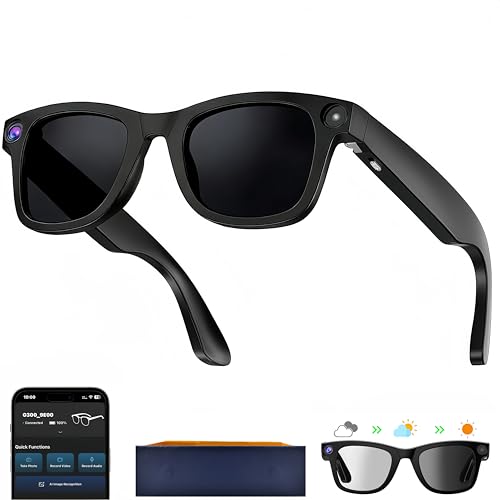
AI Smart Glasses with Camera, 8MP HD Camera Glasses for Men, AI Recording Glasses with Voice Assistant,Open-Ear Audio,Real-Time Translation,Video Recording Sunglasses for Life & Work (Photochromic)
【Built for an Active, On-the-Go Life】Warchody camera glasses are engineered for dynamic lifestyles, these AI glasses with camera…
As an affiliate, we earn on qualifying purchases.
As an affiliate, we earn on qualifying purchases.
Signals for Tech Giants: Amazon and Microsoft
The bold moves by Walmart and Salesforce also send a clear signal to other tech giants, chiefly Amazon and Microsoft, that the race is on to define the AI-agent future.
- Amazon: As the world’s largest online retailer and cloud AI provider, Amazon finds itself in a complex position. On one hand, Amazon’s retail business faces direct competitive pressure from Walmart’s innovation. Walmart’s integration with ChatGPT can be seen as an effort to counter Amazon’s ecosystem – indeed, Walmart’s growing investment in AI aims to “close the gap with online behemoth Amazon, which had a head start with its chatbot, Rufus”reuters.com. Amazon has been experimenting with generative AI in shopping: its internal assistant “Rufus” (quietly rolled out for some users) can answer shopper questions and even reveal price histories to discern true dealsreuters.comwcpo.com. Amazon also revamped its Alexa voice assistant with generative AI capabilities, indicating a vision of Alexa as a more conversational shopping advisor. However, Amazon so far keeps these AI experiences within its own walls (its website, app, and devices), whereas Walmart jumped onto an external platform (ChatGPT). The question for Amazon is whether it will open up any of its services to third-party AI assistants or double down on making Alexa/its app the go-to AI shopping destination. Given Amazon’s strengths – a trove of shopping data and an army of Prime customers – it will likely intensify its AI efforts (perhaps a more advanced Alexa or shopping bot) to ensure it doesn’t cede the convenience edge. In cloud services, Amazon (AWS) also competes with Microsoft and Salesforce to host enterprise AI – we might expect Amazon to tout its own AI agent frameworks for businesses to build upon, leveraging its Bedrock and Titan model offerings instead of relying on OpenAI.
- Microsoft: Microsoft has a foot in both the consumer and enterprise AI camps, and these announcements intersect with its interests. Microsoft is a major backer of OpenAI (which powers ChatGPT), so Walmart’s use of ChatGPT for commerce indirectly benefits Microsoft’s ecosystem (likely running on Azure cloud). But Microsoft is also directly in the game: it has introduced AI “copilots” across its products and even launched its own shopping agents and integrations. For instance, Microsoft recently previewed a “Personal Shopping Agent” that retailers can embed in their sites or apps, built on Azure OpenAI serviceswindowscentral.comwindowscentral.com. Microsoft’s Bing and Windows Copilot have also been adding commerce features – e.g. a partnership with Curated For You brings shoppable fashion suggestions into the Microsoft Copilot experiencedigitalcommerce360.comdigitalcommerce360.com. And just days after the Walmart/Salesforce news, Microsoft announced “Hey Copilot” – a voice-activated AI and autonomous agent system for Windows 11 that can perform tasks on a PC via voice commandventurebeat.com. All these moves show Microsoft’s determination to weave AI agents into daily life and work, from your operating system to productivity apps. Strategically, Microsoft stands to gain if agent-based computing becomes mainstream, as it provides the infrastructure (Azure cloud, AI models) behind many of these services. However, it also means Microsoft will compete more directly with Salesforce in the enterprise AI agent arena (Salesforce’s CRM vs. Microsoft’s Dynamics 365 and Office suite with Copilot). We can expect Microsoft to accelerate its “Copilot for everything” strategy, ensuring that its AI agents can handle both productivity tasks and shopping experiences in a cohesive way. The fact that Salesforce felt the need to integrate OpenAI and Anthropic models highlights the clout of those AI labs – and Microsoft’s alliance with OpenAI gives it a privileged position. At the same time, Salesforce’s openness to multiple AI partners (including Google’s models in the future) indicates that other AI providers will vie for enterprise partnerships, an area Microsoft will watch closely.
- Others (Google, Meta, etc.): While the question emphasizes Amazon and Microsoft, it’s worth noting that Google and others are also in this race. Google has been enhancing its search and Bard chatbot with shopping features – for example, Google is working on making its search more interactive for commerce as a counter to ChatGPT’s shopping focusretailtouchpoints.com. And enterprise players like Oracle, SAP, Meta (with its AI studio) are all exploring agent-like automation. The broader implication is that “agentic AI” could become a new platform layer, much as mobile apps or cloud services did. Every major tech company will need a strategy for AI agents that either ties people into its own ecosystem or at least ensures its services are represented in others’ AI ecosystems.

SmartShopper Grocery List Organizer with Embedded Thermal Printer (SS-101)
State-of-the-art voice recognition
As an affiliate, we earn on qualifying purchases.
As an affiliate, we earn on qualifying purchases.
A New Paradigm: Opportunities and Challenges Ahead
The Walmart and Salesforce announcements demonstrate that AI agents are no longer theoretical—they are launching in real products that will touch consumers and knowledge workers alike. For business leaders in retail and enterprise tech, these developments offer a glimpse of how competitors and partners may be leveraging AI:
- Customer Experience is Being Redefined: Retailers should imagine shopping not as a sequence of web pages, but as a conversation or even an AI-driven task. This could increase customer expectations for convenience and personalization. Companies that invest early in conversational commerce (through partnerships or in-house AI assistants) could gain an edge in customer loyalty and conversion rates. Those that don’t could find their traditional websites/apps getting less traffic as consumers gravitate to more natural, chat-based interfaces.
- Productivity and Workflow Acceleration: In the enterprise, adopting AI agent platforms like Agentforce 360 (or Microsoft’s Copilots, etc.) could become a competitive necessity. Early evidence suggests these tools can dramatically cut response times, improve service availability, and allow employees to handle more strategic worksalesforce.comtechnologymagazine.com. However, integrating AI agents requires thoughtful change management – reengineering processes, updating IT infrastructure, and addressing employee concerns about job displacement. The successful companies will likely be those that augment their teams with AI (as Salesforce and Walmart have stressed, focusing on AI training and new AI-related roles for staffcorporate.walmart.cominvestor.salesforce.com) rather than simply trying to replace headcount.
- Ecosystem Plays and Partnerships: Both announcements show that partnerships (OpenAI with Walmart and Salesforce; Anthropic with Salesforce; likely others to come) are key to delivering these AI capabilities. No single company has all the pieces – retailers have the products and customers, AI firms have the models, platform companies have the interfaces. We will probably see more alliances forming: e.g., retailers teaming up with AI providers or tech platforms, enterprise software firms partnering with multiple AI model vendors to offer flexibility, etc. This also means an explosion of integration points – APIs connecting retail catalogs to chatbots, plugins linking enterprise data to AI agents, and so forth. Companies must navigate these while maintaining data governance and brand identity.
In conclusion, the events of October 14, 2025 mark an inflection point: AI is moving from simply providing information to taking action in commercial and professional domains. Walmart is embedding commerce into an AI conversation, potentially reshaping how we shop. Salesforce is rolling out an AI agent workforce to augment how we work. This agent-based paradigm – sometimes called “ambient AI” or “autonomous agents” – points to a future where interacting with technology feels less like using software and more like collaborating with a capable assistant. It’s a future where, as Microsoft noted in its own AI push, we go beyond chatbots to a world of AI that can “complete complex tasks on [our] behalf”venturebeat.com.
For other industry players, the message is clear: the race to provide useful AI agents is on, and those who lag may find themselves disintermediated from customers or outpaced in productivity. Amazon and Microsoft are already responding in kind, and we can expect even more announcements in the coming months as every major company stakes its claim in the agentic AI era. The competitive landscape is evolving quickly, but one thing is certain – businesses that harness these AI agents effectively stand to unlock new levels of convenience for customers and efficiency for themselves, while those that ignore the trend risk falling behind in the next great technological transformation.
Sources:
- Walmart Inc., “Walmart Partners with OpenAI to Create AI-First Shopping Experiences,” Oct. 14, 2025corporate.walmart.comcorporate.walmart.com.
- Reuters, “Walmart partners with OpenAI for ChatGPT shopping feature,” Oct. 14, 2025reuters.comreuters.com.
- Retail TouchPoints, “Walmart Becomes Latest Retailer to Join ChatGPT’s Instant Checkout,” Oct. 14, 2025retailtouchpoints.comretailtouchpoints.com.
- Morning Brew, “Walmart wants you to check out (on) ChatGPT,” Oct. 15, 2025morningbrew.commorningbrew.com.
- Salesforce (BusinessWire press release), “Welcome to the Agentic Enterprise: With Agentforce 360, Salesforce Elevates Human Potential in the Age of AI,” Oct. 13, 2025investor.salesforce.cominvestor.salesforce.com.
- Reuters, “Salesforce deepens AI ties with OpenAI, Anthropic to power Agentforce platform,” Oct. 14, 2025reuters.comreuters.com.
- CBS News, “Salesforce will invest $15B to keep San Francisco as ‘world’s AI capital’,” Oct. 13, 2025cbsnews.comcbsnews.com.
- Technology Magazine, “Salesforce Agentforce 360 Connects AI Agents to Staff,” Oct. 13, 2025technologymagazine.comtechnologymagazine.com.
- VentureBeat, “Microsoft launches ‘Hey Copilot’ voice assistant and autonomous agents for all Windows 11 PCs,” Oct. 16, 2025venturebeat.com.