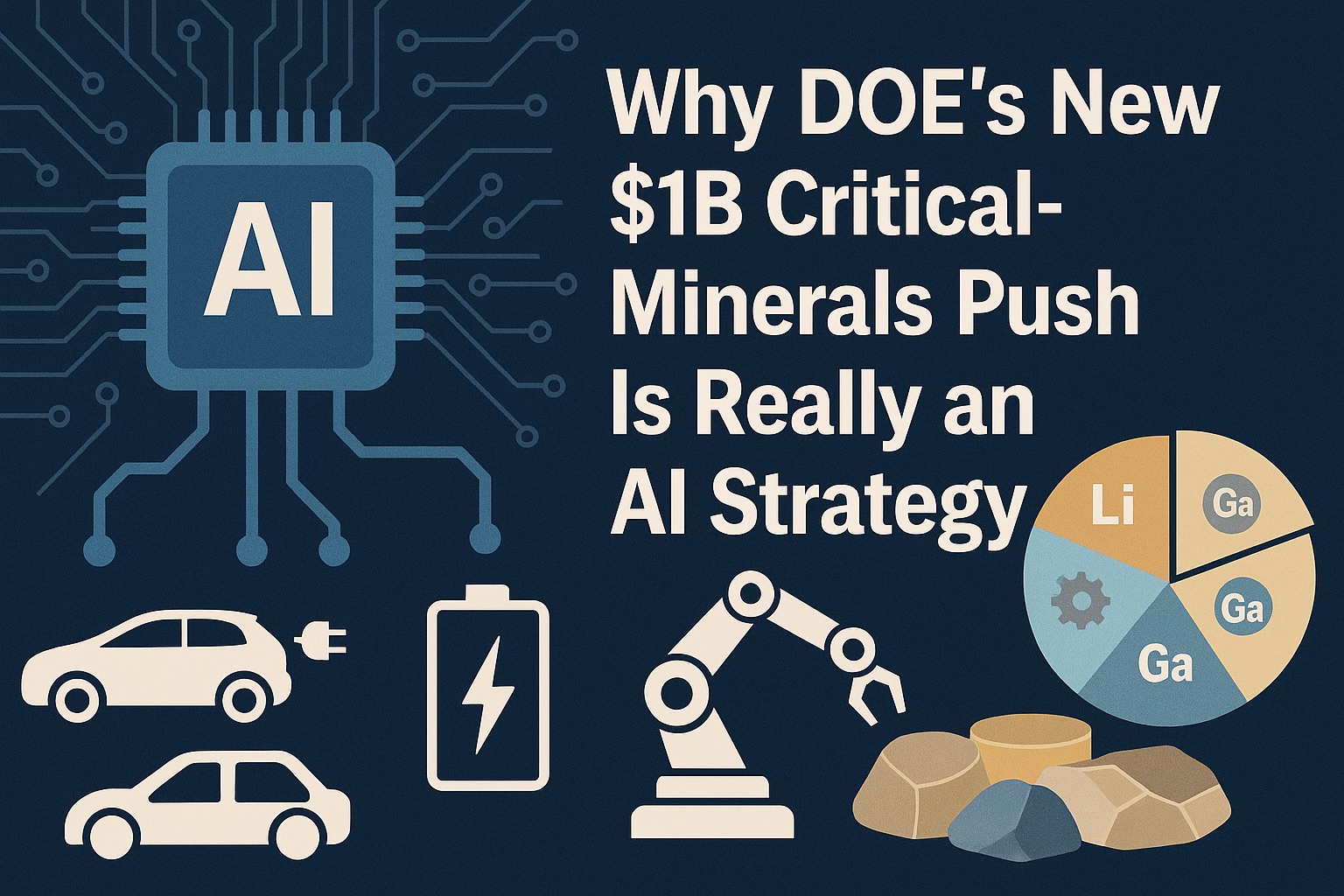

How a supply‑chain program aimed at lithium, graphite, cobalt, rare earths, gallium, germanium—and more—underpins U.S. leadership in artificial intelligence and national security.
At‑a‑glance: DOE’s funding tracks → AI hardware impact
- REE demonstration + Accelerator → Motors & actuators for AI robotics; magnet‑intensive sensors. The Department of Energy’s Energy.gov+1
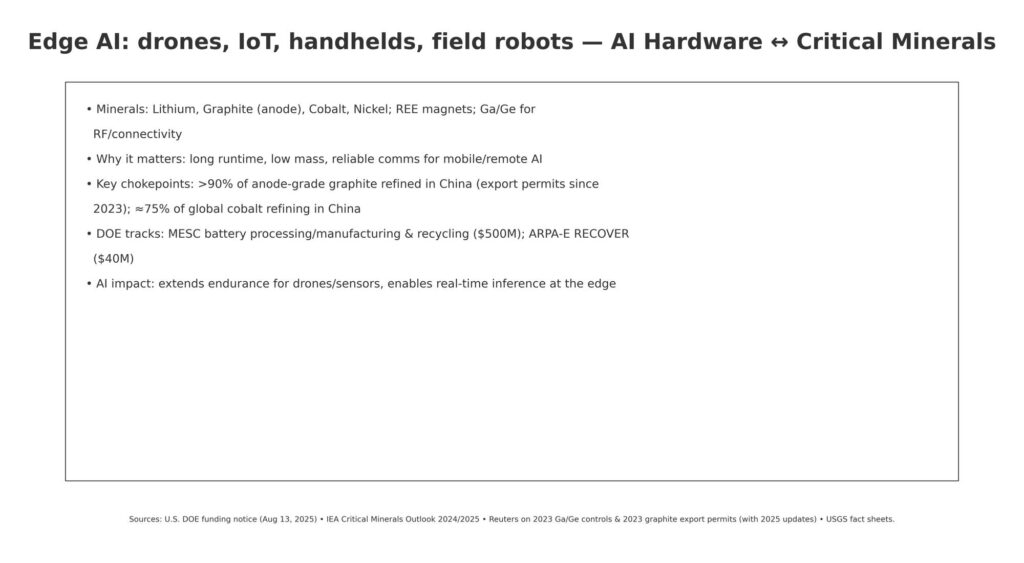
- Battery processing/manufacturing/recycling → Edge AI devices, drones, autonomous systems, data‑center backup. The Department of Energy’s Energy.gov
- Byproduct recovery pilots (Ga/Ge, REE, etc.) → Chips’ RF/power ecosystem, silicon photonics, magnet alloys. The Department of Energy’s Energy.govUSGS
What just happened
On August 13, 2025, the U.S. Department of Energy (DOE) announced its intent to issue notices of funding opportunities (NOFOs) totaling nearly $1 billion to expand domestic capabilities across the critical‑minerals value chain—from mining and recovery to refining, alloying, and manufacturing. Four pillars anchor the plan:
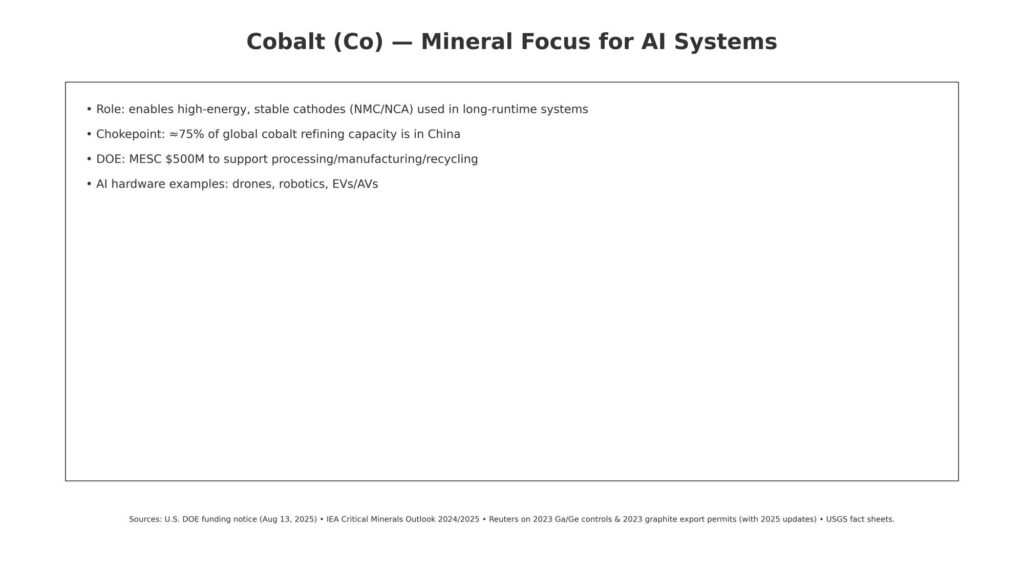
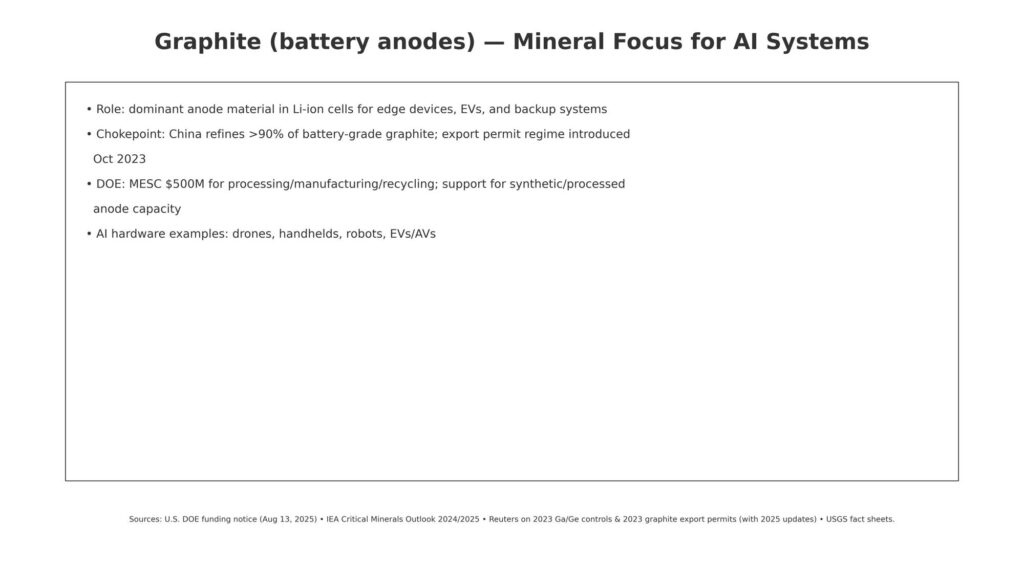
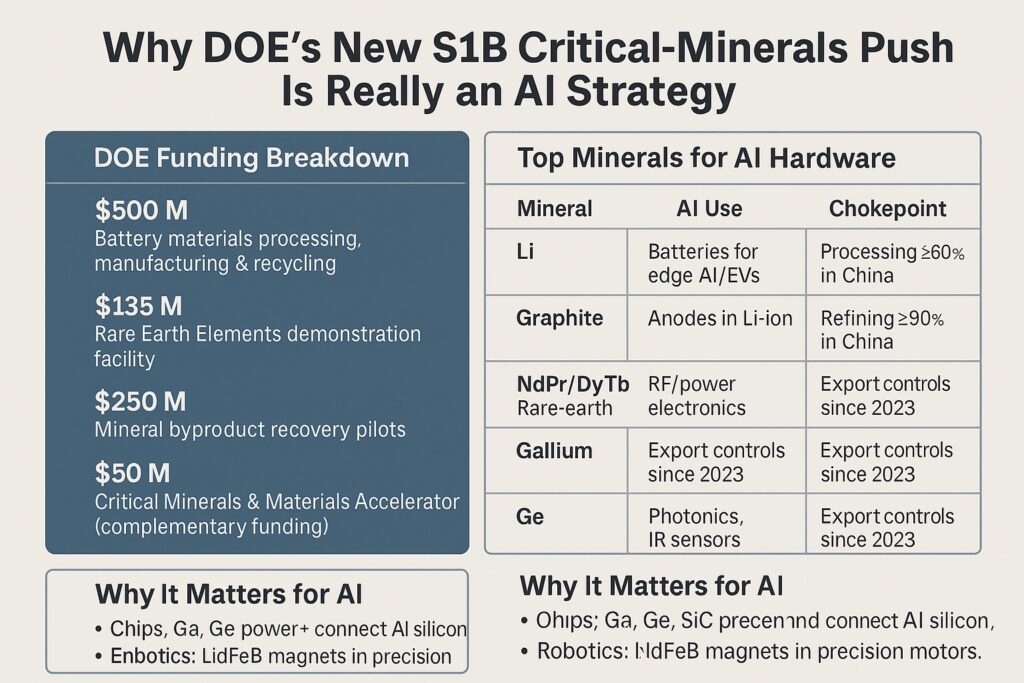
- Up to $500 million (MESC) for battery materials processing, battery manufacturing, and recycling at demonstration/commercial scale (≥50% cost share).
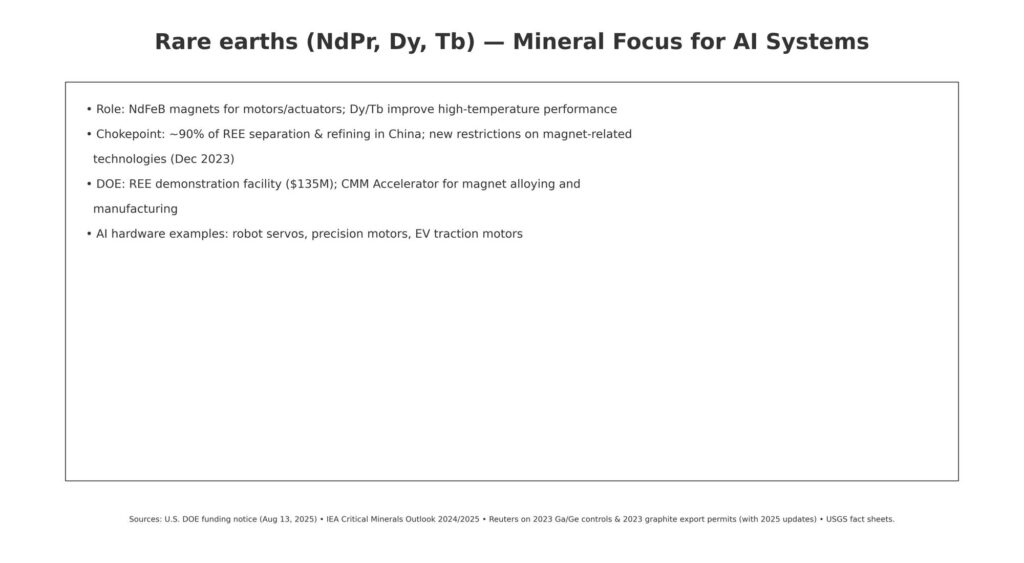
- Up to $135 million (MESC) for a Rare Earth Elements (REE) demonstration facility that proves domestic refining/recovery from tailings and waste, with an academic partner and ≥50% cost share.
- ~$250 million (FECM) to pilot recovery of mineral byproducts (e.g., from coal and other industrial facilities) to de‑risk commercialization.
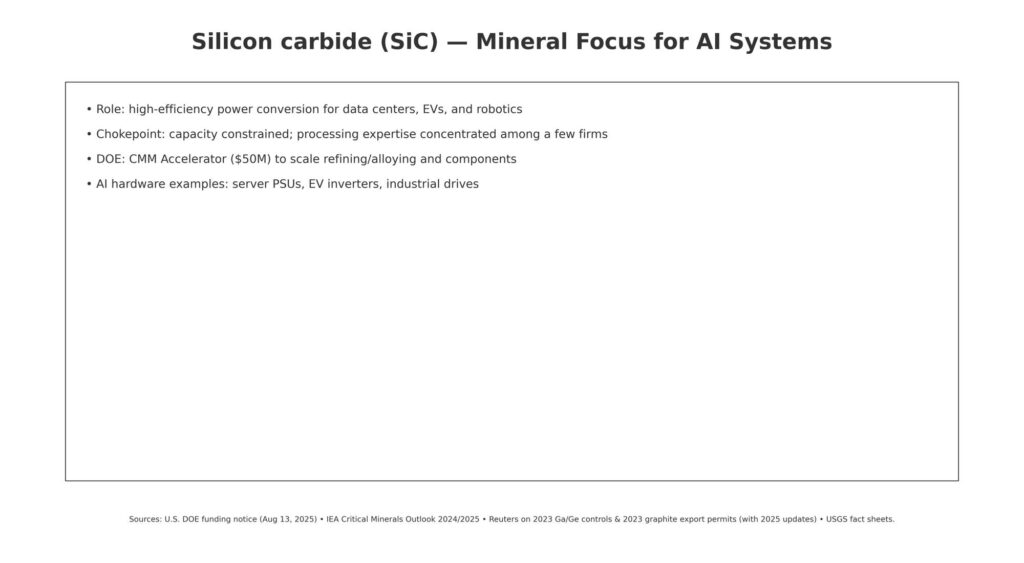
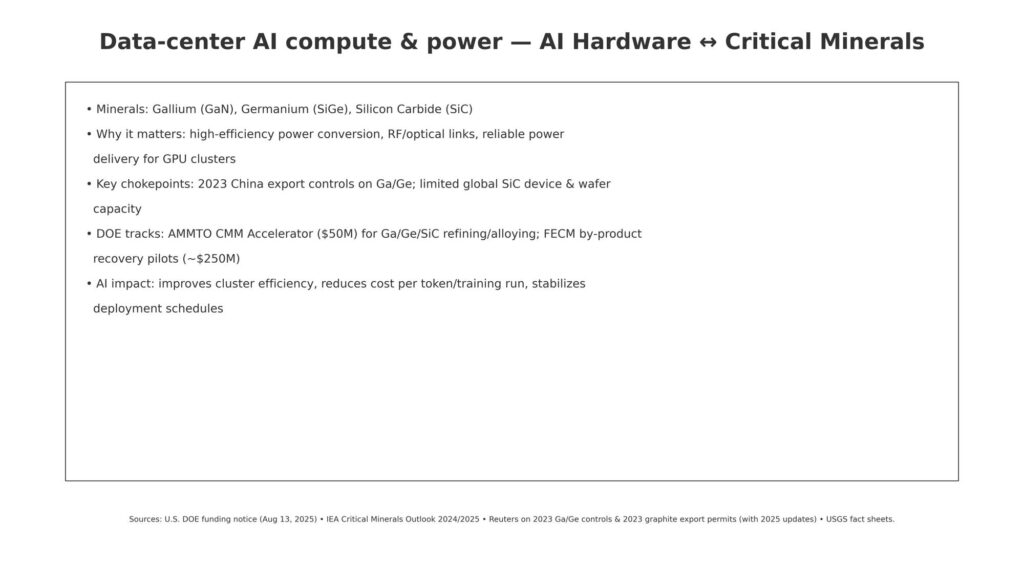
- Up to $50 million (AMMTO) for a Critical Minerals & Materials Accelerator targeting process scale‑up in the rare‑earth magnet supply chain and refining/alloying of gallium, germanium, and silicon carbide, among others.
DOE also flagged forthcoming $40 million ARPA‑E “RECOVER” selections on extracting critical minerals from industrial wastewater—complementary to, but separate from, the ~$1 billion NOFOs. The Department of Energy’s Energy.gov

Independent coverage framed the action as a nearly $1 billion federal push to reshore supply chains spanning mining, processing, and advanced materials manufacturing. Reuters
Why this matters for AI
AI doesn’t run on code alone—it runs on matter. Compute‑hungry models depend on:
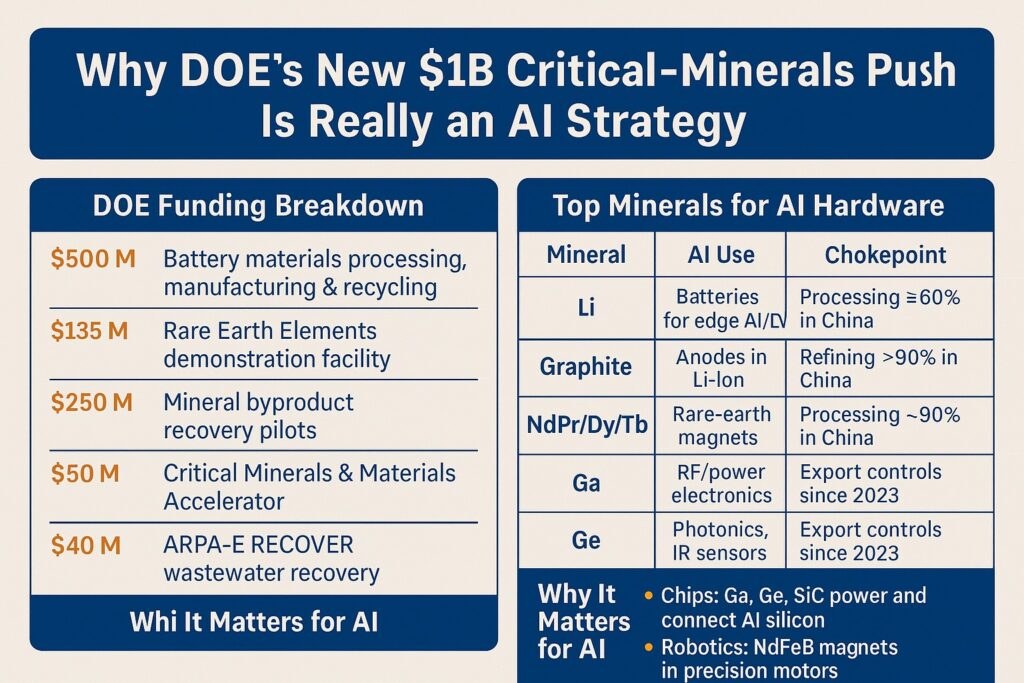
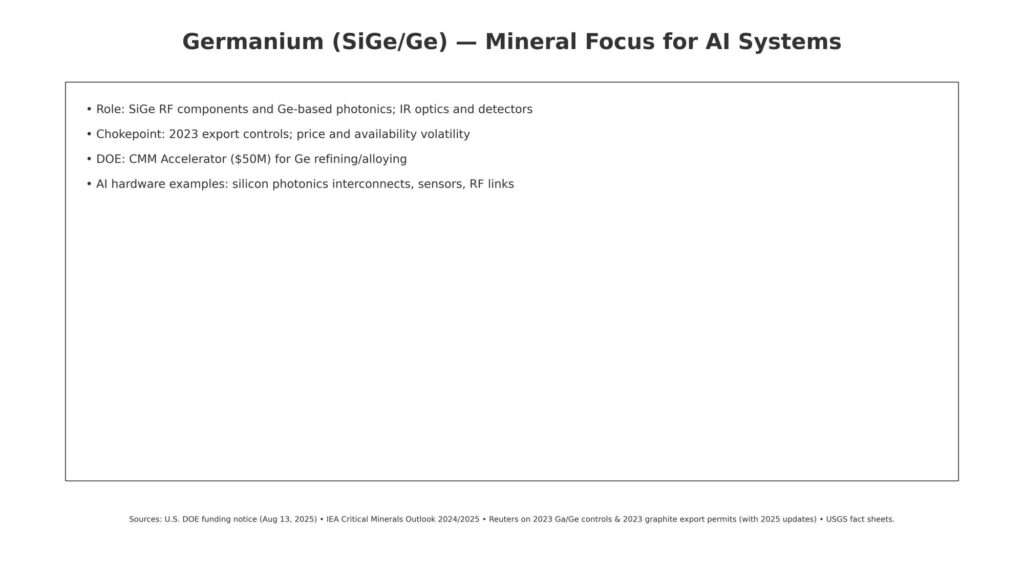
- Chips & power electronics. While GPU/TPU dies are silicon, the surrounding ecosystem relies on gallium (Ga) and germanium (Ge) for RF, photonics, and power devices (e.g., GaN, SiGe), and SiC for high‑efficiency power conversion in data centers and robotics. USGS and independent analyses highlight these roles across semiconductors and advanced electronics. USGSCSIS
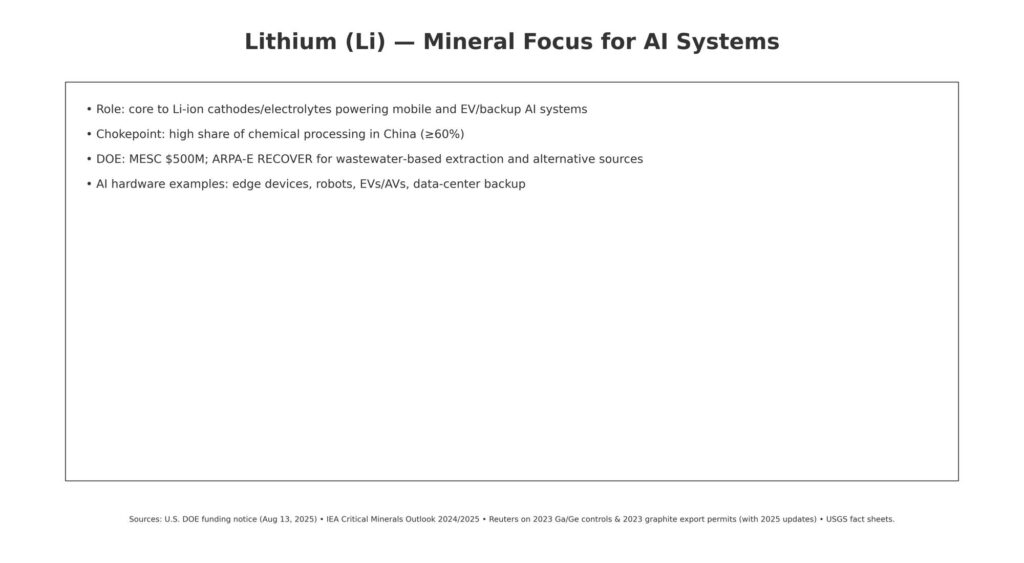
- Battery systems. Mobile AI (edge devices, robots, drones) and data‑center backup increasingly lean on lithium‑ion chemistries—anchored by graphite anodes (virtually all Li‑ion today) plus lithium, nickel, cobalt cathode inputs. China’s export‑permit regime for graphite underscores the fragility. Reuters
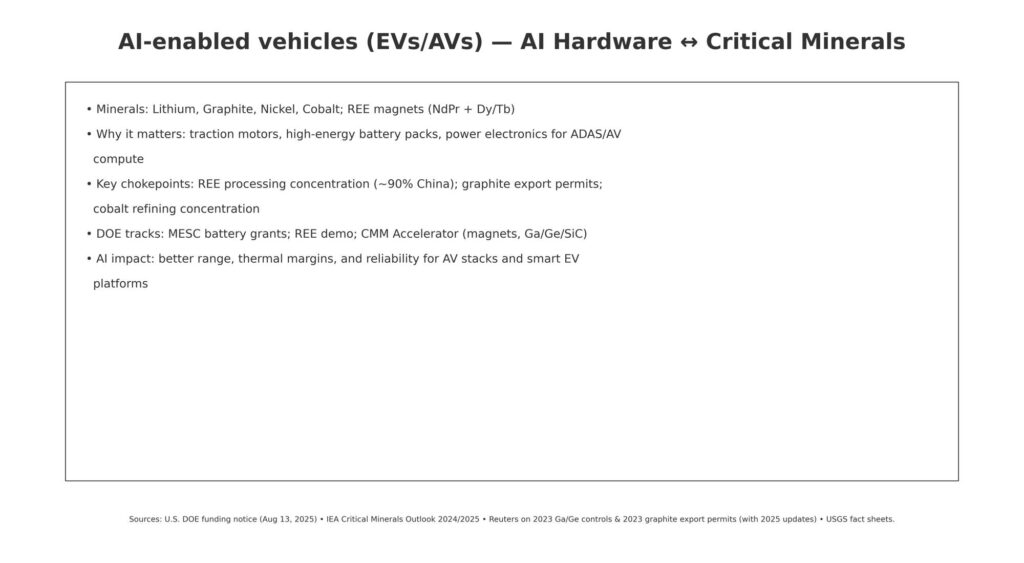
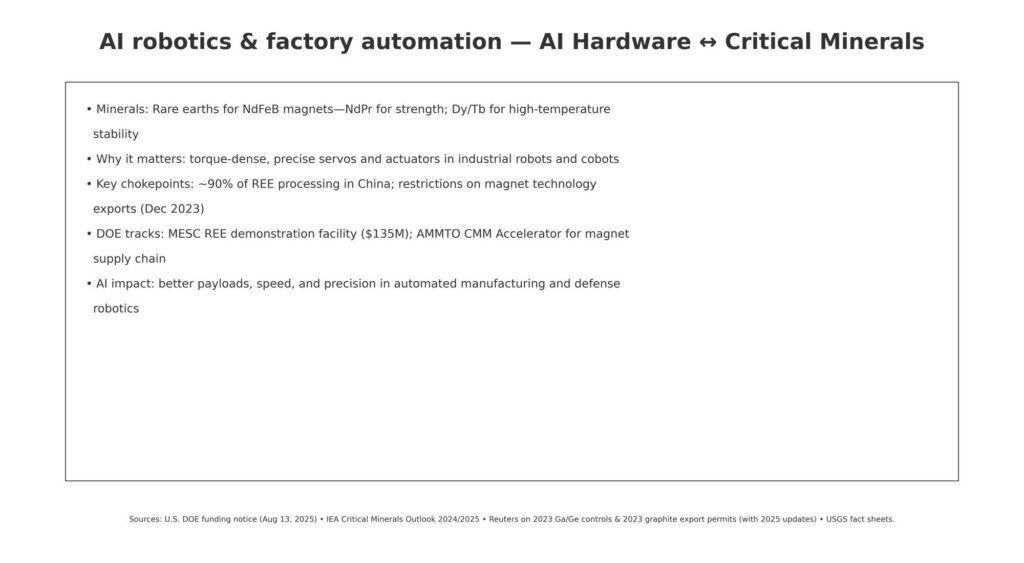
- Rare‑earth magnets (NdFeB). Precision motors/actuators in AI robotics and automation require magnets containing neodymium/praseodymium (strength) and dysprosium/terbium (high‑temperature stability). DOE’s own supply‑chain report details their centrality. The Department of Energy’s Energy.gov
The geopolitical kicker: China dominates refining and processing—the chokepoints that turn ore into components. The IEA finds China is the dominant refiner for 19 of 20 assessed energy‑transition minerals (≈70% average share), and projects continued concentration. For REE processing, China historically holds ~90%; for cobalt refining, >75%; and for battery‑grade graphite, >90%. That level of control means export controls can instantly ripple into AI hardware schedules and costs. IEA+1IEA BlobReuters
Those risks are not theoretical. Beyond 2023 curbs on gallium and germanium, China required export permits for graphite and has tightened oversight and controls on rare‑earth magnets and related technologies—a direct pressure point on EVs, defense systems, and automation hardware used alongside AI. Reuters+3Reuters+3Reuters+3
How DOE’s $1B targets the chokepoints
1) Rare‑earths refining & magnets (REE demonstration + Accelerator).
The REE NOFO funds domestic refining/recovery from tailings and waste streams—key because separation/refining, not mining, is where China maintains near‑total leverage. The Accelerator simultaneously aims at magnet‑supply processes and alloying/refining steps (including Ga/Ge/SiC) critical to chips and motors. Together, they cultivate the upstream chemistry and metallurgical capability needed to onshore NdFeB magnet capacity for AI robotics and defense. The Department of Energy’s Energy.gov
2) Batteries & recycling (MESC $500M).
By supporting processing, manufacturing, and recycling at demonstration/commercial scale—with meaningful cost‑share—DOE is trying to shorten the time from bench‑scale innovation to bankable plants for lithium, graphite, nickel, copper, aluminum, and even REEs in commercial batteries. That directly addresses graphite’s choke point amid Chinese export controls and helps decouple edge‑AI devices and autonomous systems from single‑country dependencies. The Department of Energy’s Energy.gov
3) Byproduct recovery pilots (FECM ~$250M).
A sizable tranche will pilot extraction of critical minerals from industrial facilities—including coal‑based sites—where minerals like gallium (often from bauxite/zinc processing) or rare earths can be recovered as byproducts. This taps non‑traditional domestic feedstocks to diversify supply for semiconductors and magnets without waiting years for greenfield mines. The Department of Energy’s Energy.gov
4) ARPA‑E RECOVER ($40M, separate).
Project selections will focus on recovering critical minerals from industrial wastewater, complementing the other pillars and expanding secondary supply routes. The Department of Energy’s Energy.gov
The AI lens: concrete linkages
- AI chip manufacturing: Resilient access to Ga/Ge/SiC supports RF/power components, silicon photonics, and power delivery around data‑center AI clusters—even as leading‑edge compute remains on silicon. Losing these materials to export shocks or price spikes can bottleneck boards, power modules, and interconnects, throttling the deployment of AI hardware. USGSCSIS
- AI robotics & automation: NdFeB magnets are indispensable in servos and precision motors; dysprosium/terbium extend high‑temperature performance. Securing REE separation and magnet‑making closes a critical gap for advanced manufacturing and defense robotics. The Department of Energy’s Energy.gov
- Energy storage for AI at the edge: Whether drones, handhelds, or autonomous systems, graphite‑dominant Li‑ion remains the workhorse. With China refining >90% of anode‑grade graphite and now controlling exports, a domestic processing/recycling base is an AI‑hardware resilience issue, not just an EV story. Reuters
The bigger picture: concentration, controls, and volatility
- Concentration risks are rising, not falling. The IEA reports the top three refining nations’ market share climbed to 86% in 2024, with China the primary growth driver for cobalt, graphite, and rare earths. IEA
- Controls are spreading. Over 2023–2025, Beijing introduced permit regimes, technology export bans, and tracking systems spanning graphite, magnets, gallium, and germanium, reinforcing chokepoints in the very materials that feed AI hardware and electrified systems. Reuters+2Reuters+2
- Price swings are severe. The IEA’s mineral price indices show large swings (e.g., lithium’s round‑trip surge and slump), complicating project finance; policy support helps bridge that financing and timing risk. IEA
What success would look like (and how to measure it)
- Processing capacity on U.S. soil: commissioned tonnage for battery‑grade graphite, lithium chemicals, and REE oxides/metals—plus magnet alloy output and first NdFeB magnet lines.
- Byproduct‑recovery economics: proven LCOE‑style metrics for gallium/germanium/REE from coal, bauxite, and other industrial streams.
- Time‑to‑hardware impact: shorter lead times and fewer “single‑point failure” components in GPU server BOMs, power modules, and robotic actuators.
- Recycling rates: rising share of secondary feedstock (magnets, batteries) flowing into U.S. plants.
DOE’s design—demo/commercial scale + 50% cost‑share—is explicitly about bankability: pushing projects over the commercialization hump so private capital continues the build‑out. The Department of Energy’s Energy.gov
Risks & realities
- Permitting & social license remain gating factors even for processing facilities; early community engagement is pivotal.
- Technology risk in byproduct recovery and new refining routes needs staged pilots—precisely what FECM and ARPA‑E are backing. The Department of Energy’s Energy.gov
- Global counter‑moves (tariffs, additional export curbs) could keep markets volatile; the structural fix is capacity and diversity, not just stockpiles. The IEA underscores that processing remains the Achilles’ heel. IEA
Bottom line
DOE’s ~$1 billion initiative is not just about rocks—it’s a compute strategy. By targeting refining, separation, alloying, and magnet manufacturing—the steps where China’s leverage is greatest—the U.S. is hardening the physical backbone of AI. If executed well, this program will cut lead times, stabilize costs, and reduce geopolitical exposure for AI chips, robots, and energy systems that make modern AI possible—a direct investment in technological sovereignty and national security.
Sources & further reading (selected):
- DOE press release and NOFO summaries (Aug 13, 2025). The Department of Energy’s Energy.gov
- Reuters coverage of the DOE plan (Aug 13, 2025). Reuters
- IEA on minerals concentration and China’s refining dominance. IEA+1
- IEA on refined REE and graphite concentration projections. IEA
- IEA on cobalt refining share (>75%). IEA Blob
- Reuters on China’s graphite permits and controls; magnet tech/export restrictions. Reuters+1
- USGS and CSIS on gallium/germanium roles in semiconductors and related components. USGSCSIS
Top picks for "critical mineral push"
Open Amazon search results for this keyword.
As an affiliate, we earn on qualifying purchases.