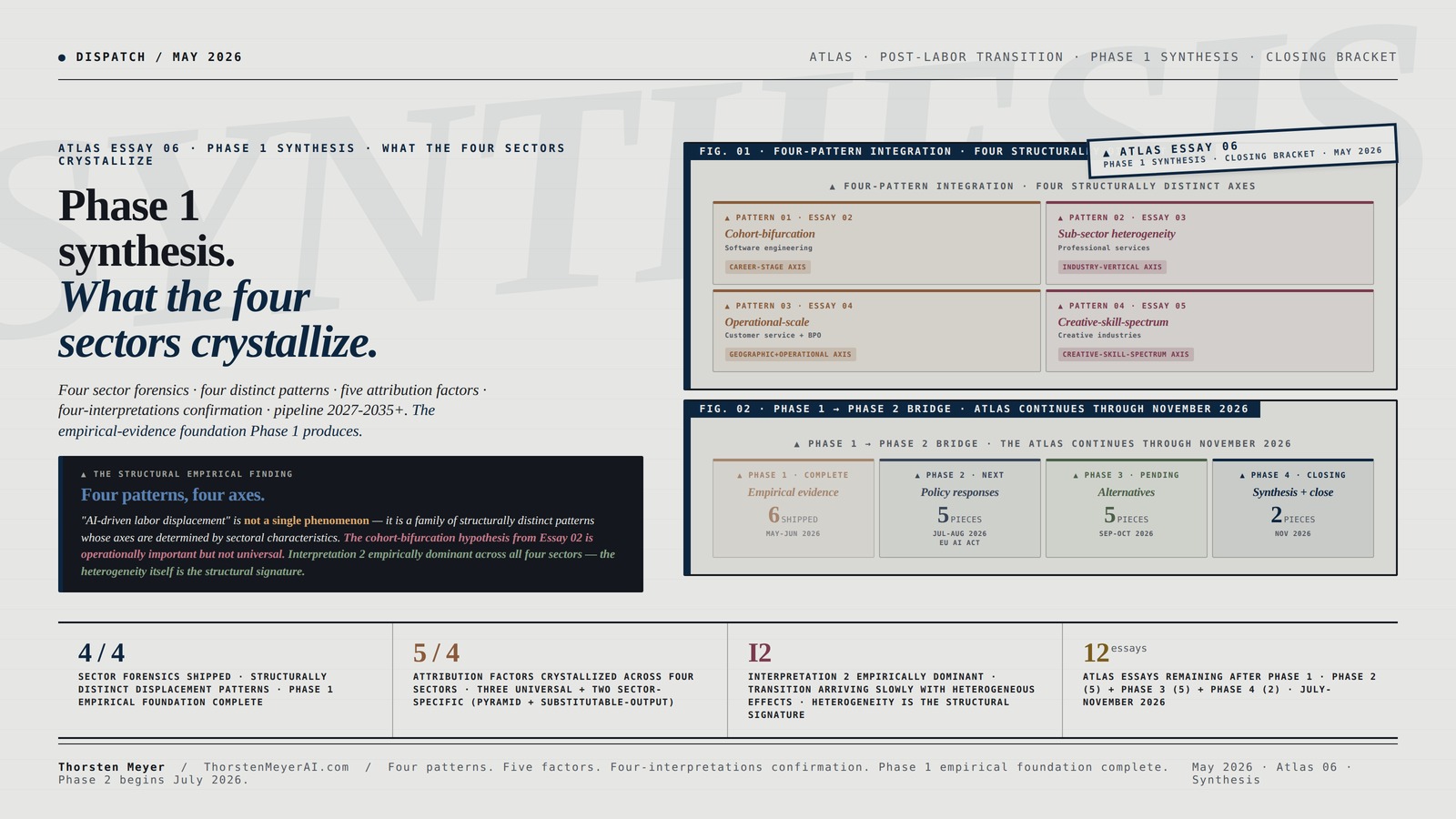

Four sector forensics shipped. Four structurally distinct displacement patterns identified. Five attribution factors crystallized. The cohort-bifurcation hypothesis from Essay 02 is empirically important but not universal — Essays 04 and 05 produce structurally distinct patterns that the framework holds simultaneously. The “middle squeeze” pattern from Essay 05 establishes that “AI-driven labor displacement” operates across four structurally distinct axes determined by sectoral characteristics: career-stage axis (software engineering), industry-vertical axis (white-collar professional services), geographic + operational axis (customer service + BPO), creative-skill-spectrum axis (creative industries). Interpretation 2 from Essay 01’s framework (transition arriving slowly with heterogeneous effects) is empirically dominant across all four sector forensics — and the heterogeneity itself is the structural signature, not a deviation from it. This is what Phase 1 crystallizes. Phase 1’s empirical-evidence foundation is structurally complete. Phase 2 begins July-August 2026 with the jurisdictional policy-response essays operationally aligned with the August 2 EU AI Act enforcement window.
By Thorsten Meyer — May 2026
This is Atlas Essay 06 — the Phase 1 synthesis closing the empirical-evidence sector-forensic foundation of the Post-Labor Transition Atlas. Essay 01 established the four-dimension architecture, the six chromatic registers, and the four structural interpretations. Essays 02-05 produced four sector forensics across software engineering, white-collar professional services, customer service + BPO, and creative industries. Essay 06 crystallizes the integrative synthesis: what the four sectors collectively produce as Phase 1’s structural-empirical finding, before Phase 2 (jurisdictional policy responses · July-August 2026) begins.
The structural argument I want to make: Phase 1 of the Atlas has produced an empirical-evidence foundation that is structurally complete — four sector forensics, four distinct displacement patterns, five attribution factors, four-interpretations confirmation — and the cross-sector integrative finding is that “AI-driven labor displacement” is not a single phenomenon but a family of structurally distinct patterns whose axes are determined by sectoral characteristics. This is the analytical-discipline finding the Atlas framework crystallizes. Phase 1 is not the conclusion of the Atlas; it is the empirical-evidence foundation Phases 2-4 operate on. The synthesis essay closes Phase 1 by integrating what the four sectors crystallize and naming the structural bridge to Phase 2.
The headline integrative finding: Phase 1’s four sector forensics empirically confirm Interpretation 2 from Essay 01’s framework (transition arriving slowly with heterogeneous effects) — but the heterogeneity operates across four structurally distinct axes that the prior post-labor discourse has not crystallized. The heterogeneity itself is the structural signature. Software engineering’s cohort-bifurcation, professional services’ sub-sector heterogeneity, BPO’s operational-scale displacement, and creative industries’ middle-squeeze are not deviations from a single underlying pattern — they are four structurally distinct patterns produced by four structurally distinct sectoral characteristic profiles. Phase 1’s contribution to the post-labor economics discourse is the analytical-discipline framework that holds all four patterns simultaneously.
This essay walks the four-pattern integration (the structural-empirical foundation Phase 1 produces), the five-factor attribution synthesis (which factors are universal vs. sector-specific), the four-interpretations confirmation framework (which sectors privilege which interpretations), the cross-sector pipeline-horizon synthesis (2027-2029 + 2030-2035+ + 2028-2030 horizons integrated), the Phase 1 → Phase 2 bridge (the policy-response dimension Phase 2 will document), and the closing-bracket observations for the post-labor economics discourse.
Phase 1 synthesis.
What the four
sectors crystallize.
Four sector forensics shipped · four distinct displacement patterns · five attribution factors · four-interpretations confirmation · pipeline horizons 2027-2035+. The empirical-evidence foundation Phase 1 produces — and the structural bridge to Phase 2 (jurisdictional policy responses · July-August 2026).
This is Atlas Essay 06 — the integrative synthesis closing Phase 1’s empirical-evidence sector-forensic foundation before Phase 2 begins. Phase 1 has produced an empirical-evidence foundation that is structurally complete — and the cross-sector integrative finding is that “AI-driven labor displacement” is not a single phenomenon but a family of structurally distinct patterns whose axes are determined by sectoral characteristics. Pattern 1 cohort-bifurcation (Essay 02 · software engineering · career-stage axis). Pattern 2 sub-sector heterogeneity (Essay 03 · professional services · industry-vertical axis). Pattern 3 operational-scale displacement (Essay 04 · BPO · geographic+operational axis). Pattern 4 creative-skill-spectrum bifurcation (Essay 05 · creative industries · creative-skill-spectrum axis). Interpretation 2 from Essay 01 — transition arriving slowly with heterogeneous effects — is empirically dominant across all four sectors. The heterogeneity itself is the structural signature, not a deviation from it.
Four patterns. Four axes.
Phase 1’s four sector forensics produce empirical evidence for four structurally distinct displacement patterns operating across four structurally distinct axes determined by sectoral characteristics. This is what Phase 1 contributes to the post-labor economics discourse — the analytical-discipline framework that holds multiple patterns simultaneously.
axis
axis
operational axis
spectrum axis
![Free Fling File Transfer Software for Windows [PC Download]](https://m.media-amazon.com/images/I/41Vq6ZqHfjL._SL500_.jpg)
Free Fling File Transfer Software for Windows [PC Download]
- User-Friendly FTP Interface: Intuitive and easy to use
- Reliable Site Management: Simplifies FTP site maintenance
- Automation & Sync: Automates transfers and synchronization
As an affiliate, we earn on qualifying purchases.
As an affiliate, we earn on qualifying purchases.
Five factors. Sector-specific rigor.
The analytical-decomposition crystallization Phase 1 produces. Five attribution factors identified across four sectors — three universal plus two sector-specific. The Atlas framework operates on sector-specific attribution rigor rather than universal-displacement-driver claims.
services
As an affiliate, we earn on qualifying purchases.
Four interpretations. Phase 1 confirmation.
Essay 01 introduced four structural interpretations the framework holds simultaneously. Phase 1’s four sector forensics empirically test which interpretation each sector privileges. The cross-sector pattern crystallizes which interpretations are dominant in which sectoral contexts.
sectors
specific
sector
only

Acid Gas Detector by Forensics | USA NIST Calibration & Certificate | Dust & Explosion Proof | USB Recharge | Sound, Light and Vibration Alarms | 0-10 ppm |
- Gas Detection Range: 0-10 ppm for acidic gases
- Sensor Type: Electrochemical cell sensor
- Calibration: NIST calibration certificate included
As an affiliate, we earn on qualifying purchases.
As an affiliate, we earn on qualifying purchases.
Four horizons. 2027-2035+.
The temporal-integration crystallization Phase 1 produces. Pipeline problems across the four sectors operate on different horizons — but they share the structural mechanism of cohort-bifurcation second-order effects. The forward-looking landscape Phase 4 will integrate.
horizon
concentration
horizon
compression

Legacy Will Estate Planning Kit – AI-Guided Online Will Maker with Activation Code, Step-by-Step Estate Planning Guide, Create a Legal Will in Minutes
- Create a legal will from home: AI-guided online will maker
- Includes activation card and planning guide: Step-by-step estate planning assistance
- Secure online storage and updates: Download, store, and update documents
As an affiliate, we earn on qualifying purchases.
As an affiliate, we earn on qualifying purchases.
Bridge to Phase 2. July 2026.
The structural-discipline crystallization Phase 1 produces. Phase 1’s empirical-evidence foundation is structurally complete. Phase 2 begins July-August 2026 with the jurisdictional policy-response analysis operationally aligned with the August 2 EU AI Act enforcement window.
EU AI Act window
full closing bracket
Phase 1’s four sector forensics produce empirical evidence for four structurally distinct displacement patterns operating across four structurally distinct axes determined by sectoral characteristics. “AI-driven labor displacement” is not a single phenomenon — it is a family of patterns. The cohort-bifurcation hypothesis from Essay 02 is operationally important but not universal. Interpretation 2 — transition arriving slowly with heterogeneous effects — is empirically dominant across all four sectors. The heterogeneity itself is the structural signature, not a deviation from it. This is the analytical-discipline framework Phase 1 contributes to the post-labor economics discourse — and the empirical foundation Phases 2-4 operate on.
I · The four-pattern integration · Phase 1’s structural-empirical foundation
The integrative crystallization of what Phase 1 produces. Four sector forensics. Four structurally distinct displacement patterns. The pattern variation is not noise — it is the structural signature.
Pattern 1 · Cohort-bifurcation (Essay 02 · software engineering · career-stage axis)
The empirical signature: junior cohort displaced (~40% hiring drop · 15-20→2-3 cohort compression · 37% employers prefer AI over new grads) · senior cohort augmented (METR senior+codebase finding · Anthropic Economic Index 57/43 augmentation/automation · “one-person software factory” 5-10× productivity top 20%) · pipeline collapsing (2-5 year mid-level engineer gap forecast 2027-2029 · the second-order effect the discourse underweights).
The structural mechanism: within-sector cohort stratification operates on the career-stage axis. The displacement is determined by where in the training pyramid the cohort sits. Junior task floor raised by AI tools; senior task floor not yet substitutable. The cohort-bifurcation is the canonical empirical case the Atlas framework operates from.
Pattern 2 · Sub-sector heterogeneity (Essay 03 · white-collar professional services · industry-vertical axis)
The empirical signature: cohort-bifurcation pattern present but fragmented across four sub-sectors (Big 4 accounting clearest · -29% KPMG · -18% Deloitte · -11% EY · -6% PwC graduate intake) (investment banking compression · Goldman Sachs + Morgan Stanley AI testing 2/3 entry-level positions) (consulting fragmented · McKinsey +12% contra-signal against industry pattern) (legal lagging · NALP 93.4% + law-firm grads +13% 2023-2024 at aggregate level alongside firm-level restructuring).
The structural mechanism: cohort-bifurcation within sub-sector with intensity gradient determined by sub-sector dynamics. Pipeline horizon structurally longer (5-10 year partner-track gap 2030-2035+) reflecting the 5-8 year associate-to-partner training cycle. Pyramid-model pressure is the sector-specific fourth attribution factor.
Pattern 3 · Operational-scale displacement (Essay 04 · customer service + BPO · geographic + operational axis)
The empirical signature: geographic concentration (India 6M + Philippines 2M = 8M workers facing 2030 reckoning · IT-BPM 2028 targets requiring revision) · direct displacement signals (Oracle -12K + TCS -12K + India IT +17 net employees fiscal 2026) · workforce-wide horizontal pressure (not cohort-specific) · hybrid-model emergence from failure (Klarna canonical case: launch → scaling → reversal → hybrid equilibrium · “AI handles routine 60-75% + humans handle escalations”) · McKinsey 400M global by 2030 projection.
The structural mechanism: AI chatbot deployment at enterprise scale creates direct workforce displacement that is not cohort-specific (entry-level + experienced agents both face pressure) and not sub-sector-fragmented (all customer-service tier-1 functions face the same substitution). The displacement is horizontally distributed across the workforce within geographically-concentrated operations. The cohort-bifurcation hypothesis breaks down here.
Pattern 4 · Creative-skill-spectrum bifurcation (Essay 05 · creative industries · creative-skill-spectrum axis)
The empirical signature: graphic designer postings -33% in 2025 · AI-collaboration job postings +340% 2023-2024 · content production -28% same period · 90% content marketers planning AI 2026 · 73%/12% volume-vs-quality split · stock photo bimodal CTR distribution · -21% freelance opportunity slash. The “middle squeeze” — top-tier augments (brand strategy + art direction + AI-orchestration), commodity substitutes (stock photography + routine copy + template design), middle creative-professional tier compresses.
The structural mechanism: skill-tier within the same workforce determines outcome rather than career-stage cohort. A 12-year-experienced designer in routine commercial work faces the squeeze; a 12-year-experienced designer in brand-strategy positioning augments. Substitutable-output axis is the sector-specific fifth attribution factor.
The four-pattern integrative finding
Phase 1’s four sector forensics produce empirical evidence for four structurally distinct displacement patterns operating across four structurally distinct axes determined by sectoral characteristics:
- Sectors with stratified training pyramids (software engineering, professional services) produce cohort-bifurcation patterns with career-stage and industry-vertical variations
- Sectors with operational-scale workforces in specific geographies (customer service + BPO) produce geographic-concentration patterns with hybrid-model equilibrium emergence
- Sectors with substitutable-output spectrums (creative industries) produce skill-spectrum bifurcation patterns with the middle-squeeze structural signature
This is the structural-empirical foundation the Atlas framework’s Phase 1 produces. It is not a conclusion — it is the starting point Phases 2-4 operate from.
II · The five-factor attribution synthesis · universal vs. sector-specific
The analytical-decomposition crystallization Phase 1 produces. Five attribution factors identified across four sectors. Three universal · two sector-specific. The attribution-rigor framework operates sector-by-sector.
The three universal attribution factors
Factor 1 · Macroeconomic · 2023-2024 interest rate hikes + capital crunch + cost-cutting pressure. Empirically dominant in driving initial hiring freezes across all four sectors. Would have produced some hiring decline even without AI tool maturation.
Factor 2 · AI-tool maturation · operational substitutability crossed threshold in 2023-2025 with sector-specific tool stacks:
- Software engineering: GitHub Copilot · Cursor · Claude Code · Cody
- Professional services: Harvey · Casetext · Microsoft Copilot for audit · IndexGPT · KPMG Clara · PairD · ChatPwC · EY.ai
- Customer service + BPO: Klarna OpenAI · enterprise chatbot deployments · agent augmentation tools
- Creative industries: Midjourney · DALL-E · Adobe Firefly · Canva (44% market share) · Sora · Runway · Suno · DeepL · ChatGPT · Claude · Jasper
Factor 3 · Cohort-specific compounding · entry-level positions structurally most exposed to macroeconomic + AI-tool pressure simultaneously. The cohort-bifurcation amplifies the other factors. Operationally most visible in software engineering and professional services; structurally weaker in creative industries (skill-tier axis dominates) and customer service + BPO (workforce-wide horizontal pressure).
The two sector-specific attribution factors
Factor 4 · Pyramid-model pressure (Essay 03 · white-collar professional services-specific) · pre-existing structural erosion of the pyramid model (large junior cohorts billing routine work under senior supervision, generating leverage for partner compensation) under client efficiency pressure for over a decade. AI tools accelerate this existing pressure rather than initiating it. The structural mechanism that produces the 5-10 year partner-track pipeline horizon.
Factor 5 · Substitutable-output axis (Essay 05 · creative-industries-specific) · “good enough” threshold varies dramatically across creative-output spectrum. Low-threshold commodity work easily AI-achievable; high-threshold signature work requires creative judgment AI cannot reliably reproduce; middle-threshold commercial work faces reliability gaps that create the squeeze. The structural mechanism that produces the middle-squeeze pattern.
The attribution-synthesis observation
Five factors across four sectors crystallize the analytical-discipline finding: the Atlas framework operates on sector-specific attribution rigor rather than universal-displacement-driver claims. Each sector has its own attribution profile — three universal factors plus zero, one, or two sector-specific factors depending on sectoral characteristics. This is structurally consequential for Phase 2’s policy-response analysis — policy responses that address universal factors (macroeconomic stabilization, AI-tool regulation) operate differently from policy responses that address sector-specific factors (pyramid-model reform in professional services, substitutable-output minimum-wage frameworks in creative industries).
III · The four-interpretations confirmation · which sectors privilege which interpretations
The framework-confirmation crystallization Phase 1 produces. Essay 01 introduced four structural interpretations the framework holds simultaneously. Phase 1’s four sector forensics empirically test which interpretation each sector privileges — and the cross-sector pattern crystallizes which interpretations are dominant.
Interpretation 2 · transition arriving slowly with heterogeneous effects · empirically dominant
Empirically dominant across all four sector forensics. Software engineering’s cohort-bifurcation is the canonical heterogeneity signature. Professional services’ sub-sector heterogeneity is heterogeneity-across-verticals. BPO’s operational-scale displacement is heterogeneity-across-geographies. Creative industries’ middle-squeeze is heterogeneity-across-skill-tiers. The heterogeneity itself is the structural signature of Interpretation 2 across all four sectors.
Interpretation 1 · transition not arriving at scale · partial fit in some sectors
Partially confirmed at aggregate-sector level. Software engineering aggregate employment is not collapsing (junior cohort displaced but overall sector employment rising). Legal sub-sector NALP 93.4% law-school employment rate is the most prominent aggregate-no-displacement signal. But the cohort-specific and tier-specific displacement evidence in every sector is substantial — Interpretation 1 does not hold cleanly at any disaggregated level.
Interpretation 3 · transition arriving fast with structural alternatives unrecognized · strongest in BPO
Empirically strongest in customer service + BPO. The 8M workers facing 2030 reckoning + Oracle -12K + TCS -12K + India IT +17-net-employees + IT-BPM 2028 targets requiring revision + McKinsey 400M global projection collectively support fast-arriving transition framing. The structural alternatives (UBI · automation tax · broad-based capital ownership · platform cooperatives) are not yet operationally deployed at scale in the affected geographies. Phase 3 (structural alternatives) will document the policy mechanisms that address this interpretation.
Interpretation 4 · transition arriving fast with structural alternatives operationally available · partially supported
Partially supported across multiple sectors. Klarna’s hybrid-model equilibrium emergence (Essay 04) is operationally-available alternative-to-full-replacement. Creative platform cooperatives (Stocksy United) operationally tested but not at scale. Nordic social-protection framework · Finland UBI experiment retrospective · Gulf states sovereign-wealth model · Argentine Jefes y Jefas program operationally tested in adjacent contexts but not at scale in the affected sectors. Phase 3 will document which structural alternatives operate at scale.
The four-interpretations integrative observation
Phase 1’s cross-sector pattern crystallizes Interpretation 2 as empirically dominant — the post-labor transition is arriving slowly with heterogeneous effects across four structurally distinct axes. Interpretation 3 is empirically strongest in customer service + BPO specifically, where the displacement is most operationally concentrated and the structural alternatives are not yet at scale. Interpretation 4 has operational-credibility support across multiple sectors but not deployment-at-scale support. Interpretation 1 is the partially-confirmed-at-aggregate-level interpretation that the public discourse should not dismiss but should also not over-rely on.
The Atlas framework holds all four interpretations simultaneously — and Phase 1’s empirical evidence supports the editorial-discipline framing the framework operates on. The post-labor economics discourse benefits from the framework’s analytical rigor: holding multiple interpretations + multiple patterns + multiple attribution factors simultaneously is what makes the empirical-evidence base genuinely usable.
IV · The cross-sector pipeline-horizon synthesis · 2027 → 2035+
The temporal-integration crystallization Phase 1 produces. The pipeline problems across the four sectors operate on different horizons — but they share the structural mechanism of cohort-bifurcation second-order effects.
The horizon-by-sector synthesis
- Software engineering · 2-5 year mid-level engineer gap · 2027-2029 peak crisis · cohort-bifurcation second-order effect from junior hiring contraction 2024-2026
- Professional services · 5-10 year partner-track / equity-track gap · 2030-2035+ horizon · pyramid-model erosion accelerating · longer cycle reflects 5-8 year associate-to-partner training
- Customer service + BPO · 2028-2030 reckoning · IT-BPM 2028 targets requiring revision · McKinsey 400M global by 2030 · structural workforce-wide pressure with geographic concentration
- Creative industries · ongoing structural compression · middle-tier reskilling timeline 2-4 years · platform-cooperative emergence horizon uncertain
The integrative observation
All four sectors face structural second-order effects that the Atlas framework’s Phase 1 crystallizes as the forward-looking finding. The cohort-bifurcation second-order effect (juniors not hired today = mid-levels missing tomorrow) operates on different time horizons by sector but produces structurally similar consequences: pipeline gaps, reskilling pressures, training-system reconfiguration requirements. This is what Phase 4 (synthesis + closing bracket) will integrate as the forward-looking landscape across the four sectors.
The structural-policy implication
The pipeline-horizon synthesis is structurally consequential for Phase 2’s policy-response analysis. Policy responses operationally aligned with the cohort-bifurcation timing (workforce-development frameworks · reskilling programs · training-system reform) need to be timed to the sector-specific horizons. The US response, EU response, Nordic response, UK response, Asian response, Gulf states response operate on different policy-tool sets — and Phase 2 will document which jurisdictions are operationally aligned with which sector horizons.
V · The Phase 1 → Phase 2 bridge · what comes next
The structural-discipline crystallization Phase 1 produces. Phase 1’s empirical-evidence foundation is structurally complete. Phase 2 begins July-August 2026 with the jurisdictional policy-response analysis operationally aligned with the August 2 EU AI Act enforcement window.
What Phase 2 covers
Phase 2 · Policy responses · five jurisdictional essays + Phase 2 synthesis · July-August 2026:
- Essay 07 · The US response · bipartisan workforce-development framing · state-level UBI experiments · federal AI workforce framework · the absence of broad-based capital-ownership policy
- Essay 08 · The EU response · EU AI Act + Digital Markets Act labor provisions · German Kurzarbeit + Bürgergeld · French universal-income experiments · Spain Ingreso Mínimo Vital · European social-protection framework as structural baseline · operationally aligned with August 2 enforcement window
- Essay 09 · The Nordic + UK response empirical update · Finland UBI experiment retrospective · Sweden + Denmark + Norway social-protection frameworks · Labour government framework · AI workforce strategy · post-Brexit labor-market dynamics
- Essay 10 · The Asian response divergence · Japan automation-positive framework · South Korea chaebol labor adjustment · Singapore SkillsFuture · China social-credit + labor management · structural differences from Western responses
- Essay 11 · The Gulf states sovereign-wealth model · UAE + Saudi Arabia + Qatar · structural alternative where capital ownership is already concentrated and distributed via sovereign wealth · plus Phase 2 synthesis
What Phase 1 does not yet cover (Phases 3-4)
Phase 3 · Structural alternatives · five theoretical-framework essays · September-October 2026:
- Broad-based capital ownership · sovereign wealth funds · employee stock ownership plans · citizen dividends · land value taxation · automation tax + UBI hybrid models
- Platform-cooperative alternative · Stocksy United · Mondragon · structural differences from VC platform extraction · scale question
- Taxation-reform landscape · automation tax · wealth tax · land value taxation · political-economy reality
- Shorter working week movement · Iceland 4-day week trial retrospective · UK 4-Day Week Foundation data · productivity-gains-to-working-hours-reduction relationship
- Job-guarantee alternative · MMT framework · Pavlina Tcherneva · Argentina Jefes y Jefas program · structural relationship to UBI · plus Phase 3 synthesis
Phase 4 · Synthesis + closing bracket · two essays · November 2026:
- Post-labor economics synthesis · the theoretical framework crystallized · broad-based capital ownership + market mechanisms + AI-driven productivity gains as the policy response to automation
- Closing-bracket retrospective · what the Atlas covers and what comes next · structurally parallel to Essay 11 (Saturation) of the European sovereign-LLM track
The structural bridge
Phase 1 → Phase 2 operates on this structural bridge: the empirical-evidence foundation (four patterns + five attribution factors + four-interpretations confirmation) is what Phase 2’s jurisdictional policy-response analysis builds upon. The post-labor transition’s structural pressure is empirically real, operationally heterogeneous, and structurally bounded across the four sectors documented. Phase 2 documents how different jurisdictions are operationally responding to this empirical reality.
VI · The closing argument · what Phase 1 crystallizes for the post-labor economics discourse
The integrative observation Phase 1 produces. The Post-Labor Transition Atlas is the empirically-grounded structural framework that holds the four-pattern integration + five-factor attribution + four-interpretations confirmation across the four sector forensics — and that is what Phase 1 contributes to the post-labor economics discourse.
The Phase 1 contribution crystallized:
- “AI-driven labor displacement” is not a single phenomenon. It is a family of structurally distinct patterns whose axes are determined by sectoral characteristics. The Atlas framework’s Phase 1 empirically establishes this finding across four sector forensics.
- The cohort-bifurcation hypothesis from Essay 02 is operationally important but not universal. It applies cleanly in sectors with stratified training pyramids (software engineering, professional services). It does not apply cleanly in sectors with operational-scale workforces (BPO) or substitutable-output spectrums (creative industries).
- The attribution-rigor framework operates sector-by-sector. Three universal factors (macroeconomic + AI-tool maturation + cohort-specific compounding) plus zero, one, or two sector-specific factors (pyramid-model pressure · substitutable-output axis) depending on sectoral characteristics.
- Interpretation 2 from Essay 01’s framework is empirically dominant across all four sector forensics. The transition is arriving slowly with heterogeneous effects — and the heterogeneity itself is the structural signature, not a deviation from it.
- The pipeline-horizon synthesis spans 2027-2035+ across the four sectors. The cohort-bifurcation second-order effects operate on different time horizons by sector but produce structurally similar consequences. The forward-looking landscape Phase 4 will integrate.
- Phase 1’s empirical-evidence foundation is structurally complete. Phase 2 (July-August 2026 · jurisdictional policy responses · aligned with August 2 EU AI Act enforcement) operates from this foundation. Phase 3 (September-October 2026 · structural alternatives) extends the framework. Phase 4 (November 2026 · synthesis + closing bracket) crystallizes the integrative observation.
For the post-labor economics discourse specifically:
The Phase 1 contribution is the analytical-discipline framework that holds multiple displacement patterns + multiple attribution factors + multiple structural interpretations simultaneously. The post-labor economics discourse has tended toward either AI-utopian framing (transition arriving at scale producing broad productivity gains) or AI-doomerist framing (mass unemployment imminent across all sectors). Phase 1’s empirical evidence supports neither framing cleanly — but it does support the analytical-discipline framework that holds the heterogeneity as the structural signature.
The structural-empirical finding from Phase 1: AI-driven labor displacement as of mid-2026 is real and substantial in specific sectoral patterns; the patterns vary structurally across sectors; the attribution decomposition is sector-specific; the policy implications operate on multiple jurisdictional dimensions Phase 2 will document; the structural alternatives exist at operational-test scale but not deployment-at-scale Phase 3 will document; the synthesis framework Phase 4 will integrate is the post-labor economics theoretical-framework crystallization the discourse needs.
For Thorsten’s post-labor economics thesis specifically:
The Atlas framework’s Phase 1 produces the empirical foundation for the broader thesis that broad-based capital ownership + market mechanisms + AI-driven productivity gains is the structurally credible policy response to automation. The Phase 1 evidence does not prove this thesis — it crystallizes the empirical landscape the thesis operates against. Phase 2 will document which jurisdictions are operationally aligned with thesis-adjacent policy frameworks. Phase 3 will document which structural alternatives are operationally tested. Phase 4 will integrate the synthesis framework. The Atlas is the empirically-grounded structural framework the thesis needs — not the proof of the thesis.
That’s the read on Phase 1 of the Post-Labor Transition Atlas as the empirical-evidence foundation crystallized as of mid-May 2026 — twelve weeks before the August 2 EU AI Act enforcement window opens and approximately six months before the Phase 4 synthesis-bracket retrospective ships in November 2026. The work is real across the four sector forensics. Software engineering’s cohort-bifurcation is empirically rigorous. Professional services’ sub-sector heterogeneity is empirically robust. BPO’s operational-scale displacement is operationally documented in the Klarna canonical case. Creative industries’ middle squeeze is empirically supported across five sub-fields. All four patterns are structurally distinct manifestations of the same underlying phenomenon — and the Atlas framework’s Phase 1 crystallizes this analytical-discipline finding.
The empirical-evidence foundation is complete. Six pieces shipped. Twenty-four deliverables produced. The framework operates on the editorial discipline of holding four patterns + five factors + four interpretations simultaneously. Phase 2 begins July 2026 with the jurisdictional policy-response dimension Phase 1 sets up. The Post-Labor Transition Atlas continues across the post-labor transition’s operational landscape through November 2026 — the empirically-grounded structural framework the post-labor economics discourse needs, and that the Atlas framework crystallizes.
About the Author
Thorsten Meyer is a Munich-based futurist, post-labor economist, and recipient of OpenAI’s 10 Billion Token Award. He spent two decades managing €1B+ portfolios in enterprise ICT before deciding that writing about the transition was more useful than managing quarterly slides through it. More at ThorstenMeyerAI.com.
Related Reading · the Post-Labor Transition Atlas
Phase 1 · empirical-evidence foundation (complete)
- Atlas Essay 01 · The Atlas opening · what the framework is · four-dimension architecture · six chromatic registers · four structural interpretations · synthesis-deep register
- Atlas Essay 02 · Software engineering · the canonical case · Pattern 1 cohort-bifurcation · career-stage axis · empirical-clay register
- Atlas Essay 03 · White-collar professional services · the Tier 1 displacement · Pattern 2 sub-sector heterogeneity · industry-vertical axis · labor-rose register
- Atlas Essay 04 · Customer service + BPO · the operational-scale displacement · Pattern 3 operational-scale · geographic+operational axis · empirical-clay register
- Atlas Essay 05 · Creative industries · the bifurcated reality · Pattern 4 creative-skill-spectrum · creative-skill-spectrum axis · labor-rose register
- This piece · Atlas Essay 06 · Phase 1 synthesis · what the four sectors crystallize · synthesis-deep register
Phase 2 · forthcoming · jurisdictional policy responses · July-August 2026
- Forthcoming · Atlas Essay 07 · The US response · workforce-development framing · structural-slate register
- Forthcoming · Atlas Essay 08 · The EU response · EU AI Act + social-protection framework · structural-slate register
- Forthcoming · Atlas Essay 09 · The Nordic + UK response · structural-slate register
- Forthcoming · Atlas Essay 10 · The Asian response divergence · structural-slate register
- Forthcoming · Atlas Essay 11 · The Gulf states sovereign-wealth model + Phase 2 synthesis · synthesis-deep register
Phase 3 · forthcoming · structural alternatives · September-October 2026
- Forthcoming · Atlas Essays 12-16 · structural alternatives deep-dives + Phase 3 synthesis · alternative-sage + synthesis-deep registers
Phase 4 · forthcoming · integrative synthesis + closing bracket · November 2026
- Forthcoming · Atlas Essays 17-18 · post-labor economics synthesis + closing bracket · synthesis-deep register
Sources
Phase 1 sector-forensic source dossier · integrated across Essays 02-05
Software engineering empirical base (Essay 02):
- Final Round AI · 40% junior hiring drop · Heather Doshay SignalFire NYT quote
- Second Talent · 20-35% global junior + QA decline · top-15 tech -25% 2023→2024
- Lycore · pipeline 2-5 years · 2027-2029 mid-level gap forecast
- SolidAITech · 15-20 → 2-3 juniors per cohort compression
- CodeConductor · Salesforce Marc Benioff no-new-engineers framing
- BDTechJobs · Anthropic Economic Index 57/43 · METR senior+codebase finding
- Frontier Wisdom · macroeconomic attribution analysis
- Frontend Highlights · 5-10× productivity top 20% · one-person software factory
- Anthropic Economic Index · millions of Claude conversations · 57% augmentation / 43% automation
- METR study · senior+codebase > AI for deep work
- Goldman Sachs · 20-30yo tech-exposed +3pp unemployment since early 2025
White-collar professional services empirical base (Essay 03):
- Accountancy Age · Big 4 graduate intake reductions · KPMG -29% · Deloitte -18% · EY -11% · PwC -6%
- The Agency Recruiting · SF firm 27% staffing-cost drop · paralegal 1.9% unemployment
- Global Law Lists · 44% firms need AI expertise · 39% algorithm transparency concern
- Artificial Lawyer · pyramid model erosion · 2026 predictions
- Paralegal Edu · BLS 0% paralegal growth 2024-2034 · 39,300 annual openings · 367,220 employed
- MIT Technology Review · NALP 93.4% law-school grads employed · law firm grads +13% 2023-2024
- V7 Labs · pyramid model under pressure
- HazenTech · BLS 0% paralegal growth · “quantity goes down, skill depth goes up”
- Wall Street Oasis · “compression not extinction” insider framing
- CIO.com · Goldman + Morgan Stanley 2/3 entry-level analyst AI testing · NYT report
- Boston Institute of Analytics · investment banking 2026 transformation
- Whitehat SEO · JPMorgan + Goldman + HSBC + Barclays AI deployment
- American Banker · 2026 AI Talent Shift survey · 1/3 big banks forecasting layoffs
- Bloomberg Businessweek · May 2026 issue · Princeton-graduate “entry-level roles obsolete” quote
- Web Pro News · McKinsey +12% North America hiring 2026 · Eric Kutcher framing
- Road to Offer · Big 4 scale · 1.5M professionals · $220B+ combined revenue
Customer service + BPO empirical base (Essay 04):
- Storyantra · 8 million workers India + Philippines 2030 reckoning · IT-BPM 2028 targets requiring revision
- Outsource Accelerator · Oracle -12K + TCS -12K · India IT +17 net employees fiscal 2026
- PS Engage · 67% Philippine BPO companies implementing AI · IBPAP 135,000 jobs added 2024
- Outsource Philippines · BPO market exceeds $400B 2026
- Staple.ai · McKinsey 400M global displacement by 2030
- Klarna International press release · February 2024 launch · 2.3M chats · 700 agents equivalent
- Fini Labs · Klarna 4-5 large global partners · 650,000+ employees collectively
- Twig · 82% resolution time drop · 2025 walk-back · three failure modes
- CBS News · Siemiatkowski interview · 3,000 → 2,000 outsourced agents
- CX Dive · Klarna AI tune change · February 2026 · pivot to hybrid
- AI Business · “didn’t fire 700 people · proved they were unnecessary” framing
- Digital Applied · canonical 2026 cautionary tale framing · three failure modes
- CX Today · staff redeployment from marketing/engineering/legal to customer service · EU AI Act August 2026
- PITON-Global · 60-75% routine inquiries autonomous · 85-92% Filipino agent first-contact augmented
- Unity Connect · three structural reasons AI doesn’t fully replace
- SuperStaff · hybrid model · emerging roles
Creative industries empirical base (Essay 05):
- Risk Quiz · -33% graphic design postings 2025 · Canva 44% · designer 31% vs developer 59% AI adoption
- Upwork · designer community perspective · human-made design as sought-after
- We and The Color · Envato 2026 (1,780 creatives) · “tweak the AI output” race-to-the-bottom
- Filthy Rich Writer · JPMorgan + Persado 5-year deal
- Click Forest · 90% content marketers AI 2026 · 73%/12% HubSpot split
- SEOwind · Coca-Cola GPT platform · 40% time reduction
- Mustard and Moxie · Google penalty on AI content
- European Parliament study · Hartmann et al. 2025 · bimodal CTR distribution
- Brookings · Hui et al. 2024 Organization Science · pronounced LLM-aligned submarket displacement
- arXiv · Generate the Future of Work · Upwork dataset analysis
- Medium · AI freelance opportunity slash 21%
- Goldberg and Lam 2025 art platform finding
Phase 1 framework documentation sources (Essay 01)
- Frontiers in Human Dynamics · May 2026 PRISMA systematic review · 94 studies / 1,847 records
- Smart Humain · 55,000 US jobs · Goldman Sachs 300M FTE · ~0.5pp transition aggregate
- International Center for Law & Economics · Hartley et al. 35.9% US adoption
- The World Data · Goldman 20-30yo tech-exposed +3pp · WEF + SHRM + Brookings + BLS
- ALM Corp · WEF 350,000 emerging AI roles · Veritone Q1 2025 +25.2% YoY
- Innovative Human Capital · Massenkoff & McCrory 2026 · exposure-vs-displacement distinction
- Wiley · Ly 2026 · manufacturing/logistics 20-30% routine employment reduction
- Click Vision · sector-level data · cross-validated
Key Phase 1 reference figures crystallized
- Four sector forensics shipped · 24 deliverables · empirical-evidence foundation structurally complete
- Four distinct displacement patterns · cohort-bifurcation + sub-sector heterogeneity + operational-scale + creative-skill-spectrum
- Four structurally distinct axes · career-stage + industry-vertical + geographic+operational + creative-skill-spectrum
- Five attribution factors · macroeconomic + AI-tool maturation + cohort-specific compounding (3 universal) + pyramid-model + substitutable-output (2 sector-specific)
- Four structural interpretations confirmation · Interpretation 2 empirically dominant across all four sectors · Interpretation 3 strongest in BPO · Interpretations 1 + 4 partial fits
- Pipeline-horizon synthesis · software engineering 2027-2029 · BPO 2028-2030 · professional services 2030-2035+ · creative industries ongoing
- Phase 1 → Phase 2 bridge · July-August 2026 · jurisdictional policy responses · aligned with August 2 EU AI Act enforcement
- 18-essay Atlas scope · Phase 1 (6) shipped · Phase 2 (5) Jul-Aug · Phase 3 (5) Sep-Oct · Phase 4 (2) Nov 2026
- The post-labor economics discourse contribution · analytical-discipline framework holding multiple patterns + factors + interpretations simultaneously