
By Thorsten Meyer | ThorstenMeyerAI.com | February 2026
Executive Summary
The post-labor debate is stuck in a false binary. One side predicts mass unemployment. The other insists nothing fundamental changes. The stronger evidence supports a third view: uneven task automation, rapid organizational redesign, and redistribution institutions that lag both by years.

The World Economic Forum’s Future of Jobs Report 2025 projects 92 million jobs displaced by 2030 — and 170 million created. Net positive. But the net figure obscures the distributional problem: the displaced and the hired are rarely the same people, in the same places, with the same skills. That’s not a labor market adjusting. That’s a labor market fracturing along lines of geography, education, and institutional access.
The OECD’s income data makes the baseline clear: the average income of the richest 10% is 8.4 times that of the poorest 10% across OECD countries. US labor share of GDP has fallen from 67.8% to 58.4% between 1987 and 2019 — the smallest share since 1947. AI-exposed industries are now seeing 4x higher productivity growth than unexposed ones. Workers with AI skills command a 56% wage premium, up from 25% last year.
The strategic question isn’t whether jobs disappear. It’s whether the gains from AI-driven productivity accrue broadly enough to sustain demand, social stability, and political legitimacy — or concentrate narrowly enough to trigger the institutional failures that history says follow.
| Metric | Value |
|---|---|
| Jobs displaced by 2030 (WEF) | 92 million |
| Jobs created by 2030 (WEF) | 170 million |
| Job disruption by 2030 | 22% of jobs |
| OECD income ratio (top 10% / bottom 10%) | 8.4:1 |
| US labor share of GDP (2019) | 58.4% (down from 67.8%) |
| US labor share: lowest since | 1947 |
| AI wage premium | 56% (up from 25%) |
| Skills change rate (AI-exposed occupations) | 66% faster |
| Productivity growth (AI-exposed industries) | 4x higher |
| Workers needing reskilling by 2030 (WEF) | 59% of workforce |
| Employers planning upskilling | 85% |
| Workers at medium-term redundancy risk | 120 million |
| Workers recognizing AI skills critical | 54% |
| Workers actively training | 4% |
| AI training/certifications (2025) | 58 million globally |
| Skills gap economic risk (IDC) | $5.5 trillion |

AI Displaced Workers: Online AI Skills Courses & Certification Programs
As an affiliate, we earn on qualifying purchases.
As an affiliate, we earn on qualifying purchases.
1. Three Transition Channels That Matter Most
The post-labor transition isn’t one phenomenon. It’s three distinct channels operating simultaneously, each with different winners, losers, and policy implications.
Channel 1: Task Substitution
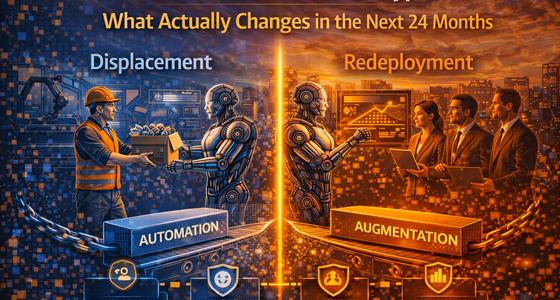
Routine cognitive tasks move to AI systems. Effect: job content changes first; headcount effects vary by sector and policy response.
The evidence is now granular enough to map. MIT research suggests 11.7% of current tasks are directly replaceable by AI at current capability levels. But task substitution doesn’t happen evenly. The WEF projects that 22% of jobs will experience disruption by 2030 — not elimination, but structural change in what the job requires.
The 2025 labor data is telling: the US added 584,000 jobs — versus 2 million in 2024. That’s not collapse, but it’s a sharp deceleration that coincides with the broadest AI deployment wave in history. The occupations most exposed aren’t the lowest-paid. They’re at the 80th percentile of earnings — knowledge workers, analysts, coordinators. The people who thought automation was someone else’s problem.
Channel 2: Task Augmentation
Workers with AI tools gain leverage and throughput. Effect: wage premiums rise for AI-complementary roles — and fall for everyone else.
PwC’s 2025 Global AI Jobs Barometer documents the augmentation premium with unusual precision: workers with AI skills earn 56% more than peers without them, up from 25% the prior year. That premium doubled in twelve months. Industries most exposed to AI are experiencing nearly 4x higher productivity growth — jumping from 7% to 27% since generative AI’s proliferation in 2022.
But the augmentation dividend isn’t distributed by effort. It’s distributed by access. Only 4% of workers are actively training in AI skills, despite 54% recognizing them as critical. That’s a 50-point action gap representing roughly $18,000 in annual opportunity cost per worker. The skills demanded by employers are changing 66% faster in AI-exposed occupations — and the training infrastructure isn’t keeping pace.
Channel 3: Organizational Consolidation
Firms redesign processes and reduce coordination layers. Effect: fewer middle-process roles; more demand for exception managers and domain integrators.
This is the channel that corporate planning documents acknowledge least and organizational redesign reveals most. When AI handles routing, triage, and first-pass analysis, the coordination roles that connected those functions lose their structural justification. The result isn’t mass layoffs — it’s role compression.
The evidence: 32.7% of companies that conducted AI-led layoffs have already rehired 25-50% of the roles they initially eliminated. Another 35.6% rehired more than half. The roles came back — but transformed. Less coordination, more exception handling. Less process management, more domain judgment.
| Channel | Mechanism | Who’s Affected | Metric |
|---|---|---|---|
| Task Substitution | Routine cognitive tasks → AI | Knowledge workers, 80th percentile earners | 22% jobs disrupted by 2030 |
| Task Augmentation | AI-equipped workers gain leverage | Those with/without AI skills | 56% wage premium; 4x productivity |
| Organizational Consolidation | Coordination layers compress | Middle-process roles | 33% of AI layoffs → rehired transformed |
“The post-labor transition isn’t about whether machines replace humans. It’s about which humans get the tools, the training, and the institutional support to remain on the productive side of the divide.”
AI-powered reskilling programs
As an affiliate, we earn on qualifying purchases.
As an affiliate, we earn on qualifying purchases.
2. Why Inequality Can Rise Even If GDP Rises
The aggregate numbers look fine. Global GDP continues to grow. AI investment is accelerating. Productivity in AI-exposed sectors is surging. But aggregate growth has never guaranteed inclusive distribution — and the current structural dynamics make divergence more likely than convergence.
The Labor Share Problem
US workers took home their smallest share of national income since 1947. Labor share — the fraction of GDP paid as wages — fell from 67.8% in 1987 to 58.4% in 2019, and the trend has accelerated. When productivity rises but labor share falls, the gains flow to capital owners, not workers. AI amplifies this dynamic because AI capital is unusually concentrated: a small number of firms control the foundational models, the compute infrastructure, and the data ecosystems.
The Wage Polarization Problem
The AI wage premium creates a paradox: workers who adopt AI tools earn significantly more, while those who don’t fall further behind. This isn’t the gradual skill premium of the IT revolution. The 56% wage premium doubled in a single year. Skills demand in AI-exposed occupations changes 66% faster. The result is a workforce splitting into two tiers at a speed that training systems weren’t designed to handle.
The Ownership Concentration Problem
AI productivity gains accrue disproportionately to firms that own the models and infrastructure. The top AI companies now capture margins that exceed those of the previous generation’s platform monopolies. When productivity gains concentrate in capital-heavy, labor-light firms, GDP rises while median wages stagnate — the defining economic pattern of the last two decades, now accelerating.
| Inequality Driver | Evidence | Direction |
|---|---|---|
| Labor share of GDP | 67.8% → 58.4% (US, 1987-2019) | Declining |
| OECD income ratio | 8.4:1 (top/bottom decile) | Persistent |
| AI wage premium | 56% (doubled in 12 months) | Widening |
| Skills change velocity | 66% faster in AI-exposed roles | Accelerating |
| AI capital concentration | Top firms capture outsized margins | Concentrating |
| Workers actively reskilling | 4% (vs. 54% who say it matters) | Lagging |
“GDP can rise while median purchasing power stalls. That’s not a forecast — it’s the last 20 years of data. AI at scale makes the divergence faster, not slower.”

The Women Who Founded RISD: "What a beginning is worth”: The Women’s Centennial Committee of Rhode Island and the Founding of RISD, 1875-1877 (The Ecology of Culture in Rhode Island)
As an affiliate, we earn on qualifying purchases.
As an affiliate, we earn on qualifying purchases.
3. What “Post-Labor Economics” Should Mean in Practice
The phrase “post-labor” is often dismissed as futurism. It shouldn’t be. Properly understood, post-labor economics isn’t about the end of work. It’s about the end of the assumption that wage employment is the primary mechanism for distributing economic gains. That assumption is already breaking — AI accelerates the break.
Four Architecture Requirements
For policy and enterprise planning, useful post-labor frameworks require four institutional architectures:
| Architecture | What It Addresses | Current Status |
|---|---|---|
| Income Architecture | Wages + transfers + new social insurance | Fragmentary; UBI pilots, gig-economy gaps |
| Work Architecture | Shorter hours, phased retirement, flexible credentials | Limited adoption; 4-day week trials emerging |
| Capability Architecture | Lifelong learning tied to real labor demand | 58M trained (2025); 120M at risk of missing out |
| Competition Architecture | Anti-concentration in compute/data ecosystems | Early-stage; EU DMA, pending US action |
Income Architecture: Beyond Wages Alone
The UK government is now actively weighing universal basic income. Minister for Investment Lord Jason Stockwood told the Financial Times in February 2026 that UBI may be necessary to “cushion the blow from AI-related job losses.” Ireland’s Basic Income for the Arts program — launched as a three-year pilot — becomes permanent in 2026.
Robot tax proposals range from 1% to 3.7% of automated labor value, but analysis shows that taxing robots at the same rate as replaced workers supplies a UBI amount of only 30% of the former wage. The funding math for universal programs remains unsolved. The policy momentum, however, is shifting from “whether” to “how.”
Capability Architecture: The Training Gap
The numbers expose the gap between rhetoric and reality:
| Training Indicator | Value |
|---|---|
| Workers receiving AI training (2025) | 58 million |
| Workers at medium-term redundancy risk | 120 million |
| LinkedIn Learning AI enrollment growth | +62% |
| Coursera AI-track enrollments | 14.2 million (>50% mid-career) |
| European AI retraining (YoY) | +39% |
| US government certifications for displaced | 120,000 funded |
| Companies: reskilling formally discussed | 44.9% (55.1% have not) |
| Employers planning upskilling by 2030 | 85% |
| WEF: global workforce needing training | 59% |
| Economic risk from skills gap (IDC) | $5.5 trillion |
85% of employers plan to prioritize workforce upskilling by 2030. But 55.1% of companies haven’t formally discussed reskilling and redeployment. The stated intent and operational reality are disconnected — and the 120 million workers at medium-term redundancy risk are living in the gap.
“85% of employers plan to upskill. 55% haven’t formally discussed it. The gap between planning and doing is where 120 million careers are at stake.”

Fundamentals of Generative AI: A Pathway to AI Certification
As an affiliate, we earn on qualifying purchases.
As an affiliate, we earn on qualifying purchases.
4. Enterprise Strategy Implications
Firms face two strategic errors in the post-labor transition:
- Treating workforce transition as a communications problem. Announcing “reskilling commitments” without building redeployment infrastructure. The data: 32.7% of companies that conducted AI layoffs rehired 25-50% of eliminated roles. Those that planned redeployment in advance preserved institutional knowledge and avoided the morale damage of unnecessary separation.
- Postponing redesign until regulation forces it. Colorado’s AI Act is effective. The EU AI Act’s workforce provisions are coming. OMB guidance on responsible AI includes workforce impact requirements. Waiting for regulatory compulsion means paying compliance costs without capturing early-mover advantages.
What Winning Firms Build
| Capability | What It Does | Why It Matters |
|---|---|---|
| Task-Level Workforce Planning | Maps automatable, augmentable, and judgment-critical tasks | Moves beyond job-title planning |
| Redeployment Pipelines | Internal mobility pathways for displaced roles | Preserves institutional knowledge; reduces rehiring costs |
| AI Wage Frameworks | Transparent pay structures for AI-augmented roles | Prevents hidden polarization within organizations |
| Distribution Dashboards | Tracks who gains from AI by level, function, region | Identifies concentration before it becomes systemic |
| Workforce Compacts | Reskilling targets, transition timelines, mobility guarantees | Aligns productivity gains with workforce stability |
The Demand-Side Risk
The enterprise risk that most AI strategies ignore: if AI-driven consolidation reduces purchasing power broadly enough, the demand assumptions that justify AI investment may fail. This isn’t theoretical. When 58.4% is the labor share of GDP — and declining — every productivity gain that doesn’t translate into broad wage growth is eroding the consumer base that makes the productivity worthwhile.
“Every enterprise AI strategy that models productivity gains without modeling demand effects is assuming someone else’s workforce will sustain the customer base. That assumption fails when everyone makes it simultaneously.”
5. Practical Implications and Actions
For Enterprise Leaders
1. Adopt task-level workforce planning. Stop planning by job title alone. Map automatable, augmentable, and judgment-critical tasks across every function. The firms that conducted AI layoffs and then rehired 25-50% of those roles learned this lesson expensively.
2. Tie AI productivity gains to workforce compacts. Include reskilling targets, transition timelines, and internal mobility guarantees. 85% of employers say they’ll upskill — make it contractual, not aspirational.
3. Publish distribution dashboards. Track who gains from AI inside the organization — by level, function, geography. If the 56% AI wage premium is creating a two-tier workforce internally, you need to see it before it becomes a retention crisis.
4. Build redeployment pipelines before you need them. The 55.1% of companies that haven’t formally discussed redeployment are building technical debt in their workforce strategy. Redeployment preserves institutional knowledge; severance destroys it.
5. Model demand-side effects. If your AI strategy assumes stable consumer demand while simultaneously reducing the labor share of value creation, stress-test that assumption.
For Public-Sector and Policy Leaders
6. Coordinate on portable benefits and social insurance. The gig economy exposed the gap; AI-driven project work will widen it. Workers moving between roles need benefits that move with them.
7. Update social insurance for intermittent work. Current systems assume continuous employment. AI-augmented work patterns — project-based, multi-employer, variable-hour — break that assumption.
8. Invest in capability architecture at scale. 58 million workers trained in 2025 against 120 million at medium-term risk. The gap is 62 million — and closing it requires public investment, not just employer intentions.
9. Take robot-tax and UBI design seriously. The policy window is opening: UK government weighing UBI, Ireland making basic income permanent. The funding models need work — taxing robots at the replaced-worker rate yields only 30% of former wages. But “the math doesn’t work yet” is different from “the concept is wrong.”
10. Build scenario plans for social risk. If broad purchasing power weakens, tax revenue projections, social program funding, and growth assumptions all need revision.
What to Watch Next
- Whether wage dispersion widens in early-adopting sectors and the 56% premium stabilizes or accelerates
- Whether countries update social insurance for intermittent and projectized work
- Whether capital-market pressure rewards “AI margin expansion” over “AI transition quality”
- Whether the 120 million workers at medium-term redundancy risk get the training systems they need or become the structural underclass of the AI economy
- Whether corporate redeployment pipelines become standard practice or remain the exception
The Bottom Line
The post-labor transition is already here — not as the dramatic job collapse that headlines predict, but as the quieter, more consequential shift in who captures value from work. 92 million displaced, 170 million created — but the mismatch between the two groups is where the political, social, and economic risk concentrates.
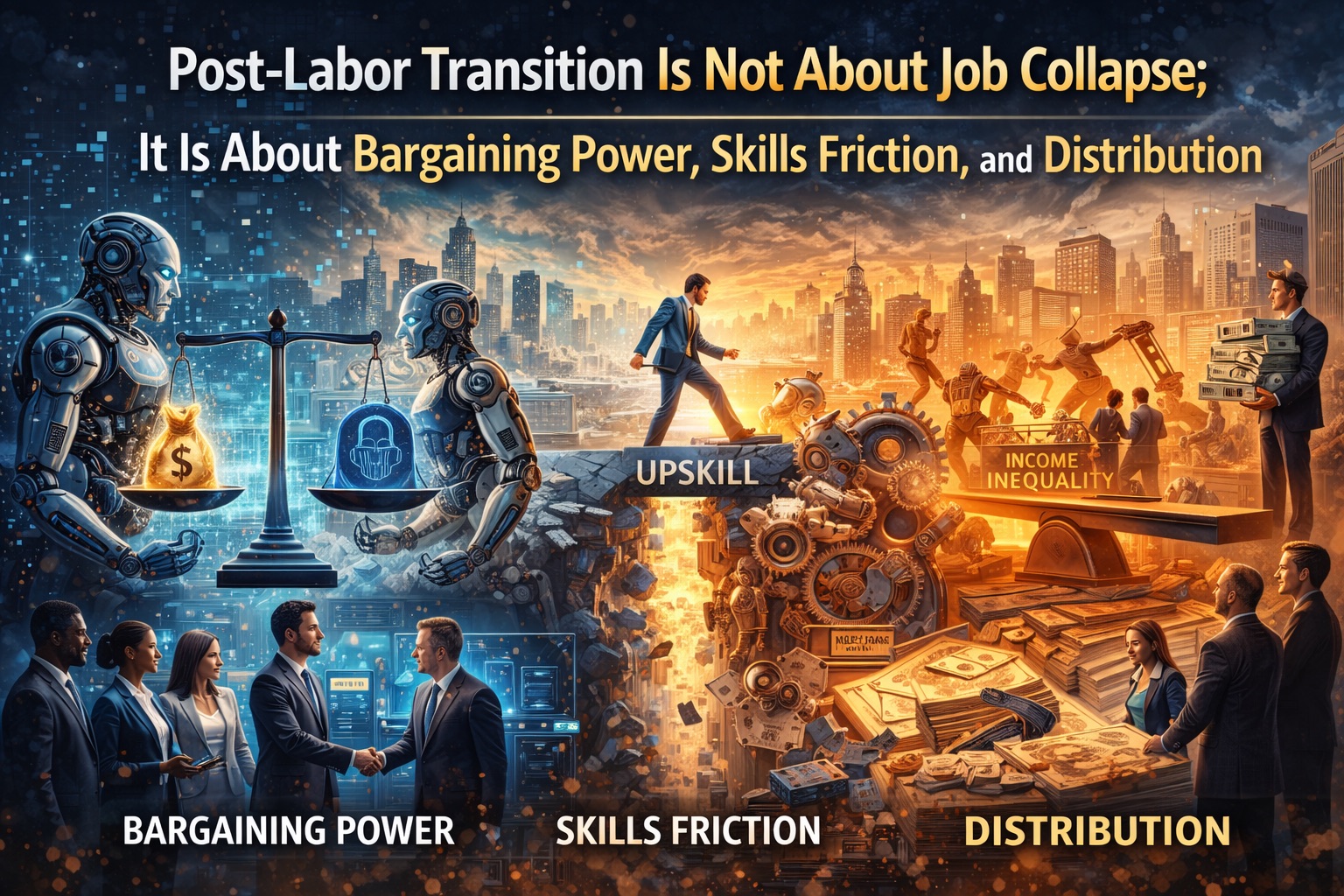
The binding variables aren’t technological. They’re institutional: bargaining power, training access, benefit portability, and the willingness of capital to share productivity gains with labor. The OECD’s 8.4:1 income ratio, the 56% AI wage premium, and the 58.4% labor share aren’t just data points. They’re the fault lines along which the next decade’s economic structure will form.
The post-labor question isn’t “will there be jobs?” There will be. The question is whether the jobs that remain distribute enough value to sustain the society that creates them — or whether we’re building an economy that’s productive, profitable, and politically unsustainable.
The economy doesn’t collapse when AI takes the routine work. It fractures when the gains from that work stop reaching the people who used to do it.
Thorsten Meyer is an AI strategy advisor who thinks the most revealing number in economics isn’t GDP growth — it’s the gap between productivity and median wages, and what happens to societies when that gap stops closing. More at ThorstenMeyerAI.com.
Sources:
- World Economic Forum — Future of Jobs Report 2025: 92M displaced, 170M created by 2030
- OECD — Income Inequality Data: 8.4:1 top/bottom decile ratio (2021)
- OECD — Society at a Glance 2024: Income and Wealth Inequalities
- Fortune — US Workers’ Smallest Labor Share Since 1947 (January 2026)
- David Autor et al. — Resolving the Automation Paradox: Falling Labor Share, Rising Wages (arXiv, January 2026)
- PwC — Global AI Jobs Barometer 2025: 56% Wage Premium, 4x Productivity Growth
- IDC — The $5.5 Trillion Skills Gap: AI Workforce Readiness
- IMF — New Skills and AI Reshaping the Future of Work (January 2026)
- IMF — The Global Impact of AI: Mind the Gap (April 2025)
- Yale Budget Lab — Evaluating AI’s Impact on the Labor Market (2025)
- Penn Wharton Budget Model — Projected Impact of Generative AI on Productivity
- Gloat — AI Workforce Trends 2026: Enterprise Reskilling and Internal Mobility
- LinkedIn Learning — 62% Growth in AI Enrollments (2025)
- Coursera — 14.2 Million AI-Track Enrollments (2025)
- Careerminds — AI-Led Layoffs: Rehiring Patterns (32.7% Rehired 25-50%)
- Fortune — UK Minister Weighs UBI for AI Displacement (February 2026)
- Ireland — Basic Income for the Arts: Permanent from 2026
- LSE Business Review — UBI as Social Contract for the Age of AI (2025)
- Tax Project Institute — Robot Tax and Universal High Income Models
- WEF — Reskilling Revolution: Preparing 1 Billion People (January 2026)
- Digital Cooperation Organization — AI Accelerated Workforce Transformation (2026)
- Workera/IDC — AI Workforce Readiness and the $5.5T Risk
- Colorado AI Act — Effective February 1, 2026
- EU AI Act — High-Risk Provisions: August 2, 2026
- OMB — Responsible AI Workforce Guidance (2025-2026)