

Get business pricing on tech for your team
- Business-only prices and quantity discounts
- Tax-exempt purchasing
- Multiple users, one account, clear invoices
Executive shock‑therapy
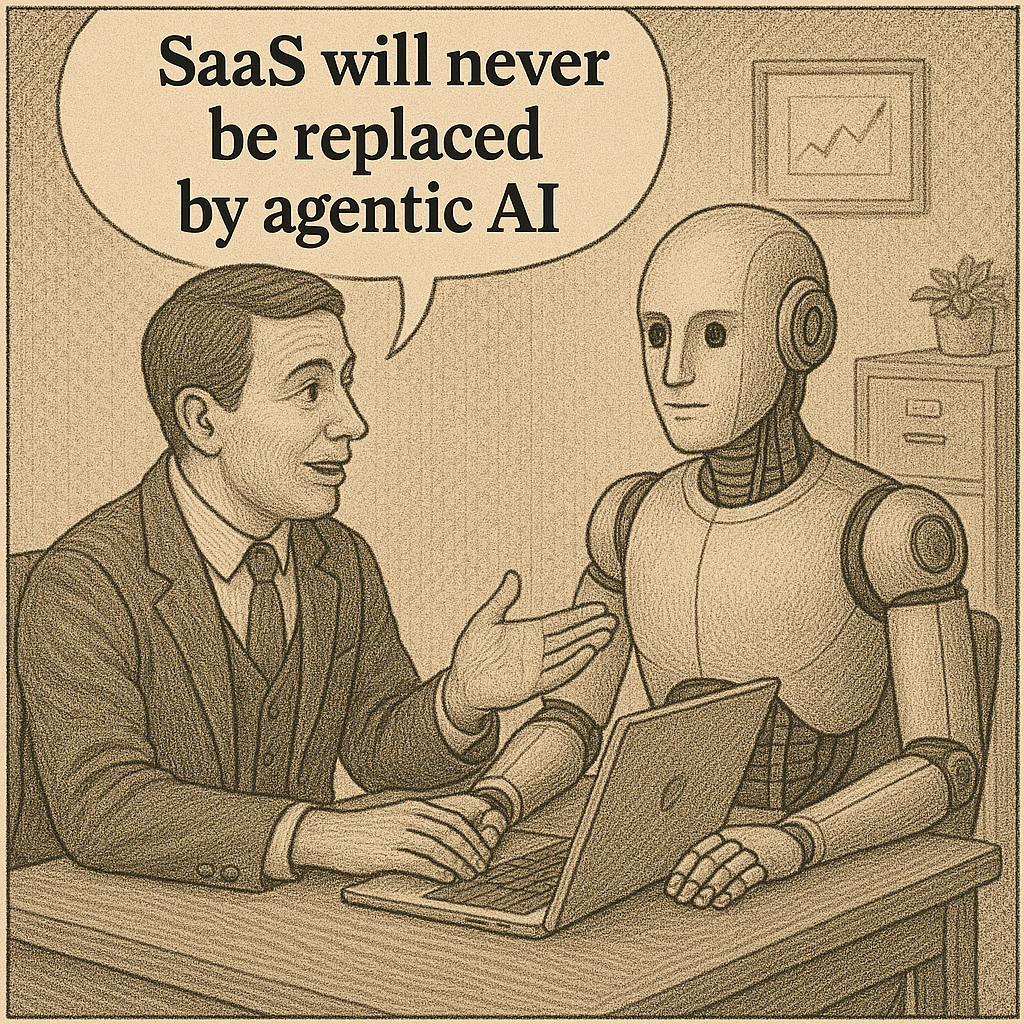
By 2030, one in every two applications that today dominate the B2B SaaS top‑50 will either be commoditised behind an agent layer, acquired for their data graphs, or exit the Fortune Cloud 100 altogether.
The trigger is agentic AI: autonomous software units that sense, reason, and act across multiple tools without a human in the loop. Three structural forces make this wave more violent than mobile or cloud:
- Zero‑UI access. Agents treat an app’s UI as a function call; the user never logs in.
- Outcome pricing. Salesforce has already published a $0.10 “per‑action” tariff for Agentforce , a model that obliterates per‑seat ARR economics.
- Fluid switching costs. Open‑source frameworks (LangChain 2.0, AutoGen, CrewAI) standardise tool invocation, so agents can swap underlying SaaS back‑ends in minutes .
As an affiliate, we earn on qualifying purchases.
2025‑2030 displacement timeline (aggressive scenario)
| Phase | Window | What happens | Casualties |
| Platform coup | 2025‑26 | ServiceNow, SAP and Microsoft position themselves as “AI OS” layers and expose agent marketplaces . | Point‑solution vendors lose expansion seats. |
| Overlay land‑grab | 2026‑28 | Adept ACT‑style agents automate workflows across vendor boundaries; buyers redirect budgets from SaaS seats to agent invocation credits. | Mid‑tier SaaS (Atlassian, Monday, HubSpot) face ≥ 35 % seat churn unless they shift to usage pricing. |
| Seat collapse | 2028‑30 | Boards demand outcome‑based SLAs; legacy UIs are de‑provisioned. Gartner predicts 33 % of enterprise apps embed agents and 15 % of decisions run fully autonomously . | We forecast 50 % of today’s top‑50 B2B apps fall below the Rule‑of‑40 as seat ARR implodes. |
As an affiliate, we earn on qualifying purchases.
Predicted winners & losers (brutally frank)
| Vendor (2024 rank) | Agentic fitness test* | 2030 seat‑loss risk | Aggressive prediction |
| ServiceNow | Native workflow engine + integration hub | <10 % | Survives; becomes “middleware OS” that taxes every agent execution. |
| Microsoft 365 / Dynamics | Azure + Copilot Studio = full stack | 15 % | Keeps incumbency but cedes some usage to OpenAI‑powered overlays. |
| Salesforce | Vast data cloud but UI‑heavy | 30 % | Converts ¼ of CRM seats to Agentforce actions; margins compress. |
| SAP | End‑to‑end processes, slow cloud move | 40 % | Retains core ERP, loses edge‑apps (travel, expenses) to agents. |
| Atlassian | Feature‑first, launching “Rovo” agents | 60 % | If usage pricing lags, 2029 revenue peak becomes secular decline despite FY25 AI marketing push . |
| Adobe | Creative UI moat vulnerable | 65 % | Generative design agents cannibalise Creative Cloud; Adobe shifts to asset‑licensing rather than seat licences. |
| Vertical point SaaS (legaltech, martech, EDM) | Narrow feature scope | 70 – 90 % | Most are abstracted away; the survivors expose APIs and get bundled into agent marketplaces. |
*Fitness test = data gravity × tool API richness × agent studio maturity.
As an affiliate, we earn on qualifying purchases.
Market mechanics behind the bloodletting
- Economic gravity flips: when Siemens saved US $ 2 m a year in IT by letting agents triage tickets before humans , CFOs noticed. Procurement now asks “why pay US$80/seat/month if 90 % of the work is done by agents?”
- Pricing inversion is already live: Salesforce’s $500 for 100 k “Flex Credits” (€0.10 per agent action) is a template buyers will weaponise against every other vendor .
- Data is the only moat: overlay agents need structured, governed data. Vendors without a robust data cloud will be interchangeable parts; those with it can charge “data gravity rent.”
- Talent drain accelerates decline: engineers flock to agent‑native companies; legacy vendors spend more on retention, eroding gross margin and starving R&D.
outcome-based SaaS pricing solutions
As an affiliate, we earn on qualifying purchases.
As an affiliate, we earn on qualifying purchases.
New entrants: where the next $100 B of value emerges
| Arena | Greenfield TAM by 2030 | Example plays |
| Agent orchestration hubs | $25 B | Adept, Rewind, Autogen Cloud—own the intent layer, auction tasks to cheapest SaaS backend. |
| Micro‑vertical co‑pilots | $20 B | Agents for lab compliance, maritime chartering, agri‑chem audits—markets too small for legacy SaaS but perfect for domain LLMs. |
| Outcome‑as‑a‑Service brokers | $15 B | Logistics‑cost arbitrage agents that guarantee savings and take a revenue‑share. |
| Autonomous BPO replacements | $40 B | Finance‑shared‑service agents that replace offshore invoice hubs. |
Survival playbook for incumbents (no half measures)
| Immediate (‑6 months) | 2026 Goal | 2028 Goal |
| Cannibalise yourself: publish an internal pay‑per‑API SKU cheaper than your seat price. | Full agent studio & marketplace: third parties must be able to build, deploy and monetise agents on your data fabric. | Outcome contracts: price at % of cost saved / revenue created. If you’re still charging per seat in 2028, assume −30 % valuation. |
| Audit data lineage; publish granular scopes & consent APIs. | De‑risk with guardrails, rollback, audit logs. | Embed multi‑vendor orchestration—even competitors—before an overlay does it for you. |
Key leading indicators to watch
- Ratio of agent invocations to human UI sessions per customer.
- % of revenue on usage or outcome‑based SKUs (track Salesforce, ServiceNow quarterly reports).
- Gross‑margin shift caused by GPU inference costs vs. seat support costs.
- Ecosystem talent flow: GitHub stars and job postings for LangChain/AutoGen vs. proprietary SDKs.
Bottom line
The agentic AI wave will not be a gentle enhancement to today’s SaaS model; it will crater seat‑based economics and reorder the vendor leaderboard within five years. Incumbents that refuse to cannibalise their own licences and expose open agent APIs will watch overlays siphon their users, relegating them to low‑margin infrastructure. Conversely, founders who build for the intent layer—owning the orchestration rather than the UI—have a once‑in‑a‑decade chance to create the next ServiceNow or even the next Microsoft.
These forecasts are deliberately aggressive to illustrate the scale of disruption and should not be interpreted as investment advice.
Halloween Picks
halloween
As an affiliate, we earn on qualifying purchases.