By Thorsten Meyer | November 15, 2026 | ThorstenMeyerAI.com

Get business pricing on tech for your team
- Business-only prices and quantity discounts
- Tax-exempt purchasing
- Multiple users, one account, clear invoices
Key takeaways
- What it is: Claude Meetings, an Anthropic beta announced on November 12, 2026, lets you add Claude to a Google Meet call “as a visible participant”. According to Anthropic’s Help Center, it “takes the notes, answers questions, and builds artifacts, such as docs, whiteboards, and slides, live during the call”.
- Who gets it: Team and Enterprise plans, in Claude and Claude Desktop. Google Meet only for now; Anthropic says support for other platforms “is coming soon”. During the beta it is not available to some organizations, including those with zero data retention, HIPAA-ready configuration or customer-managed encryption keys.
- The defaults differ by plan: on Team plans the feature is on by default and calls with outside guests are allowed by default. On Enterprise plans it stays off until an owner turns it on, and it is limited to internal meetings by default.
- What it keeps: a transcript, a summary and screen descriptions, “not audio”. It shows up as a participant and posts a notice in the call’s chat. Getting everyone’s agreement is left to the user: “make sure everyone on your call is okay with being transcribed.”
- What it costs: notes, transcripts and answers are included in Team and Enterprise plans. Docs and whiteboards made in a meeting are free through February 10, 2027. Anything that uses your connected tools counts toward usage.
- What is open: Anthropic’s Meetings pages give no retention period for meeting records, no price after February 10, 2027 and no date for other platforms. A Gartner report quoted by Computerworld calls it “a beta entrant in a mature market”.
Claude Meetings · beta since Nov 12, 2026
What happens when Claude joins your call
One video call with Claude as a participant, in six steps: how it gets in, what it hears, what it makes, and where the results go, as Anthropic describes it.
The call (schematic)
Step by step
- AddedSomeone adds Claude from the calendar, or has auto-join on. It joins as a visible participant and posts a notice in the chat.
- ListensIt follows the call and keeps a live transcript on a meeting page. It saves text, not audio.
- Builds“Claude, make a doc”: docs, whiteboards and slides appear on the meeting page. Answers go to the Meet chat, visible to everyone.
- ActsConnected tools, like a Slack message, only with each person’s permission. A yes applies going forward.
- GuestsIf outside guests are not allowed, Claude leaves when one joins. If allowed, it takes notes but does not reply in chat.
- AfterNotes, summary, action items, transcript. Colleagues on the invite get a recap email; guests do not. Stays up to 8 hours.
Source: Anthropic, “Introducing Claude Meetings” (Nov 12, 2026) and Help Center article “Use Claude Meetings” (retrieved Nov 15, 2026). The call picture is a schematic: tile names and labels are illustrative, not Anthropic’s interface.
Graphic: Powered by Thorsten Meyer AI
Products Worth Considering

Bose SoundLink Max Portable Bluetooth Speaker, IP67 Waterproof and Dustproof, Up to 20 Hours of Battery Life, Black

Apple Watch Ultra 4 GPS + Cellular, 49 mm

Anker SOLIX C1000 Gen 2 Portable Power Station with 100W Solar Panel
As an affiliate, we earn on qualifying purchases.
A participant that never misses a word
Anthropic’s own example goes like this. A team is planning a customer event, and Claude is on the call. Someone says: “Claude, start a doc for this plan.” Claude writes up what has been said so far, and colleagues edit the plan while the talking goes on. Someone asks what last year’s event cost; Claude asks for approval to look it up and posts the answer in the meeting chat. When the call ends, the notes, action items, plan and whiteboard are on the meeting’s page.
AI note-takers in video calls are not new. What changes here is the job description. This participant does not just write down what was said. It builds documents during the call, can reach into the tools people have connected, and keeps a written record of everyone who speaks, including guests from outside the company. That makes one question more important than whether it is useful: who decided it is OK to have it there?
What Anthropic says it does
The details below are from Anthropic’s announcement and its Help Center article “Use Claude Meetings”, as retrieved on November 15, 2026.
- How it joins: Claude joins “when someone adds it or has auto-join on”. You connect your Google Calendar (an owner must enable Google Calendar for the organization first), select a meeting and click “Add Claude”. Auto-join is a personal setting: all your meetings, or all except one-on-ones. “Owners can’t set auto-join for you.”
- Getting in: “Claude usually joins without having to ask.” If it does ask, the host can let it in. If the host declines, Claude does not try that call again unless someone adds it.
- During the call: you say “Claude” and ask your question, or type it in the Meet chat. “By default, Claude answers in writing in the Meet chat.” Anything it posts there “is visible to everyone on the call”. Its tile in the call is live and “shows Claude’s current state”.
- Building things: “Claude, make a doc” or “Claude, make a whiteboard”. Each artifact is attached to a meeting page, which also holds the live transcript and a chat that is internal to the organization.
- Using tools: Claude can use connected tools during the call, “like sending a Slack message”. It uses each person’s tools with that person’s permission: “It asks the first time, and a yes applies going forward.” For spoken requests, “Claude asks each time to confirm who’s speaking.”
- Stopping it: ask it to stop listening or pause it on the meeting page, ask it to leave, or select “Remove Claude”. It can stay “for up to eight hours” and warns before it leaves.
- Afterward: the meeting page has the notes, including a summary and action items, plus the transcript and everything Claude made. People from your organization on the invite get a recap email, can see the notes and can edit what Claude made. The page can be shared with others in the organization, and you can later ask Claude about past meetings you have access to.
Anthropic also says it is working with Gong, Attention, Granola, Fireflies.ai, Otter and Plaud, so that “you’ll soon be able to send a meeting’s transcript to the tools your team already uses”. It gives no date.
If you read our look at Claude Sheets and Whiteboards from November 11: back then, Anthropic only said Meetings was coming. This is that product.
Outside guests: where the defaults matter
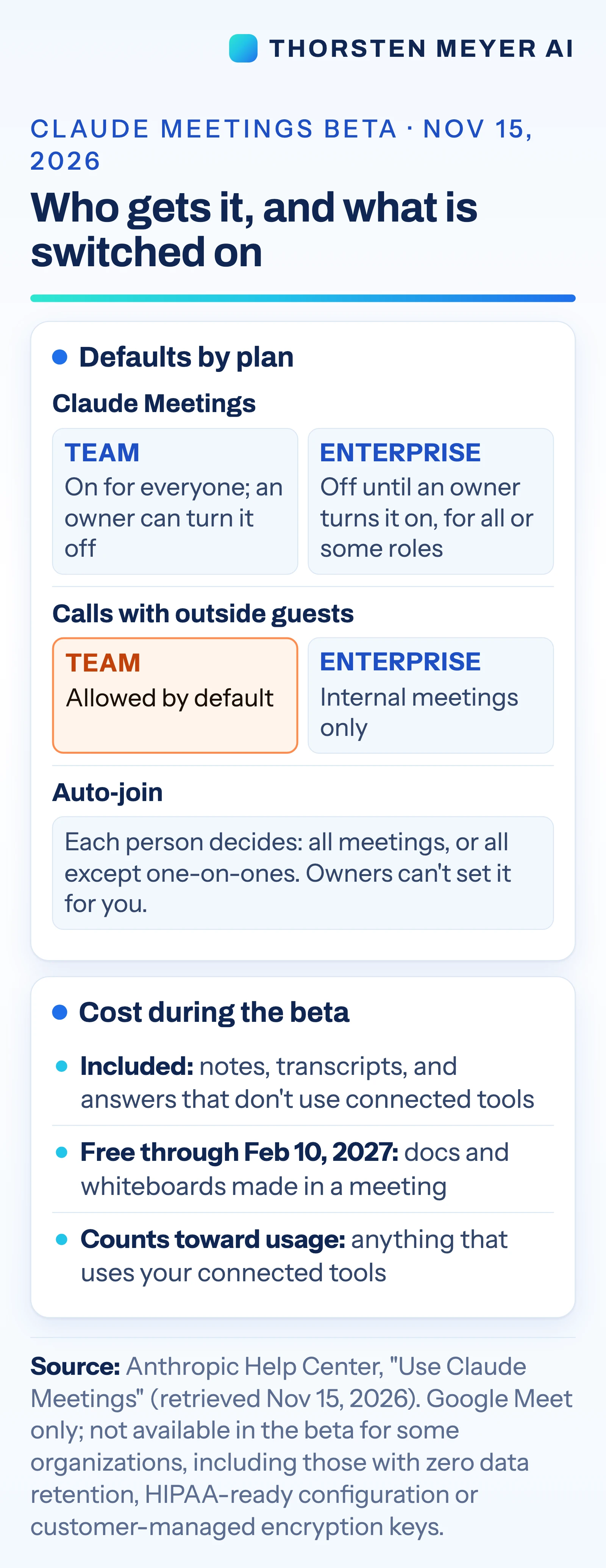
The most important setting is about people from outside your organization. The Help Center is clear: “On Team plans, Claude can join calls with outside guests by default, and an owner can turn this off. On Enterprise plans, an owner must allow it first.”
When outside guests are not allowed, Claude stays out of calls where someone from outside is invited, and leaves “if someone from outside, including another company’s notetaker bot, joins partway through”.
When they are allowed, the rules change: “Claude listens and takes notes, and posts its notice in the call’s chat but doesn’t reply there. What guests say is included in the notes and transcript.” Guests do not get the meeting page or the recap email. Each person also has their own setting for meetings with external guests.
One wording to watch. Anthropic’s announcement says “By default, Claude is set to stay out of calls when someone from outside your organization is invited”, without mentioning the Team-plan difference, and Computerworld reported that Claude “requires admin approval to attend calls including external guests”. The Help Center’s admin settings list “allowed” as the default on Team plans. Our reading: Team owners who want the cautious behaviour should check the setting rather than rely on the announcement.
What it costs
- Included: “Notes, transcripts, and answers that don’t use your connected tools are included on Team and Enterprise plans.”
- Free for now: “Docs and whiteboards made in a meeting are free through February 10, 2027.”
- Counts toward usage: “Using your connected tools counts toward your own usage and can lead to charges for your organization.”
What docs and whiteboards made in meetings will cost after February 10, 2027 is not stated.
What it means for businesses
This is not legal advice. Before switching it on, talk to your data protection officer, your works council where there is one, and a lawyer who knows your jurisdictions. What the sources say:
- The consent job is yours. Anthropic builds in signals: Claude appears as a participant, posts a notice and shows its state on its tile. But the instruction to make sure everyone is okay with being transcribed sits with whoever adds it. Craig Durr, chief analyst at The Collab Collective, said, according to Computerworld: “IT, legal, and HR should agree on when Claude is allowed into a meeting before it’s rolled out.”
- In the EU, the company is responsible, not only the vendor. Spain’s data protection authority, the AEPD, wrote on April 20, 2026 that an organization that adds an AI voice transcription service “actuará como responsable del tratamiento”, it will act as the data controller, whether the tool is its own or a third party’s (our translation). The AEPD rejected the idea that people who join a session after being told that “al unirse dan su consentimiento” (by joining, they consent) have given valid consent, citing its decision PS/00342/2023. It also said people must be told how long both the voice recording and the transcript are kept. Our reading: Claude Meetings keeps no audio, by Anthropic’s account, but the transcript point still applies.
- Consent at work is shaky ground. In an earlier post from January 14, 2026, the AEPD wrote that consent “pudiera estar viciado en una relación empleado-empleador”, it might be flawed in an employee-employer relationship (our translation). It named other possible legal bases, such as legitimate interest, which has to be weighed against people’s rights.
- Works councils in Germany. Under section 87(1) no. 6 of the Works Constitution Act, the works council has a right of co-determination on “the introduction and use of technical devices designed to monitor the behaviour or performance of the employees” (official English translation by the Federal Ministry of Labour and Social Affairs). Our reading: a tool that writes down who said what in meetings is the kind of system works councils will want to discuss before rollout. Whether the rule applies in your case is a legal question.
- Decide the settings before people find them. On Team plans, the feature is on by default. Owners can switch it off, turn it on for everyone or (on Enterprise) only for certain roles, decide on outside guests, and set “Members’ connectors in meetings”, which decides whether Claude may use members’ connected tools during meetings.
- Treat the notes as a draft. The AEPD points out that a transcript “no es un texto neutro” (is not a neutral text): it attributes words to a specific person, and a wrong transcription triggers the right to rectification under Article 16 GDPR. It recommends human review of transcripts. Our reading: check names and action items before anyone acts on them.
- Mind what leaves the meeting. When Claude sends a Slack message or looks something up, meeting content moves into other systems, under each person’s own permissions.
Analysts urge patience. “Don’t extend Claude into meetings until it proves that it can operate within your organization’s approved meeting platform, repository, privacy and support model,” a Gartner report states, according to Computerworld. The Gartner analysts said Anthropic still has to show “better outcomes than incumbent assistants” and the “granular meeting controls, retention, auditability, repository synchronization, and cost predictability required for enterprise use”.

What it means for employees
- You will see it. Claude appears as a participant and posts a notice in the call’s chat. Its tile shows what it is doing.
- You can ask for a pause. Claude can be asked to stop listening or to leave, and the host can decline when it asks to join. If you would rather not be transcribed, say so before the meeting starts.
- Auto-join is your choice. Owners cannot set auto-join for you. You pick all meetings or all except one-on-ones.
- What you say becomes text others can read. People from your organization on the invite can see the notes, and the meeting page can be shared further inside the organization. Answers in the Meet chat are visible to everyone on the call.
- As a guest, your words go into the host company’s notes and transcript, but you do not get the meeting page or the recap.
- Think before you say yes to tool access. When Claude asks to use your connected tools, a yes “applies going forward”.
- You have rights to your data. In the EU, the AEPD writes that people keep their right of access (Article 15 GDPR) to transcripts about them, and that access cannot be refused across the board just because other participants’ data is in them, when that data can be protected.
What is not known
- How long meeting records are kept. The Meetings pages do not say how long transcripts, summaries and screen descriptions are stored. Anthropic’s general privacy article for organizations says chats saved in its commercial products are kept until you delete them, and deleted conversations are removed from back-end storage within 30 days. Whether meeting pages follow the same rules is not stated.
- What “screen descriptions” cover. Anthropic says Claude saves them, but not in detail what it captures from shared screens.
- Where the data is processed and which model runs it. Not stated on the pages we read.
- Other platforms. Anthropic says “coming soon”. Computerworld reported that an Anthropic spokesperson named Google Meet and Microsoft Teams. No date is given.
- The price after February 10, 2027 for docs and whiteboards made in meetings.
- Accuracy. Anthropic publishes no figures on transcription quality or supported languages on these pages.
- More autonomy. According to Computerworld, citing an Axios report, the tool currently only acts when instructed but could become “more proactive” over time. Durr’s warning: “A meeting participant that acts on its own is a different product, and it starts a different governance conversation.”
- The guest default. The announcement and the Help Center word it differently for Team plans (see above).
The bottom line
Claude Meetings is a real beta with clear limits: Google Meet only, Team and Enterprise only, text instead of audio, and a set of admin switches. The technology is the easy part. The harder part is the agreement around it: who may add Claude, which meetings are off limits, what guests are told, how long the record lives and who checks the notes. Companies that settle that first can try it with fewer surprises. Companies that let the Team-plan default decide will find out in their next meeting.
I’m Thorsten Meyer. The full sources are below, and more reality checks are at thorstenmeyerai.com.
Sources
- Anthropic: “Introducing Claude Meetings”, claude.com, November 12, 2026 (retrieved November 15, 2026)
- Anthropic Help Center: “Use Claude Meetings” (retrieved November 15, 2026)
- Anthropic Help Center: Release notes, entry of November 12, 2026 (retrieved November 15, 2026)
- Anthropic: “Introducing Claude Whiteboards, Claude Sheets, and Claude Data”, claude.com, November 10, 2026
- Anthropic Privacy Center: “How long do you store my organization’s data?” (retrieved November 15, 2026)
- Computerworld (Matthew Finnegan): “Anthropic targets workplace collaboration with Claude Meetings”, November 11, 2026, with quotes from Craig Durr (The Collab Collective), Irwin Lazar (Metrigy), a Gartner report and a report by Axios
- Agencia Española de Protección de Datos (AEPD), blog: “Transcripción de voz con IA: implicaciones para la protección de datos”, January 14, 2026
- Agencia Española de Protección de Datos (AEPD), blog: “Transcripción de voz con IA (II): responsabilidad, derechos y transparencia”, April 20, 2026
- German Works Constitution Act (Betriebsverfassungsgesetz), section 87, German text and official English translation by the Language Service of the Federal Ministry of Labour and Social Affairs, gesetze-im-internet.de
Researched and drafted with AI assistance, including Anthropic’s Claude. This article is about an Anthropic product; Anthropic did not review or sponsor it, and we have tried to report its limits as fully as its features. Our own text and graphics contain no affiliate links; offer and product boxes added by the site may contain Amazon affiliate links. This article is for information only. It is not legal advice. Translations from Spanish marked as ours are my own. Product details as published by Anthropic and as reported by the outlets above, as of November 15, 2026; features and defaults in a beta can change. Images: AI-generated illustration (Runware) and graphics by Thorsten Meyer AI; no real people or logos are shown in our images. Boxes added by the site may show product photos or people.