By Thorsten Meyer | November 15, 2026 | ThorstenMeyerAI.com

Get business pricing on tech for your team
- Business-only prices and quantity discounts
- Tax-exempt purchasing
- Multiple users, one account, clear invoices
Ten days before Grand Theft Auto VI goes on sale, the head of its publisher was asked about AI tools that, in IGN’s words, let hackers “clone games much faster than ever before.” Strauss Zelnick, chairman and CEO of Take-Two Interactive, did not call them a financial threat. He did take a swipe at two of the companies that build them. “If you’re in the intellectual property business, which Anthropic is and OpenAI is, then it seems ironic on the one hand to stomp on someone else’s IP and hope that yours is protected,” he told IGN in an interview published on November 9, 2026. Since then, headlines say he “called out” both AI companies. The interview itself shows something narrower: an answer to a question about a rule Anthropic had just added to its coding tool, and a principle that both AI companies’ own policies already state on paper. Here is what was said, what the rules say, and where the gaps are.
Key takeaways
- Where it was said: in a phone interview with IGN, published on November 9, 2026, the evening Take-Two reported its fiscal second-quarter results. Zelnick was answering a question about Anthropic’s new rule and whether OpenAI should do the same.
- What he said: “I think all companies should be protecting intellectual property, their own and everyone else’s.” He did not name a product, a clone or a case, and he did not say which conduct he meant by “stomp on someone else’s IP”.
- How he rates the risk: “I don’t think it’s a financial matter, in terms of a threat to our business. I do think it’s a creative matter.” On the earnings call the same day he said piracy is going to become “more of a challenge” and that Take-Two is “enhancing our technical defenses and enhancing our legal activities appropriately.”
- Anthropic’s rule: Claude Code, Anthropic’s coding agent, tells the model not to build “a recreation of a specific existing game (its name, characters, art, music, levels or look), even if it is renamed or called original.” That wording has been in the program since version 2.1.317, published on November 2. Anthropic grounds the rule in its usage policy, which bans infringing the intellectual property of third parties.
- OpenAI’s rules: OpenAI’s usage policies bar “attempts to infringe on intellectual property rights of others.” We found no game-specific instruction in the open-source code of its Codex CLI coding agent.
- No public reply: we found no public response from Anthropic or OpenAI to Zelnick’s remarks as of 21:30 UTC on November 14.
AI coding agents and existing games · as of Nov 14, 2026
Prompt in, game out: where the line runs
Three example requests (illustrative, not real cases) and what each vendor’s published rules say about them.
- Example request
“An original racing game with my own art”own idea, own assets
Claude Code (Anthropic)AllowedRule text: build original games and games from the user’s own designs and assets
Codex / policies (OpenAI)No objectionNothing in the published usage policies against it
- Example request
“A heist game with mechanics like [a named hit]”a game named as a reference
Claude Code (Anthropic)Allowed since v2.1.317Builds an original game in that genre, per Anthropic
Codex / policies (OpenAI)No game rule foundNo game-specific instruction in the Codex CLI code
- Example request
“Rebuild [a specific game], just rename it”a copy under a new name
Claude Code (Anthropic)Not allowedCovers its name, characters, art, music, levels or look; offers to build something similar
Codex / policies (OpenAI)General IP banUsage policies bar attempts to infringe IP; no game-specific rule found
Outside the tools: Take-Two says it relies on its own “technical defenses” and “legal activities”. Copyright and trademark law apply whichever tool writes the code.
The requests are our own illustrations. The rows summarize published rules, not tests of how the tools behave. ChatGPT’s and Codex Web’s server-side instructions are not public.
Sources: Claude Code program text, versions 2.1.317 to 2.1.325, and Anthropic’s statement of Nov 4, 2026 (via Tom’s Hardware); OpenAI usage policies, version effective Nov 20, 2026 (Internet Archive copy of Oct 28, 2026); Codex CLI repository on GitHub, checked Nov 14, 2026; Take-Two fiscal Q2 2027 earnings call, Nov 9, 2026.
Graphic: Powered by Thorsten Meyer AI
Products Worth Considering

Sony WH-1000XM6 Wireless Noise-Canceling Headphones, Black

Apple MacBook Air 15-inch Laptop with M5 Chip, 16GB Memory, 512GB SSD, Liquid Retina Display, and Touch ID (Midnight)

Amazon Kindle Paperwhite Signature Edition (2024), 32 GB, Metallic Black
As an affiliate, we earn on qualifying purchases.
What Zelnick was asked, and what he said
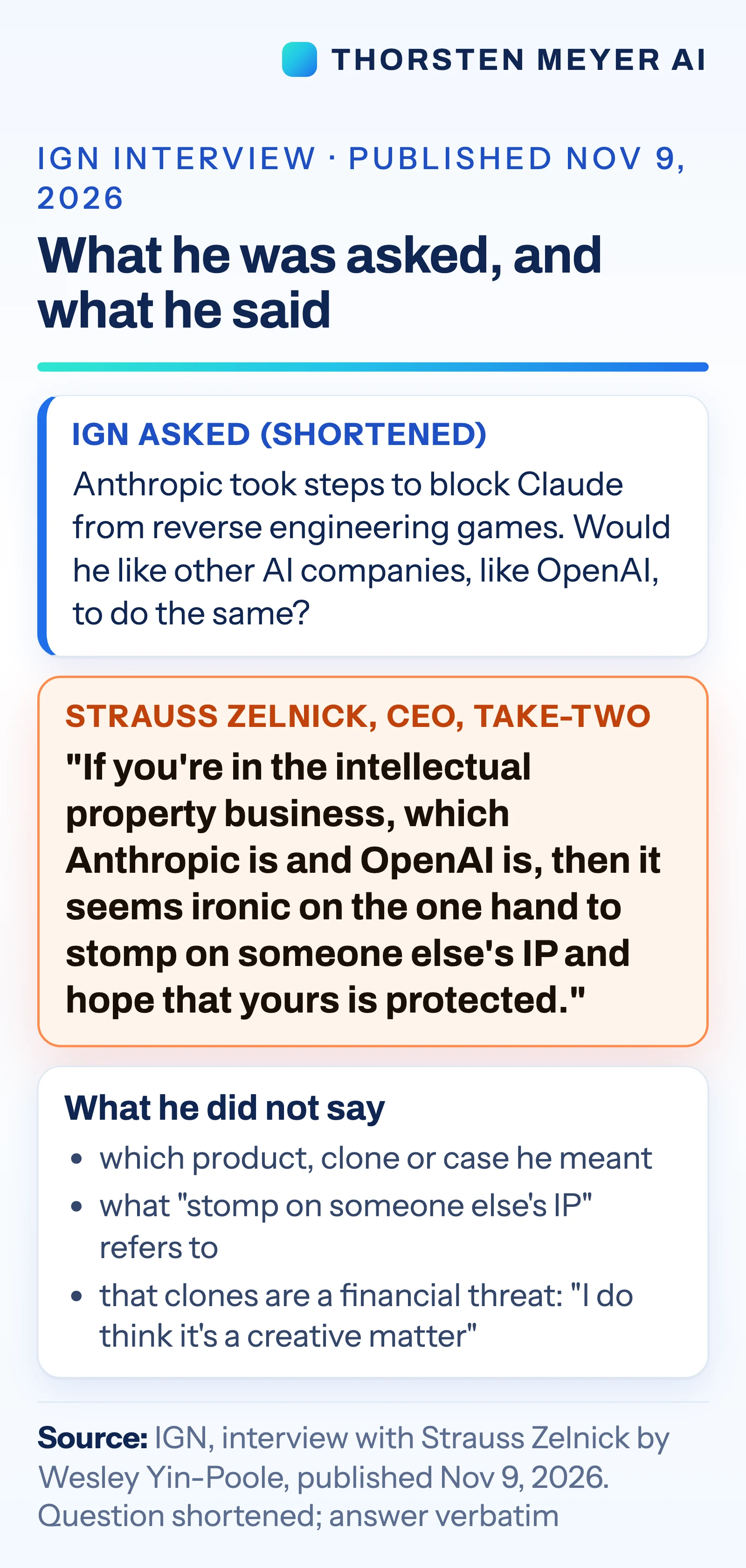
IGN managing editor Wesley Yin-Poole interviewed Zelnick by phone. IGN published the interview on November 9, the evening Take-Two reported its results for the quarter ended September 30, 2026. The two questions that matter here came back to back.
The first was about AI and piracy. “We’ve seen hackers using AI to clone games much faster than ever before, even try to jailbreak consoles,” the interviewer said, and asked how much of a threat it would be if GTA 6 turned up on PC unofficially. Zelnick answered: “I don’t think it’s a financial matter, in terms of a threat to our business. I do think it’s a creative matter. It’s important to everyone, our developers and our consumers alike, to deliver the experience Rockstar envisions. And at the same time, of course, we protect our intellectual property vigilantly. So we are focused on these concerns. We’re not in the least cavalier about them.”
The second named the AI companies. “Related, last week Anthropic confirmed they took steps to block Claude from reverse engineering video games. I would assume you would welcome that. And would you like to see other AI companies like OpenAI do the same thing to prevent people from using these powerful AI models to clone your games?” Zelnick’s full answer: “I think all companies should be protecting intellectual property, their own and everyone else’s. And if you’re in the intellectual property business, which Anthropic is and OpenAI is, then it seems ironic on the one hand to stomp on someone else’s IP and hope that yours is protected.”
Three things are worth noting about that exchange:
- He was answering, not launching an attack. The names Anthropic and OpenAI came from the question. GamesRadar’s story says he “called out companies like Anthropic and OpenAI for allowing users to plagiarize and clone pre-existing games”; the transcript shows a general principle and a charge of irony, not a specific accusation.
- He left the target open. Zelnick did not say whether “stomp on someone else’s IP” refers to what users build with AI tools, to how the models were made, or to something else. He did not say that any Take-Two game has been cloned with Claude or ChatGPT.
- The question was broader than the rule. IGN described Anthropic’s step as blocking Claude “from reverse engineering video games”. The rule Anthropic published speaks of recreating a specific existing game. It does not mention reverse engineering or decompiling.
On the earnings call that evening, an analyst asked about “AI-assisted reverse engineering and decompilation of games”. Zelnick said the business “has been largely immune to piracy concerns forever because of file sizes, complexity of piracy, being connected to servers” and that it would be “very difficult to replicate the experience of consuming our game as intended because of technical limitations.” Then he conceded that piracy is going to become “more of a challenge”. Take-Two’s response, in his words: “enhancing our technical defenses and enhancing our legal activities appropriately.” Asked about Rockstar in “an AI-influenced world”, he also said: “Look, technology benefits us,” and: “Hit creation remains the purview of human beings.” He did not sound against AI tools as such. His concern, as we read it, is whose property they are used on.
Grand Theft Auto VI comes out on November 19, 2026, for PS5 and Xbox Series X|S, according to Take-Two’s release list. No PC version is on that list. We looked at the pre-order numbers in our GTA VI piece.
What Anthropic’s rules say
Anthropic’s rules work on two levels.
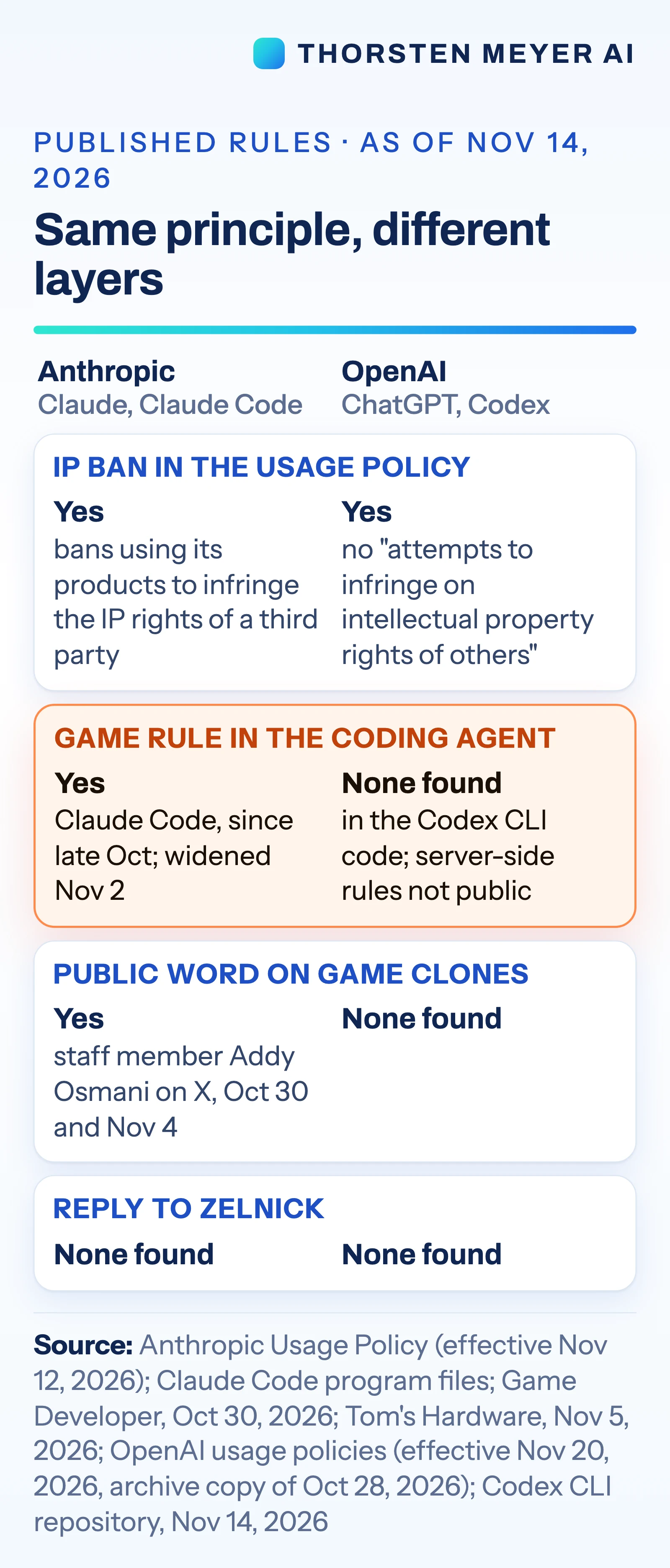
The usage policy. Anthropic’s Usage Policy, in its version effective November 12, 2026, lists under “Do Not Violate Applicable Laws or Engage in Illegal Activity” using its products to “Infringe, misappropriate, or violate the intellectual property rights of a third party”. That applies to every Anthropic product and is not specific to games.
The game rule in Claude Code. Claude Code is, in Anthropic’s description, “an agentic coding tool that reads your codebase, edits files, runs commands, and integrates with your development tools.” Since late October it carries an instruction about games. Game Developer reported on October 30 that an X user had spotted the rule, pushed “sometime on October 27”. An Anthropic spokesperson referred Game Developer to a post by Addy Osmani, a member of Anthropic’s technical staff: “We added two sentences to Claude Code’s prompt on Opus 5.5 to steer it away from recreating someone else’s specific game because using Claude to infringe IP is against our usage policy.” Original games, genre games and games built from your own designs and assets “are meant to keep working,” he wrote. We covered that first version, the wave of AI-built remakes before it and where copyright law draws the line in October.
The rule has changed since then. We searched the program files of Claude Code versions published on the npm registry and those installed on our machine:
- Version 2.1.316 (published October 31): “Do build original games, games in a genre, and games from the user’s own designs and assets. Don’t build a recreation of a specific existing game, even if it is renamed or called original.”
- Version 2.1.317 (published November 2) through 2.1.325 (November 13), the latest we checked: “Do build original games, games in a genre or with similar mechanics, and games from the user’s own designs and assets. Don’t build a recreation of a specific existing game (its name, characters, art, music, levels or look), even if it is renamed or called original.”

The new version does two things. It adds games “with similar mechanics” to what is allowed, and it spells out what counts as a recreation: name, characters, art, music, levels or look. Osmani explained the change on X on November 4. The first rule “was also kicking in when you referenced one just to describe the mechanics you wanted,” he wrote, as quoted by Tom’s Hardware. “We’ve updated that rule in 2.1.317. You can name a game to describe what you want, and Claude should now build an original game in that genre. If you ask for a copy of the original, it’ll offer to build something similar instead.” He added: “We want Claude to be as helpful as possible when you’re building something original, but also to protect your work if someone else tries to copy it.” The public Claude Code changelog does not mention the game rule in any of these versions.
The limits are on record too. Game Developer wrote that the rule “may only deter the most low-effort copycats,” that safety limits on AI tools “can be sidestepped by deploying rhetorical tricks,” and: “It’s also unclear how the software would be able to interpret whether or not a user owns a game idea or game assets.” Many users, the outlet noted, pointed out that cloners can turn to “open-weight models that have no such restrictions in place.”
What OpenAI’s rules say
OpenAI’s usage policies, in the version that takes effect on November 20, 2026, say: “Your use of OpenAI services must follow these Usage Policies”. Under “Protect people”, the list of things its services may not be used for includes “destruction, compromise, or breach of another’s system or property, including malicious or abusive cyber activity or attempts to infringe on intellectual property rights of others”. openai.com blocked our automated request on November 14, so we read this in an Internet Archive copy from October 28.
OpenAI’s coding agent is Codex. Its open-source command-line version, Codex CLI, “is a coding agent from OpenAI that runs locally on your computer,” according to its README. We searched the repository’s code and instructions at its latest commit on November 14 (19:40 UTC) for rules about existing games or game recreations and found none. That is not the whole product: Codex also runs as a “cloud-based agent”, Codex Web, and ChatGPT runs on OpenAI’s servers, where instructions are not public. GamesRadar wrote that OpenAI “seemingly has no such restrictions in place for now.”
We found no public statement from OpenAI on game recreations or on Zelnick’s remarks.
What it means for studios and businesses
This is not legal advice. Three observations:
- On principle, nobody disagrees. Zelnick says all companies should protect others’ IP. Anthropic’s and OpenAI’s policies both ban using their services to infringe it. The dispute is about enforcement: how much a tool should refuse, and who carries the burden when it does not.
- A vendor rule is a filter, not a fence. Anthropic’s game rule is an instruction in one tool. It does not bind other tools or open-weight models, and Game Developer’s reporting suggests determined users can get around it. Take-Two itself names its own defenses: technical protection and legal action. Studios that worry about clones of a demo or a launch will rely on those, not on AI vendors’ prompts.
- The rule’s definition is a usable checklist. If your team builds games or interactive marketing with AI, “name, characters, art, music, levels or look” is a practical list of what not to copy from someone else’s game. Naming a hit to describe the mechanics you want is allowed in Claude Code now, according to Anthropic. That is our reading of the rule, not a legal test; copyright and trademark law decide what infringes.
What it means for people who build games with AI
- In Claude Code: original games, genre games, games “with similar mechanics” and games from your own designs and assets are allowed by the rule text. A request to rebuild a specific existing game, even under a new name, should get an offer to build something similar instead, according to Anthropic.
- In other tools: the absence of a game-specific rule is not a permission. OpenAI’s usage policies bar attempts to infringe IP, and the law applies whichever tool writes the code.
- For players waiting for GTA VI: Take-Two lists only PS5 and Xbox Series X|S. Any PC version before an official one would not come from Rockstar, and Zelnick says Take-Two protects its IP “vigilantly”.
What is not known
- What Zelnick meant. He did not say whether “stomp on someone else’s IP” refers to clones built by users, to how AI models are trained, or to something else.
- Take-Two’s next steps. Zelnick spoke of “enhancing our legal activities” but named no case, target or AI company. We found no report that Take-Two has contacted Anthropic or OpenAI.
- OpenAI’s server-side rules. Whether ChatGPT or the cloud version of Codex has any instruction about game recreations is not public.
- How well the Claude Code rule works. Anthropic has published no numbers on how often it refuses, or wrongly refuses, game requests. Whether the same instruction applies outside Claude Code is not stated.
- Replies. Neither Anthropic nor OpenAI has responded publicly to Zelnick, as far as we could find.
The bottom line
Zelnick’s line was sharper than his argument. The argument, that companies which want their own IP protected should protect everyone else’s, is one Anthropic and OpenAI already put in their usage policies. Anthropic has gone one step further and written a game rule into Claude Code, then adjusted it after developers said it refused projects it should have built. OpenAI has a general ban but, as far as we can see, no game-specific rule. Take-Two, for its part, is not waiting for either: it is relying on its own technical and legal defenses. The launch on November 19 will show how much of that pressure is real.
I’m Thorsten Meyer. The full sources are below, and more reality checks are at thorstenmeyerai.com.
Sources
- IGN, Wesley Yin-Poole: “Take-Two Boss Strauss Zelnick on GTA 6 Expectations, GTA Online, and the Decade to Come”, published November 9, 2026
- Take-Two Interactive: “Take-Two Interactive Software, Inc. Reports Results for Fiscal Second Quarter 2027”, November 9, 2026 (press release, 19 pages; release list on page 4)
- Take-Two Interactive fiscal Q2 2027 earnings call, November 9, 2026, transcripts by The Motley Fool and StockAnalysis (Quartr); quotes used only where both transcripts agree
- Anthropic: Usage Policy (effective November 12, 2026), Claude Code overview (code.claude.com/docs) and newsroom, checked November 14, 2026
- Claude Code program files, versions 2.1.316 to 2.1.325 (npm registry and local installs), and the public Claude Code changelog, checked November 14, 2026
- Addy Osmani on X, October 30 and November 4, 2026 (via X’s embed service, Game Developer and Tom’s Hardware)
- Game Developer, Bryant Francis: “Anthropic orders AI tool Claude to stop remaking video games”, October 30, 2026
- Tom’s Hardware, Jowi Morales: “Anthropic loosens game restrictions”, November 5, 2026 (via Yahoo Tech)
- OpenAI: Usage policies (version effective November 20, 2026; Internet Archive copy of October 28, 2026); Codex repository on GitHub (README and code, commit of November 14, 2026)
- GamesRadar, Kaan Serin: Ahead of GTA 6, Take-Two CEO calls out Anthropic and OpenAI over AI game clones, November 14, 2026
- Insider Gaming, Robert DeFelice: report on Zelnick’s IGN interview, November 2026
Researched and drafted with AI assistance, including Anthropic’s Claude. Anthropic, one of the two companies Zelnick named, makes Claude and the Claude Code rule described here. Neither Anthropic, OpenAI nor Take-Two reviewed or sponsored this article. We report each side’s words as published and take no view on who is right. This article is for information only and is not legal advice. Statements as published by the sources above, as of 21:30 UTC on November 14, 2026. Our own text and graphics contain no affiliate links; offer and product boxes added by the site may contain Amazon affiliate links. Images: AI-generated illustration (Runware) and graphics by Thorsten Meyer AI; no game artwork or logos are shown in our images. Boxes added by the site may show product photos or people.