
By Thorsten Meyer

Get business pricing on tech for your team
- Business-only prices and quantity discounts
- Tax-exempt purchasing
- Multiple users, one account, clear invoices
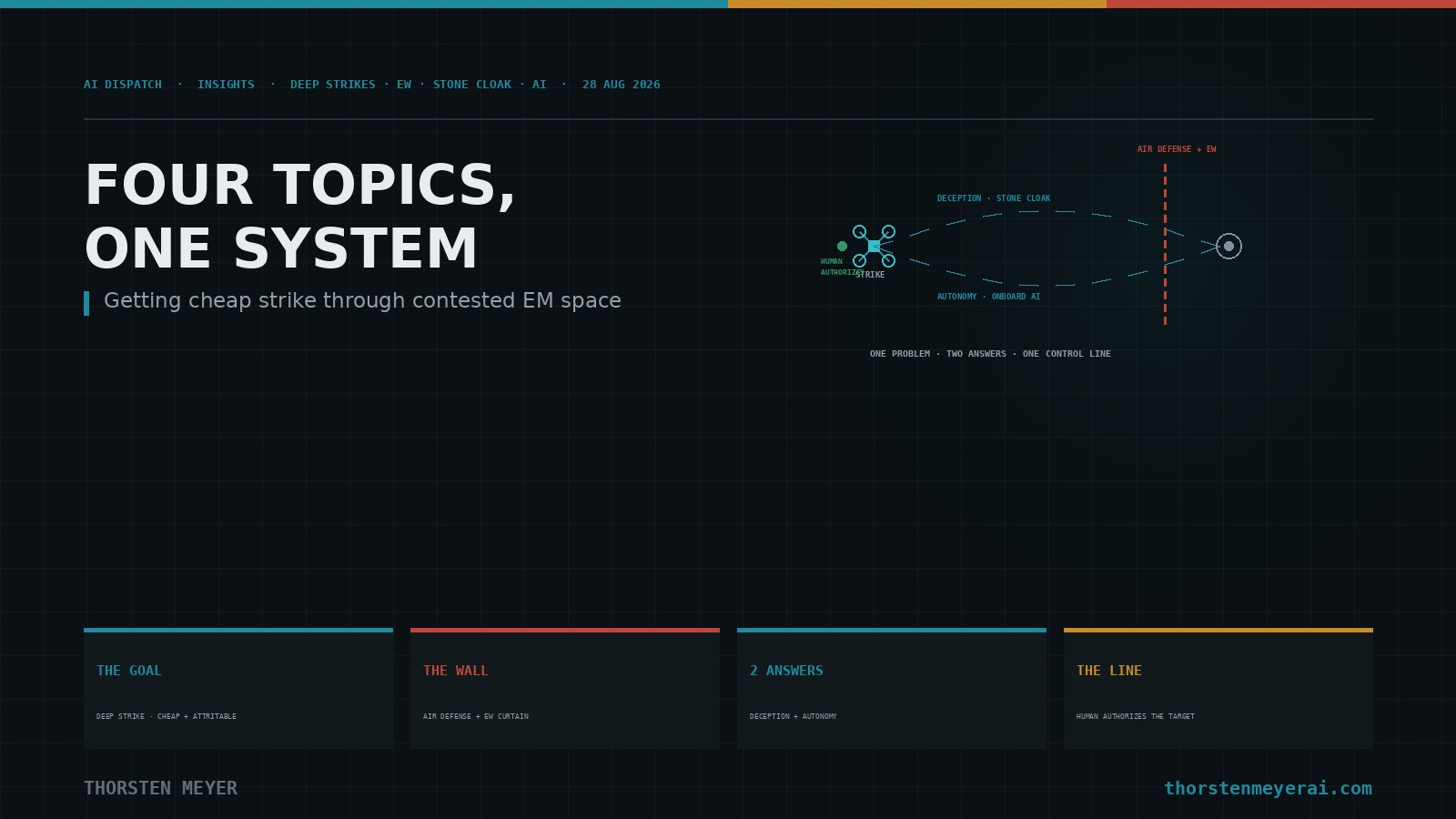
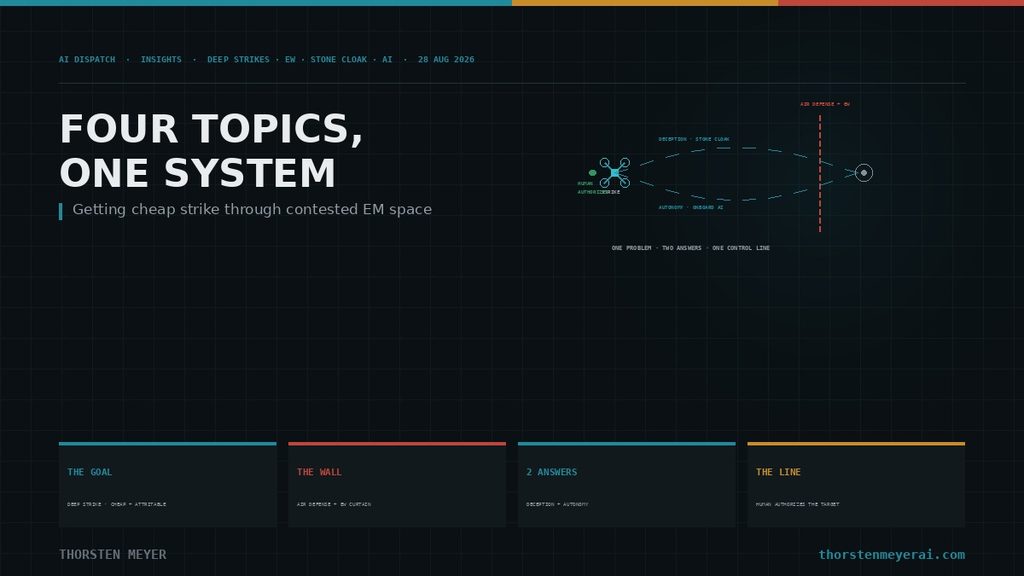
The four things worth understanding about the technological turn in the Russia–Ukraine war — deep strikes, electronic warfare, the British Stone Cloak system, and the impact of AI — are usually written up as four separate stories. They’re not. They’re one system, and it clicks into focus the moment you see the single problem underneath all of them: how do you get a cheap, expendable drone or missile through a dense wall of air defense and radio jamming to hit something hundreds of kilometers away? Deep strike is the goal. Electronic warfare is the wall. Stone Cloak and onboard AI are two different answers to the same question of how to get through it. Read them together and the logic of the whole contest becomes legible.
Let me take them in that order — the goal, the wall, and the two answers — and then get to the line that matters most, which is where the human stays in the loop. This is strategic analysis at the level defense literature operates on; there’s no operational or technical detail here that would help anyone build, defeat, or aim any of it, and that’s deliberate.
Deep strikes: the goal, and the economics under it
Ukraine’s long-range strike drones have become one of its primary means of reaching deep inside Russia, hitting targets like oil refineries, military airfields, and ammunition depots far behind the front. Russia has answered by thickening a layered air-defense network, including mobile surface-to-air systems configured specifically to hunt drones rather than conventional aircraft. The contest runs both ways: Ukrainian drones have also become a primary means of destroying Russian air-defense systems, and the campaign has at points pushed strikes toward heavily protected areas defended by dozens of point-defense systems and multiple long-range batteries.
Deep strike is the goal. Electronic warfare is the wall. Stone Cloak (deception) and onboard AI (autonomy) are two answers to the same question: how to get through.
The deep logic here is economic, and it's the thing to hold onto. A mass-produced one-way attack drone can cost on the order of tens of thousands of dollars; the interceptors and batteries arrayed against it cost vastly more. When cheap, attritable strike meets expensive layered defense, the attacker's problem isn't destruction — it's penetration. Getting through is the whole game, and getting through is what the next three pieces are about.
As an affiliate, we earn on qualifying purchases.
Electronic warfare: the wall
Electronic warfare is the reason penetration is hard, and it has shaped every aspect of this war. The front sits under what operators describe as an EW "curtain." Broadly, EW counters a drone two ways: it jams — flooding the spectrum with interference to sever the radio link between drone and operator — or it deceives. The jammed radio link is the drone's structural weak point, because a drone that loses contact with its operator, in the classic design, is a drone that fails. Ukrainian EW, for its part, works the same problem in reverse against Russian cruise missiles, interfering with the systems they use to navigate and correct their course. Whoever controls the electromagnetic spectrum over a stretch of front largely controls what can fly through it. That is the wall every deep strike has to cross.
As an affiliate, we earn on qualifying purchases.
Stone Cloak: the deception answer — and the sovereignty story
The first answer to the wall is to not fight the radar but fool it. Stone Cloak is a British electronic-warfare system, a module roughly the size of a tablet that attaches to attack drones and is designed to make them far harder for air defenses to track and target. Public reporting is candid that exactly how it works isn't known — it's understood to rely on electronic deception rather than brute jamming, behaving more like an aircraft self-protection suite than a ground-based jammer, but I'll stay at that level of abstraction because it's where the open sources responsibly stop. What's established is the effect: it improves the survivability of drones penetrating dense air defense, thousands of units have already been supplied to Ukraine, and — a telling detail — despite that volume, the system hasn't been publicly identified or recovered and analyzed by the other side.
But the news that actually matters isn't the hardware; it's the transfer. In mid-2026 the UK granted Ukraine not just devices but a production license and the intellectual-property rights, letting Ukrainian industry manufacture Stone Cloak domestically, adapt and upgrade it, and integrate it into its own drones and future cruise missiles — and the technology is set to feed back into next-generation UK low-cost strike systems in turn. This is the part I'd underline, because it's the sovereignty argument I keep making, applied to weapons. In a war where the technological state of the art turns over in weeks, the durable capability isn't owning a device — it's owning the ability to change the device faster than your opponent adapts to it. Handing over the IP and the right to modify is worth more than handing over any quantity of finished units, because it moves Ukraine from consuming a capability to producing and evolving one. Production sovereignty, not hardware, is the real transfer.
deception drone stealth technology
As an affiliate, we earn on qualifying purchases.
As an affiliate, we earn on qualifying purchases.
The impact of AI: the other answer — and the line under the most pressure
The second answer to the wall is to make the drone stop needing the radio link at all — and this is where AI has become, by several accounts, the decisive shift of the last two years. The core move is AI-assisted terminal guidance: an operator locks a drone onto a target from some distance out, and the drone's onboard system carries it the final stretch to impact on its own. The strategic consequence is blunt — if the last phase of the flight needs no active link to a human, then an EW system near the target has nothing to jam. Autonomy doesn't defeat the jammer; it makes the jammer irrelevant to the part of the flight that counts. Short-range first-person-view drones got this capability at scale beginning in 2025; larger fixed-wing "middle-strike" drones followed in 2026, and several analysts consider that second step the more consequential one, because it extends jam-proof precision to the ranges where deep strike actually happens.
AI and autonomy show up in the surrounding technology too, all pointed at the same independence-from-the-link goal: optical navigation, where an onboard computer matches live terrain images against stored maps to fly without satellite positioning; dual-band communication that switches frequencies when one is jammed; and, further out, coordinated autonomy — a trial announced in early 2026 demonstrated a single operator directing dozens of drones as an autonomous network that planned its own actions, leaving the human to focus on one thing.
That one thing is the line that matters, and I want to give it the weight it deserves rather than bury it under the capability. In the systems being fielded, the human still authorizes the target. AI is doing navigation and terminal guidance — flying the drone to a target a person designated — not choosing whom to strike. Ukrainian practitioners have been unusually direct that AI cannot be trusted to select targets on its own, because it can err and hit civilians, and that ethics remains the barrier to fully autonomous weapons. The further step — a system that picks its own target and decides on its own to attack — is, by these same accounts, only in the earliest stages of combat testing, on both sides. So there is a real, currently-held line between AI that guides a human-chosen strike and AI that chooses the strike, and everything about the war's logic is pressing on that line. This is the same control problem I wrote about after the OpenAI incident, wearing camouflage: capability racing ahead of the guardrail, and the guardrail here is human target authorization.
As an affiliate, we earn on qualifying purchases.
The part that's mine to make
Put the four together and you can see the shape of modern high-intensity conflict, which is exactly the cross-domain contest I've been describing in the abstract, now concrete. The electromagnetic domain is the decisive terrain; the offense-defense race there is answered by deception on one hand and autonomy on the other; and the durable advantage goes to whoever can adapt fastest, which is why the Stone Cloak IP transfer — the right to modify — matters more than any hardware count. That's the sovereignty thesis I hold for models and inference, arriving in the hardest possible domain: own and evolve your own capability, or remain dependent on someone else's release schedule while the technology turns over under you.
And the AI dimension is the one I'd watch with the most care, precisely because the logic is so relentless. Autonomy is winning not because anyone set out to build killer robots but because independence from the jammable link is the only reliable way through the wall — the economics and the operational pressure both push, hard and continuously, toward more onboard intelligence and less human tether. That same pressure pushes on the target-authorization line, because the last tether to remove, for a purely military-efficiency logic, is the human in the decision. The line holds today by deliberate choice and stated ethics, not by technical necessity — which means it's exactly the kind of line that erodes quietly unless it's defended on purpose. "Alignment has to hold everywhere; a lapse only has to win once" is not only a lab-safety slogan. In this domain it's literal.
Where I land
Deep strikes, electronic warfare, Stone Cloak, and AI aren't four stories; they're one system with a single problem at its center — getting cheap strike through contested electromagnetic space — and two complementary answers to it, deception and autonomy, with production sovereignty as the durable edge and human target-authorization as the control line under the most pressure. The uncomfortable synthesis is that the very capability making these strikes jamming-proof is one short step from removing the human from the kill decision entirely, and the entire economic and operational logic of the war leans toward taking that step. What's holding it is a choice, not a law of nature. That's the thing to watch — not because it's science fiction, but because it's the most ordinary kind of line there is: the kind that stays in place only as long as someone keeps deciding to keep it there.
Analysis from a builder, founder, and post-labor economist running a local-first inference operation, whose work includes defense-ISR. A strategic and doctrinal synthesis at the level of open defense literature, verified at time of writing against reporting from Defense Express, UNITED24 Media, Root-Nation, RBC-Ukraine, ADS Advance, TrenchArt, GlobalSecurity, and others. It describes the impact, economics, and control implications of publicly reported capabilities; it deliberately contains no operational, engineering, targeting, or countermeasure detail, and where open sources stop (e.g. how Stone Cloak functions), so does this piece. Characterizations of the war's dynamics follow the cited reporting; this is not a political endorsement of any party. Point-in-time as of 28 August 2026.
Halloween Picks
halloween
As an affiliate, we earn on qualifying purchases.