
By Thorsten Meyer AI
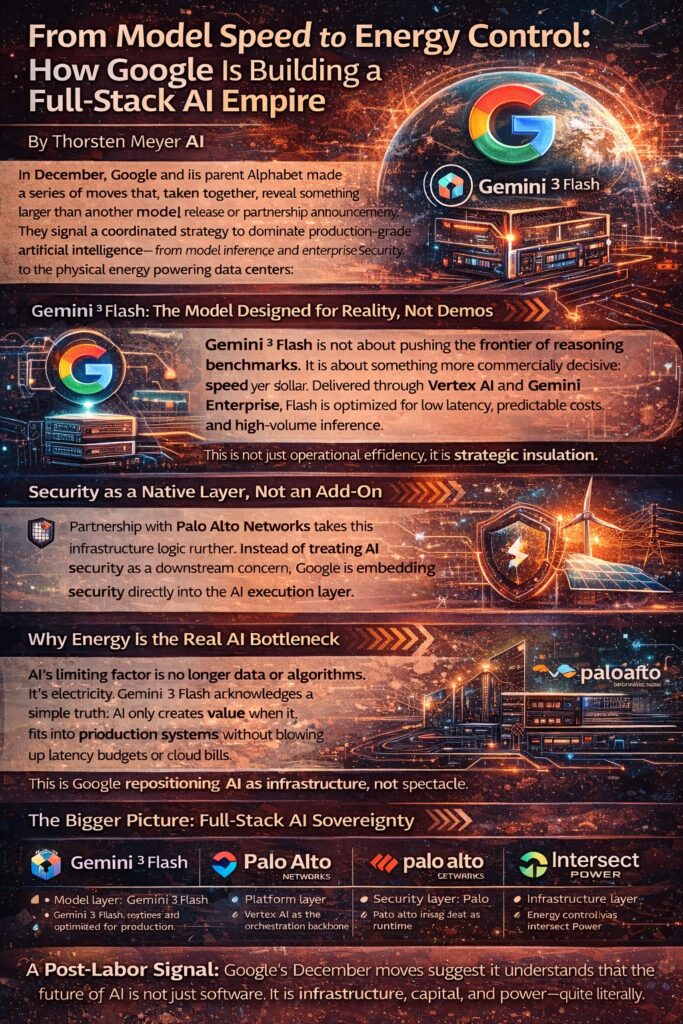
In December, Google and its parent Alphabet made a series of moves that, taken together, reveal something larger than another model release or partnership announcement. They signal a coordinated strategy to dominate production-grade artificial intelligence—from model inference and enterprise security to the physical energy powering data centers.
The release of Gemini 3 Flash, a multibillion-dollar enterprise security deal with Palo Alto Networks, and the acquisition of energy-infrastructure specialist Intersect Power form a coherent blueprint. Google is not just competing on intelligence. It is competing on throughput, trust, and thermodynamics.
Gemini 3 Flash: The Model Designed for Reality, Not Demos
Gemini 3 Flash is not about pushing the frontier of reasoning benchmarks. It is about something more commercially decisive: speed per dollar. Delivered through Vertex AI and Gemini Enterprise, Flash is optimized for low latency, predictable costs, and high-volume inference.
This matters because most enterprise AI workloads are not philosophical reasoning tasks. They are:
- Real-time customer interactions
- Automated security analysis
- Content moderation
- Workflow orchestration
- Agent-based operations
In these environments, milliseconds matter more than marginal gains in abstract intelligence. Gemini 3 Flash acknowledges a simple truth: AI only creates value when it fits into production systems without blowing up latency budgets or cloud bills.
This is Google repositioning AI as infrastructure, not spectacle.

AI Engineering: Building Applications with Foundation Models
As an affiliate, we earn on qualifying purchases.
As an affiliate, we earn on qualifying purchases.
Security as a Native Layer, Not an Add-On
The partnership with Palo Alto Networks takes this infrastructure logic further. Instead of treating AI security as a downstream concern, Google is embedding security directly into the AI execution layer.
Palo Alto’s decision to migrate significant internal workloads to Google Cloud—and integrate its AI-driven security products into Vertex workflows—signals enterprise confidence. This is not a pilot project. It is a long-term alignment measured in billions of dollars.
The implication is subtle but powerful:
AI systems are no longer experimental assets. They are mission-critical infrastructure that must be defended like financial systems or power grids.
In a world of agentic AI and autonomous workflows, security cannot be bolted on afterward. It must operate at runtime, continuously, invisibly.

AI Hardware Blueprint: Building High-Performance Nodes for Local Inference: A Technical Guide to GPU Selection, VRAM Optimization, and Thermal Engineering for Local LLMs and Generative AI
As an affiliate, we earn on qualifying purchases.
As an affiliate, we earn on qualifying purchases.
Why Energy Is the Real AI Bottleneck
The most under-discussed move came last: Alphabet’s acquisition of Intersect Power.
AI’s limiting factor is no longer data or algorithms. It is electricity.
Training and running large-scale models requires stable, scalable, and politically resilient energy supplies. As AI workloads grow, cloud providers face a new constraint: energy availability becomes a competitive weapon.
By acquiring Intersect, Alphabet is doing something unprecedented at this scale—vertically integrating energy strategy into AI infrastructure. This reduces exposure to grid volatility, regulatory uncertainty, and long-term cost inflation.
In practical terms, it means Google can plan AI expansion years ahead with greater certainty than competitors dependent on external power markets.
This is not just operational efficiency. It is strategic insulation.

Advanced Concepts for Renewable Energy Supply of Data Centres
As an affiliate, we earn on qualifying purchases.
As an affiliate, we earn on qualifying purchases.
The Bigger Picture: Full-Stack AI Sovereignty
Together, these moves form a coherent stack:
- Model layer: Gemini 3 Flash optimized for production
- Platform layer: Vertex AI as the orchestration backbone
- Security layer: Palo Alto integrated at runtime
- Infrastructure layer: Energy control via Intersect Power
This is not how AI competition looked two years ago. Back then, the race was about who had the smartest model. Today, the race is about who can deliver AI reliably at scale.
Google is betting that the winners of the next decade will not be the most intelligent systems, but the most operationally integrated ones.

Mastering AI Infrastructure and Cyber Security: Practical Applications and Tools for Building Secure AI Systems (AI Technologies)
As an affiliate, we earn on qualifying purchases.
As an affiliate, we earn on qualifying purchases.
A Post-Labor Signal
From a post-labor economics perspective, this strategy is telling. AI is no longer augmenting work at the edges—it is becoming the backbone of enterprise operations. As AI systems replace entire workflows, the companies controlling inference cost, security trust, and energy supply will shape how value is distributed.
This is not just about cloud market share. It is about who controls the means of cognition in a machine-driven economy.
Google’s December moves suggest it understands that the future of AI is not just software. It is infrastructure, capital, and power—quite literally.
And in that future, intelligence alone is not enough.