By Thorsten Meyer | November 10, 2026 | ThorstenMeyerAI.com

Get business pricing on tech for your team
- Business-only prices and quantity discounts
- Tax-exempt purchasing
- Multiple users, one account, clear invoices
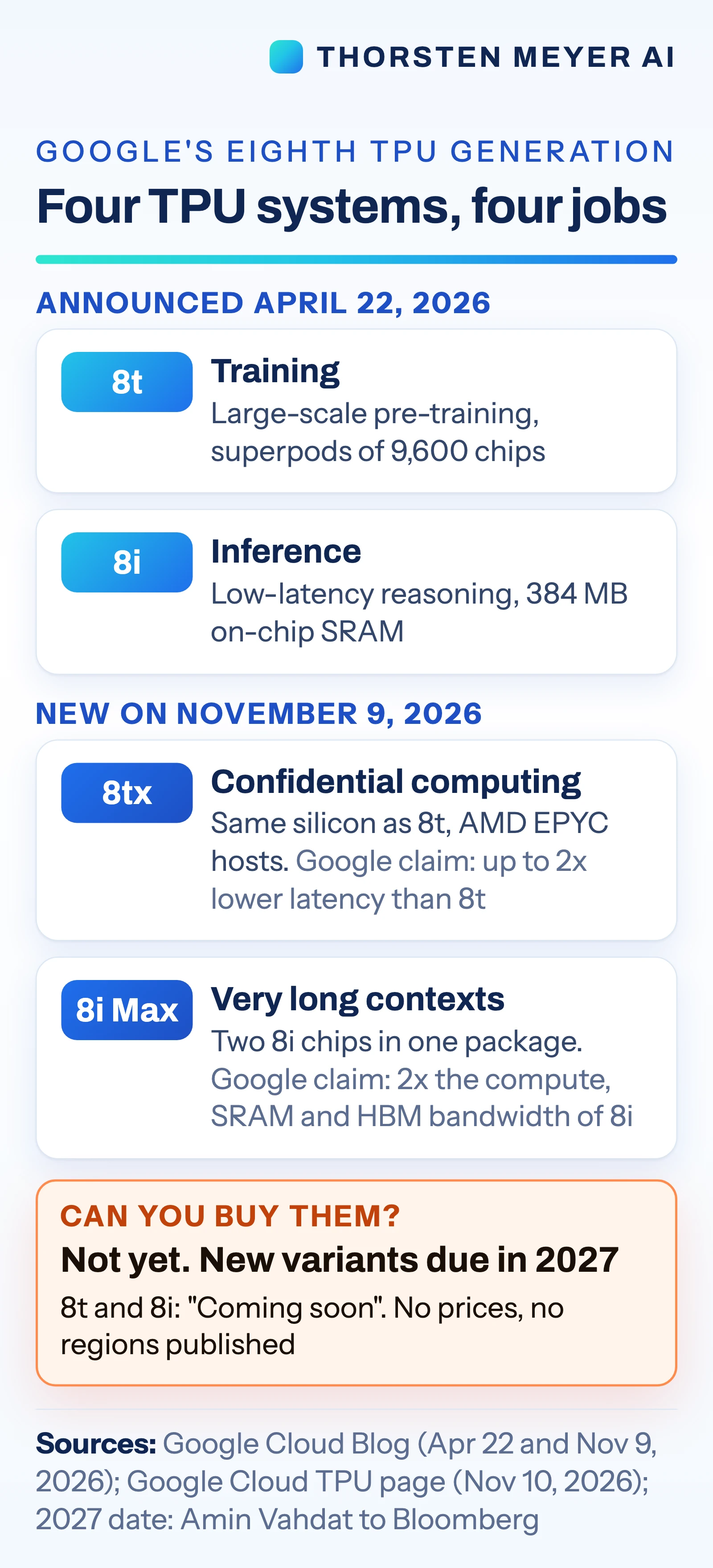
For most companies, buying serious AI computing power has meant one thing: renting or buying Nvidia GPUs, and waiting in line for them. Google wants to be the other line. On November 9, 2026, it added two new variants to its own AI chips, the tensor processing units (TPUs): the TPU 8tx for confidential work and the TPU 8i Max for very long inputs. “This is the first time we have introduced four TPU systems in a single year,” Google wrote.
That pace is new. Google’s chip unit “once released a new AI processor every two years”, Bloomberg reported. Now it is slicing one generation into specialised versions, the way you would pick a truck or a van instead of one vehicle for everything.
There is a catch. None of the four eighth-generation systems is on sale yet. Google’s TPU page lists all four as “Coming soon”, and Google’s chip chief told Bloomberg the two new variants will be available in 2027. There are no list prices and no independent benchmarks for them. So what did Google actually announce, and why should anyone outside a data center care?
Conflict of interest: This article was drafted with the help of Anthropic’s Claude. Anthropic is a Google TPU customer, as Alphabet said on its October earnings call. Neither Google nor Anthropic reviewed or sponsored this article.
Key takeaways
- Four chips, four jobs. TPU 8t for training, TPU 8i for fast answers (inference), and now TPU 8tx for confidential computing and TPU 8i Max for very long contexts. The two new ones are new systems built from existing silicon, not new chip designs.
- All vendor claims so far. Google says TPU 8tx has up to 2x lower latency than TPU 8t, and TPU 8i Max doubles the compute, on-chip memory (SRAM) and memory bandwidth of TPU 8i. Nobody outside Google has tested them.
- Not available yet. The two new variants are due in 2027, according to Google’s Amin Vahdat, speaking to Bloomberg. Google has not published regions or prices.
- Demand is the story. Google says nearly 100 customers use TPUs, and Alphabet describes a “supply-constraint environment”. Oracle will offer Google TPUs in its own cloud from calendar year 2027.
- For buyers, a second source means leverage, but switching from GPUs to TPUs still costs engineering time, and the best comparison data covers the previous TPU generation only.
Products Worth Considering

Apple Watch SE 3 GPS 40mm Smartwatch

Jackery Explorer 300 Portable Power Station with SolarSaga 100W Solar Panel

Amazon Kindle Paperwhite Signature Edition (12th Generation, 2024), 32 GB, Metallic Raspberry
As an affiliate, we earn on qualifying purchases.
What Google announced
Google introduced the eighth TPU generation at its Cloud Next conference on April 22, 2026, and for the first time split it into two chips. TPU 8t is the training chip, built for superpods of 9,600 chips. TPU 8i is the inference chip, meant for running models with low latency. Google claims “up to 2.7x performance-per-dollar improvement” for TPU 8t over its previous generation, Ironwood, for large-scale training, and “up to 80% performance-per-dollar improvement” for TPU 8i in inference. These are Google’s own numbers.
The November 9 post by Amin Vahdat, Google’s chief technologist for AI and infrastructure, adds two variations on that base:
- TPU 8tx is “optimized for secure and confidential inference” and aimed at “regulated enterprises and governments”. Normally, data is encrypted on disk and in transit but has to be unlocked in memory while a computer works on it. TPU 8tx, Google says, keeps “sensitive data and model weights protected and isolated even while in active use”. It is built “on the same silicon as TPU 8t” and paired with 5th Generation AMD EPYC processors. Google claims “up to 2x lower latency compared to TPU 8t with a near-zero performance penalty”.
- TPU 8i Max puts “two low-latency TPU 8i chips” on one package. Google says that delivers “double the compute, double the SRAM and double the HBM bandwidth of TPU 8i” and fits “twice the silicon within the existing rack footprint”. It is meant for “massive context windows”, such as agents working across a whole codebase or hours of video.
Google stresses the difference between a new chip and a new system: designing a chip takes years, while changing the packaging, memory, networking and security around it can be done “in a matter of months rather than years”. In plain terms: Google can now build variants to order. Vahdat told Bloomberg the new versions are “not completely new silicon designs” but reconfigured for tasks customers asked for.
The software side matters as much. Google points to TorchTPU, open-sourced last month, so that “PyTorch code and Hugging Face models now run natively on TPUs”, plus TPU backends for the open-source inference engines vLLM and SGLang. Cloud Pathways, the runtime Google DeepMind uses behind Gemini, is now generally available on Google Kubernetes Engine.
The specs Google has published
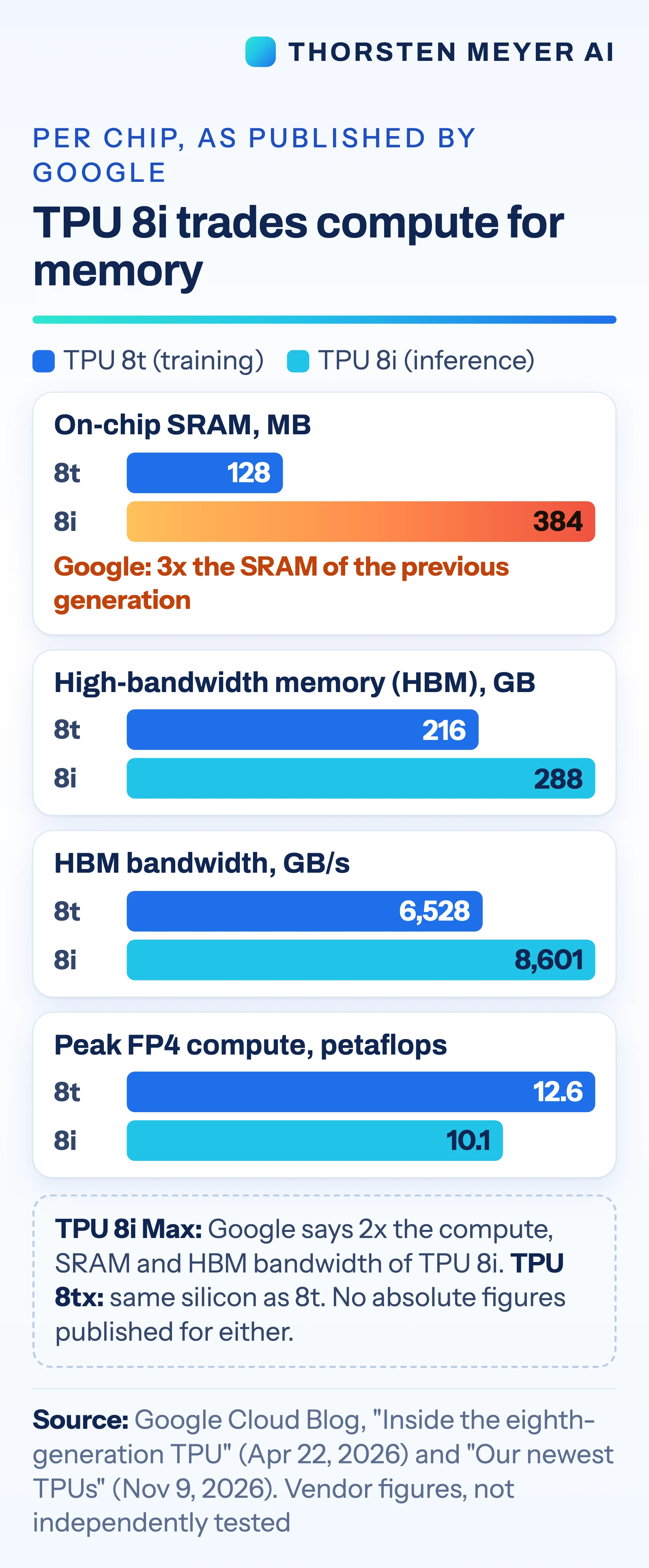
For the two base chips, Google’s April deep dive lists concrete figures. TPU 8t has 216 GB of high-bandwidth memory (HBM), 128 MB of on-chip SRAM, 12.6 petaflops of peak FP4 compute and 6,528 GB/s of memory bandwidth. TPU 8i trades a little raw compute (10.1 petaflops) for memory: 288 GB of HBM, 384 MB of SRAM and 8,601 GB/s of bandwidth.
That trade-off explains the whole strategy. Answering long questions for many users at once is limited less by arithmetic than by how fast a chip can move data in and out of memory, what Google calls “the memory wall”. TPU 8i Max doubles down on exactly that. Google has not published absolute figures for TPU 8i Max or TPU 8tx, only the ratios above.
Why a second source matters
Nvidia still dominates. Bloomberg describes TPUs as competing “in a market dominated by Nvidia’s graphics processing units”, and reports that “the demand for AI processors from Nvidia remains larger than it can satisfy”. That, Bloomberg writes, “has left room for Google and other contenders”. Amazon, Microsoft and OpenAI are developing their own accelerators too, The Decoder notes.
Google is turning its chips from an in-house tool into a product. On Alphabet’s earnings call on October 28, 2026, Google said “Nearly 100 customers use TPUs today” and named Anthropic and Apple, plus firms such as Citadel Securities and Jump Trading. Alphabet also said it has entered partnerships to deliver TPU systems with Crux AI and Oracle. Oracle says Google TPUs on its cloud “will be available in calendar year 2027”, the first time Google TPUs will be offered on a hyperscale cloud platform outside Google.
Price is part of the pitch. According to Bloomberg, Mandeep Singh, an analyst at Bloomberg Intelligence, said TPUs “cost about 30% less than Nvidia’s GPUs” while doing “a competitive job” on throughput. That is an analyst’s estimate, not a published price list. Jump Trading’s chief technology officer, Alex Davies, gave a more nuanced picture: the firm still “mainly uses Nvidia for training”, but TPUs work very well “for a subset of tasks”.
Google is not immune to shortages either. Alphabet said on the same call that, “given the supply-constraint environment”, it started using third-party compute capacity at the end of the third quarter. A second source helps only if it has chips to sell.
What independent tests show so far
There are no independent benchmarks for any of the eighth-generation chips yet. The best outside data covers Ironwood, the seventh generation that Google sells today.
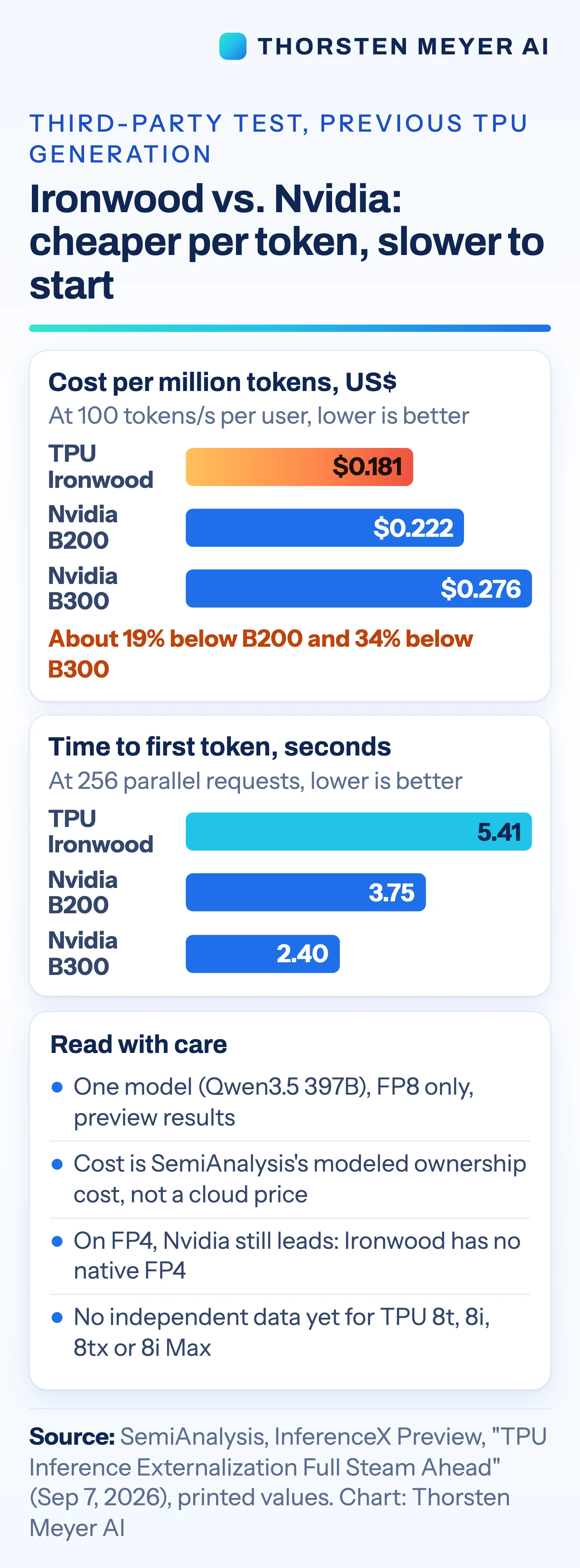
In September 2026, the research firm SemiAnalysis published what it called “the first third-party inference results for TPUv7 Ironwood” on its InferenceX benchmark, a preview. In its comparison with one large open model (Qwen3.5 397B) at FP8 precision, at a speed of 100 tokens per second per user, Ironwood cost about $0.181 per million total tokens, against $0.222 on Nvidia’s B200 and $0.276 on the B300. That is a modeled cost, based on SemiAnalysis’s own estimate of the total cost of ownership for a large AI lab buying the hardware, not a cloud list price.
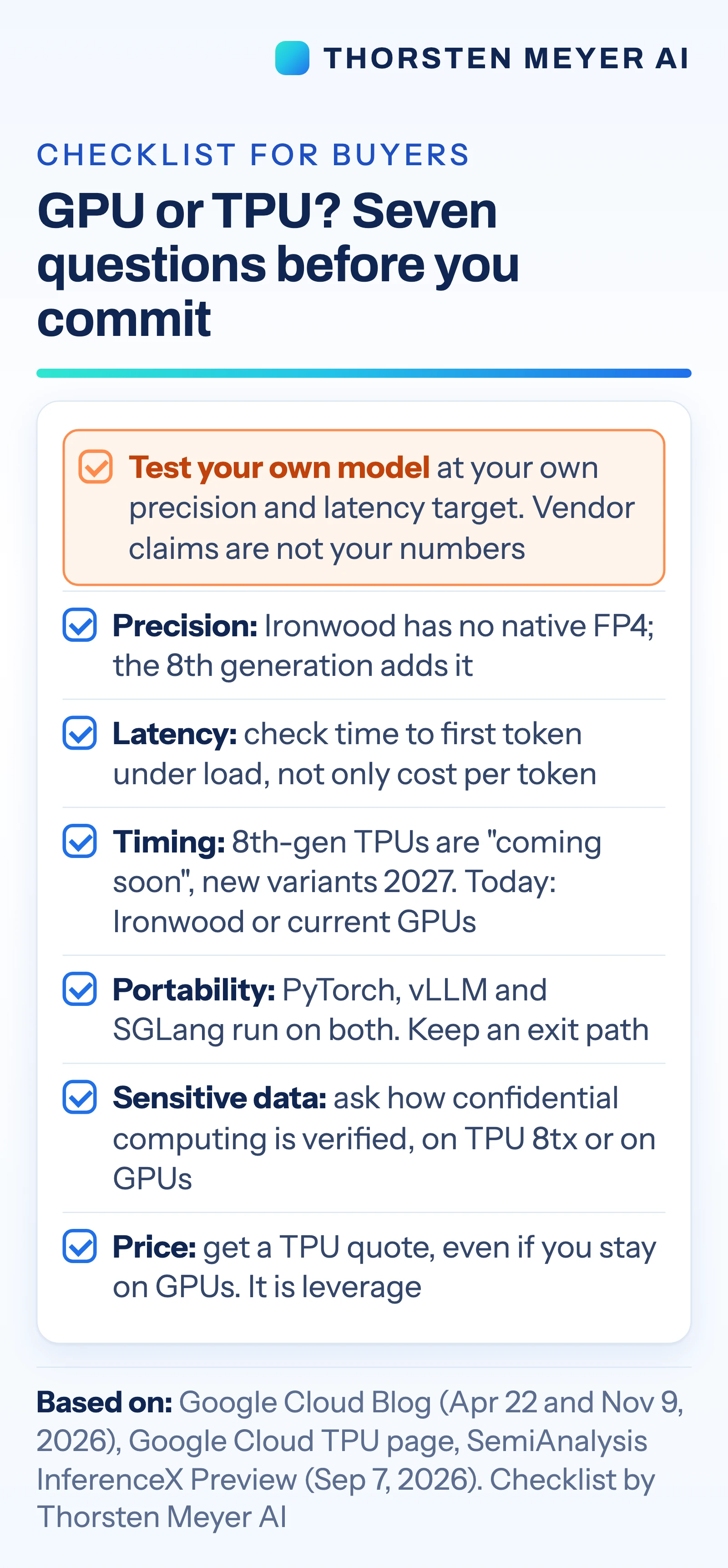
The same report lists the limits. Under heavy load, at 256 parallel requests, Ironwood took 5.41 seconds on average before the first token appeared, compared with 3.75 seconds on B200 and 2.40 seconds on B300. Ironwood “does not have native FP4 computation”, so on FP4, Nvidia “still maintains the lead”. And tuning the software for this one test model took “hundreds of engineering hours”, SemiAnalysis writes. SemiAnalysis says it will compare FP4 to FP4 once TPU 8i is on the benchmark.
Google itself claims that its vLLM and TorchTPU stack “achieved state-of-the-art price-performance marks” on InferenceX and AgentX. It does not give the numbers in its post.
What it means for businesses
Cloud pricing gets a second anchor. Today you can see what Ironwood costs on Google’s public price list: $12.00 per chip-hour on demand in Iowa, or $5.40 per chip-hour with a 3-year commitment. Google has not published prices for any eighth-generation system. When you negotiate GPU capacity, a credible TPU quote is leverage, even if you never switch.
Lock-in moves, it doesn’t vanish. TPUs come only from Google: in its cloud, as TPU systems in customers’ own data centers, and from 2027 also through Oracle. Committing to TPUs swaps dependence on Nvidia for dependence on Google’s hardware and software stack. Google’s answer is open-source software: TorchTPU, vLLM and SGLang backends, and an XLA Serving Engine that runs “across TPUs, GPUs, and CPUs”. Keep your code portable so you can move again.
Choosing between GPU and TPU is a workload question. For many teams the honest answer is: test both. Run your own model, in your own precision, at your own latency target. The SemiAnalysis numbers show that the winner can flip with the setting: cheaper per token in one regime, slower to the first token in another.
Confidential computing becomes a buying criterion. If you handle regulated data, TPU 8tx targets you. The Decoder notes that Nvidia already offers a comparable confidential-computing feature for its GPUs. Ask both vendors how the protection is verified and certified before you trust it with model weights or customer data.
Plan for 2027, not next month. The new variants are due in 2027, and Google is supply-constrained today. If you need capacity now, your options are today’s chips: Ironwood or current Nvidia GPUs.
What it means for users
You will not buy a TPU. But the chips behind an AI service shape what it costs and how fast it answers. Google’s Gemini runs on TPUs, and Anthropic and Apple are named TPU customers. More competition among chip suppliers can push the cost of each answer down over time. Whether those savings reach your subscription price is the provider’s decision.
The TPU 8i Max is also a hint at where AI products are going: assistants that read an entire codebase, a full contract archive or hours of video in one go. Those features are expensive today because of the memory wall. Hardware built for long contexts could make them cheaper and faster. Google’s claims for TPU 8i Max are a promise, not yet a measurement.
What is not known
- Independent benchmarks for TPU 8t, 8i, 8tx and 8i Max. All performance claims are Google’s.
- Prices. Google lists no prices for the eighth generation. Analyst estimates are not price lists.
- Exact dates and regions. “Coming soon” for TPU 8t and 8i, 2027 for the new variants (per Bloomberg), no regions named.
- Absolute specs for TPU 8tx and TPU 8i Max. Google gives only ratios.
- How TPU 8tx protection is verified, for example which attestation or certifications apply.
- Supply. How many chips Google can deliver, and to whom first.
The limits of this story
This article relies on Google’s own posts from April 22 and November 9, 2026, its TPU product and pricing pages, Alphabet’s earnings call transcript of October 28, 2026, Oracle’s announcement of October 27, 2026, and the SemiAnalysis InferenceX preview of September 7, 2026, all accessed November 10, 2026. Media reports by Bloomberg (via The Straits Times), Reuters (via CNA) and The Decoder are marked as reported. Google’s performance figures are vendor claims; I could not test any of the chips. Market and share-price figures in the coverage are deliberately left out.
For the background on who else is buying Google’s chips, see our look at OpenAI’s reported TPU plans.
I’m Thorsten Meyer. The full sources are below, and more reality checks are at thorstenmeyerai.com.
Sources
- Google Cloud Blog: Our newest TPUs: 8tx and 8i Max, built for the agentic era, Amin Vahdat, November 9, 2026 (also on blog.google)
- Google Cloud Blog: What’s next in Google AI infrastructure: Scaling for the agentic era, April 22, 2026
- Google Cloud Blog: Inside the eighth-generation TPU: An architecture deep dive, April 22, 2026
- Google Cloud: Tensor Processing Units (TPUs) and Cloud TPU pricing, accessed November 10, 2026
- Alphabet: Q3 2026 earnings call transcript, October 28, 2026
- Oracle: Oracle Brings Google TPUs to Oracle Cloud Infrastructure, October 27, 2026
- SemiAnalysis: TPU Inference Externalization Full Steam Ahead – InferenceX, September 7, 2026 (free part)
- Bloomberg via The Straits Times: Google escalates Nvidia rivalry with specialised versions of AI chips, November 9, 2026
- Reuters via CNA: Google unveils new AI chip variants as cloud demand surges, November 9, 2026
- The Decoder: Google ships four TPU variants in one year as it ramps up competition with Nvidia, November 9, 2026
Researched and drafted with AI assistance, including Anthropic’s Claude. Anthropic is a Google TPU customer. Neither Google, Nvidia, AMD, Oracle, SemiAnalysis nor Anthropic reviewed or sponsored this article, and it contains no affiliate links. Not investment advice. Images: AI-generated illustration (Runware) and graphics by Thorsten Meyer AI; no real chips, people or logos are shown.