

By Thorsten Meyer | November 10, 2026 | ThorstenMeyerAI.com

Get business pricing on tech for your team
- Business-only prices and quantity discounts
- Tax-exempt purchasing
- Multiple users, one account, clear invoices
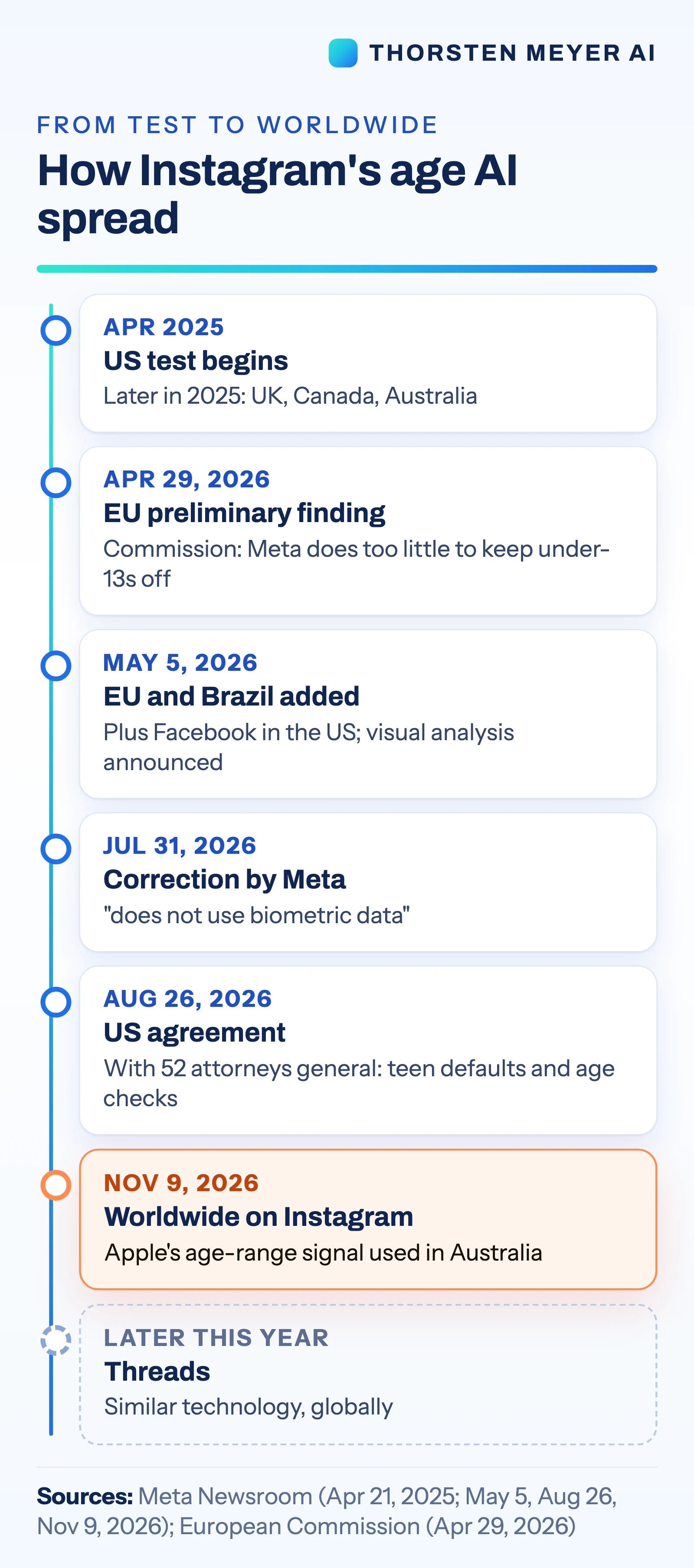
Type an adult birthday into Instagram, and for years that was the end of the conversation. Not anymore. On November 9, 2026, Meta said it is “expanding our AI age-estimation technology globally”. The system looks for people it suspects are teens, “even if they use an adult birthday”, and moves them into Teen Accounts with stricter limits.
Meta expects this to place “millions more teens” into those protections. For parents, that sounds like good news. But it also means a machine now decides, for Instagram users around the world, who looks like a teenager. And Meta has not published how often it gets that wrong.
So how does it work, what happens to adults it misjudges, and why is Meta doing this now?

Key takeaways
- What changed: Instagram’s AI age estimation, used so far in a set of countries, now runs globally. Suspected teens between 13 and 17 are placed in Teen Account protections, even with an adult birthday.
- More signals: in Australia, Meta now also uses Apple’s age-range signal. Facebook is getting the technology, and Threads follows “later this year”.
- Parents: in the US, parents get a notification on Instagram this month explaining the process and how to make sure their teen’s age is correct.
- The pressure behind it: an agreement with 52 attorneys general in the US, and a preliminary finding by the European Commission that Meta does too little to keep under-13s off Instagram and Facebook.
- Not known: error rates, how many adults get misclassified, and exactly which signals the AI weighs.
Products Worth Considering

LG UltraGear 32GX850A-B 32-inch 4K UHD OLED Gaming Monitor

LG UltraGear 27-inch QHD OLED Gaming Monitor, 240Hz

LG UltraGear 25G590B-B 25-Inch Full HD 1000Hz Gaming Monitor
As an affiliate, we earn on qualifying purchases.
What Meta announced
Teen Accounts are Instagram’s restricted mode for users under 18. According to Meta, they “automatically limit who can contact them, the content they see, and their time on our apps”. Meta has said that teens under 16 need a parent’s or guardian’s approval to change those settings.
The problem Meta describes is simple: the protections only work if Instagram knows who is a teen, and “some teens may misrepresent their age online”. So Meta uses AI to “find people we suspect to be teens, even if they use an adult birthday”.
The November 9 post adds three things:
- Global rollout on Instagram. Meta says it is “encouraged by the results” in the countries where the system already ran and is now expanding it worldwide.
- Apple’s age-range signal in Australia. When parents set up a phone for a teen, the app store can confirm the user’s age and assign an age range. When the teen downloads an app, Apple passes that range to the developer. Meta says it uses this signal voluntarily.
- A message to US parents. An in-feed video on Instagram links to an article on Meta’s age assurance approach and how parents can help make sure their teen’s age is accurate.
Meta also says it is rolling the technology out on Facebook and will start “launching similar technology globally on Threads” later this year.
How the AI decides
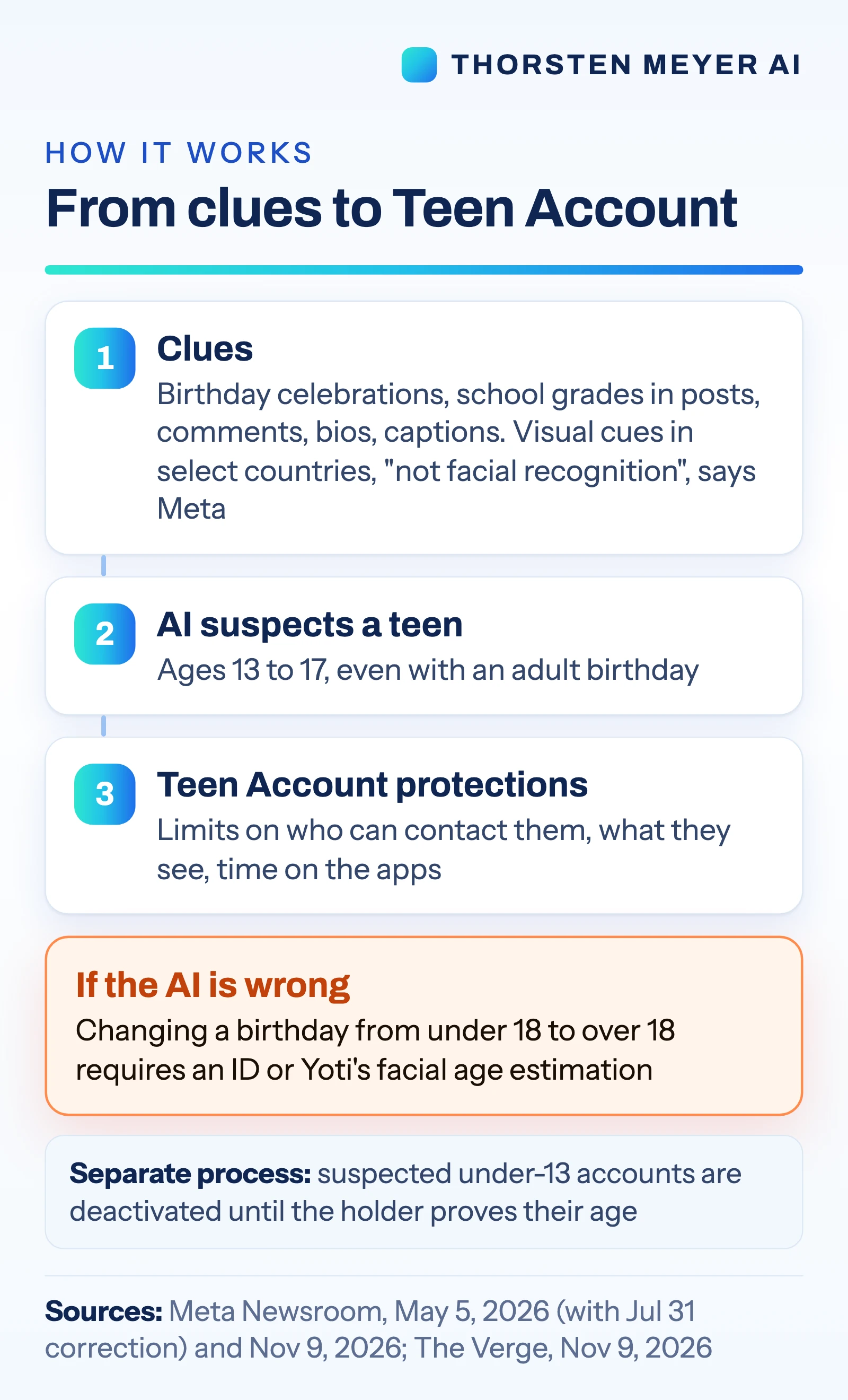
Meta has not published the model, but its posts describe the inputs. In May 2026, Meta wrote that its AI analyzes “entire profiles for contextual clues”, such as “birthday celebrations or mentions of school grades”, in posts, comments, bios and captions.
It also described “visual analysis”: AI that looks at photos and videos for visual clues about a person’s age. Meta insists this “is not facial recognition”. In a correction added on July 31, 2026, Meta wrote that its AI “does not use biometric data”, “does not create facial fingerprints or identify who is in a photo”, and is trained to recognize “general visual patterns” that suggest someone underage is in a photo. Meta also said visual analysis is available only “in select countries” for now.
Two different jobs run side by side, and it helps to keep them apart:
- Teens aged 13 to 17 who claim to be adults are moved into Teen Account protections. That is what went global on November 9.
- Children under 13, who are not allowed on Instagram at all, are handled by a separate process. Meta says accounts it believes are underage are deactivated, and the holder must prove their age to stop the account from being deleted. The Verge corrected its own report on November 9 after Meta said the global expansion covers only the Teen Account placement.
What happens when the AI is wrong
This is the weak spot of any age estimation, and Meta’s posts are thin on it.
When Meta first tested the system in the US in April 2025, it wrote that “in case we make a mistake, we’re giving people the option to change their settings”. Its May 2026 post describes a stricter rule for one case: if someone tries to change their birthday from under 18 to over 18, Meta requires them “to verify their age using an ID or Yoti’s facial age estimation tools”.
That creates a real tension. Meta stresses that its own AI uses no biometric data. But an adult who wants out of Teen Account restrictions after a wrong guess may end up showing an ID or using a third-party facial age estimation tool. Meta’s posts do not publish an error rate or describe an appeal process for the November expansion.
Meta does say its AI is getting better in one related area: for user reports of underage accounts, it supplements human reviewers with AI models, and “In our testing, this AI-driven review delivers higher accuracy and faster resolutions than human review alone”. It gives no numbers.
Why now: lawyers and regulators
Meta frames the expansion as safety work. The timing also follows legal pressure.
In the US, Meta announced an agreement with “52 attorneys general across US states, territories, and the District of Columbia” in August 2026. Meta says it includes a default two-hour daily time limit, a default block from the apps between midnight and 6am, and muted notifications between 8 AM and 3 PM for teens in participating states, plus “even stronger technology” to catch under-13 accounts and identify 13- to 17-year-olds. Meta’s November post says the global expansion “builds on our commitments” under that agreement.
In the EU, the European Commission said on April 29, 2026 that it had preliminarily found Instagram and Facebook in breach of the Digital Services Act for failing to keep children under 13 off the platforms. The Commission wrote that minors “can enter a false birth date” with “no effective controls in place” to check it, and cited evidence that “roughly 10-12% of children under 13” access Instagram and/or Facebook. These are preliminary findings; the Commission says they “do not prejudge the final outcome”. Meta told The Guardian it disagrees, according to The Verge.
Meta’s own answer to the regulators is to push responsibility toward app stores. In its November post, it says it has “long supported legislation requiring age verification and obtaining parental consent on the app store”, and calls one verified signal from the device “far more effective and privacy-preserving than asking every platform to verify age individually”.
What it means for businesses
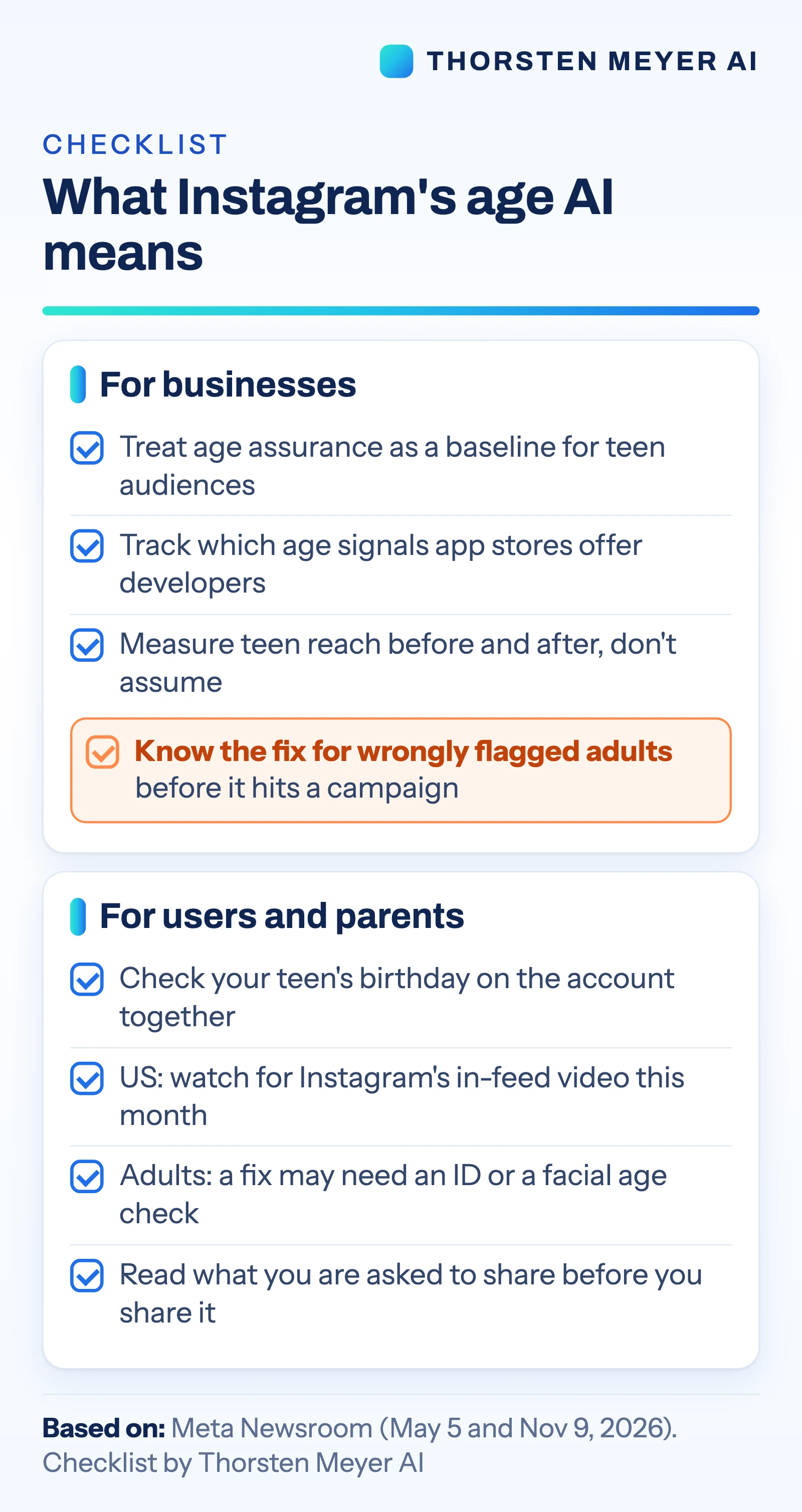
Age assurance is becoming a baseline, not a feature. Regulators in the EU are asking how a platform knows a user’s age, and a US agreement now spells out teen defaults in detail. If your app or community has teen users, expect the same question. Meta’s view is that the app store should verify age once and share it with every app; whether lawmakers follow is open.
Device-level age signals are arriving. Meta now uses Apple’s age-range signal in Australia, according to Meta’s post. If you build consumer apps, it is worth tracking which age signals app stores offer to developers in your markets.
Your teen audience on Instagram may shrink or change. More users will sit in Teen Accounts, with limits on who can contact them and what they see. Meta’s posts do not say how this changes reach or ad delivery for brands and creators. If teens matter to your marketing, measure before and after rather than assume.
False positives hit adults too. Some adult customers, employees or creators may be placed in Teen Account settings by mistake. Getting out can involve an ID or a facial age estimation by a third party. If your social team runs brand accounts or works with young-looking creators, know the process before it hits a campaign.
What it means for users and parents
For parents: the AI is a backstop, not a guarantee. Check the birthday on your teen’s account together; Meta’s own advice is to talk with teens about giving the correct age. In the US, watch for the in-feed video this month.
For teens: an adult birthday no longer reliably unlocks the adult experience. Meta’s AI looks for clues like birthday celebrations or mentions of school grades in posts, comments, bios and captions.
For adults: if Instagram suddenly treats you like a teen, the fix may require an ID or a facial age check. Meta says it doesn’t use biometric data for its own estimation, but a verification step can still mean sharing sensitive data. Read what you are asked to share before you share it.
What is not known
- Accuracy. Meta has not published error rates for the age estimation, nor how many adults were wrongly placed in Teen Accounts.
- The signals. Meta names examples, not the full list or how they are weighed.
- Appeals. The November post does not describe how a misclassified adult appeals, beyond the age verification step.
- Where visual analysis runs. Meta says “select countries” without naming them.
- Data handling. The posts do not say how long age-estimation results are stored.
- The EU case. The Commission’s findings are preliminary; the outcome is open.
The limits of this story
This article relies on Meta’s own newsroom posts from April 2025, May, August and November 2026, the European Commission’s press release of April 29, 2026, and reporting by The Verge, all accessed November 10, 2026. Meta’s posts describe its own systems and results; I could not test the age estimation, and Meta publishes no independent accuracy data. Statements of the parties to the EU proceedings are reported as their positions, not as findings of fact.
If you want more on how Meta’s AI handles personal data, see our look at Meta Muse and private messages.
I’m Thorsten Meyer. The full sources are below, and more reality checks are at thorstenmeyerai.com.
Sources
- Meta Newsroom: Expanding Teen Account Protections to Teens Around the World, November 9, 2026
- Meta Newsroom: New AI-Powered Age Assurance Measures to Place Teens in Age-Appropriate Experiences, May 5, 2026, with correction of July 31, 2026
- Meta Newsroom: Our Agreement With Bipartisan Attorneys General, August 26, 2026
- Meta Newsroom: Working With Parents and New Technology to Enroll More Teens Into Teen Accounts, April 21, 2025
- European Commission: Commission preliminarily finds Meta in breach of Digital Services Act for failing to prevent minors under 13 from using Instagram and Facebook, April 29, 2026
- The Verge: Instagram’s AI age detection is expanding globally, November 9, 2026, including its correction
- The Verge: Meta isn’t doing enough to keep kids off Facebook and Instagram, rules EU, April 29, 2026 (Meta’s response)
Researched and drafted with AI assistance, including Anthropic’s Claude. Neither Meta, Apple, the European Commission nor Anthropic reviewed or sponsored this article, and it contains no affiliate links.