
By Thorsten Meyer | November 11, 2026 | ThorstenMeyerAI.com

Get business pricing on tech for your team
- Business-only prices and quantity discounts
- Tax-exempt purchasing
- Multiple users, one account, clear invoices
Key takeaways
- What happened: On November 10, 2026, IBM and Microsoft announced Imagine Enterprise, which they call “an agentic platform designed to help enterprises build, run, and govern AI agents that help people execute industry-specific processes.”
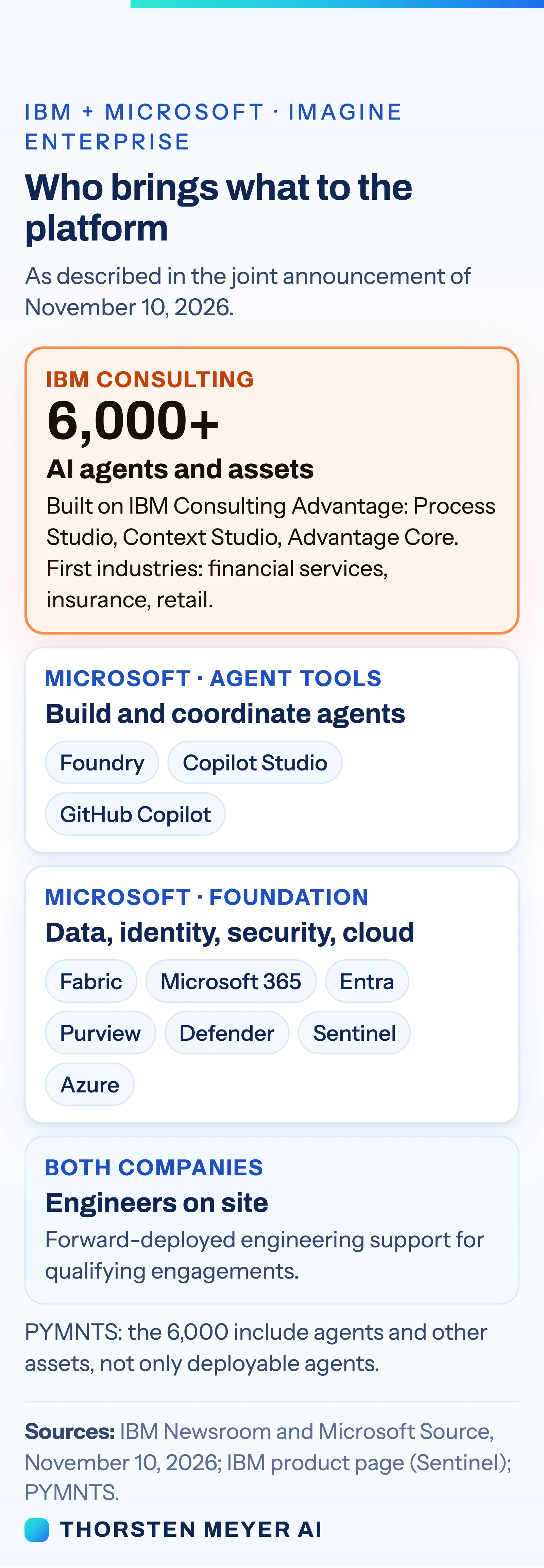
- Who brings what: IBM Consulting contributes “more than 6,000 AI agents and assets” and its delivery platform IBM Consulting Advantage. Microsoft supplies the technology underneath: Foundry, Copilot Studio, GitHub Copilot, Fabric, Microsoft 365, Entra, Purview, Defender and Azure. Engineers from both companies work on site with customers in qualifying engagements.
- Who it is for: Large organizations, “especially in regulated industries”. The first industry frameworks cover financial services, insurance and retail.
- The promise: Built-in governance. According to IBM, every agent action is logged, and rules set what an agent may do alone, what needs human approval and when it must escalate.
- What is not known: price, general availability date, regions, which AI models run underneath, how many of the 6,000 items are actual agents, and whether any customer runs the platform in production yet.
Products Worth Considering

LG UltraGear 34G600A-B 34-Inch Curved WQHD Gaming Monitor, 160Hz

Samsung 27-inch Odyssey OLED G6 QHD Gaming Monitor

Jackery Explorer 300 Portable Power Station with 40W Solar Panel, 292Wh
As an affiliate, we earn on qualifying purchases.
Ready-made agents, sold with consultants
Most companies have tried AI. Few have rebuilt how they work around it. IBM puts it bluntly in its launch blog: “Most organizations are running AI pilots. Almost none have fundamentally changed how the businesses operate.”
Imagine Enterprise is the two companies’ answer to that gap. Instead of building every AI agent from scratch, a bank or insurer is supposed to start with agents and building blocks that IBM Consulting has already made for its industry, and adapt them. IBM’s product page calls the platform “a digital talent agency for the enterprise.”
The press release, published by both companies, describes three selling points: a head start with “more than 6,000 AI agents and assets”, a platform that is “designed to connect with an organization’s existing data, processes, systems, and technology environment”, and a layer that connects company knowledge so that “people and agents can operate with richer enterprise knowledge and context behind them.”
One detail matters for anyone reading the big number. PYMNTS notes: “The 6,000 figure includes agents and other assets, rather than exclusively deployable agents.” Neither company says how many of the 6,000 are working agents.
Who builds what
The split is clear in the announcement. IBM brings the industry know-how and its own tooling: IBM Consulting Advantage’s “Process Studio, Context Studio, and Advantage Core help organizations design, deploy, and govern tailored AI agents.”
Microsoft brings the technical base. According to the release, Microsoft Foundry, GitHub Copilot and Microsoft Copilot Studio “help coordinate AI agents and enterprise systems”, while Fabric, Microsoft 365, Entra, Purview, Defender and Azure “provide the data, identity, AI governance, security, and cloud foundation.” IBM’s product page adds Microsoft Sentinel to the security layer.
The third piece is people. Both companies offer “forward-deployed engineering support for qualifying engagements”. In plain words: engineers from IBM and Microsoft sit with the customer’s team to get agents from testing into production. The release does not say what makes an engagement “qualifying”.
How customers get it also says a lot. The platform “is available to clients by engaging IBM Consulting to deploy and operate the platform on the client’s behalf or co-innovating with IBM Consulting on enterprise-scale implementations.” The release adds one sentence: “Self-management options are also available.” It gives no details about them.
How the guardrails are supposed to work
IBM’s blog describes the control layer in three parts.
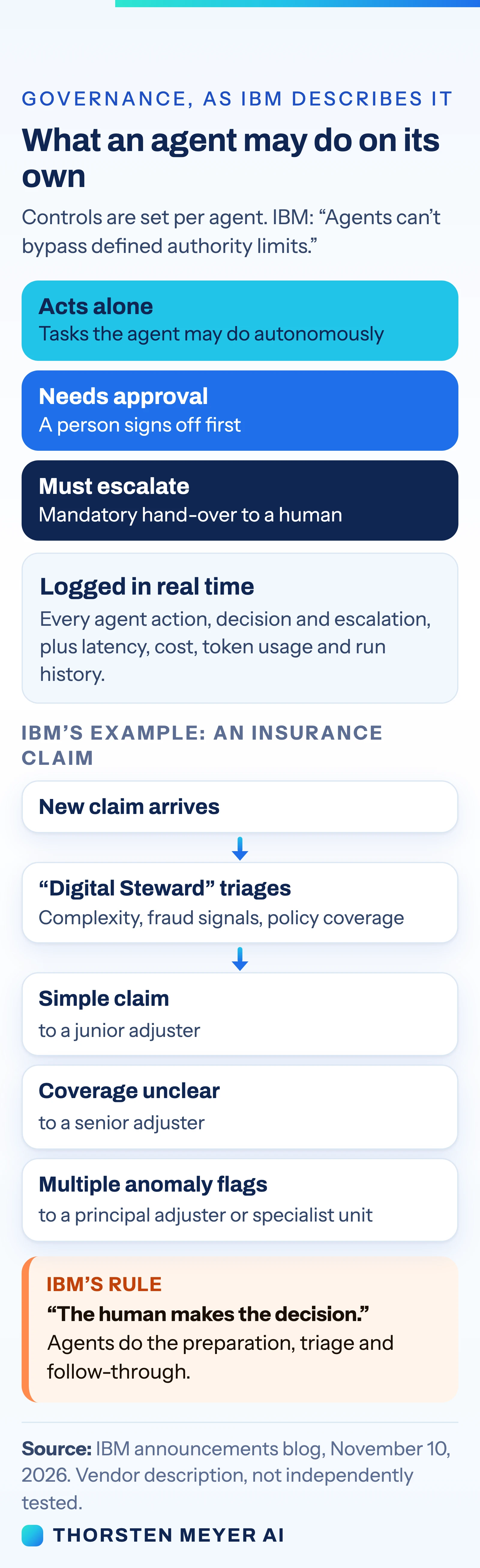
- Observability: “Every agent action, decision and escalation is logged, and latency, cost, token usage and run history are available in real time.”
- Control: “Governance controls define what each agent can act on autonomously, what requires human approval and when escalation is mandatory. Agents can’t bypass defined authority limits.”
- Continuous improvement: A monitoring layer suggests changes, and “approved changes are redeployed automatically.”
IBM’s example is an insurance claim. A coordinating agent it calls the “Digital Steward” triages each new claim: it assesses complexity, flags possible fraud signals, checks policy coverage and routes the case. Simple claims go to junior adjusters, unclear coverage to senior adjusters, and the most complex cases “with multiple anomaly flags” to principal adjusters or specialist investigators. IBM sums up the division of labor: “The human makes the decision. The digital workforce does the preparation, triage and follow-through.”
These are the vendor’s descriptions. No independent test of the controls has been published.
Where it fits in the agent race
Microsoft already sells its agent tools directly. Foundry and Copilot Studio are at the core of this platform too. What the deal adds is IBM’s consulting arm as a sales and delivery channel into large, regulated companies.
PYMNTS frames the launch as part of “Microsoft’s efforts to expand AI adoption across its existing enterprise software customer base.” It reports that Microsoft has 450 million commercial Microsoft 365 seats, “but fewer than 7% carry paid Copilot licenses,” a figure PYMNTS says it reported in September.
The timing fits the calendar. IBM’s product page points to Microsoft Ignite, which it calls “Microsoft’s largest annual client event”, on 17–20 November in San Francisco.
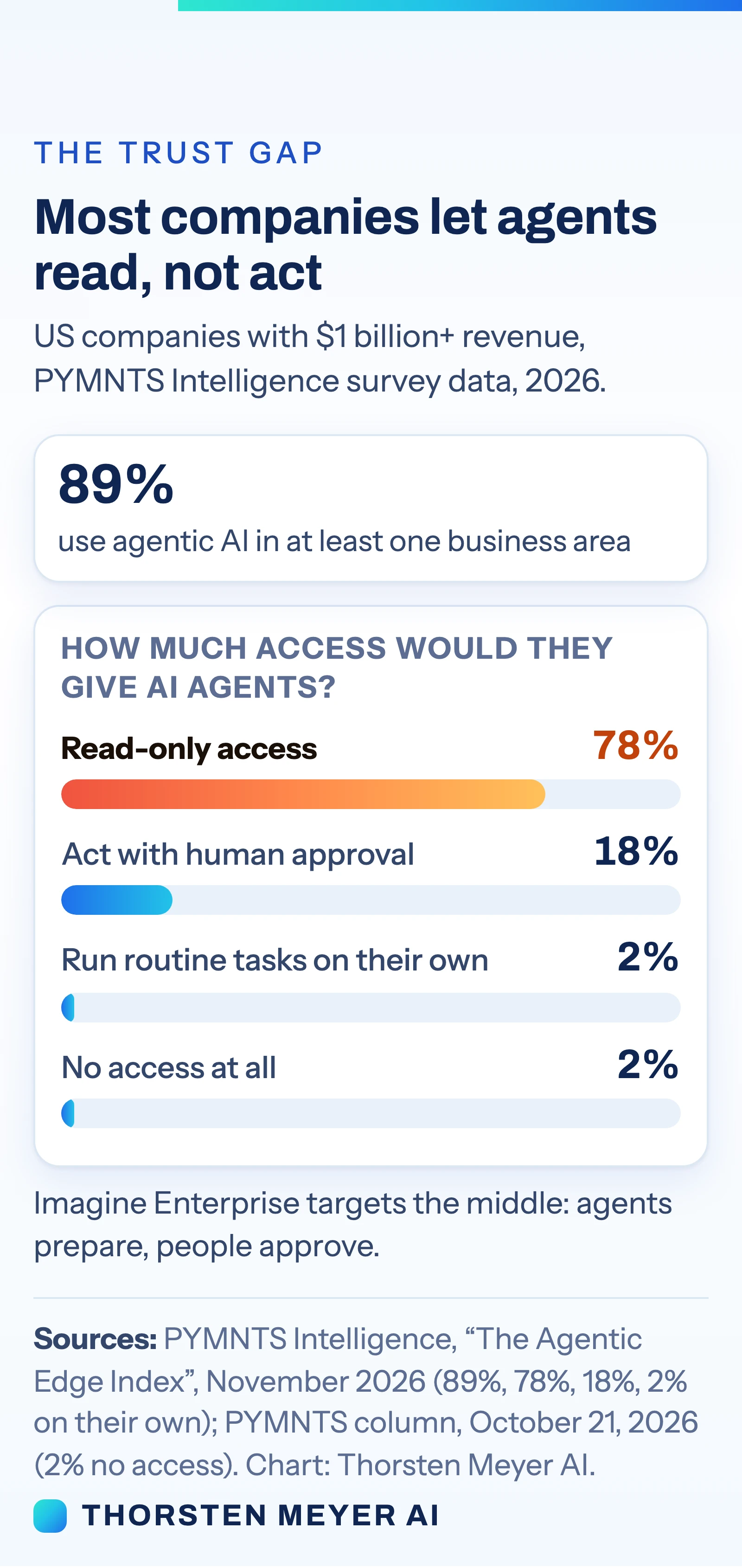
The bigger hurdle may be trust, not technology. PYMNTS Intelligence regularly surveys executives at US companies with $1 billion or more in revenue. In its November report, “The Agentic Edge Index”, 89% of companies use agentic AI in at least one business area. But when asked how much access they would give agents, 78% would allow read-only access, 18% would let agents act with human approval, and 2% would let agents run routine tasks on their own. In a separate column, PYMNTS adds that only 2% would refuse agents any access.
Imagine Enterprise is built for exactly that middle ground: agents that prepare and suggest, with people approving. Whether that is enough to move companies from the 78% to the 18% is the open question.
What it means for businesses
Governance is the pitch, so test it. Logging every agent action and setting approval rules is what regulated companies need. Before signing, ask to see the audit log for a real process, who can change an agent’s authority limits, and how a change is reviewed before it is “redeployed automatically.”
Integration depends on your stack. The platform is built on Microsoft’s identity, data and cloud services. Companies already running Microsoft 365, Entra and Azure start closer to the finish line. Companies on other clouds or identity systems should ask early how much would have to move.
Lock-in comes in two layers. The main way in is through IBM Consulting, and the technology underneath is Microsoft’s. That means dependence on a consultancy and on a cloud vendor at the same time. Ask what you own at the end: the agent definitions, the process models, the logs. And ask what the “self-management options” actually include.
Budget is unknown. No price has been published. Expect a consulting engagement plus Microsoft licenses and usage costs. PYMNTS notes that Microsoft 365 Copilot “costs $30 per user monthly, while newer agent capabilities are billed according to usage.” The release does not say how Imagine Enterprise is priced.
What it means for employees and customers
For employees, IBM’s picture is that people keep the decisions and the agents do the groundwork. In the claims example, “every employee starts their day with a prioritized, context-rich workload.” IBM’s blog states: “It’s not about replacing people. It’s about amplifying them.”
Executives describe their own goals differently. In a PYMNTS column on its survey data, 84% of executives “expect AI to let them grow without a matching increase in headcount.” That does not mean job cuts. It does mean companies plan to do more work without hiring at the same pace. Employees whose work is triaged, prepared and routed by agents should expect their roles to change. Whose performance is measured how, and on what data, is a fair question for works councils and staff representatives.
For customers of banks, insurers and retailers, the effect will be indirect. If a claim or a request is first sorted by an agent, the speed and quality of that sorting shape what happens next. Customers will not usually see which steps an agent handled.
What is not known
- Price and availability. No price, no general availability date and no list of regions.
- The models. The release names Microsoft Foundry but does not say which AI models the agents use.
- The 6,000. How many are deployable agents and how many are other assets.
- Customers in production. SEI, a financial services firm that IBM says manages, advises or administers about $2 trillion in assets, is “exploring emerging and agentic technologies with IBM Consulting, with the support of Microsoft”. The release names no customer running Imagine Enterprise in production and gives no results.
- Regulation. The release promises “AI-compliance support” but does not name a law or standard it is built to meet.
- Self-management. What customers can run without IBM Consulting.
The companies themselves add a caveat: “Statements regarding IBM and Microsoft’s future direction and intent are subject to change or withdrawal without notice, and represent goals and objectives only.”
The bottom line
Imagine Enterprise is less a new technology than a new package: Microsoft’s agent tools, IBM’s prebuilt industry components, and engineers from both companies to make it work. Its strongest promise is governance, with logs and authority limits for every agent. That fits what companies say they need, since most still let agents only read. But until there is a price, a production customer and an outside look at the controls, it is a promise. If you are evaluating it, judge it by the audit trail it can show you, not by the number 6,000.
For more context, read what personal AI agents look like inside a bank, why few companies profit from AI so far, and how attackers target AI tools, sessions and agent traces.
I’m Thorsten Meyer. The full sources are below, and more reality checks are at thorstenmeyerai.com.
Sources
- IBM Newsroom: “IBM and Microsoft Announce a New AI Agent Platform Designed for Industry-Specific Transformation”, November 10, 2026
- Microsoft Source: “IBM and Microsoft announce a new AI agent platform designed for industry-specific transformation”, November 10, 2026
- IBM: “Imagine Enterprise” product page, ibm.com/consulting/imagine-enterprise, checked November 11, 2026
- IBM: “The digital workforce: Why the next competitive frontier isn’t AI—it’s how you operationalize it”, IBM announcements blog, November 10, 2026
- PYMNTS: “IBM and Microsoft Launch AI Agent Platform”, November 10, 2026
- PYMNTS Intelligence: “The Agentic Edge Index: How Leading Companies Put AI to Work”, report summary, November 5, 2026, and “Agentic AI and Payments Test Who Controls the Money”, November 6, 2026
- PYMNTS, Karen Webster: “The Agentic Edge: Who Has It and How to Get It”, October 21, 2026
Researched and drafted with AI assistance, including Anthropic’s Claude. No company named here reviewed or sponsored this article, and it contains no affiliate links. This article is for information only and is not investment or legal advice. Statements as published by IBM, Microsoft and PYMNTS as of November 11, 2026. Images: AI-generated illustration (Runware) and graphics by Thorsten Meyer AI; no real people or logos are shown.