
By Thorsten Meyer | November 11, 2026 | ThorstenMeyerAI.com

Get business pricing on tech for your team
- Business-only prices and quantity discounts
- Tax-exempt purchasing
- Multiple users, one account, clear invoices
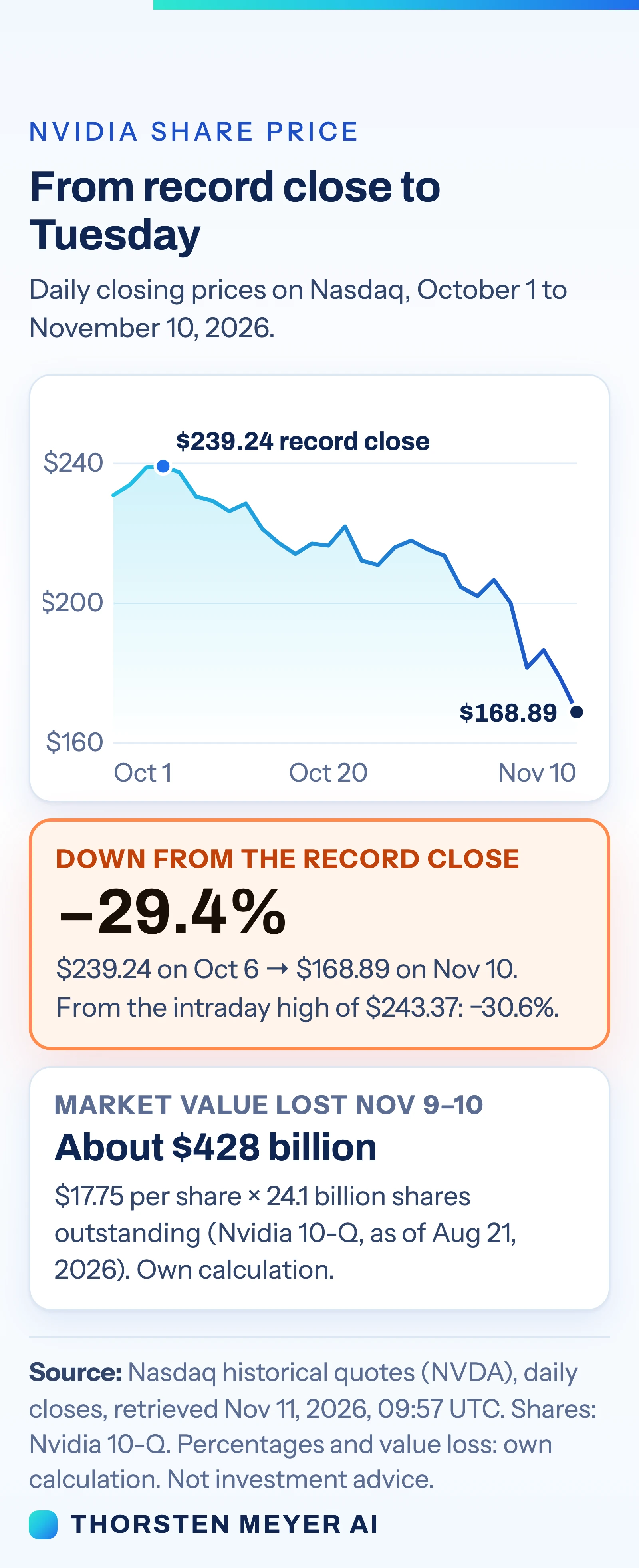
In two trading days, Nvidia lost about $428 billion in stock-market value. That is my calculation: the share price fell from $186.64 at the close on Friday, November 6, to $168.89 at the close on Tuesday, November 10 (Nasdaq data), a drop of $17.75 per share. Nvidia’s latest quarterly report lists 24.1 billion shares outstanding as of August 21, 2026. Multiply the two and you get roughly $428 billion.
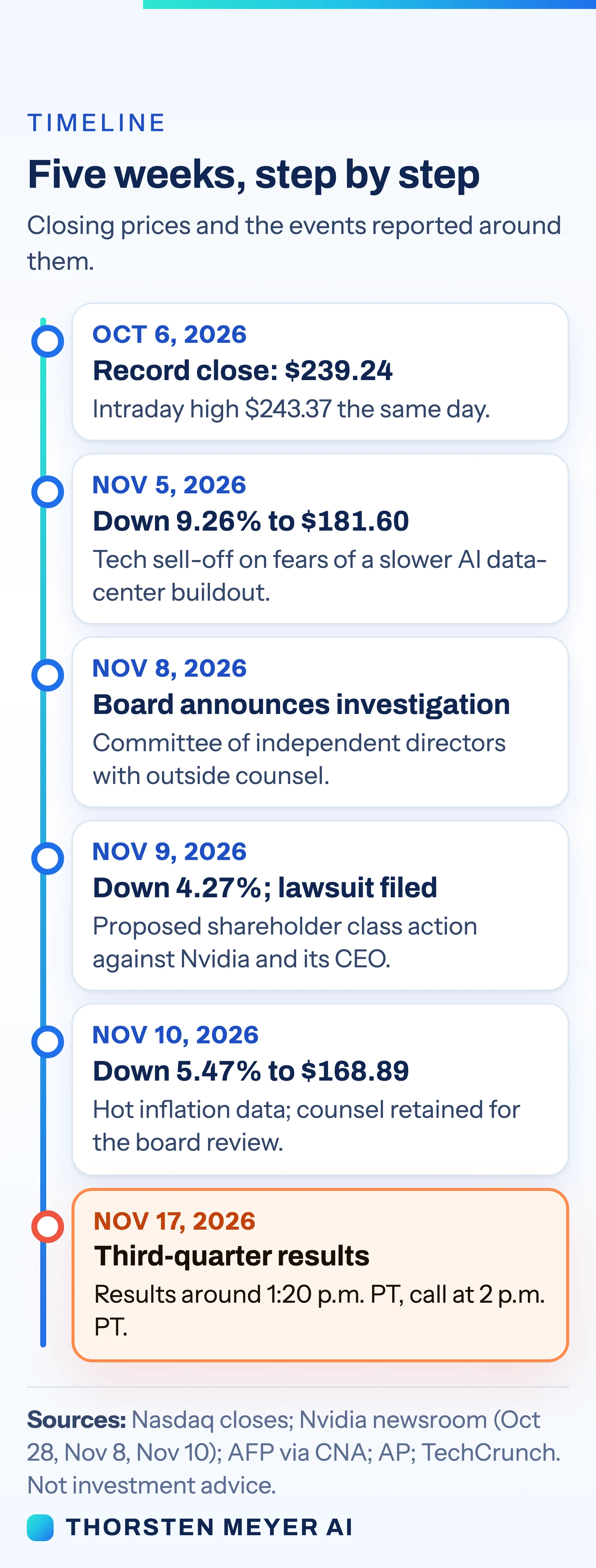
The longer view: Nvidia now sits 29.4% below its record close of $239.24 on October 6, five weeks ago, and 30.6% below the intraday high of $243.37 reached that same day. With the same share count, the drop from the record close comes to about $1.7 trillion in market value ($70.35 per share). The Motley Fool summed it up on Tuesday: Nvidia “has lost 30% of its value” from its all-time high. All figures in this article are as of the close on Tuesday, November 10.
The company whose chips power most of the AI boom has had a rough week. Part of the slide hit the whole tech sector. Part of it is about Nvidia alone: a board investigation, a shareholder lawsuit and questions about a customer under export-control scrutiny. Here is what the sources say, what Nvidia itself has said, why one company’s fall moves whole indexes, and what it means for businesses and users.
This article explains market data and public reporting. It is not investment advice and contains no buy or sell recommendation.
Key takeaways
- The figures: about $428 billion in market value lost on November 9 and November 10 (own calculation from Nasdaq closes and Nvidia’s reported share count). Nvidia closed at $168.89 on November 10, down 29.4% from its record close of $239.24 on October 6. Measured from the intraday high of $243.37, the drop is 30.6%. Since the record close, about $1.7 trillion in market value is gone (own calculation).
- The fast part: Since the close of November 4, the stock has lost 15.6% in four trading sessions, including a 9.26% fall on November 5 and drops of 4.27% and 5.47% on November 9 and November 10.
- Market-wide drivers: fears of a slower AI data-center buildout after the US midterm elections, and on Tuesday a hotter-than-expected inflation report that raised expectations of Federal Reserve rate hikes (AFP).
- Nvidia-specific drivers: a board investigation announced on November 8, a proposed shareholder class action filed on November 9, and scrutiny of a Nvidia customer over export controls.
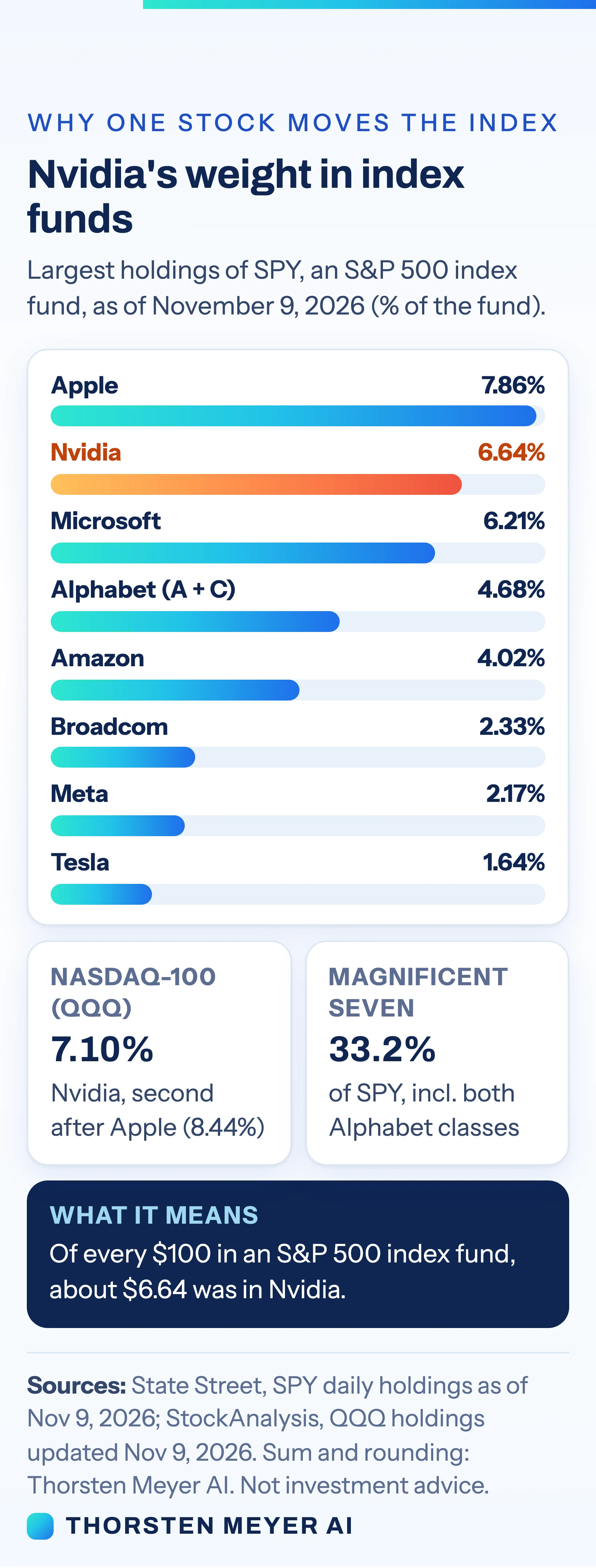
- Why it matters beyond Nvidia: Nvidia was 6.64% of the S&P 500 tracker SPY and 7.10% of the Nasdaq-100 tracker QQQ as of November 9. On Tuesday, CNBC reported, Nvidia “dragged down the three major averages.”
- What comes next: Nvidia reports its third-quarter results on November 17.
Products Worth Considering

Samsung 32 Odyssey G5 (G51F) QHD 180Hz Gaming Monitor

Bose TV Speaker (2nd Gen) Compact Soundbar with Bluetooth and HDMI Connectivity, Black

Bose QuietComfort Wireless Noise-Cancelling Over-Ear Headphones, Twilight Blue
As an affiliate, we earn on qualifying purchases.
From record to Tuesday’s close
On October 6, Nvidia closed at $239.24. Yahoo Finance reported that day that the shares settled “just below an all-time high set in afternoon trading” and that the company’s intraday market value reached $5.84 trillion.
The decline after that was slow at first. On October 30, the stock fell 4.22%. On November 4, it closed at $200.13. Then the pace picked up:
- Thursday, November 5: down 9.26% to $181.60, a loss of $18.53 per share in one session.
- Friday, November 6: a partial rebound, up 2.78% to $186.64.
- Monday, November 9: down 4.27% to $178.67.
- Tuesday, November 10: down 5.47% to $168.89. During the session, Reuters reported, Microsoft briefly overtook Nvidia as the world’s second-most valuable company. By the close, according to AFP, Nvidia was back in second place behind Apple.
All prices are Nasdaq closing prices; the percentage changes are my own calculation from those closes.
Why the stock is falling: the reported drivers
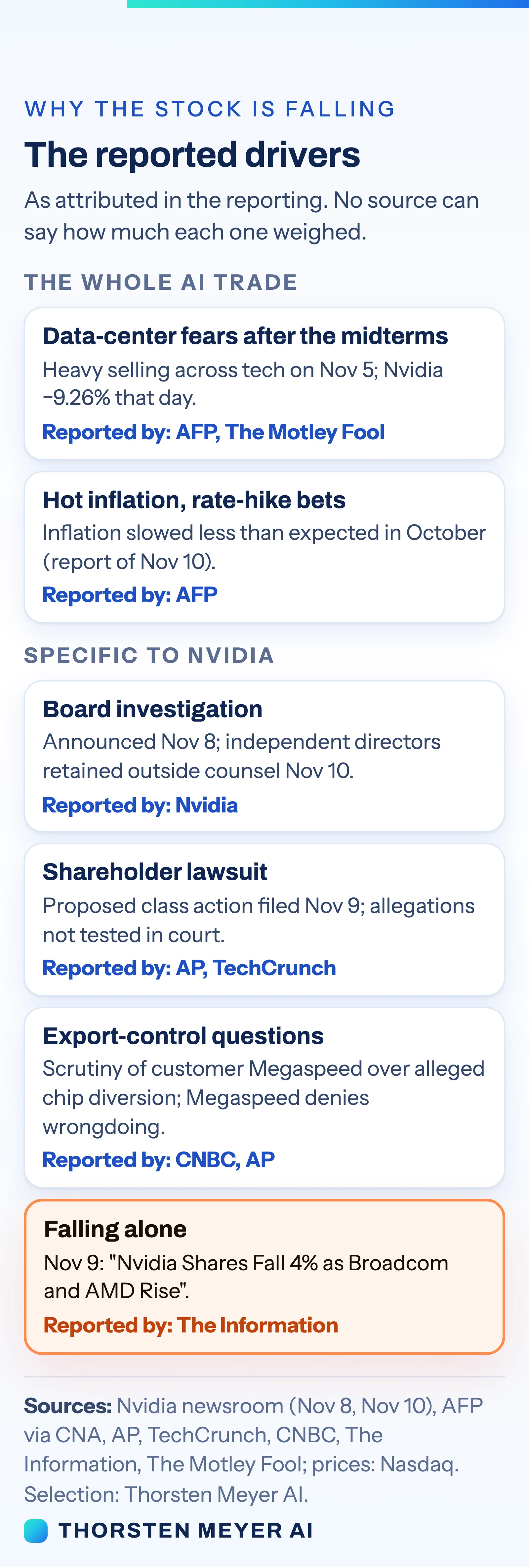
No single source can say how much each factor contributed to a price move. What the reporting shows is two layers: pressure on the whole AI trade, and problems specific to Nvidia.
Layer one: the whole AI trade
Data centers and the midterms. The heaviest single day, November 5, came shortly after the US midterm elections. AFP reported that “fears of a slower AI data centre buildout sparked heavy selling across the tech sector last week.” The Motley Fool wrote that the market expects the incoming Congress to be “more hostile to unfettered AI development” and that several incoming governors have announced plans for moratoriums on data-center construction. We covered that day in detail in The Nasdaq’s Worst Day in 19 Months.
Inflation and interest rates. On Tuesday, AFP reported, Wall Street fell after “US data showing inflation slowed less than expected in October,” which “boosted expectations of Federal Reserve interest rate hikes.” CNBC reported that the consumer price index rose 0.4% in October, above the 0.3% economists had expected. The Nasdaq lost 0.7%. Higher rates make borrowing more expensive, and the AI buildout runs on borrowed money as well as on profits.
Doubts about the AI outlook. Reuters attributed Tuesday’s fall partly to “uncertainty over the outlook for AI.”
Layer two: problems specific to Nvidia
A board investigation. On Sunday, November 8, Nvidia’s board announced “an independent investigation in light of recent reporting that founder and CEO Jensen Huang has been the target of a foreign intelligence effort.” A committee of independent directors, assisted by outside independent counsel, oversees it. On November 10, the independent directors said they had retained Joon H. Kim, a former acting U.S. Attorney for the Southern District of New York, and his firm Wachtell, Lipton, Rosen & Katz.
A shareholder lawsuit. On Monday, November 9, a retail investor filed a proposed class action against Nvidia and its CEO in federal court in the Northern District of California, according to TechCrunch and the Associated Press. According to the complaint, as reported by AP and TechCrunch, Nvidia and its CEO misled investors in earlier statements about the company’s dealings with Megaspeed, a Singapore-based buyer of Nvidia chips; the complaint cites news reports about the CEO’s personal conduct. The suit seeks unspecified damages and a jury trial. These are allegations. They have not been tested in court, and AP reported that Nvidia “didn’t immediately respond to a request for comment.”
A customer under export-control scrutiny. Megaspeed sells access to computing power from Nvidia chips in Southeast Asian data centers, CNBC reports. It “has faced scrutiny over allegations that Nvidia chips it acquired were diverted to China,” where US rules restrict exports of some advanced chips. Megaspeed denies wrongdoing. It says inspections by the US Commerce Department’s Bureau of Industry and Security, Malaysia’s trade ministry and Nvidia found “no evidence of any violations concerning the illicit transfer of chips or any illegal activities.” AP reported that Nvidia said at the time that its compliance team had checked and found Megaspeed was not doing anything illegal. The lawsuit challenges statements like these.
Falling alone. On November 9, The Information headlined: “Nvidia Shares Fall 4% as Broadcom and AMD Rise.” That is the clearest sign in the reporting that part of this week’s slide is about Nvidia itself, not about chips in general.
What Nvidia has said
- November 8, board statement: “While the Board has no reason to believe that either national security or NVIDIA secrets were compromised, the Board’s inquiry will examine all available information.” The CEO “fully supports the review and has committed to cooperating with it.” The board “has confidence in Jensen and his leadership team and will provide further updates as appropriate.”
- November 10, independent directors: they retained outside counsel “to conduct a thorough and independent investigation as was announced on Sunday.”
- On the lawsuit: no public response found as of the sources above.
- On results: Nvidia will report third-quarter results for fiscal year 2027 on Tuesday, November 17, at about 1:20 p.m. Pacific time, followed by a conference call at 2 p.m. Pacific time.
Why Nvidia moves the whole market
Most big stock indexes weight companies by their market value. The bigger the company, the bigger its slice. That makes Nvidia one of the heaviest stocks in the market:
- S&P 500: In State Street’s holdings file for SPY, an exchange-traded fund that tracks the S&P 500, Nvidia had a weight of 6.64% as of November 9, second only to Apple at 7.86%. Next came Microsoft at 6.21%, Alphabet at 4.68% (both share classes), Amazon at 4.02%, Broadcom at 2.33%, Meta at 2.17% and Tesla at 1.64%. Put simply: of every $100 in a fund that tracks the S&P 500, about $6.64 was in Nvidia.
- Nasdaq-100: In Invesco’s QQQ, which tracks the Nasdaq-100, Nvidia’s weight was 7.10%, according to StockAnalysis holdings data updated November 9. Again only Apple was larger, at 8.44%.
- The big group: In the same SPY file, Apple, Nvidia, Microsoft, Amazon, Alphabet (both share classes), Meta and Tesla, often called the Magnificent Seven, add up to 33.2% (my sum of the weights). The Motley Fool counted the index’s 10 largest companies at 39% of its weight in early November.
What that weight did this week:
- Monday, November 9: the S&P 500 had its best day since April, CNBC reported, while Nvidia fell 4.27%. The rest of the market rallied without it.
- Tuesday, November 10: the S&P 500 lost 0.38% and the Nasdaq Composite 0.74%. CNBC wrote that Nvidia “dragged down the three major averages.” Yahoo Finance noted that “the typical S&P 500 stock finished the day flat”: the equal-weight S&P 500, which gives every company the same slice, finished flat.
- The five-week picture: a Yahoo Finance basket of 62 chip stocks has lost “nearly $5 trillion in market value since Oct. 6, roughly a quarter of its worth,” compared with “roughly $2.7 trillion” for the whole S&P 500 over the same stretch. Over the same period, according to Yahoo Finance, the equal-weight S&P 500 is “up about 4%.”
Chip stocks and other markets. The knock-on effects were strongest during last week’s AI sell-off. On Friday, November 6, South Korea’s Kospi index fell as much as 8.78% before closing 6.02% lower at 5,059.69, according to a Yahoo Finance report. Memory maker SK hynix, a key supplier of high-bandwidth memory for AI chips, dropped 10.44%, and Samsung Electronics lost 6.35%. The Korea Herald tied the drop to fears of tighter US rules on AI data-center construction, as cited in that report. This week looked different: on Tuesday, AMD and Broadcom rose while Nvidia fell, Yahoo Finance reported, and AFP wrote that “European and Asian stock markets mostly rose.”
What the weight means for index-fund savers. An S&P 500 or Nasdaq-100 fund is not a bet on 500 or 100 equal pieces. A few companies carry a large share, so a sharp move in one of them shows up in the fund, as it did on Tuesday. This is how market-value weighting works; it is not a reason by itself to buy or sell anything.
What it means for the AI industry
Nvidia is the reference stock for the whole AI buildout. CNBC lists Microsoft, Amazon, Google, Meta and Oracle among its customers. When its share price falls this fast, it changes the mood around everything built on AI spending: chip suppliers, data-center developers, and AI companies raising money. AFP linked the wider AI wariness to Anthropic’s IPO plans, which we looked at in Anthropic Sets Its IPO Range.
Two other points matter beyond the share price. First, the export-control questions around Megaspeed are about how advanced chips move through cloud providers and resellers. CNBC notes that US rules restrict the export of some advanced chips to China, but that remote access to computing power is “a separate question.” Second, the slide adds to a debate that was already running: whether big AI customers should rely less on one supplier. We covered Google’s chip push in Google’s Two New AI Chips Make Four in One Year.
What it means for businesses that depend on Nvidia
A falling share price does not change what is in a server rack today. The chips, the cloud contracts and the software keep working. What businesses should watch is different:
- Supply and terms. Nothing in the sources points to delivery problems. The quarterly report on November 17 is where Nvidia usually speaks about demand and supply.
- Compliance in the supply chain. If you rent GPU capacity through regional cloud providers or resellers, export-control questions can reach your suppliers. It is reasonable to know where your computing capacity is located and who operates it. That is my reading, not a finding of any authority.
- Concentration risk. Many AI projects depend on one chip vendor and a few clouds. A week like this is a reminder to know what your plan B would be. That is a planning question, not a prediction.
What it means for ordinary investors and users
If you use AI tools, nothing changes for you today. If you have savings in broad stock-market funds, Nvidia is very likely among the holdings: as of November 9, it was 6.64% of SPY and 7.10% of QQQ. Large swings in one stock show up in those funds.
This article does not say whether the stock is cheap or expensive, and it makes no forecast. Analyst price targets are left out on purpose. For decisions about your own money, talk to a licensed adviser.
What is not known
- The weight of each driver. Nobody can split the 29.4% decline cleanly into a midterms part, an inflation part and an Nvidia-specific part.
- The board investigation. Its scope beyond the board’s statement, its timeline and its findings are not public. The board says it will “provide further updates as appropriate.”
- The lawsuit. It is a proposed class action at the earliest stage. The court decides later who leads the case, TechCrunch notes, and Nvidia’s response to the complaint is not public.
- Megaspeed. Whether any Nvidia chips were diverted in breach of US export rules has not been publicly established. Megaspeed denies wrongdoing.
- The quarter. Nvidia’s results and outlook come on November 17. Until then, there is no new company data on demand.
- The next sessions. This article reflects prices as of the close on November 10. Share prices can move sharply in either direction from here; we make no forecast.
The bottom line
Nvidia’s two-day loss of about $428 billion and its nearly 30% slide from the October record have two layers: an AI trade under pressure from politics and interest rates, and a company facing a board investigation, a shareholder lawsuit and questions about a customer and export controls. The facts that can be checked are the prices, the index weights, the board’s statements and the court filing. Everything else, including how this ends, is still open.
Sources
- Nasdaq: NVIDIA Corporation (NVDA) historical quotes, daily closing prices September 25 to November 10, 2026, retrieved November 11, 2026, 09:57 UTC
- NVIDIA Newsroom: “Statement From NVIDIA Board of Directors”, November 8, 2026
- NVIDIA Newsroom: “Statement From the Independent Members of the NVIDIA Board”, November 10, 2026
- NVIDIA Newsroom: “NVIDIA Sets Conference Call for Third-Quarter Financial Results”, October 28, 2026
- Associated Press (Kelvin Chan), via Anchorage Daily News: report on the shareholder lawsuit against Nvidia, November 10, 2026
- TechCrunch: “The race is on to sue Nvidia”, November 9, 2026
- CNBC: “What is Megaspeed?” explainer on the Nvidia chip buyer, November 9, 2026
- Reuters, via Yahoo Finance: “Microsoft tops Nvidia’s market cap for first time since June 2025”, November 10, 2026
- AFP, via CNA: “US stocks fall on hot inflation report as Nvidia tumbles again”, November 10, 2026
- The Information: “Nvidia Shares Fall 4% as Broadcom and AMD Rise”, November 9, 2026 (headline)
- The Motley Fool: “Nvidia Is Down 30% From Its High. History Says This Is What Happens Next.”, November 10, 2026
- Yahoo Finance: “Nvidia stock rises to new highs as market cap closes in on $6 trillion”, October 6, 2026
- NVIDIA Corporation: Form 10-Q for the quarter ended July 26, 2026 (shares outstanding as of August 21, 2026), SEC EDGAR
- State Street Global Advisors: SPDR S&P 500 ETF Trust (SPY) daily holdings, as of November 9, 2026
- StockAnalysis: Invesco QQQ Trust holdings, updated November 9, 2026
- CNBC: “Stock market today: Live updates”, live blog on the trading day of November 10, 2026
- Yahoo Finance: “Chip stocks’ slide nears $5 trillion as Nvidia hits most extreme selling level since 2019”, November 10, 2026
- Yahoo Finance: “SK hynix Stocks Plunge 10.44% as AI Memory Leader Leads Seoul Selloff”, November 6, 2026
- The Motley Fool: “These 6 Stocks Make Up a Big Share of the S&P 500”, November 5, 2026
Researched and drafted with AI assistance, including Anthropic’s Claude. No company named here reviewed or sponsored this article. This article is for information only. It is not investment, legal or tax advice and contains no buy or sell recommendation. Prices are Nasdaq closing prices through November 10, 2026, retrieved November 11, 2026; percentage changes and the two-day market-value loss are own calculations from those closes and the share count in Nvidia’s latest 10-Q. Index weights are fund holdings as of November 9, 2026. Images: AI-generated illustration (Runware) and graphics by Thorsten Meyer AI; no real people or logos are shown.