
Disclosure: This article contains affiliate links, and as an Amazon Associate I earn from qualifying purchases — at no extra cost to you. I only recommend gear I’d put in my own rigs. Prices and availability change constantly; confirm current pricing and compatibility before you buy.

Get business pricing on tech for your team
- Business-only prices and quantity discounts
- Tax-exempt purchasing
- Multiple users, one account, clear invoices
Most air-versus-liquid guides are written for gaming PCs, and they ask the wrong question for our purposes. They optimize for peak temperatures and benchmark numbers. But an AI workstation isn’t a gaming PC — it’s a machine you intend to leave running, often unattended, for hours or days at a time. And once “runs 24/7” is part of the spec, the most important question stops being “which cools better” and becomes “which one will still be working in three years without me thinking about it.“
That reframing changes the answer for most people. This guide walks the real tradeoff for an always-on inference rig, names exactly when each option wins, and gives you a clear way to decide.
It’s the comparison companion to the pillar, How to Reduce Heat and Noise in a High-Power AI Workstation (lever two, matching the cooler to a sustained load), and it pairs with the specific product picks in Best Quiet CPU Coolers for Sustained AI/Compute Loads. Here we’re deciding the category; that guide picks the parts.
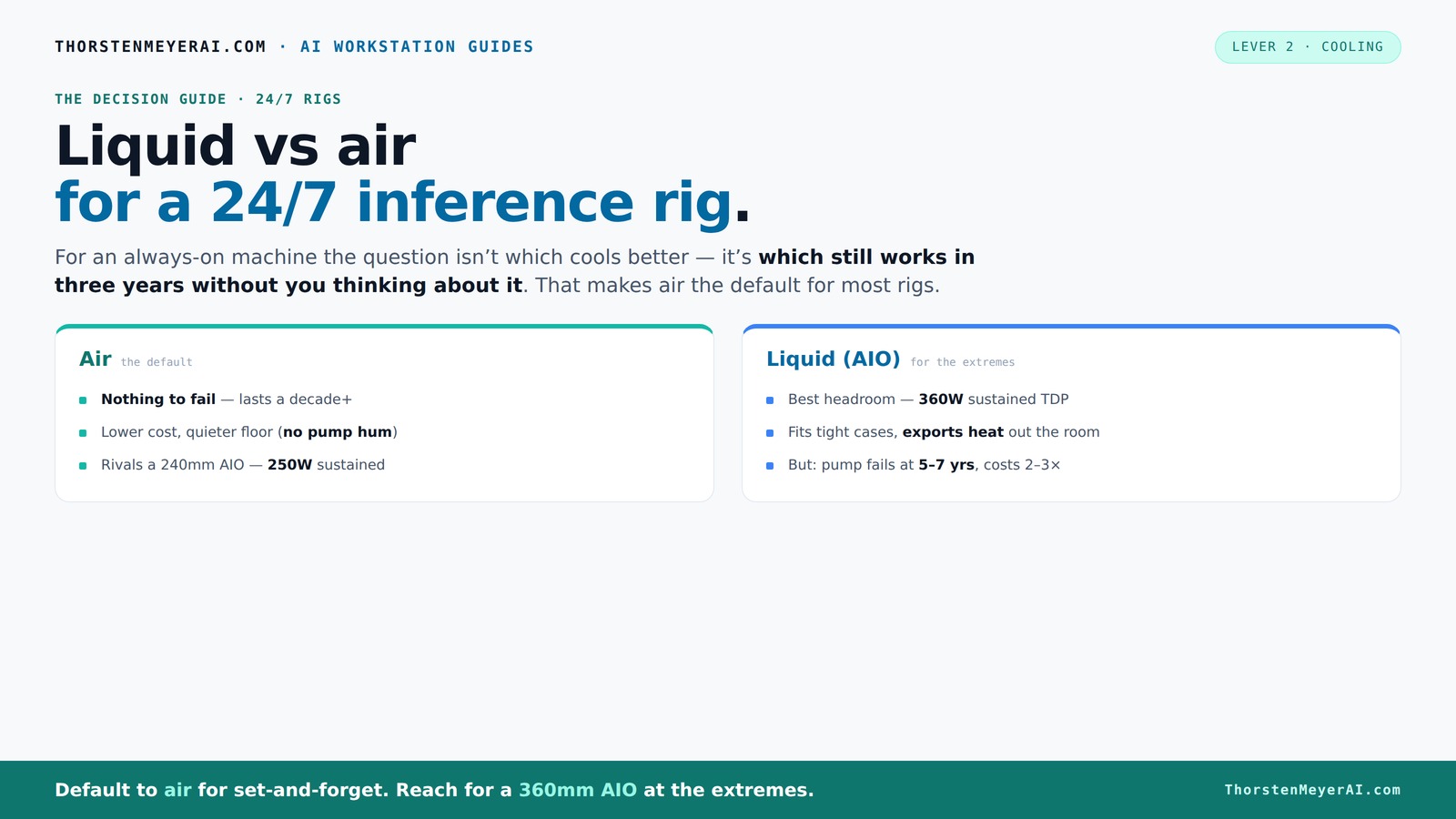
Liquid vs air
for a 24/7 inference rig.
For an always-on machine the question isn’t “which cools better” — it’s which one still works in three years without you thinking about it. That reframing makes air the default for most rigs. Answer three questions in Part 2 to find yours.
- Nothing to fail — fan swaps in minutes
- Lasts a decade+; lower total cost
- Quieter floor — no pump hum (~40–45 dBA)
- Trivial maintenance — wipe & repaste
- Tall — can block RAM, dumps heat in case
- Best headroom — ~360W TDP sustained
- Compact block — fits tight cases, clears RAM
- Exports heat out the radiator & room
- Pump fails at 5–7 yrs; replace whole unit
- Costs 2–3× more over its life; pump hum
- You run it 24/7 and want set-and-forget.
- Your CPU is mainstream-to-high-end (or power-capped).
- A big tower fits your case.
- You value lower cost and a quieter floor.
- Your CPU is too hot for air under sustained all-core load.
- A big tower won’t fit (compact / multi-GPU case).
- You need to export heat out of a warm room.
- RAM clearance is tight.
The short answer
For most 24/7 inference rigs, air cooling is the default — it's cheaper, simpler, quieter at the noise floor, and above all has nothing to fail. A top dual-tower air cooler handles a great many CPUs under sustained load without breaking a sweat.
Reach for a 360mm AIO in three specific situations: your CPU runs hot enough that air genuinely struggles under sustained all-core load; your case physically won't fit a big air tower; or you need to export heat out of a warm, non-climate-controlled room rather than dump it into the case. Outside those cases, the pump is complexity you're paying for and don't need.
Everything below is the reasoning behind that.
As an affiliate, we earn on qualifying purchases.
The thing that matters most for an always-on machine: reliability
Here's the difference that the gaming-focused guides underweight. An air cooler has exactly one moving part — the fan — and if it ever fails, you replace it in minutes for a few dollars. The heatsink itself is a solid block of metal that will outlast the rest of your system. Quality air coolers are warrantied for years, and Noctua famously extends to a decade. There is nothing in an air cooler to wear out, evaporate, leak, or seize.
An AIO (all-in-one liquid cooler) is a sealed loop with several interdependent parts, each with its own clock running:
- The pump is a single point of failure. It typically lasts 5–7 years, and when it goes, the whole cooler is dead — AIOs are non-refillable and non-repairable, so you replace the entire unit. Manufacturers warranty them for 5–6 years, which tells you what they actually expect.
- Coolant slowly permeates out through the rubber tubing — roughly 0.5% a year — so the loop gradually loses effectiveness over 3–5 years even if nothing breaks.
- Seals and tubing can harden, crack, or deform with age and heat.
- Leaks are rare with modern units, but not zero — and a leak can damage other components.
None of this makes AIOs bad. Modern ones are genuinely reliable today. But they have a defined lifespan, and running a pump 24/7 is exactly the duty cycle that accelerates the wear. For a set-and-forget machine, that's the crux: air cooling's simplicity is a feature, not a limitation. As the consensus across testing puts it, for set-and-forget systems air remains the safest choice. If your rig sits in a closet running jobs while you sleep, "nothing to fail" is worth more than a few degrees of headroom.
As an affiliate, we earn on qualifying purchases.
Where air cooling wins
Reliability and simplicity, as above — the decisive factor for an unattended 24/7 machine. One moving part, replaceable in minutes, no fluid to manage.
Value. Air cooling consistently wins on cost. A top dual-tower air cooler delivers performance comparable to a mid-size AIO for meaningfully less money, and over the life of the machine the gap widens — AIOs cost roughly 2–3x more in total cost of ownership once you account for eventual replacement.
A lower noise floor. This surprises people: quality air coolers are often quieter than AIOs under sustained load, because an AIO adds a constant low pump hum on top of its fan noise. Testing typically measures quality air coolers at around 40–45 dBA under load versus 45–55 dBA for AIOs once you factor in the pump. For a machine you sit next to, that constant hum is exactly the kind of noise that wears on you.
Trivial maintenance. Cleaning an air cooler is wiping dust off the fins and, occasionally, reapplying thermal paste. That's it.
Raw capability is closer than you'd think. A high-end dual-tower air cooler like the Noctua NH-D15 rivals a 240mm AIO, dissipating 200–250W and keeping even an i9 or Threadripper under 80°C during sustained tasks. For a large share of workstation CPUs, air simply is enough.
👉 See the top air cooler picks — or check a top dual-tower air cooler on Amazon
high durability liquid cooling for servers
As an affiliate, we earn on qualifying purchases.
As an affiliate, we earn on qualifying purchases.
Where liquid (AIO) wins
Peak and sustained thermal headroom on the hottest chips. This is the real one. A 360mm (or larger) AIO has more thermal mass and can handle around 360W of sustained TDP — the territory of the hottest CPUs run flat-out under all-core load, or overclocked. If your processor genuinely saturates a top air cooler during long jobs, a big AIO holds a steadier, lower temperature.
It fits where big air won't. The CPU block on an AIO is compact, so it never conflicts with tall RAM, and the radiator mounts to a case panel. In a compact case, or a densely packed multi-GPU build where a 160mm+ air tower physically won't fit, an AIO sidesteps the clearance problem entirely.
It exports heat out of the case — and the room. This is the underrated one for an inference rig. An air cooler dumps its heat into the case, raising the internal ambient temperature, which matters when the GPU is already flooding the case with heat. An AIO moves that CPU heat to a radiator mounted on an exhaust vent, pushing it straight out. In a non-climate-controlled room where ambient temperatures climb past 30°C, AIOs maintain better stability — they isolate the hot air instead of recirculating it.
RAM clearance and a cleaner CPU area, as a bonus — useful in tight or multi-GPU layouts.
👉 Check a top 360mm AIO on Amazon
As an affiliate, we earn on qualifying purchases.
Head to head
| Factor | Air cooler | 360mm AIO |
|---|---|---|
| Reliability (24/7) | Nothing to fail; fan replaceable in minutes | Pump is a single point of failure |
| Lifespan | A decade+; Noctua warranties to 10 yrs | 5–7 years; replace whole unit |
| Peak headroom | Great (rivals 240mm AIO) | Best, esp. 360mm+ (~360W TDP) |
| Noise floor | ~40–45 dBA, no pump hum | ~45–55 dBA incl. constant pump hum |
| Heat handling | Dumps into case | Exports out radiator/room |
| Case fit | Tall; can block RAM | Compact block; flexible radiator |
| Maintenance | Wipe fins, repaste | None, but non-repairable |
| Cost (TCO) | Lower; best value | ~2–3x more over its life |
| Best for | Set-and-forget 24/7 rigs | Hottest CPUs, tight cases, hot rooms |
How to decide
Walk these in order — the first "yes" points you to your answer.
- Does your case physically fit a big dual-tower air cooler? If no (compact or dense multi-GPU build), you're going AIO by necessity. If yes, continue.
- Is your CPU one of the hottest chips, run flat-out under sustained all-core load? If yes, a 360mm AIO gives you headroom air can't match. If you're on a mainstream or upper-mainstream CPU — or you've power-capped it (lever one) — air is plenty.
- Is the rig in a hot, non-climate-controlled room where exporting heat out of the case matters? If yes, an AIO's radiator-out-the-vent design helps. If it's in a normal room, this doesn't move the needle.
- Otherwise — default to air. For a 24/7 machine you want to set and forget, the reliability, simplicity, value, and lower noise floor make a top air cooler the right call.
The throughline: let your situation, not the marketing, choose. Most inference rigs are mainstream-to-high-end CPUs in adequate cases in normal rooms — and for those, air is the smarter, more durable choice. The AIO earns its place at the extremes.
A note on what's coming
Air-cooling technology keeps advancing, and there's an interesting middle path worth knowing about: pumpless liquid coolers. The Ice Giant ProSiphon Elite uses thermosiphon technology — a sealed loop that moves heat by evaporation and gravity rather than a pump — and already matches 360mm AIO performance without the pump that's the AIO's main failure point. It's niche and pricey today, but it's the kind of design that could eventually give you liquid-class headroom with air-class reliability. For now, it's one to watch rather than a mainstream recommendation.
The bottom line
For a 24/7 inference rig, the deciding question isn't which cooler wins a benchmark — it's which one keeps working, unattended, for years. By that standard, air cooling is the default: nothing to fail, lower cost, lower noise floor, trivial maintenance, and more than enough capability for most workstation CPUs. Choose a 360mm AIO when your CPU is genuinely too hot for air under sustained load, when your case won't fit a big tower, or when you need to export heat out of a warm room.
And remember the order of operations from the pillar guide: if you undervolt and power-cap first, you reduce the heat your cooler has to handle in the first place — which often turns a "do I need liquid?" question into a comfortable "air is plenty." Then pick the specific part from the coolers roundup.
Figures and lifespan estimates from 2026 cooling comparisons across Tom's Hardware, Corsair, MSI, and independent reviewers. Pump lifespan, permeation, and noise figures are typical ranges and vary by unit, mounting, and environment. As an Amazon Associate I earn from qualifying purchases.
Columbus Day / Indigenous Peoples' Day Picks
long weekend sales
As an affiliate, we earn on qualifying purchases.