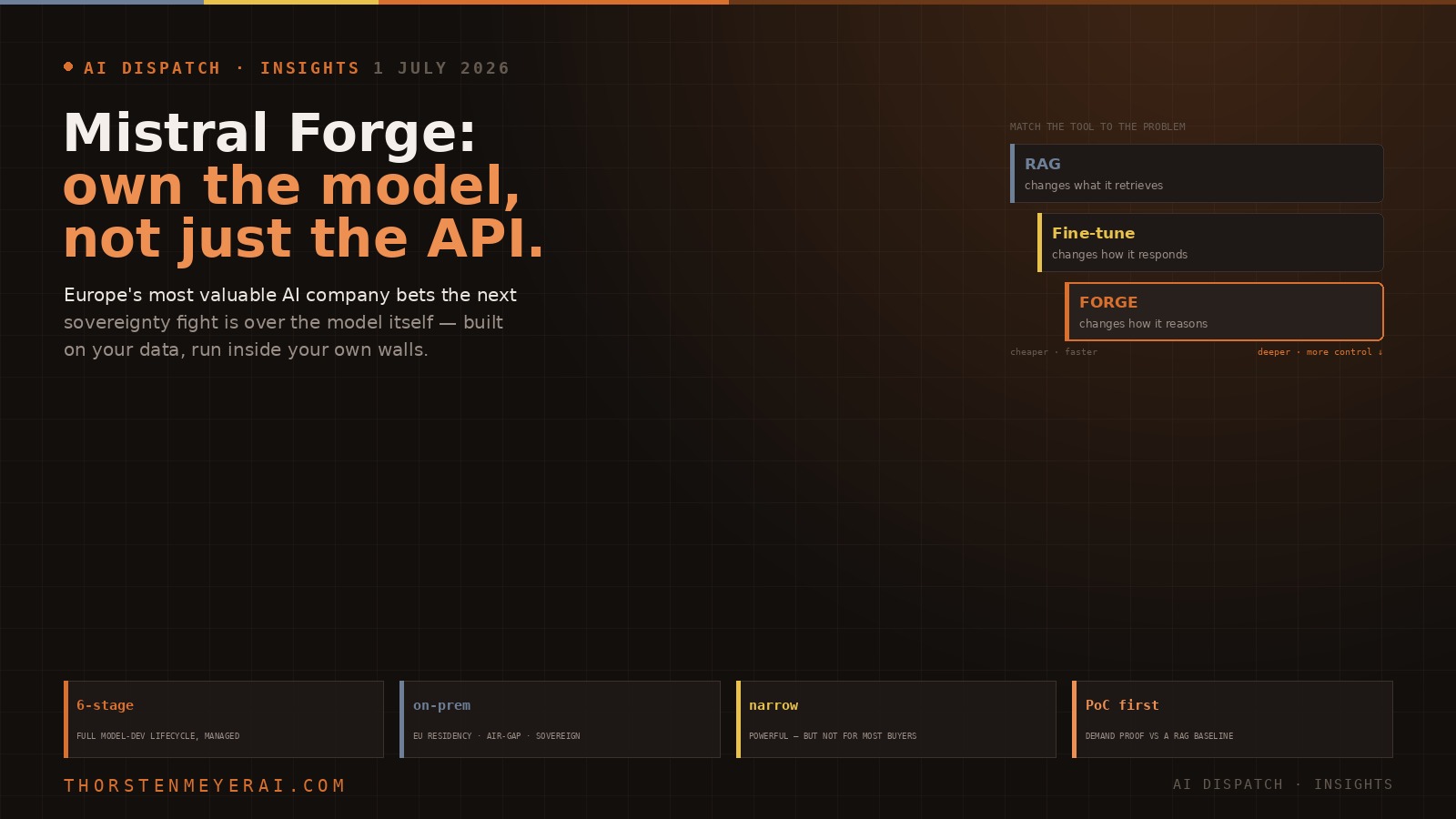

For two years, “enterprise AI” has mostly meant one thing: rent a big general-purpose model through an API, then bend it toward your needs with prompts, a retrieval pipeline, and a governance wrapper. Mistral’s Forge, announced at Nvidia’s GTC in March 2026, argues for a different path entirely.

Get business pricing on tech for your team
- Business-only prices and quantity discounts
- Tax-exempt purchasing
- Multiple users, one account, clear invoices
The pitch is blunt: don’t adapt a generic model to your company — build a model that is your company. Train it on your documents, your code, your terminology, your rules, and run it inside your own walls. Europe’s most valuable AI company is betting that the next front in the sovereignty fight isn’t which API you call — it’s whether you own the model at all.
For a specific kind of organization, that’s a genuine capability leap. For most, it’s a bigger commitment than the problem needs. The honest version of this story is about knowing which one you are — so here’s what Forge actually is, when it’s worth it, and the questions to ask before signing anything.
Mistral Forge: owning the model, not just renting the API
Europe’s most valuable AI company is betting the next sovereignty fight isn’t which API you call — it’s whether you own the model at all. Forge builds a model adapted to your data, terminology & rules, run inside your own walls. A leap for the right buyer; overkill for most.
Your proprietary knowledge changes how the model reasons — engineering/code, industrial constraints, government language & law, security telemetry, agentic tool-use by your rules. High-consequence, data-mature, sovereignty-bound.
You want a knowledge assistant, doc search or support bot — RAG or light fine-tuning wins on cost, speed & updatability. Analysts warn most enterprises lack the clean, governed data Forge assumes.
Train on your data, in your jurisdiction, on infrastructure you control, with a non-US vendor — air-gapped if needed, keeping the models, infra & knowledge. In a year when model access proved to be a geopolitical variable, owning the model stops being philosophy and becomes a hedge. (US labs offer custom models too; Forge’s moat is the combination — full pre-training + EU residency + on-prem, one platform.)
Forge packages what used to require an in-house AI research team — deep adaptation, sovereign deployment, full lifecycle, with embedded engineers. For big, regulated, data-rich orgs with high-consequence use cases, that’s a real leap, and the European framing is a feature. For everyone else it’s a heavier commitment than the problem needs — climb the ladder (RAG → fine-tune → Forge) and demand proof, not marketing. The deeper signal: enterprise sovereignty is shifting from “which API?” to “do I own the model?”
The three-rung ladder: RAG, fine-tuning, Forge
The single most useful thing to get straight is where Forge sits relative to the cheaper options, because the difference is not marketing — it’s a real difference in what part of the model changes.
RAG (retrieval-augmented generation) gives a general model access to your documents at the moment it answers. It changes what the model can look up, not what it understands. Best for frequently changing facts, citations, and document search.
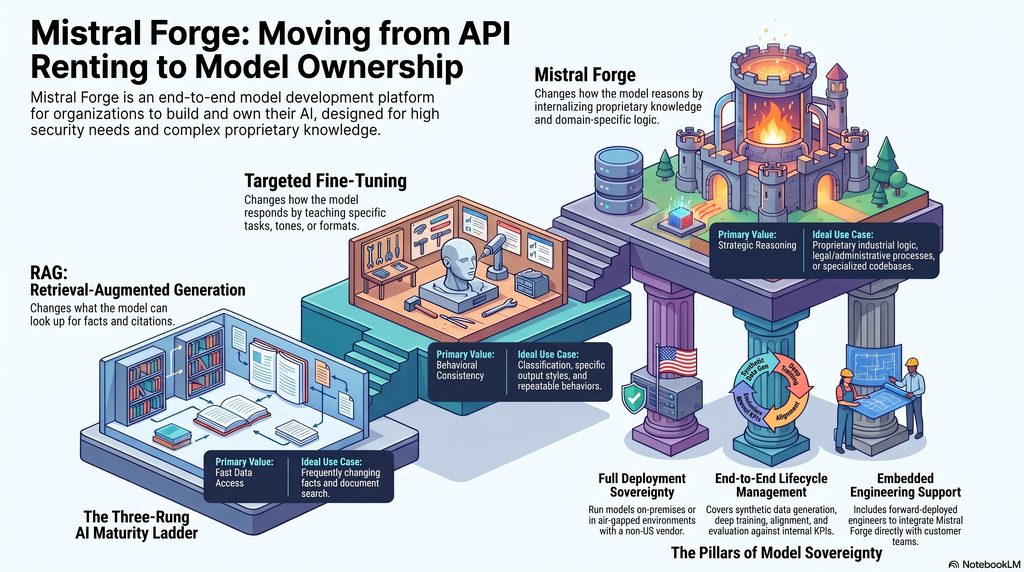
Fine-tuning teaches an existing model a task, a tone, a format, or a repeatable behavior. It changes how the model responds. Best for output style, classification, and consistent task behavior.
Forge creates and operates a substantially domain-adapted model — potentially including additional pre-training, alignment, and reinforcement learning. It changes how the model reasons. Best when your proprietary knowledge isn’t just information to retrieve but something that should shape the model’s judgment itself.
The sensible sequence for almost everyone is RAG first, targeted fine-tuning second, Forge only when model-level specialization delivers a clear incremental benefit you can measure. Skipping straight to Forge because it sounds most powerful is the expensive mistake.
enterprise AI model training software
As an affiliate, we earn on qualifying purchases.
As an affiliate, we earn on qualifying purchases.
What’s actually in the box
Forge is closer to a managed model-development program than a self-service builder — an end-to-end lifecycle platform that packages the toolchain an internal AI research team would otherwise have to assemble. The stages Mistral describes:
Data preparation — including synthetic data generation to manufacture rare edge cases and compliance-oriented scenarios your real corpus lacks. Training — on large volumes of internal text, code, and records, supporting both dense and mixture-of-experts architectures, with multimodal foundations where relevant. Alignment and specialization — the full post-training kit: LoRA, supervised fine-tuning, Direct Preference Optimization, RLHF, and distillation. Evaluation — against your KPIs, regression suites, and drift tests, not just public leaderboards. Lifecycle management — versioning and lineage for datasets, models, configs, and training runs, with auditing and rollback. Deployment — private cloud, on-premises, or Mistral’s own compute, depending on your security and data-residency constraints.
Two details matter more than the feature list. Forge ships with forward-deployed engineers who embed directly with customer teams — a Palantir-style, consulting-heavy model that tells you this is a program you run with Mistral, not a product you buy off a shelf. And it’s built for agentic workflows: Mistral’s own code agent, Vibe, can drive Forge to tune models, search hyperparameters, schedule jobs, and generate synthetic data. The base models underneath are Mistral’s open-weight checkpoints.
local AI model development platform
As an affiliate, we earn on qualifying purchases.
As an affiliate, we earn on qualifying purchases.
When it’s worth it — and when it isn’t
The strong case for Forge is narrow and real: when your proprietary knowledge affects how the model should reason, not merely what it retrieves. Think an engineering model that has internalized your architecture, coding conventions, and legacy systems; an industrial model fluent in your specialist vocabulary and operating constraints; a government model adapted to local language, law, and administrative process; a security model aligned to your telemetry and incident history; or an agent trained to pick your internal tools and follow your workflows. Mistral’s early adopters — ASML, Ericsson, the European Space Agency, Reply, and Singapore’s DSO and HTX — are exactly this profile: organizations whose data is too sensitive or too specialized to hand to a third-party API and hope.
The honest counter-case is that this describes very few companies. For the typical organization that wants an internal knowledge assistant, document search, or a customized support bot, Forge is overkill — RAG or light fine-tuning wins decisively on cost, speed, and updatability. And there’s a technical reason even Forge adopters keep RAG around: knowledge baked into model weights is hard to update, delete, or cite. Recent facts, traceable evidence, and frequently changing policies belong in a document store you can edit, not in weights you’d have to retrain.
The sharpest critique comes from the analysts at Futurum, and it’s worth taking seriously: the addressable market may be narrower than Mistral implies, because Forge assumes a level of data maturity most enterprises don’t have. Their survey found a large share of organizations spend more than half their time just maintaining and organizing data rather than using it. The adopters who benefit — the ASMLs and ESAs — are precisely the ones with clean, structured data and the technical capacity to run a training program. They are not representative of the broader market. Forge sells a capability many buyers aren’t yet ready to use.
As an affiliate, we earn on qualifying purchases.
The sovereignty angle — why this is a European story
Strip away the toolchain and Forge’s real differentiators are three: deep domain adaptation, deployment sovereignty, and full lifecycle control. The middle one is the strategic core. Forge lets an organization train its models on its own data, in its own jurisdiction, on infrastructure it controls, with a non-US vendor — and, in the air-gapped case Mistral describes with Singapore’s HTX, retain control of the models, the infrastructure, and the knowledge outright.
That positioning didn’t come from nowhere. It lands in a year when model access proved to be a geopolitical variable — when a frontier model could be switched off worldwide on a government’s directive. Against that backdrop, the ability to own and run your model sovereignly stops being a philosophical preference and becomes an operational hedge. Mistral’s founder frames the company’s whole thesis as owning the full stack — “electrons into tokens” — and is building data centers to back it. Forge is the model-layer expression of that bet: for buyers who can’t or won’t depend on someone else’s model access, it offers a way to not have to.
It’s fair to note the competitive reality rather than overstate the uniqueness. OpenAI runs a custom-model program for large customers, and Anthropic offers enterprise fine-tuning through cloud partners; the big US labs are not standing still on customization. Forge’s genuine distinction is the combination — full pre-training, EU data residency, and on-prem or air-gapped deployment in a single managed platform from a European provider. That bundle, not any one feature, is the moat.
As an affiliate, we earn on qualifying purchases.
The catch: cost, commitment, and the questions to ask
Forge demands far more than the cheaper rungs — more data, more evaluation work, more compute, and real organizational commitment. There’s no public rate card; custom models and private deployment sit under enterprise “contact us” pricing, so treat any six- or seven-figure estimate skeptically until it’s tied to a specific model, dataset, and deployment design.
Before committing, a serious buyer should get clear answers on: IP rights (who owns the resulting weights, adapters, synthetic data, and evaluation sets?); portability (can you export the complete model and training artifacts and run them without Mistral?); data handling (where is it processed, what telemetry is retained, how is deletion done?); base-model licensing (what restrictions carry over from the underlying checkpoint?); refresh cadence (how often must you retrain as knowledge and policy change?); operational ownership (who does monitoring, red-teaming, rollback, incident response, upgrades?); and true total cost (data prep, specialist staff, GPU capacity, evaluation, inference, and maintenance — not just the training run).
Above all, one piece of due diligence outranks the rest: insist on a controlled proof-of-concept that pits Forge against a much cheaper RAG-plus-fine-tuning baseline, and against competing open-model approaches, on your actual business task. If model-level specialization can’t beat the baseline on evidence, it isn’t worth the platform commitment — however good the demo looked.
The take
Forge is strategically interesting because it packages what used to require a sophisticated in-house AI research and infrastructure team: deep domain adaptation, sovereign deployment, and full model-lifecycle tooling, wrapped in embedded engineering support. For large industrial, governmental, and regulated organizations — the ones with valuable proprietary data, high-consequence use cases, and a genuine need for on-prem or sovereign operation — that’s a real leap, and the European, non-US framing is a feature, not a footnote.
For everyone else, it’s a heavier commitment than the problem calls for, and even the right buyers should climb the ladder deliberately — RAG, then fine-tuning, then Forge — and demand proof over marketing. Because the product is only a few months old and most public evidence still comes from Mistral and its partners, the mature move is a controlled bake-off before any platform bet.
The deeper signal is the one worth keeping. The sovereignty question in enterprise AI is shifting from “which API do I call?” to “do I own the model?” — and a European champion has just planted a flag on the far end of that spectrum. Whether you need to stand there yet is a different question. But the direction of travel is unmistakable, and it points toward owning more of your own stack.
Sources: Mistral AI (Forge announcement and product pages, HTX case study, pricing); TechCrunch, VentureBeat, Forbes, Futurum Group, and trade coverage of the March 17, 2026 GTC launch (early adopters ASML/Ericsson/ESA/Reply/DSO/HTX; forward-deployed engineers; Mistral Vibe integration; dense + MoE and full-lifecycle tooling); TCS press materials (first global systems-integrator partner, May 2026); Futurum’s data-maturity critique. ASML led Mistral’s Series C (2025, ~€11.7B valuation). Vendor capability claims should be validated by a customer-specific evaluation rather than assumed. Analysis and framing are the author’s; not investment advice.
Halloween Picks
halloween
As an affiliate, we earn on qualifying purchases.