The Mistral piece I wrote ended on a question I couldn’t answer and didn’t want to fake: why would a company pay Mistral to run models on-prem when it could download Qwen and run it for free? It’s the sharpest challenge to the entire European sovereignty pitch, and it deserves a real answer rather than a hand-wave. So here’s the answer, as honestly as I can give it — and it starts by retiring the most misleading word in the whole conversation.

Get business pricing on tech for your team
- Business-only prices and quantity discounts
- Tax-exempt purchasing
- Multiple users, one account, clear invoices
“Free.”
The weights are free to download. Running them well is not. And the gap between “free to download” and “cheap to operate” is exactly where every serious decision about open versus closed AI actually lives. I want to walk through what that real comparison looks like, because I’ve spent real money on both sides of it — and the answer is more interesting, and more favorable to running your own, than either the cloud evangelists or the local-AI purists will tell you.
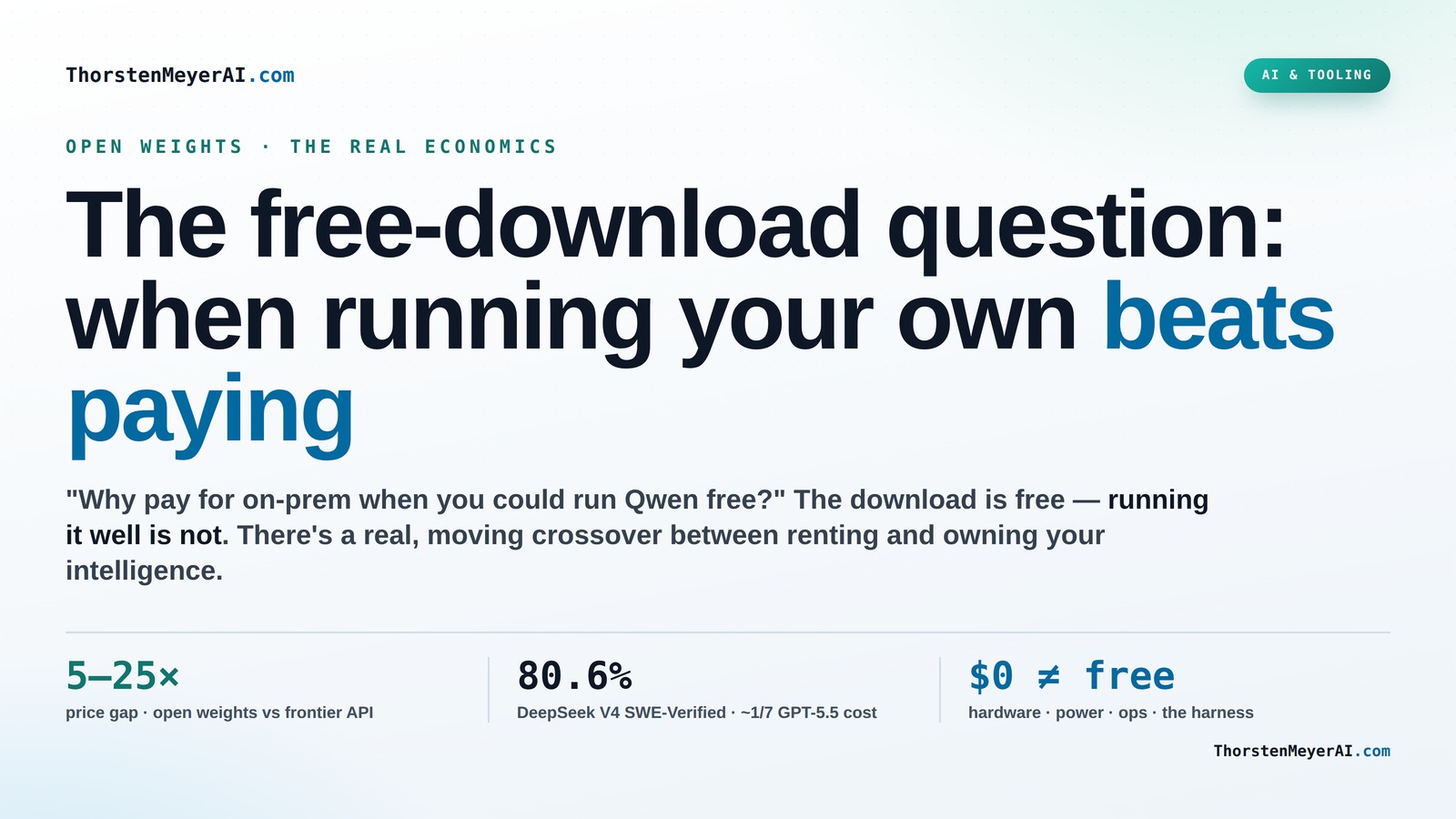
The free-download question: when running your own actually beats paying
“Why pay for on-prem when you could run Qwen free?” The download is free — running it well is not. The honest comparison is total cost of ownership vs. per-token API. And there’s a real, moving crossover.
“Free” means the download, not the running
When someone says an open model is free, they mean the weights. They’re not counting the hardware, power, ops time, the quality gap, or depreciation. For most workloads, those are the entire cost.
- Hardware — the machine to hold & run it
- Electricity — sustained inference draws real power
- Ops time — updates, queue health, tuning, 2 a.m. breakage
- The harness — context, persistence, retries (not optional)
- Quality gap — 6–12 mo behind frontier on hardest tasks
- Depreciation — frontier hardware dates in ~3 years
Where owning beats renting
Below some usage level the API wins decisively. Above some sustained, predictable volume, owned hardware wins — and the meter never restarts. Drag the volume; toggle the task and sovereignty needs.
API vs. own-hardware — monthly cost balance
An illustrative model, not a quote. The point is the shape: a real crossover that moves with your inputs.
Two regional pools, a 5–25× price gap
The “you trade away too much capability” objection got much weaker. Open weights have closed to within 5–15 points of the closed frontier — and on some tasks drawn level.
What you own when you own the inference
Apple Silicon’s unified memory rewired the math — a 192GB Mac Studio holds a 70B model in memory; MoE models (e.g. 35B total / ~3B active) make frontier-adjacent capability runnable on a desk. But owning inference means owning all of this:
The true-cost line items the “free” framing skips
Lived from a small Mac fleet running Qwen on MLX for a high-volume publishing pipeline: at sustained volume it pays for itself against the per-token meter — but every item below is real.
Hardware capex
The fleet up front. Depreciates — dates in ~3 years even if no invoice shows it.
Electricity
Sustained inference draws real power. At fleet scale it’s a monthly bill, not a rounding error.
Operational burden
Model updates, quantizations, queue health, throughput tuning, 2 a.m. breakage you now own.
The harness
Context, persistence, retries, tool routing. Not optional — the model is only half the system.
No per-token meter
The payoff: once owned, inference cost stops scaling with use. The meter never restarts.
Data never leaves
Nothing sent to strangers. Sovereignty is structural, not a contractual promise.
The crossover zone is real — and growing
The “just run Qwen” dismissal and the “you need a vendor” reflex are both too simple. The local path wins in a specific, identifiable zone — and that zone is bigger than a year ago.
Which way it tips
What “free” actually costs
When someone says an open-weight model is free, they mean the download. They are not counting the hardware it runs on, the electricity it draws, the engineering time to make inference reliable, the quality gap against the frontier on your hardest tasks, or the depreciation of the machine you bought. Those are not rounding errors. For most workloads they are the entire cost.
The honest comparison is not “free model versus paid API.” It’s total cost of ownership — capital expenditure, power, operations, and the opportunity cost of a slightly weaker model — set against per-token API pricing with zero operational burden. Frame it that way and the question stops being ideological and becomes arithmetic, which is where it belonged all along.
And arithmetic has a crossover point. Below some level of usage, the API wins decisively, because you’re renting capability you’d otherwise have to buy and babysit. Above some level of sustained, predictable volume, owning the hardware wins, because the per-token meter never stops running and at scale it dwarfs the one-time cost of a machine. The interesting questions are where that crossover sits, which way it’s moving, and what besides volume tips it.
As an affiliate, we earn on qualifying purchases.
The open weights are genuinely good enough now
The first thing that’s changed — and changed fast — is that the “you’re trading away too much capability” objection has gotten much weaker. As of mid-2026, the open-weight field has closed to within roughly five to fifteen points of the closed frontier on the benchmarks engineering teams actually track, and on some tasks it has drawn level.
The specifics matter. DeepSeek V4 Pro tops the open-weight leaderboard at 80.6% on SWE-bench Verified, and at roughly $0.43/$0.87 per million tokens it costs about one-seventh of GPT-5.5. On neutral testing — Artificial Analysis’s Intelligence Index — Kimi K2.6 leads open weights at 54, DeepSeek V4 Pro follows at 52, and GLM-5.1 sits at 51. GLM-5.1 is a 754-billion-parameter mixture-of-experts model under an MIT license that, by its lab’s own benchmarks, outperforms GPT-5.4 and Claude Opus 4.6 on SWE-Bench Pro. The shape of the field is best captured by one line from a developer writing in late April: the 2026 stack is no longer Anthropic-versus-OpenAI-versus-Google; it is two regional pools — a Western frontier and a Chinese frontier — with overlapping capability and a 5–25× price gap.
A five-to-twenty-five-times price gap is not a detail. It is the whole argument. When the open model is one-fifth to one-twenty-fifth the cost of the frontier and within a handful of points on capability, the “pay for the best” reflex stops being obviously correct and starts depending entirely on what you’re doing.
Two honest caveats, though, because this is the house style and because they’re true. First, the pattern is consistent: open models lag the frontier by six to twelve months, then catch up on the specific capabilities that were hardest the year before. If your work lives on the genuine bleeding edge of agentic reasoning, the frontier closed models are still ahead, and the gap is real on the hardest long-horizon tasks. Second — and this one is non-negotiable — every open-weight model performs significantly better inside a structured agent harness than in raw chat mode, and that investment isn’t optional for production use. The model is half the system. The harness around it — context, persistence, retries, tool routing — is the other half, and a great harness around a slightly weaker model routinely beats a frontier model in a clumsy one. The “free download” gives you the model. It does not give you the harness.
As an affiliate, we earn on qualifying purchases.
The hardware finally makes individual ownership viable
The second thing that’s changed is the hardware, and this is the part I find genuinely significant for small operators rather than just enterprises.
Apple Silicon’s unified-memory architecture quietly rewired the economics of local inference. The M-series unified memory eliminates the PCIe bottleneck that hamstrings discrete-GPU setups, so a Mac Studio with 192GB of unified RAM can hold a 70-billion-parameter model fully in memory and run it without thrashing — which was not possible at this price point before 2022. Mixture-of-experts architectures push this further: a model like Qwen3.6-35B-A3B has 35 billion total parameters but activates only about 3 billion to generate each token, so memory holds the whole model while the processing cost tracks the much smaller active set. That combination — big unified memory plus sparse activation — is what makes frontier-adjacent models runnable on a desk instead of in a data hall.
I’ll speak from my own setup, because abstract cost models are less honest than lived ones. I run a small fleet of Macs for my content-generation pipeline — an M3 Ultra with 512GB as the heavy inference node, a second Ultra, an M4 Max coordinating the work, and a couple of Mac Minis as workers — with Qwen running locally through LM Studio on MLX, a daily-driver quantization for volume and a larger model held in reserve for the hard jobs, and a PostgreSQL job queue using row-level locking to keep the workers fed. I did not build this as a science experiment. I built it because the per-token cost of running my publishing volume through a frontier API was a real, recurring line item, and the fleet pays for itself against that meter. That is the crossover in practice: at sustained high volume, on work where a well-harnessed open model is good enough, owned hardware wins on cost — decisively, and then permanently, because the meter never restarts.
But I’ll be equally honest about the other side of my own ledger, because it’s the part the local-AI enthusiasts skip.
electricity cost monitor for servers
As an affiliate, we earn on qualifying purchases.
As an affiliate, we earn on qualifying purchases.
The “you’re now running a data center” reality
The moment you own the inference, you own everything that comes with it. The electricity is not free — sustained inference draws real power, and at fleet scale that’s a monthly bill, not a rounding error. The hardware depreciates; the machine you bought at the frontier of price-performance will look ordinary in eighteen months and dated in three years, and that depreciation is a true cost even if it never shows up on an invoice. The operational burden is constant: models to update, quantizations to manage, a queue to keep healthy, throughput to tune, things that break at 2 a.m. that an API provider would have handled for you. Setting up and configuring local models requires more technical know-how than simply pasting an API key — there’s a learning curve. And you are perpetually one frontier release behind on the hardest tasks, which for some work is fine and for other work is disqualifying.
This is the part that makes the crossover real rather than rhetorical. If your volume is low or spiky, the API wins easily — you’d be buying and babysitting a machine to replace a bill you could pay by the sip. If your work needs the absolute frontier on every call, you pay for the frontier, full stop. The local path wins in a specific and identifiable zone: high, sustained, predictable volume, on tasks where a well-harnessed open model clears the bar, where you have or can build the operational competence, and where data sovereignty adds value beyond cost. That zone is not everyone. But it is a lot more people than it was a year ago, and it’s growing.
As an affiliate, we earn on qualifying purchases.
So: why pay Mistral, then?
Which brings me back to the question that started this. If you can run Qwen free, why pay Mistral — or anyone — for on-prem?
The honest answer is that you pay for the parts that aren’t the weights. You pay for the harness and the integration — the context, persistence, and tooling that turn a model into a working system. You pay for support and a throat to choke when it breaks. You pay for a model genuinely tuned to your task rather than a general one you have to wrangle. You pay for someone else carrying the operational burden I described above. And in Europe specifically, you pay for provenance and compliance posture that a Chinese open-weight download, however capable, may not satisfy for a regulated bank’s auditors.
That’s a real value bundle. Whether it’s worth paying for, against a free download plus your own engineering, is exactly the calculation each organization has to run — and the answer genuinely differs by who you are. A sophisticated operator with the skills to run their own fleet and harness should think hard about whether the bundle earns its price. A regulated enterprise without that competence, or with auditors who care about provenance, may find the bundle is the entire point. Both can be right. The “just run Qwen” dismissal and the “you need a vendor” reflex are both too simple.
The shift underneath the arithmetic
I want to close on the thing that makes this more than a cost-optimization story, because I think it’s the genuinely important part.
For most of computing history, owning the means of serious computation was the privilege of institutions. Frontier capability lived in data centers you rented access to. What’s quietly happening in 2026 is that the combination of good-enough open weights, permissive licenses, and unified-memory hardware has made it possible for an individual or a small operator to own — not rent — a frontier-adjacent intelligence capability outright. The download is free, the hardware is a desk purchase, the model is yours, and the meter never runs. That is a real shift in who gets to own the means of intelligence production, and it points the same direction as every other thread I follow here: capability that used to require an institution is becoming individually ownable.
It doesn’t make the cloud wrong. For most people, most of the time, the API is the right call, and it will stay that way. But the existence of a genuine, expanding crossover zone — where a person with a few machines and the willingness to learn can run their own intelligence at a cost the frontier can’t touch — is new, and it’s structurally important. The “free” in “free download” was always misleading. What’s not misleading is that, for the first time, the full stack of owning your own model is within an individual’s reach. The question isn’t whether that’s free. It’s whether it’s yours. Increasingly, it can be.
Sources: benchmark and pricing figures from Artificial Analysis, codersera, MindStudio, and developer reporting (current as of late May 2026 and fast-moving); Apple Silicon inference characteristics from DEV Community, Contra Collective, and Local AI Master. Open-weight scores are vendor- and harness-dependent point estimates; treat cross-model rankings as directional. This is independent commentary and not affiliated with any model provider.
Fall Picks
fall essentials
As an affiliate, we earn on qualifying purchases.