By Thorsten Meyer | ThorstenMeyerAI.com | January 2026
I’m done being polite about this.
While the United States fights a brutal war against the physics of AI infrastructure—7-year grid queues, 210-week transformer backlogs, a scramble to build 134 nuclear reactors’ worth of power capacity by 2030—European policymakers are doing what they do best: writing regulations for a technology we can’t build, can’t power, and increasingly can’t deploy.
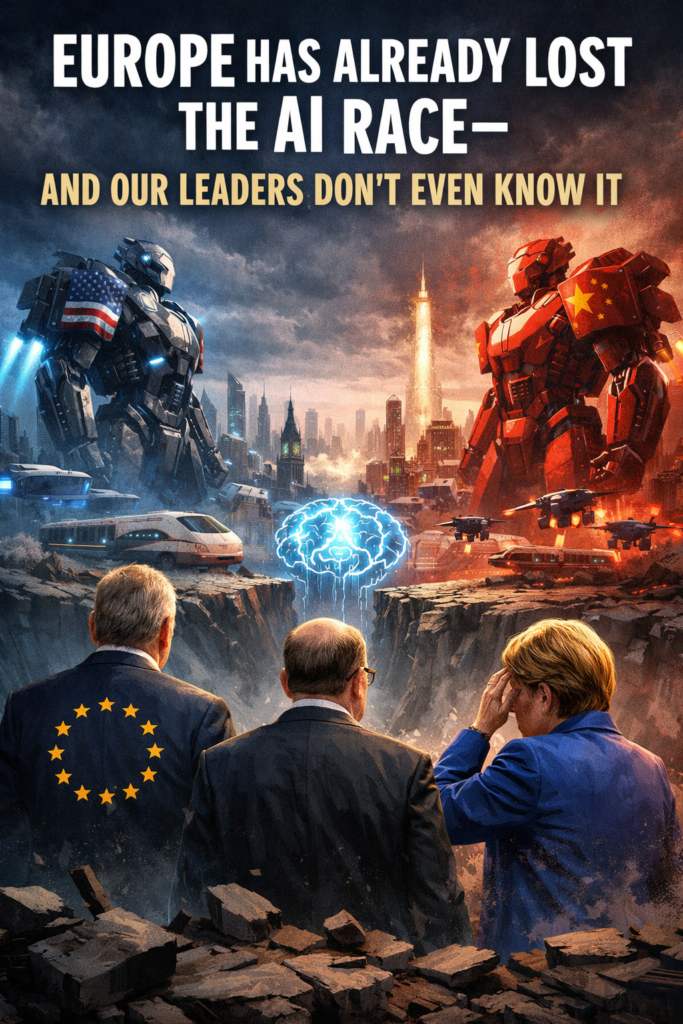
This isn’t a policy disagreement. It’s civilizational suicide with extra steps.
The numbers are not subtle: US private AI investment since 2013 exceeds $470 billion. Europe’s? $50 billion. By 2027, America will have 17 times China’s compute capacity. Europe will have zero domestic frontier-grade compute—100% dependent on American chips and Nvidia’s allocation decisions.
We’re not falling behind. We’re becoming a colony.
The Bottleneck Comparison That Should End Political Careers
David Shapiro’s recent analysis of AI infrastructure bottlenecks should terrify European policymakers—not because it describes American problems, but because it reveals what serious countries consider “problems” while we haven’t even started playing.
| Bottleneck | United States | European Union |
|---|---|---|
| Energy | 7-year grid waits; building gas, nuclear, batteries as fast as permits allow | Fragmented grid; “green vs. baseload” ideological civil war; 7-13 year connection times; Ireland already collapsing |
| Compute | Will have 17x China’s capacity; constrained by packaging, not capability | Zero domestic frontier compute; begging for TSMC scraps |
| Regulation | “Noise” about copyright/art; actual B2B deployment proceeds freely | AI Act vetocracy; $52K/year licensing; startups fleeing to Delaware |
| Liability | Insurers struggling to price risk | Strict liability + insurance exclusions = deployment impossible |
| Investment | $470B+ private capital (2013-2024) | $50B—less than 11% of US |
Americans have problems. We have a death spiral.

X13SEM-TF Bulk
Intel Xeon SPR-SP CPU up to 56 cores 350W TDP+EBGPCH,8xD
As an affiliate, we earn on qualifying purchases.
As an affiliate, we earn on qualifying purchases.
The Thermodynamic Wall We’re Not Even Fighting
Shapiro describes a “thermodynamic wall”—the raw physics of energy generation that now constrains AI more than algorithms or data. The US faces:
- 7-year average to connect a data center to the grid
- Demand surge from 4 GW to 134 GW by 2030
- 210-week lead times for critical transformers
These are brutal challenges. But Americans are fighting them. Natural gas plants going up. Grid-scale batteries deploying. Permitting reform happening.
China? They added 429 GW of generation capacity in 2024 alone—15 times the US, and roughly 30 times Europe. While we debate whether natural gas qualifies as a “transition fuel,” China is building the electrical foundation for AI dominance.
And Europe? Our grid connection times exceed America’s—7 to 13 years in major hubs. Our energy policy is paralyzed by a civil war between France (nuclear) and Germany (wind and prayers). Our permitting processes are designed to prevent things from being built.
Ireland should be Europe’s AI hub. Instead, it’s becoming a case study in data center expansion collapsing into inadequate infrastructure. Grid operators warn of national energy security threats. Labor unions revolt. Environmental groups demand moratoriums.
We’re not in the race. We’re in the stands, heckling.

DrapeMania NDR-240-24 240W 24V 10A Industrial Single Output DIN Rail Power Supply – Reliable AC to DC Converter for Data Center and Server Equipment
Reliable Performance: The DrapeMania NDR-240-24 boasts an impressive 88.5% efficiency rating,With active PFC function. reducing energy waste and…
As an affiliate, we earn on qualifying purchases.
As an affiliate, we earn on qualifying purchases.
The Supply Chain We Surrendered
Here’s what nobody in Brussels wants to admit: Europe has zero capability to produce frontier AI compute.
Every H100, every B200, every piece of silicon powering European AI research:
- Designed by NVIDIA (American)
- Manufactured by TSMC (Taiwanese)
- Memory from Samsung/SK Hynix (Korean)
- Packaged by TSMC/ASE (Taiwanese)
The European Chips Act mobilizes €43 billion. Sounds impressive until you realize:
- Cutting-edge fabs take 3-5 years to build
- TSMC’s process expertise took decades to develop
- By 2028, the AI race will be decided
- Our fabs will come online in time to make chips for an era that’s already ended
Meanwhile, High Bandwidth Memory (HBM) is sold out through 2026. CoWoS packaging—the critical bottleneck—is 50%+ booked by Nvidia. European companies are at the back of the queue, hoping for scraps.
We’re not participants in this supply chain. We’re customers. Not even priority customers.

NVIDIA H100 : Pioneering AI Hardware for the Future
As an affiliate, we earn on qualifying purchases.
As an affiliate, we earn on qualifying purchases.
The AI Act: Europe’s $52,000 Gift to American Startups

The EU AI Act is the most comprehensive AI regulation in history. It’s also the most effective competitive advantage transfer to the United States since the Marshall Plan—except this time, we did it to ourselves.
What the Act demands:
- Risk categorization across four tiers
- Third-party conformity assessments
- Quality management systems
- Technical documentation requirements
- Data governance protocols
- Human oversight mechanisms
- Ongoing monitoring obligations
- ~$52,000/year licensing costs for “high-risk” systems
$52,000 per year. For a European AI startup, that’s not a compliance cost—it’s a death sentence. For their American competitors, it’s a gift: every founder who relocates to Delaware is one less competitor.
And “high-risk”? The category is so broad that virtually any useful AI application triggers it. Employment decisions, credit scoring, educational assessment, infrastructure management—anything that might actually transform an industry faces the full compliance burden.
Shapiro calls Europe a “vetocracy.” He’s being polite. We’ve built a system where everyone can say no and nobody can say yes. Every stakeholder—member states, Parliament, Commission, NGOs, industry groups—has veto power over innovation. No one has authority to build.
One year in, implementation is chaos:
- Harmonized standards delayed into 2026
- General-Purpose AI Code of Practice delayed indefinitely
- Conformity assessment bodies under-resourced
- The Digital Omnibus already retreating from unworkable requirements
The message to AI companies is clear: build elsewhere.

How to Design an Energy-Efficient Cooling System for Modern Data Centers
As an affiliate, we earn on qualifying purchases.
As an affiliate, we earn on qualifying purchases.
The Insurance Crisis Nobody Mentions
Shapiro identifies a bottleneck that gets zero policy attention: insurance companies are writing absolute exclusions for AI risks.
Not higher premiums. Complete exclusions. Insurers can’t model AI liability, so they won’t cover it.
Without insurance, enterprises can’t deploy AI. Period. Doesn’t matter if the technology works.
Europe made this catastrophically worse. The AI Liability Directive shifts burden of proof toward AI operators. The Product Liability Directive expansion covers software. The AI Act’s documentation requirements create paper trails for plaintiffs’ lawyers.
We’ve constructed the most hostile liability environment for AI deployment on Earth. Rational insurers will either refuse European coverage entirely or price it at levels that make deployment economically impossible.
The result: operational stagnation. European companies cannot deploy AI at scale even if they want to.
The cruelest irony: regulations designed to protect Europeans from AI harm are ensuring Europeans can’t access beneficial AI. The patient who could benefit from AI-assisted diagnosis? Protected from that benefit. The student who could learn from AI tutoring? Protected from that improvement.
Protection as deprivation. Safety as stagnation.
The Investment Chasm
These numbers should force resignations:
- 2023 VC Investment: EU €7B vs. US €58.5B (8:1 ratio)
- 2024 Private Investment: US $109B vs. EU ~$4.5B (24:1 ratio)
- Foundation Models Since 2017: US 73% vs. EU ~4% (18:1 ratio)
Investment gaps compound. Each dollar generates research advances, infrastructure, talent concentration, data advantages, and market positions that fund more investment. The US is in a virtuous cycle. Europe is in a death spiral.
The Draghi Report documented all of this. 400 recommendations for European competitiveness. Published over a year ago. Implementation rate: 11%.
Mario Draghi himself is now publicly begging European leaders to act. They’re too busy debating whether ChatGPT needs a conformity assessment.
The Digestion Phase We’re Missing
Shapiro argues we’ve entered the “Digestion Phase” (2026-2028)—the critical window when AI capabilities translate into deployed systems generating real economic value.
Success requires: grid permits, fab capacity, power generation, talent retention, regulatory clarity.
Europe is failing on every dimension.
88% of AI pilots fail—due to data quality, talent gaps, and legacy system integration. These are solvable problems with investment and tolerance for failure.
But Europe’s regulatory environment punishes experimentation. When a failed pilot can trigger compliance investigations, when every deployment creates liability exposure, when documentation requirements make learning prohibitively expensive—rational companies don’t pilot at all.
We’ve created a system that rewards stagnation and punishes progress.
What Would Actually Help (If Anyone Cared)
Emergency (2026):
- Declare a 24-month AI Act moratorium. Stop the bleeding.
- Fast-track energy infrastructure with emergency permitting.
- Create government-backed insurance pools for AI deployment.
Structural (2026-2028):
- Create an EU AI Infrastructure Authority with actual power to override objections.
- Reform the AI Act: ex-post accountability instead of ex-ante compliance.
- Implement all 400 Draghi recommendations. Now.
Strategic (2028+):
- Accept that frontier AI is lost. Europe will not develop competitive foundation models.
- Focus on application: deploy AI developed elsewhere in domains where European expertise provides advantage.
- Negotiate the best dependency terms we can get from the US.
The Museum or the Workshop
The next three years will determine whether Europe participates in the AI transformation or becomes its subject.
America faces serious challenges but responds with engineering. China brings capabilities we can’t match—429 GW in a year. Both are fighting physics with concrete.
Europe alone has chosen to write regulations for a technology it cannot build.
We can keep perfecting our regulatory cathedral—debating risk categories while the future is built in Texas and Shenzhen.
Or we can admit catastrophic failure, abandon the vanity project, and pour every resource into physical infrastructure.
We can be a museum: admired for our principles, irrelevant to the future.
Or we can be a workshop: messy, imperfect, but building something.
The cathedrals can wait.
It’s time to pour concrete.
Thorsten Meyer is an AI strategist who has grown tired of polite policy papers that change nothing. Follow his work at ThorstenMeyerAI.com
Sources: