
Executive summary
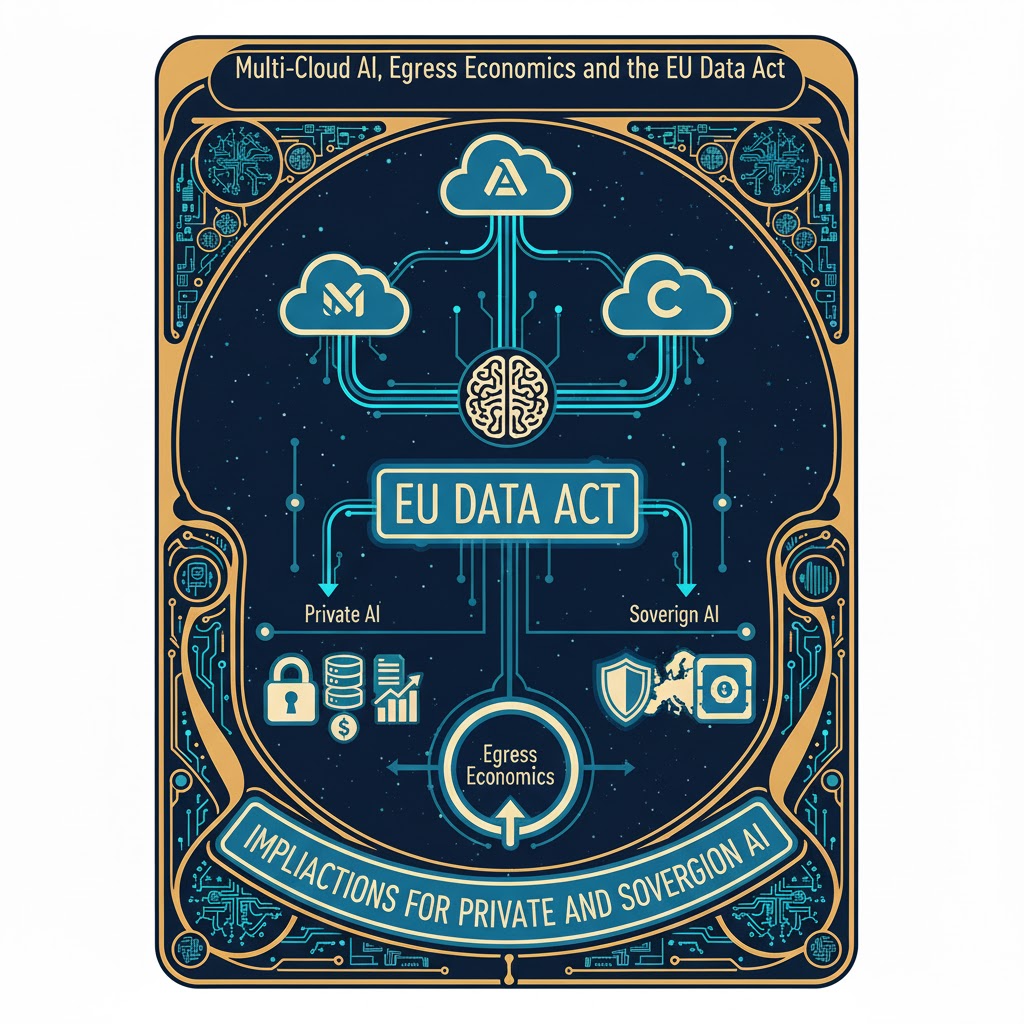
Thorsten Meyer AI champions private, responsible and sovereign AI. These principles face new challenges: AI projects are eating budgets through inference costs and hidden egress fees, while hyperscale clouds lock users in with proprietary services and data‑transfer charges. The EU Data Act, coming into force for cloud portability in September 2025, empowers European businesses and consumers to extract and move their data, restricts profiteering on data transfer, and introduces a timeline for eliminating switching feesfivetran.com. This white paper applies the Act’s provisions to multi‑cloud AI architectures and outlines strategies for protecting privacy, maintaining digital sovereignty and controlling costs.
Key insights include:
- Training vs. inference: Training is a one‑off capital expense, but inference is an ongoing operational cost that often exceeds trainingfinout.io. Generative‑AI applications are widely adopted and cost intensive due to compute‑heavy inference and API pricingcloudzero.com.
- Egress fees and lock‑in: Hyperscalers charge around US $0.09/GB for internet egress and additional fees for cross‑region transfersnops.io. Hidden network and storage charges can add 20–40 % to monthly billsgmicloud.ai. Egress fees and proprietary services create a strong lock‑in effectngpcap.com.
- Regulatory shift: The EU Data Act grants users rights to access and transfer data, prohibits unfair contract terms and requires cost‑based pricing for switching until 2027skadden.com. Free or at‑cost transfer programmes offered by Google, Microsoft and AWS apply only to migration or internal multi‑cloud usetheregister.com.
- Private and sovereign AI: Multi‑cloud AI strategies, edge inference, model optimisation and careful contract negotiation can reduce costs and enhance data sovereignty. Combining this with privacy‑preserving techniques aligns with Thorsten Meyer AI’s advocacy for responsible AI.

The Economics of AI Infrastructure for AI Engineering and Large Language Models Volume 1: Why AI Systems Are Expensive — Understanding the Cost of Training, Inference, Memory, Networking, and Scale
As an affiliate, we earn on qualifying purchases.
As an affiliate, we earn on qualifying purchases.
Introduction: Thorsten Meyer’s vision for responsible AI
Thorsten Meyer is a futurist and founder of a private AI publishing network. His platform explores topics from agentic commerce and vibe coding to universal basic income and digital sovereignty, advocating for private and responsible AIdeepintellica.com. Recent white papers on Private GenAI and AI Ops & Observability show a commitment to de‑risking AI adoption and promoting transparency.
The present paper continues this mission. As AI workloads spread across clouds and edge devices, controlling cost and ensuring data sovereignty are critical. The EU Data Act offers a unique opportunity: it legally enshrines the right to retrieve and move data, reduces barriers to switching, and aims to ban egress profiteering by 2027fivetran.com. For Thorsten’s audience—entrepreneurs, engineers and policymakers—understanding the interplay between AI economics, egress fees and regulation is essential for building sovereign, privacy‑preserving AI systems.

As an affiliate, we earn on qualifying purchases.
1. The cost dynamics of AI workloads
1.1 Training vs. inference
- Different spending profiles: Finout explains that AI economics come in two flavours—training, a massive one‑off GPU marathon, and inference, the perpetual meter that runs every time a model is usedfinout.io. Training can cost millions of dollars, but inference spend often dwarfs the original training costfinout.io.
- Generative‑AI adoption: CloudZero’s 2025 survey of 500 software engineers reports that 60 % of organisations use generative‑AI tools; these applications introduce the highest costs due to compute‑heavy inference and tokenised API pricingcloudzero.com. Average monthly AI budgets rose 36 % between 2024 and 2025cloudzero.com.
- Hidden costs: GPU compute is the largest expense for AI startups (40–60 % of budgets)gmicloud.ai. High‑end H100/H200 clusters cost US $2.10–4.50 per hour on specialised providers but US $4–8 per hour on hyperscale cloudsgmicloud.ai. Data transfer, storage and networking add 20–40 %gmicloud.ai.
1.2 The egress cost trap
- Egress pricing: AWS charges about US $0.09/GB for the first 10 TB of internet egress and extra for cross‑region transfersnops.io. Other hyperscalers have similar structures. When large models or datasets move between clouds or regions, these fees quickly exceed training costs.
- Lock‑in: NGP Capital notes that discounts and proprietary services, combined with egress fees, create a powerful lock‑in effect—hyperscalers are unlikely to remove these fees because they anchor customer retentionngpcap.com. VentureBeat reports that some organisations pay more to move data than to train models; to cut costs, they often shift inference to on‑premises or colocation environments, reducing bills by 60–80 %venturebeat.com.
- Case study: 37signals: In 2025, 37signals received a US $250,000 egress waiver from AWS while migrating off the platformawsinsider.net. By moving storage on‑premises, it expects to reduce its annual infrastructure bill from US $3.2 million to well under US $1 millionawsinsider.net. The company argues that owning hardware can be cheaper and that cloud vendors propagate the myth that running servers is too hardawsinsider.net.
These findings highlight a paradox for responsible AI: data must be free to move to ensure sovereignty, yet egress fees impose economic barriers that can undermine privacy and flexibility.
data egress fee reduction services
As an affiliate, we earn on qualifying purchases.
As an affiliate, we earn on qualifying purchases.
2. The EU Data Act: a catalyst for data portability
2.1 Rights and obligations
The EU Data Act is a cornerstone of Europe’s digital strategy. Its data‑portability provisions apply to cloud service providers (IaaS, PaaS, SaaS) offering services in the EUskadden.com. Key features:
- Data access and sharing: Users have the right to access and share data generated by connected devices and digital servicesskadden.com.
- Fair contract terms: Providers must eliminate unfair clauses that restrict switching; pricing for disengagement and data transfer must be transparentskadden.com. Model contractual terms will be recommended by September 2025skadden.com.
- Switching rights: Articles 23–29 grant users the right to extract data and switch providers without approvalfivetran.com. Any functional or technical loss during switching is prohibited.
- Fee restrictions: Article 29 phases out switching fees entirely by 2027. Until then, providers may charge only actual costs for data transfer; premium surcharges or “data ransom” pricing are bannedfivetran.com. For in‑parallel use, Article 34 allows only cost‑based egress feesfivetran.com.
By codifying these rights, the Data Act aims to restore control over data to individuals and businesses, promoting competition and digital sovereignty.
2.2 Industry responses
- Google introduced Data Transfer Essentials, a zero‑cost programme for multi‑cloud transfers within the same organisation, targeting EU/UK customers. It meters traffic separately and charges nothing when data moves between Google Cloud and another provider; misuse triggers normal internet chargestheregister.com. The service goes beyond regulatory requirements but is limited to qualifying trafficnetworkworld.com.
- Microsoft offers at‑cost data transfers for EU customers migrating to another provider; customers must file support requeststheregister.com. Azure already provides 100 GB/month of free egress globally, with additional waivers available through supportawsinsider.net.
- AWS waives egress fees for customers exiting its cloud; credits are provided via support after verifying the migration is legitimateinfoq.com. AWS frames this as promoting customer choice rather than complianceawsinsider.net.
These programmes soften but do not eliminate egress charges. They apply to specific scenarios (migration or internal transfers) and may involve administrative processes, leaving general internet egress unchanged.
2.3 Implications for private and sovereign AI
For Thorsten Meyer’s community, the Data Act is a powerful tool but not a silver bullet:
- Sovereign data mobility: The Act allows data to move freely, supporting digital sovereignty and private AI. However, until 2027, cost‑based egress fees remainfivetran.com. Careful architecture is needed to minimise data transfers across clouds.
- Contractual diligence: Contracts must reflect Data Act rights. Review existing agreements for lock‑in clauses, ensure functional equivalence at the new provider, and require cost‑based pricing. Fivetran advises auditing providers and updating procurement playbooks to enforce interoperabilityfivetran.com.
- Regional considerations: The Data Act applies to EU services; global operations must manage multiple legal regimes. Data containing personal information remains subject to GDPR and may restrict transfersfivetran.com.

WINSOON Barn Door Lock Hardware Stainless Steel, Sliver
- Durable Material: Stainless steel with brushed satin finish
- Easy Installation: Includes all necessary hardware for DIY setup
- Reversible Design: Control arm slides both ways for convenience
As an affiliate, we earn on qualifying purchases.
As an affiliate, we earn on qualifying purchases.
3. Designing private and sovereign multi‑cloud AI architectures
3.1 Align training and inference placement
- Keep data and compute co‑located: Train and serve models in the same region or provider to avoid cross‑cloud egress. When training on specialised GPU clouds and serving inference elsewhere, compress models and use efficient file formats to reduce transfer volume.
- Use specialised GPU providers: Compare pricing; e.g., specialised clouds offer H100 clusters at US $2.10–4.50 per hour versus US $4–8 on hyperscalersgmicloud.ai. Factor in hidden costs (storage, egress) that add 20–40 %gmicloud.ai. On‑premises hardware may be cost‑effective for steady workloadsawsinsider.net.
- Optimise inference: Tier models so simple queries use smaller, cheaper modelsfinout.io. Apply quantisation, distillation and caching to cut inference computefinout.io.
- Leverage off‑peak and spot pricing: Schedule training during off‑peak hours or in regions with lower pricesfinout.io. Use spot or preemptible instances for fault‑tolerant jobs.
3.2 Minimise egress through architecture
- Edge and on‑premise inference: Deploy inference servers near the user to reduce egress and latency. Cache common responses and precompute results to avoid repeated cross‑cloud requestsfinout.io.
- Federated learning: Keep data local and exchange model updates rather than raw data, reducing egress volume. This aligns with privacy and data sovereignty.
- Compression and deduplication: Compress model weights (e.g., FP16 or BFLOAT16) and deduplicate checkpoints before transferring. For backups, schedule transfers during periods when egress is cheapest.
- Cost monitoring: Tag resources by model and environment; monitor egress usage in real time. Organisations without cost attribution risk overspendingcloudzero.com.
3.3 Contractual and governance strategies
- Negotiate Data Act‑aligned clauses: Ensure contracts support data extraction, functional equivalence at the new provider and cost‑based egress fees. Remove exclusivity and “walled garden” clauses.
- Standardisation and interoperability: Participate in the Data Transfer Initiative and support open formats. Model contractual terms from the European Commission will be available by September 2025skadden.com; adopt them.
- Data governance: Classify data (personal vs. non‑personal) and apply the correct legal basis for transfersfivetran.com. Use encryption and keep control of keys to ensure privacy. Under the Data Act, providers cannot use IP or trade secrets as an excuse to withhold exportable datafivetran.com.
4. Recommendations for Thorsten Meyer AI stakeholders
- Perform an AI cost audit: Separate training, inference, storage and egress costs; use cost‑per‑model metrics to reveal hidden expensesfinout.io.
- Adopt a multi‑provider strategy with data localisation: Use specialised GPU clouds or on‑premises clusters for training and hyperscalers or edge providers for inference. Minimise cross‑cloud transfers by localising data and models.
- Plan for the EU Data Act timeline: Update contracts by September 2025 to reflect switching rights and cost‑based egress. Prepare to leverage zero‑fee switching by 2027. Use the Act as leverage in negotiations with providers.
- Optimise inference: Implement model compression, quantisation and caching to reduce compute and egress. Explore local or edge inference for privacy and cost benefits.
- Strengthen data governance: Ensure that data exports comply with GDPR and the Data Act; maintain clear roles and responsibilities. Invest in encryption and secure key management.
- Advocate for interoperability: Support open standards and data‑transfer initiatives; encourage regulators to continue promoting digital sovereignty. Use Thorsten Meyer’s platform to raise awareness and drive adoption of responsible AI practices.
Conclusion
The future of AI depends on sovereign control over data, transparent costs and ethical design. Egress fees and hidden costs can sabotage AI budgets and limit the ability to move data. The EU Data Act offers a regulatory foundation for portability and cost fairness but requires proactive engagement to realise its benefits. Google’s zero‑cost transfer programme, Microsoft’s at‑cost offering and AWS’s exit waivers show progress but also highlight the conditional nature of these concessionstheregister.com. By designing egress‑aware, multi‑cloud architectures and negotiating Data Act‑aligned contracts, Thorsten Meyer’s community can build AI systems that are private, responsible and sovereign.
Thorsten Meyer AI stands at the intersection of technology and society; this paper urges stakeholders to embrace the momentum of the EU Data Act, advocate for fairer data practices and lead by example in creating AI that respects privacy, fosters innovation and serves humanity.