Thorsten Meyer | ThorstenMeyerAI.com | March 2026
Executive Summary
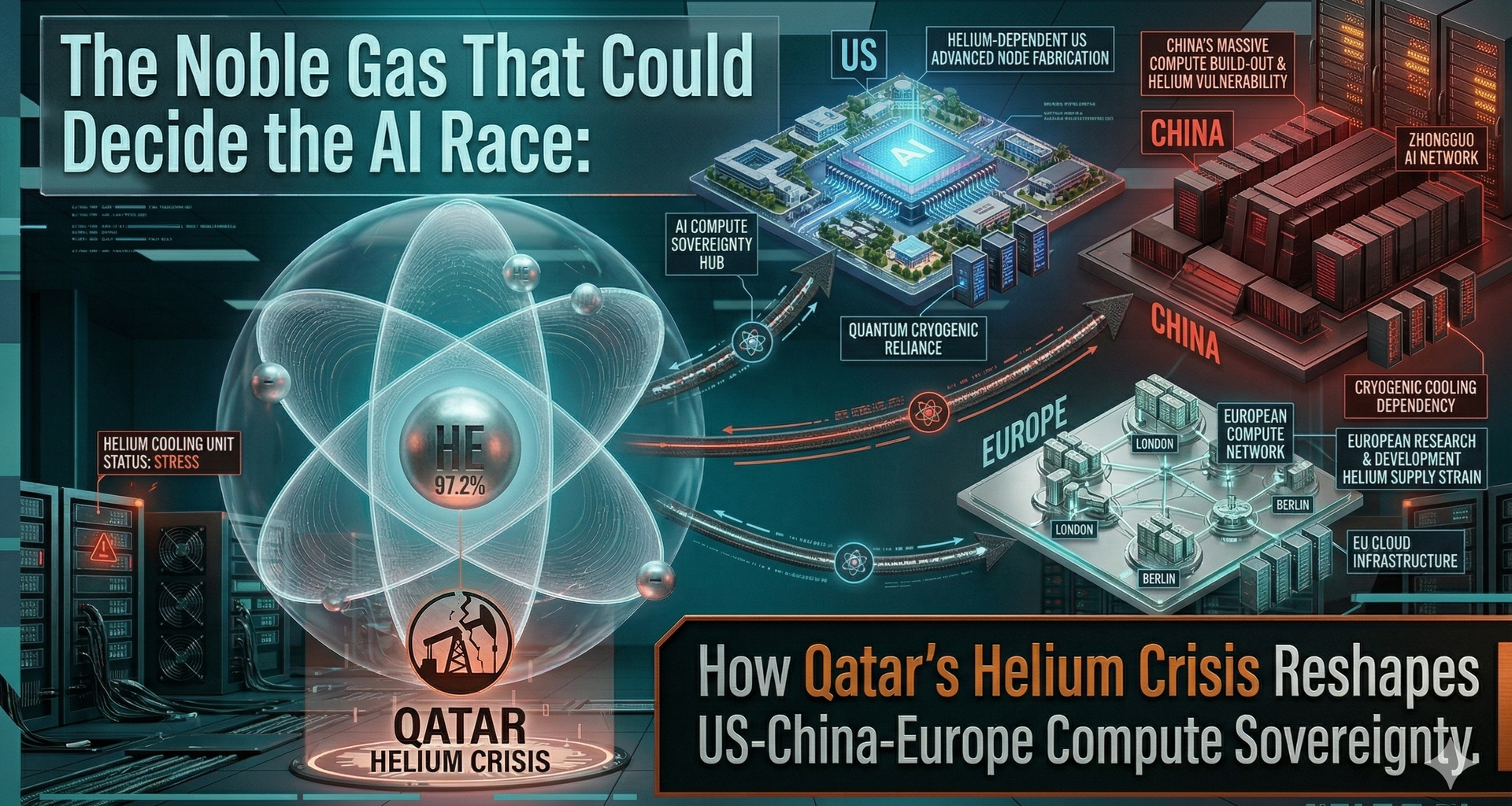
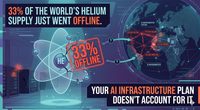
The AI race between the United States, China, and Europe just acquired an unplanned variable: a noble gas. When Iranian drone strikes hit Qatar’s Ras Laffan complex on February 28, 2026, they did not just disrupt a gas facility. They exposed the physical substrate on which the entire AI competition depends — and they exposed it asymmetrically.
The United States designs the chips (Nvidia, AMD, Broadcom) but fabricates almost none of them domestically. The chips are made in South Korea and Taiwan — the two countries most dependent on Qatari helium. South Korea sources over 70% of its helium from Qatar. Samsung and SK Hynix, which produce 90% of global High Bandwidth Memory, operate fabs with 2-4 week helium buffers. HBM is already sold out through 2026.
China cannot access cutting-edge EUV lithography tools due to export controls. But China is investing in domestic helium extraction, receives discounted pipeline gas from Russia (33% cheaper than LNG), and has accelerated semiconductor equipment self-sufficiency to 35% — with a target of 70% by 2027. China’s fab ecosystem runs on older nodes that require less helium per wafer. And China’s energy costs are not spiking because its gas arrives by landlocked pipeline, not through the closed Strait of Hormuz.
Europe fabricates less than 10% of global semiconductors. The EU Chips Act mobilized over $80 billion in investment commitments, but the European Court of Auditors has stated the 20% market share target by 2030 is “very unlikely.” Europe has no sovereign helium supply. Its LNG costs have surged 60%. And the AI Gigafactories initiative — designed to give European researchers access to world-class compute — depends entirely on chips fabricated in the same Asian fabs that are now helium-constrained.
The AI race is not just about models, benchmarks, or capital. It is about who controls the physical substrate — the materials, energy, and fabrication capacity — on which all AI computation depends. Qatar just demonstrated that a single missile strike can restructure the competitive dynamics of a trillion-dollar technology race.
| Metric | Value |
|---|---|
| Qatar helium share (global) | 33-34% |
| Supply removed from market | 27-30% |
| S. Korea helium from Qatar | >70% (64.7% per TrendForce) |
| Taiwan helium from Qatar | ~30% |
| Samsung + SK Hynix HBM share | 90% global |
| HBM supply (2026) | Sold out |
| Fab helium buffer | 2-4 weeks |
| US hyperscaler capex (2026) | $500-602 billion |
| US hyperscaler capex (2025-27) | $1.15 trillion |
| US domestic chip fabrication | <12% of global |
| China semiconductor WFE spending | $47B (2026) |
| China equipment self-sufficiency | 35% (target: 70% by 2027) |
| Russia pipeline gas vs. LNG | ~33% cheaper |
| EU Chips Act investment | >$80 billion committed |
| EU global chip share target | 20% by 2030 |
| EU actual chip share | <10% |
| European LNG price surge | +60% |
| AI data centers (US power) | 176 TWh (4.4% national) |
| Helium spot price surge | 40-100% |
| DRAM price surge (YTD) | +50% |
| DDR5 contract price surge | +100% |
| OECD unemployment | 5.0% (stable) |
| OECD broadband (advanced) | 98.9% |
helium gas supply for semiconductor manufacturing
As an affiliate, we earn on qualifying purchases.
As an affiliate, we earn on qualifying purchases.
1. The Asymmetric Exposure: Who Is Hit Hardest
The helium crisis does not affect the three AI competitors equally. The exposure is determined by three variables: helium dependency, energy source, and fabrication geography.
The Exposure Matrix
| Factor | United States | China | Europe |
|---|---|---|---|
| Chip design | Dominant (Nvidia, AMD, Broadcom) | Growing (Huawei HiSilicon) | Niche (NXP, Infineon, STMicro) |
| Chip fabrication | <12% domestic (Intel, GlobalFoundries) | Growing (SMIC, Hua Hong) | <10% (TSMC Dresden, Intel Ireland) |
| Fab helium source | US fabs: domestic | Investing in domestic + Russian | No sovereign supply |
| Chip supply dependency | Taiwan + South Korea fabs | Domestic + some Taiwan imports | Taiwan + South Korea fabs |
| Helium exposure | Indirect (via Asian fabs) | Lowest (domestic investment) | Indirect (via Asian fabs) |
| Energy source | Domestic gas + renewables | Pipeline gas (Russia) + renewables | Imported LNG (+60% surge) |
| Energy cost trend | Moderate increase | Stable or declining | Severe increase |
| HBM access | Priority customer (hyperscalers) | Limited (export controls) | Limited (no hyperscaler scale) |
| AI compute capex | $500-602B (2026) | $47B WFE + massive data center | EU Chips Act: $80B+ total |
| Strategic position | Design leader; fab-dependent | Self-sufficiency accelerating | Dependent on everyone |
The Three Vulnerabilities
| Competitor | Primary Vulnerability | Secondary Vulnerability | Structural Advantage |
|---|---|---|---|
| United States | Fab dependency on helium-constrained Asian fabs | $1.15T capex assumes chips on schedule | Design dominance; capital scale; CHIPS Act fabs (2027+) |
| China | No EUV access; older nodes only | Sanctions limit advanced chip access | Pipeline energy; domestic helium; self-sufficiency momentum |
| Europe | No sovereign helium, no fab scale, LNG cost surge | Chips Act unlikely to reach 20% target | Standards/regulation influence; ASML (lithography monopoly) |
“The AI race has three competitors with three different exposure profiles. The US designs chips it cannot fabricate. China fabricates chips it cannot design at the frontier. Europe does neither at scale — and just lost its energy cost advantage.”

High-Purity Chrome-Plated Brass Nitrogen, Helium, Argon, Carbon Dioxide, Hydrogen and Oxygen Regulator 0-250 PSIG
- Model Number: HP723C two-stage regulator
- Material: Chrome-plated brass construction
- Design: One-piece encapsulated seat with filter
As an affiliate, we earn on qualifying purchases.
As an affiliate, we earn on qualifying purchases.
2. The United States: Design Dominance, Fabrication Fragility
The United States is the undisputed leader in AI model development, chip design, and capital deployment. But every dollar of the $1.15 trillion three-year hyperscaler capex commitment assumes chips fabricated in fabs that the US does not own, in countries that depend on helium the US does not control.
The US Position
| Strength | Data | Vulnerability Created |
|---|---|---|
| Chip design | Nvidia, AMD, Broadcom dominate AI silicon | Zero leverage over fabrication bottlenecks |
| Capital scale | $500-602B capex (2026); $1.15T (2025-27) | Spending committed before helium risk priced |
| Hyperscaler demand | MSFT, GOOG, META, AMZN, AAPL | Priority customers but fab-capacity-constrained |
| CHIPS Act fabs | Intel Ohio, TSMC Arizona, Samsung Texas | Online 2027-2028; no help for 2026 crisis |
| Domestic helium | US production declining; BLM reserves depleted | Cannot backfill Qatar loss |
| HBM access | Priority customer relationships | Samsung/SK Hynix operate helium-constrained fabs |
The Timeline Problem
US-based fabs funded by the CHIPS and Science Act are not online until 2027-2028. TSMC’s Arizona fab, Intel’s Ohio facilities, and Samsung’s Texas expansion will eventually reduce Asian fab dependency. But “eventually” does not help when the helium buffer is 2-4 weeks and the crisis is now.
What the US Risks
| Scenario | Probability | Impact on AI Race |
|---|---|---|
| 2-4 week helium buffer exhausted | High (April 2026) | HBM allocation triage; training delays |
| 5-10% fab output reduction | Medium-high | GPU delivery slips by quarters |
| DRAM price spiral continues | High | AI infrastructure costs rise 20-40% |
| China gains structural energy advantage | High (already happening) | Long-term compute cost disadvantage |
| CHIPS Act fabs delayed by memory shortage | Medium | 2027-2028 timeline slips further |
“The US has the models, the capital, and the talent. It does not have the fabs, the helium, or the energy cost advantage. The $1.15 trillion bet is a check written on an assumption — that the physical substrate will hold.”

Leakmaster Pool Leak Detection Kit – 8 oz Blue Dye with Reusable Syringe – High-Visibility Leak Finder for Pools, Hot Tubs & Spas – 40+ Refills– Professional Water Tracing Tool
- Precise Leak Detection: Identify leaks quickly in pools and hot tubs
- High-Visibility Dye: Easily spot leaks underwater with vibrant colors
- Reusable Syringe: Includes syringe with 40+ refills for repeated use
As an affiliate, we earn on qualifying purchases.
As an affiliate, we earn on qualifying purchases.
3. China: The Accidental Beneficiary
China faces the most severe technology restrictions in AI history — no EUV lithography, limited advanced chip access, entity list sanctions. And yet the helium crisis may inadvertently strengthen China’s competitive position.
China’s Structural Advantages Under Helium Constraint
| Advantage | Mechanism | Data |
|---|---|---|
| Pipeline energy | Russia-to-China gas: 33% cheaper than LNG | Power of Siberia 2 in 2026-2030 plan |
| Energy stability | Landlocked pipeline; not Hormuz-dependent | No LNG price spike |
| Domestic helium | Investing in extraction capacity | Reducing external dependency |
| Self-sufficiency | 35% equipment localization; target 70% by 2027 | $47B WFE spending (2026) |
| Node advantage | Older nodes (28nm, 14nm, 7nm DUV) need less helium | Less exposed to He-intensive EUV processes |
| Scale | SMIC, Hua Hong capacity expanding | Consolidation via M&A accelerating |
The Paradox of Sanctions
| Sanctions Intended Effect | Helium Crisis Actual Effect |
|---|---|
| Deny China EUV → limit frontier chips | EUV processes are most helium-intensive → China’s DUV fabs less affected |
| Restrict HBM access | HBM is most helium-constrained → China was already excluded → no incremental loss |
| Force reliance on older nodes | Older nodes require less helium → more resilient to supply shock |
| Isolate from Western supply chains | Western supply chains are now helium-disrupted → isolation becomes insulation |
China cannot build the most advanced chips. But the helium crisis means the countries that can build the most advanced chips may not be able to produce enough of them. If Samsung and SK Hynix face helium-constrained production while SMIC operates on nodes that require less helium and runs on pipeline energy that costs a third of LNG, China’s relative position improves without China doing anything new.
What China Is Actually Doing
| Action | Status | Strategic Implication |
|---|---|---|
| Domestic helium investment | Active | Reducing single-point dependency |
| SMIC DUV lithography | Testing domestic immersion DUV tool | Equipment self-sufficiency milestone |
| Mandatory 50% domestic equipment | Policy enacted | Accelerating localization |
| Power of Siberia 2 | In 2026-2030 development plan | Structural energy cost lock-in |
| Semiconductor M&A | SMIC + Hua Hong consolidation | Scale economies in mature nodes |
“Sanctions denied China EUV. The helium crisis punishes EUV. The US restricted China from HBM. HBM fabs are most helium-exposed. China’s disadvantages have become structural insulation against the very crisis hitting its competitors.”
As an affiliate, we earn on qualifying purchases.
4. Europe: Triple Dependency, No Sovereign Substrate
Europe’s position in the AI race was already the weakest of the three. The helium crisis makes it acute.
Europe’s Triple Dependency
| Dependency | Exposure | Mitigation |
|---|---|---|
| Chip fabrication | <10% global share; almost all AI chips from Asia | EU Chips Act: $80B+ committed, but “very unlikely” to reach 20% by 2030 |
| Energy | LNG-dependent; +60% price surge | No pipeline gas alternative; renewables insufficient for base load |
| Helium | No sovereign supply; dependent on imports | No domestic extraction; no strategic reserve |
The EU Chips Act Reality Check
| Target | Actual | Gap |
|---|---|---|
| 20% global chip share by 2030 | <10% currently | European Court of Auditors: “very unlikely” |
| Sovereign fabrication | TSMC Dresden, Intel Ireland | Still Asian-dependent for advanced nodes |
| AI compute sovereignty | AI Gigafactories initiative | Depends on chips from helium-constrained fabs |
| Investment mobilized | >$80 billion committed | Significant, but 1/14th of US hyperscaler capex |
What Europe Risks
| Risk | Mechanism | Consequence |
|---|---|---|
| AI compute cost surge | LNG +60% → data center costs → inference/training costs | European AI companies become cost-uncompetitive |
| Chip supply squeeze | No priority relationships with Samsung/SK Hynix | Europe served last in allocation triage |
| AI Gigafactories delayed | Compute depends on chips that may not arrive | Sovereign AI initiative stalls |
| Brain drain accelerates | AI talent follows compute access | Researchers move to US or China |
| Regulatory advantage erodes | EU AI Act becomes moot if there is no European AI industry to regulate | Standards without substance |
ASML: Europe’s One Structural Asset
Europe has exactly one leverage point in the AI substrate: ASML, the Dutch company that holds a monopoly on EUV lithography machines. Every advanced chip in the world — every sub-7nm processor from TSMC, Samsung, and Intel — requires ASML’s machines.
| ASML Position | Strategic Implication |
|---|---|
| Monopoly on EUV | Chokepoint leverage over all advanced fabs |
| Export controls to China | Geopolitical tool (enforced by Netherlands/US) |
| Revenue concentration | Dependent on the same Asian fabs facing helium constraint |
| European policy leverage | Could negotiate chip access in exchange for EUV supply |
Europe cannot fabricate chips at scale. But it controls the tool that makes fabrication possible. Whether Europe leverages this position strategically — or continues to operate it as a commercially neutral supplier — will determine whether ASML is a European sovereign asset or merely a European-headquartered global utility.
“Europe depends on everyone and controls one thing: ASML. Whether that monopoly becomes a sovereign strategic asset or remains a commercially neutral utility is the single most consequential technology policy decision Europe will make this decade.”
5. OECD Context: Mineral Sovereignty as AI Infrastructure
OECD broadband data shows 98.9% household penetration in advanced economies. Digital infrastructure is ready. The crisis is in physical infrastructure — the materials, energy, and fabrication capacity that digital infrastructure depends on.
The Physical Substrate Gap
| Factor | Data | AI Race Implication |
|---|---|---|
| Broadband | 98.9% (advanced) | Digital layer ready; physical layer at risk |
| Unemployment | 5.0% (stable) | Labour healthy; compute supply uncertain |
| Helium removed | 27-30% of global | Fab operations at risk across OECD |
| S. Korea exposure | >70% from Qatar | OECD’s most chip-critical member: highest risk |
| LNG surge | +60% EU | European compute costs rising sharply |
| Pipeline gas | Russia→China: -33% | Non-OECD competitor gaining energy advantage |
| US helium reserves | Depleted | OECD cannot self-supply at scale |
| EU chip share | <10% | OECD Europe: dependent on non-European fabs |
| CHIPS Act fabs | 2027-2028 online | US OECD: relief coming, but not in 2026 |
The New Mineral Sovereignty Framework
The semiconductor landscape is transitioning from “just-in-time” to “mineral sovereignty” — prioritizing localized material reserves over lean inventory management. The three AI competitors are at different stages:
| Competitor | Mineral Sovereignty Status | AI Race Position |
|---|---|---|
| United States | CHIPS Act funded but 2027+; BLM helium depleted; domestic fab limited | Design leader; substrate-fragile |
| China | Domestic helium investing; pipeline energy secured; 35% equipment local | Restricted but resilient |
| Europe | No sovereign helium; no fab scale; LNG-dependent; ASML as sole leverage | Dependent; one strategic asset |
Transparency note: OECD does not directly measure mineral sovereignty, helium supply chain resilience, or compute substrate dependencies. The indicators combine OECD infrastructure data with commodity analyses, semiconductor industry data, and geopolitical assessments.
6. Practical Actions for Leaders
1. Map your AI infrastructure’s exposure to the US-China-Europe substrate asymmetry. If your chips come from South Korean fabs (most HBM does), your helium exposure is >70%. If your data centers run on European LNG, your energy costs are rising 60%. If your AI strategy depends on US hyperscaler cloud, you inherit their fab dependency. Know which leg of the triangle you sit on.
2. Scenario-model the three-bloc divergence. Model what happens to your AI roadmap under three scenarios: US-allied fabs face 3-6 month helium constraint; China gains structural energy advantage via pipeline gas; Europe’s compute costs rise 20-40% from LNG. Each scenario has different implications for where to train models, where to deploy inference, and which cloud providers to use.
3. Evaluate compute geography as a strategic variable. The helium crisis makes compute geography a first-order strategic decision — not just a latency or compliance consideration. Where your AI runs determines your exposure to helium supply risk, energy cost risk, and geopolitical restructuring risk.
4. For European leaders specifically: treat ASML as a sovereign negotiation asset. Europe controls the one tool that every advanced fab requires. Use this leverage to negotiate chip access priority, joint helium supply agreements, and compute capacity guarantees. Treating ASML as a commercially neutral utility while Europe lacks chip sovereignty is a strategic error.
5. Track the mineral sovereignty transition as a competitive intelligence priority. The “just-in-time” era for semiconductor materials is ending. Organizations that understand helium sourcing, energy cost structures, and fabrication geography will make better AI infrastructure decisions than those who treat compute as a commodity.
| Action | Owner | Timeline |
|---|---|---|
| Substrate exposure mapping | CTO + Supply Chain | Immediate |
| Three-bloc scenario modeling | CFO + Strategy | Q2 2026 |
| Compute geography evaluation | CTO + Architecture | Q2 2026 |
| ASML leverage strategy (EU) | CEO + Gov Relations | Q2 2026 |
| Mineral sovereignty tracking | Strategy + Procurement | Ongoing |
What to Watch
The April helium buffer deadline and HBM allocation decisions. When South Korean fabs exhaust their 2-4 week helium buffers, triage begins. US hyperscalers will likely receive priority allocations. European customers will likely be served last. China will be unaffected (already excluded from HBM). Watch Samsung and SK Hynix allocation announcements as the first signal of how the AI race restructures.
Power of Siberia 2 progress as a decade-long competitive signal. If China secures structural pipeline gas access at 33% below LNG cost, every fab, data center, and training run in China becomes permanently cheaper than its Western equivalent. This is not a crisis response — it is a decade-long competitive advantage baked into energy infrastructure.
Whether Europe leverages ASML or watches the race from the sidelines. Europe has two possible futures: one where ASML’s EUV monopoly is used as sovereign leverage to negotiate chip access, energy partnerships, and compute capacity; and one where ASML continues to operate commercially while Europe’s AI industry atrophies from chip dependency and energy costs. The decision is being made now.
The Bottom Line
33% helium offline. >70% South Korean dependency. 90% HBM from constrained fabs. $1.15T US capex on chips it cannot fabricate domestically. 35% Chinese equipment self-sufficiency, targeting 70%. <10% European chip share, target “very unlikely.” +60% European LNG. -33% Russian pipeline gas to China. 2-4 weeks fab helium buffer. Zero substitutes.
The AI race between the US, China, and Europe was supposed to be about models, talent, and capital. It turns out to be about helium, energy, and fabrication geography. The US has the models and the money but not the fabs. China has the energy advantage and self-sufficiency momentum but not the advanced tools. Europe has the one indispensable tool (ASML) but neither the fabs, the energy, nor the helium.
A single missile strike on a gas facility in Qatar has revealed that the AI race is ultimately a physical infrastructure race — and the competitor best positioned for the physical crisis is the one that was supposed to be disadvantaged by sanctions.
The AI race was supposed to be about intelligence. It turns out to be about helium, energy, and who actually makes the chips. The competitor that sanctions were designed to disadvantage may be the one least affected by the crisis those sanctions could not have anticipated.
Thorsten Meyer is an AI strategy advisor who notes that “sanctions denied China EUV, and the helium crisis punishes EUV” is the kind of strategic irony that makes geopolitical planners uncomfortable — and that “mineral sovereignty” is what you call supply chain management after you learn the hard way that you should have called it that earlier. More at ThorstenMeyerAI.com.
Sources
- Qatar / Ras Laffan — Iranian Drone Strike Feb 28, 2026; Force Majeure; 33-34% Global Helium
- Fortune — “Iran War Cuts Off Helium; Chip Supply Chains Threatened” (Mar 2026)
- TrendForce — “Helium Crunch Hits South Korea: Samsung, SK Hynix, TSMC” (Mar 2026)
- Tom’s Hardware — “Qatar Helium Shutdown: 2-Week Clock; Air Liquide Taiwan” (Mar 2026)
- CNBC — “Tech Stocks: Qatar, Semiconductor, LNG, Helium” (Mar 2026)
- HPCwire — “Global Helium Shortage Constrains High-Density Compute” (Mar 2026)
- Goldman Sachs — “AI Companies May Invest >$500B in 2026”; $1.15T (2025-27)
- Introl — “Hyperscaler CapEx Hits $600B” (2026)
- SK Hynix CFO — “Entire 2026 HBM Supply Sold Out”
- Samsung — DDR5 Price Surge; Memory Shortage Warning (2026)
- IDC — Global Memory Shortage Crisis (2026)
- Atlantic Council — Russia-China Pipeline Gas; Power of Siberia 2
- China 2026-2030 Plan — Pipeline Gas; 50% Domestic Equipment Mandate
- SMIC — Testing First Domestic Immersion DUV Lithography Tool (2026)
- EU Chips Act — >$80B Committed; Court of Auditors: 20% “Very Unlikely”
- EU Council — AI Gigafactories Initiative (Jan 2026)
- Chatham House — “How Middle Powers Weather US-Chinese AI Dominance” (2026)
- Frost & Sullivan — “Helium as New Chokepoint in Semiconductor Supply Chain”
- EE Times — “How AI and Geopolitics Forge a Memory Market Crisis”
- OECD — 5.0% Unemployment, 11.2% Youth, 98.9% Broadband
© 2026 Thorsten Meyer. All rights reserved. ThorstenMeyerAI.com