
By Thorsten Meyer | November 17, 2026 | ThorstenMeyerAI.com

Get business pricing on tech for your team
- Business-only prices and quantity discounts
- Tax-exempt purchasing
- Multiple users, one account, clear invoices
Conflict of interest: This article was researched and drafted with AI assistance, including Anthropic’s Claude, and Anthropic is one of its two subjects. Neither Anthropic nor Nvidia reviewed or sponsored it. It is not investment advice and does not discuss share prices.
Two events that the whole AI industry is watching fall into the same week. Nvidia, the chipmaker at the center of the AI build-out, reports its quarterly results on Tuesday, November 17. One day later, Anthropic, the company behind Claude, expects to set the price for its initial public offering, and on Thursday its shares are expected to start trading on Nasdaq.
The mood going into the week is nervous. On Monday, US stocks ended sharply lower in a broad selloff, Reuters reported, as fallout from Jensen Huang’s resignation as Nvidia’s CEO “soured enthusiasm for AI stocks, raising the stakes” for both events. At the same time, Anthropic’s offering has drawn about six times the orders for the shares available, Bloomberg News reported on November 12, citing people familiar with the matter.
This piece leaves the share prices to others. It asks what the two events mean for the companies that buy AI compute and AI services, and for the people who build and run the data centers behind them.
Key takeaways
- Results day, not stock day. Nvidia publishes its results at about 1:20 p.m. Pacific time on November 17 and holds its call at 2 p.m. Pacific. Its own outlook for the quarter was revenue of $108.0 billion, plus or minus 2%, and it assumed no data center compute revenue from China.
- A company in transition. Nvidia now names Colette Kress as Interim CEO. On results day, its board set up a new committee for national security, export controls and trade risk.
- The IPO calendar is in the filing. According to Anthropic’s European prospectus, the offer period ends on or about November 18, trading on the Nasdaq Global Select Market under “ANT” is set to begin on November 19, and the offering is set to complete on November 20. Anthropic says the price depends on regulatory clearance, demand and market conditions.
- What customers should read. The filing lists risks that matter to anyone who builds on Claude: access to compute, changes to usage and rate limits, how older models are retired, outages, and control of the company after the IPO.
- What workers should know. The filing names hiring and retention as a use of the money, says data center construction depends on skills “currently in short supply,” and warns that fears of job losses from AI could bring new rules.
One week, five dates
Nvidia reports, Anthropic lists
What is scheduled this week, as the companies have announced it. Dates are US time; anything after today can still move.
- Mon · Nov 16Markets turn nervousUS stocks end sharply lower on AI worries. The Fed chair speaks on AI and jobs.Reuters · Federal Reserve
- Tue · Nov 17Results dayNvidia reportsResults at about 1:20 p.m. PT, call at 2 p.m. PT. The board adds a national security and export control committee.Nvidia
- Wed · Nov 18Anthropic sets its priceThe offer period ends on or about this day. The price is expected, subject to regulatory clearance.Anthropic
- Thu · Nov 19Trading is set to beginClass A shares on the Nasdaq Global Select Market under “ANT”.Anthropic prospectus
- Fri · Nov 20The offering completesShares are delivered. A private placement with suppliers, Nvidia among them, follows the offering.Anthropic prospectus
The lens of this article: not share prices, but what the week means for companies that buy AI compute and services, and for the people who build and run the data centers.
Sources: Nvidia, call announcement (October 28, 2026) and board release (November 17, 2026); Anthropic, European prospectus approved November 11, 2026 (PDF page 9) and IPO FAQ; Reuters via The Straits Times (November 17, 2026); Federal Reserve (November 16, 2026).
Animation: Powered by Thorsten Meyer AI
Products Worth Considering

Apple Watch Series 12 GPS 46mm Smartwatch

Samsung Galaxy Tab A11+ Kids Edition, 128GB, Royal Blue

LG 27GR83Q-B 27-inch Ultragear QHD IPS Gaming Monitor
As an affiliate, we earn on qualifying purchases.
Why the mood is nervous
The selloff has a clear trigger in the reporting. Reuters linked it to the fallout from Huang’s resignation as Nvidia’s CEO, which followed allegations of an affair with a suspected Chinese spy, and to a new rule from the Trump administration that restricts China’s access to the best AI chips. Ross Mayfield, an investment strategy analyst at Baird quoted by Reuters, described the swings as “a day-to-day thing where, you know, some days the AI names absolutely rip and then the very next day, you know, they’re in a freefall.” He also said investors “aren’t panic-selling.”
Nvidia’s own statements show a company working through the change at the top. Its release on November 17 names Colette Kress as Interim CEO. The same release says the board created a National Security and Export Control Oversight Committee for “board-level oversight of the company’s national security policies, export control compliance and global trade risk management.” We covered who will run Nvidia separately; this piece does not repeat the succession story.
The Federal Reserve is watching the same question from another angle. In remarks on November 16, Fed Chair Kevin Warsh laid out a range of outcomes for what he calls super intelligence. In the best case, gains are “shared broadly across labor and the owners of capital.” In a second case, an expansion “could bring substantial labor market disruption as some jobs are displaced.” In a third, the technology “could disappoint,” leading to “an economic slowdown and a more notable rise in unemployment.”
What Nvidia’s results tell companies that buy AI compute
For a company that rents GPUs from a cloud provider or buys servers for its own data center, Nvidia’s report is less about the stock and more about supply, price and planning. The last report gives the frame. In the quarter that ended July 26, 2026, Nvidia reported revenue of $96.2 billion, and $89.0 billion of it came from its Data Center business. Its outlook for the quarter that ended October 25 was $108.0 billion.
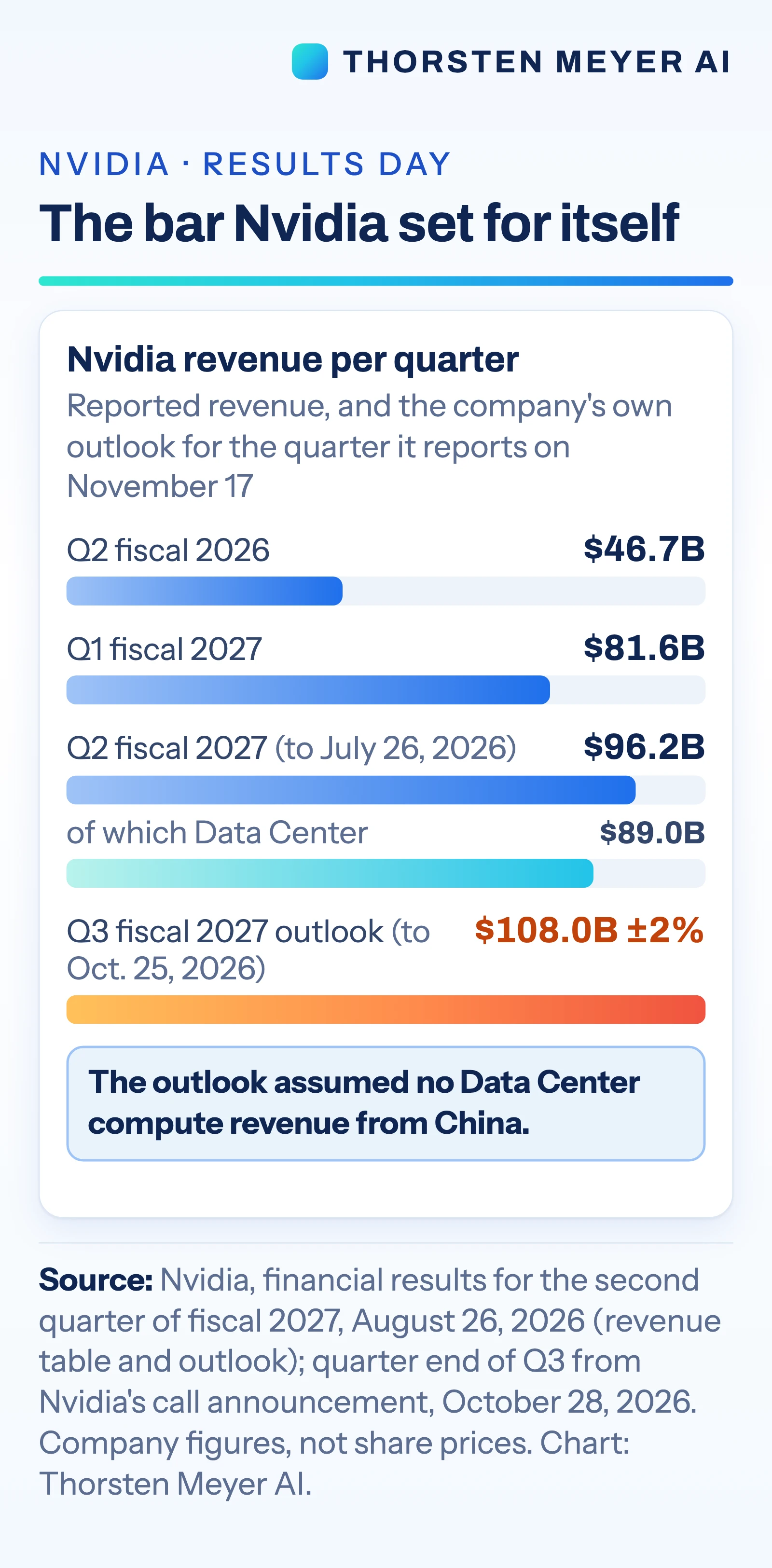
Four things in today’s release and the written commentary from the CFO are worth reading as a buyer:
- Supply of the new platform. In August, Nvidia said Vera Rubin was ramping into full production, with racks running at partners including CoreWeave, Google Cloud, Microsoft Azure, Oracle Cloud Infrastructure and Nebius. Any comment on lead times tells cloud customers how fast new capacity arrives.
- China and export rules. The outlook already assumed no data center compute revenue from China. New rules and the new board committee show that export compliance is now part of how Nvidia runs. For multinational buyers, that can mean more paperwork about where chips go.
- Who pays for the build-out. Nvidia announced partnerships with Apollo, BlackRock, Blackstone, Brookfield, Goldman Sachs and KKR to set up compute financing platforms, subject to definitive agreements. Financing affects who can build data centers, and how fast.
- The next outlook. Nvidia’s guidance for the coming quarter is the company’s own reading of demand from cloud providers, AI labs and enterprises.
Buyers have more than one supplier, and the biggest AI labs show it. Anthropic’s prospectus describes a “multi-chip compute architecture” across Amazon’s Trainium, Google’s TPUs, Nvidia GPUs and AMD GPUs, so that it can move work “to optimize for price and performance.” For enterprise teams, the lesson is the same at a smaller scale: avoid tying every workload to one chip family when the software allows it.
Data center build-outs and jobs
Both companies describe a build-out that runs into physical limits. In its filing, Anthropic reports purchase commitments and leases with an aggregate committed spend of about $900.9 billion, “substantially all of which is related to compute and infrastructure.” We looked at what that commitment means for the company when the price range was set.
The filing is frank about what can slow the build-out. Getting power on an accelerated timeline depends on “the timely and successful engineering, procurement, and construction of the associated facilities, which requires specialized expertise that is currently in short supply.” The construction of generation and transmission infrastructure is “exposed to labor shortages, supply chain disruptions, permitting delays” and other risks. Anthropic also says it has “publicly committed to covering the cost of electricity price increases to consumers caused by our data centers.”
For workers, that cuts two ways. If the skills are as scarce as the filing says, the people who have them, from grid engineers to construction crews, hold one of the build-out’s bottlenecks. But the same build-out depends on investment that can slow quickly if returns disappoint, which is Warsh’s third scenario.
What Anthropic’s filing says, and what it does not
Anthropic filed its registration statement on Form S-1 with the SEC on October 26 and launched its roadshow on November 10. Germany’s financial regulator, BaFin, approved the European prospectus on November 11. That document is the basis for this section. The registration statement in the United States has not yet become effective, and the offering can still change.
Use of the money. Anthropic plans to use the net proceeds “for general corporate purposes, including working capital, operating expenses, and capital expenditures, including investments in compute and infrastructure, as well as hiring and retention of highly skilled personnel.” It may also buy businesses, but says it has no agreements for material acquisitions. It states that it “will have broad discretion in using these proceeds.”
Suppliers as shareholders. Alongside the IPO, AMD, Broadcom, Google, Micron, Microsoft, Nvidia and TSMC have agreed to buy shares in a private placement at the IPO price, contingent on the offering closing. Nvidia is therefore both a chip supplier to Anthropic and a future shareholder. We covered suppliers turning into shareholders last week.
Who decides. Anthropic is a public benefit corporation and must balance its shareholders’ interests, the interests of those affected by its conduct, and its stated purpose. Its Long-Term Benefit Trust, intended to operate as an independent body of five “financially disinterested trustees,” elects a majority of the board. A company formed by the co-founders will hold a single share with 50.1% of the votes on general matters. All Class A shares together carry the remaining 49.9%. As new shares are sold in the IPO, the existing Class A holders’ part falls from 49.9% to 44.5%. Under Nasdaq rules, Anthropic counts as a “controlled company.”
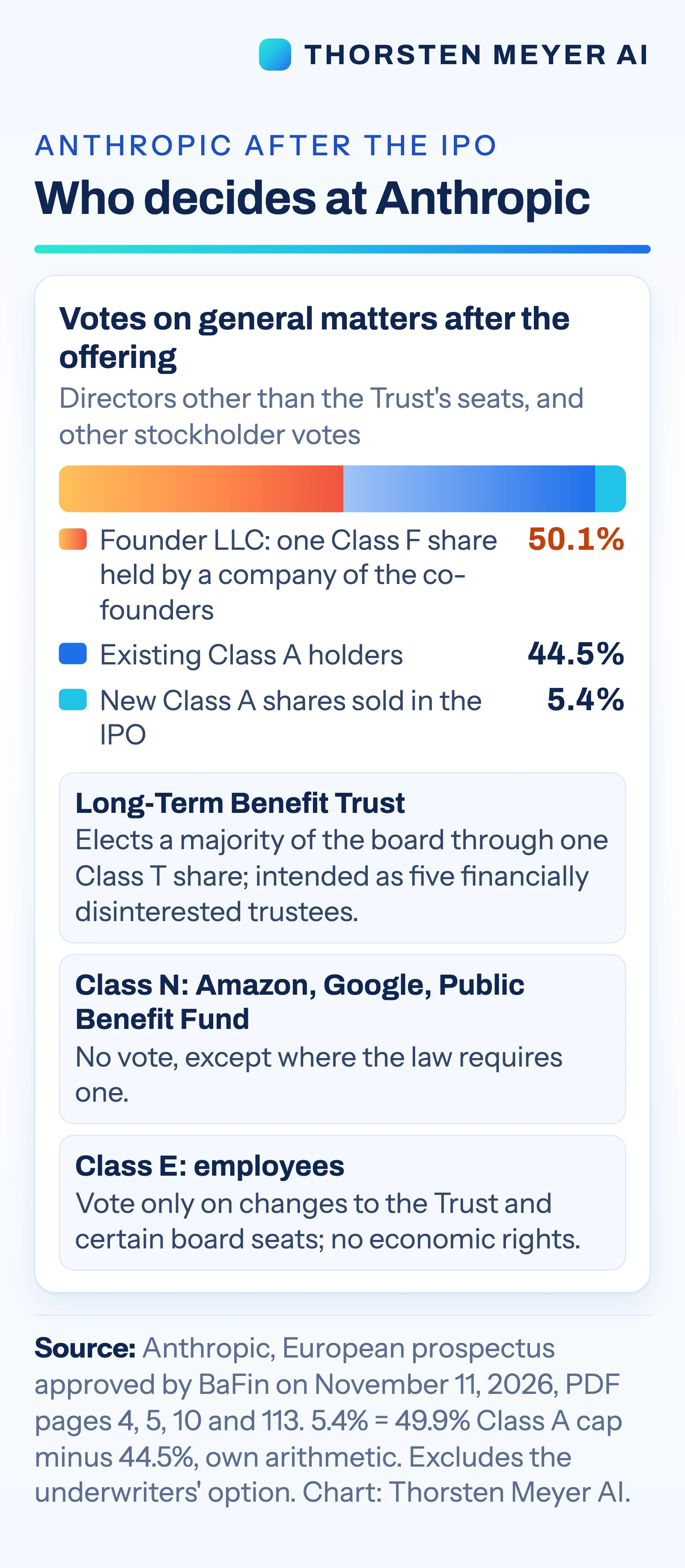
For customers, that structure means the IPO does not hand control to new investors. The people and bodies who set direction today keep it. Whether that is reassuring depends on whether you trust their judgment; the filing itself warns that the structure “may effectively eliminate the ability” of Class A holders to influence important decisions.
The risks a customer should read
Risk factors are written to protect the company, but they also show where a vendor sees its own weak spots. These passages matter most for anyone who builds on Claude:

- Compute. Without enough compute, Anthropic says it may be unable to train competitive models “or adequately serve our customers.”
- Older models. “Customers who have integrated older models into their workflows may resist migration to newer versions, and any accelerated or forced deprecation could result in customer attrition, contractual disputes, or reputational harm.”
- Limits. The company has “changed, and may in the future change, usage limits, rate limits, or model and product capabilities.”
- Benchmarks. Benchmarks “may not accurately reflect real-world performance or utility.”
- Reliability. Outages and degraded outputs are among the factors listed that could hurt results.
- Concentration. A “substantial portion” of revenue comes from “a limited number of customers and distribution channels.”
What it means for businesses
- Separate the stock from the service. A falling share price does not change your contract or your model’s quality. Read the release and the filing, not the ticker.
- Write deprecation and limits into contracts. Ask for notice periods before a model is retired and for written usage and rate limits, with a process when they change.
- Plan for more than one supplier. Keep prompts and tools portable between models and, where you run your own hardware, between chip families.
- Watch export rules. If you run AI workloads across borders, ask your cloud provider how new chip rules affect where your data and compute can sit.
- Budget for power. Anthropic’s filing points to higher electricity prices and longer grid connection times in some regions. Expect that to show up in what compute costs.
What it means for users and workers
For people using Claude or Nvidia-powered services, nothing changes on Thursday because of the listing itself. The filing does say that usage limits can change, as they have before.
For workers, the filing is unusually direct. It warns that public perception that AI contributes to “job displacement or economic disruption” could cause backlash, and that “to the extent the rate of job displacement rapidly increases,” governments may “intervene to slow the rate of adoption of AI.” Anthropic says it may voluntarily take steps “intended to ameliorate the impact of such displacement,” without promising that they will work. Its own employees get a new class of shares, Class E, that votes on changes to the Long-Term Benefit Trust and certain board seats, but carries no economic rights.
What is not known
- Nvidia’s numbers. The results come out after this piece was written. Whether revenue lands near the outlook, and what Nvidia says about the next quarter, China and supply, is open.
- The final price and timing. The registration statement is not yet effective, and the dates in the prospectus “may be extended or shortened.”
- How solid the demand is. The report of about six times the orders comes from people familiar with the matter, not from Anthropic, and Bloomberg said details “could change.”
- Who leads Nvidia. Nvidia is run by an Interim CEO, and who leads it permanently is open. So are the details of the new rule on chips for China.
- What public ownership changes. How quarterly reporting will shape Anthropic’s choices on models, limits and prices will only show over time.
I’m Thorsten Meyer. The full sources are below, and more reality checks are at thorstenmeyerai.com.
Sources
- Nvidia: NVIDIA Sets Conference Call for Third-Quarter Financial Results, October 28, 2026 (GlobeNewswire copy); NVIDIA Announces Financial Results for Second Quarter Fiscal 2027, August 26, 2026; NVIDIA Board of Directors Establishes National Security and Export Control Oversight Committee, November 17, 2026
- Anthropic: Anthropic files S-1 with the SEC for proposed initial public offering, October 26, 2026; Anthropic launches roadshow for proposed initial public offering, November 10, 2026; IPO website with FAQ and the BaFin-approved European prospectus of November 11, 2026 (PDF pages 4, 5, 7, 8, 9, 10, 17, 19, 21, 22, 37, 44, 50, 86, 113, 116), accessed November 17, 2026
- Federal Reserve: Opening remarks by Chairman Warsh at the Federal Reserve’s Productivity and Jobs Task Force Conference, November 16, 2026
- Reuters, via The Straits Times: US stocks close sharply lower on AI jitters ahead of Nvidia results, Anthropic IPO, November 17, 2026; via CNA: Wall Street ends sharply lower on AI jitters ahead of Nvidia results, Anthropic IPO, and Anthropic’s IPO is about six times oversubscribed, Bloomberg News reports, November 12, 2026
Researched and drafted with AI assistance, including Anthropic’s Claude. Anthropic is one of the two subjects of this article; I have reported the risks and open questions its own filing names, and the market’s doubts, as the sources show them. Neither Anthropic nor Nvidia reviewed or sponsored this article. Not investment advice: this article gives no view on whether to buy, sell or hold any share. Our own text and graphics contain no affiliate links; offer and product boxes added by the site may contain Amazon affiliate links. Images: AI-generated illustration (Runware) and graphics by Thorsten Meyer AI, built from the published sources; our own images show no real people or logos. Boxes added by the site may show product photos or people.