
By Thorsten Meyer | November 10, 2026 | ThorstenMeyerAI.com

Get business pricing on tech for your team
- Business-only prices and quantity discounts
- Tax-exempt purchasing
- Multiple users, one account, clear invoices
Conflict of interest: This article was researched and drafted with AI assistance, including Anthropic’s Claude; Anthropic is the subject of this story. Neither Anthropic nor any of its underwriters reviewed or sponsored it. This is not investment advice.
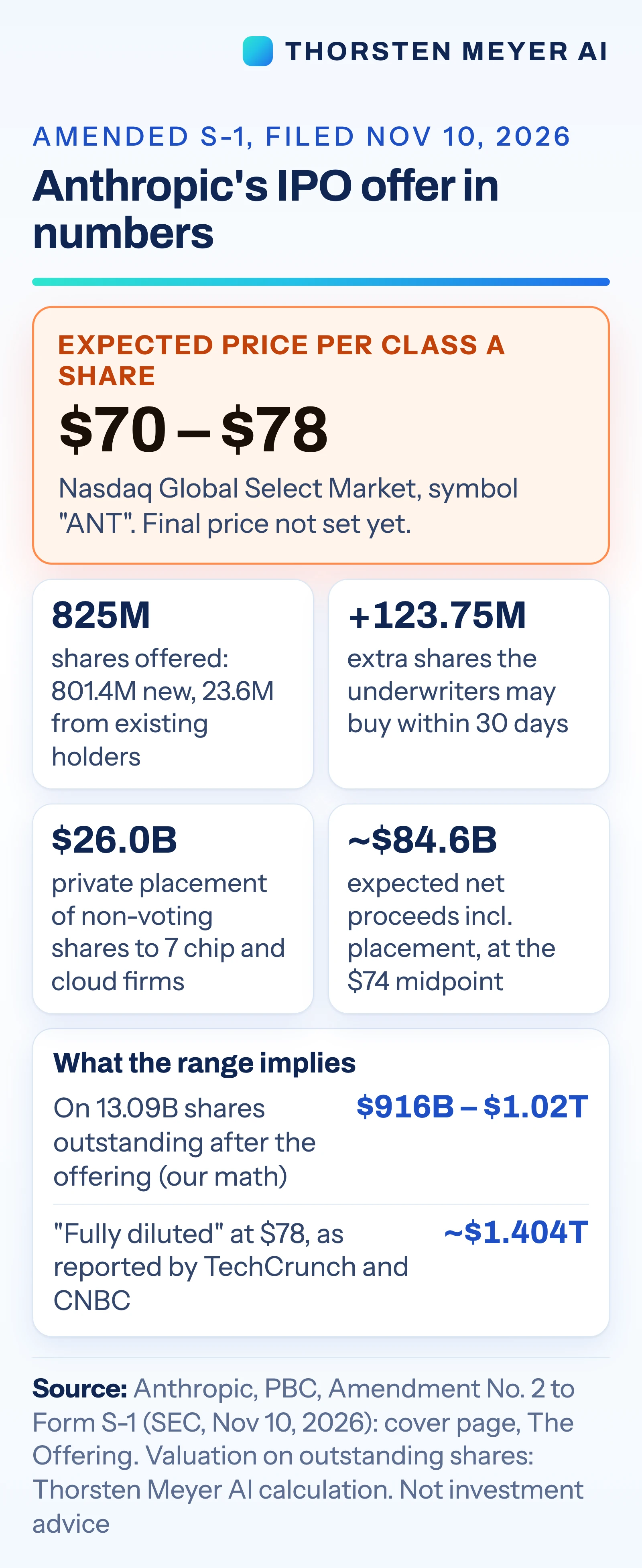
On November 10, 2026, Anthropic put a price tag on itself. In an amended registration statement filed with the U.S. Securities and Exchange Commission, the company behind Claude says it expects to sell its shares to the public at between $70 and $78 each, on the Nasdaq Global Select Market under the symbol “ANT”. The same day, it launched its roadshow, the series of investor meetings before the shares are priced.
The headlines settled on one number: an implied valuation of about $1.404 trillion. That figure does not appear in the filing. It comes from news reports, and it depends on which shares you count. On the shares the filing says will exist after the offering, the range works out to roughly $916 billion to $1.02 trillion. Both numbers can be right at once, and the gap between them is a good way into what this 300-plus-page document actually says about the company behind one of the most widely used AI model families.
Key takeaways
- The offer. 825,000,000 Class A shares at an expected $70 to $78 each: 801,351,354 sold by Anthropic and 23,648,646 by existing stockholders. Underwriters led by Goldman Sachs and Morgan Stanley can buy up to 123,750,000 more.
- Two ways to count. 13,086,672,593 shares outstanding after the offering times $70 to $78 gives $916 billion to $1.021 trillion. The reported $1.404 trillion at the top of the range implies about 18.0 billion shares, so it also counts stock options, unvested stock awards and other future shares.
- The business grew about 13-fold. Revenue was $33.2 billion in the first nine months of 2026, up from $2.5 billion a year earlier. Third-quarter revenue was $17.0 billion.
- The headline loss is mostly accounting. The nine-month net loss was $104.0 billion, but the operating loss was $1.3 billion. $94.3 billion came from revaluing convertible notes and similar instruments as the company’s value rose.
- The commitments are enormous. Anthropic has signed compute and infrastructure commitments of about $900.9 billion, about $70.7 billion of it due within 12 months.
- Buyers of Class A shares get limited control. A Long-Term Benefit Trust elects a majority of the board, and a single founder share carries 50.1% of the general voting power.
- Not known yet: the final price, the exact trading date, how shares are allocated and how the stock trades.
Products Worth Considering

Logitech MX Master 4 for Mac Wireless Ergonomic Mouse, White Silver

DJI Osmo Mobile 7P Gimbal Stabilizer with Mic Mini Transmitter, Infinity Black

Samsung Galaxy Tab A9+ 11-Inch Android Tablet, 64GB, Graphite
As an affiliate, we earn on qualifying purchases.
What Anthropic filed
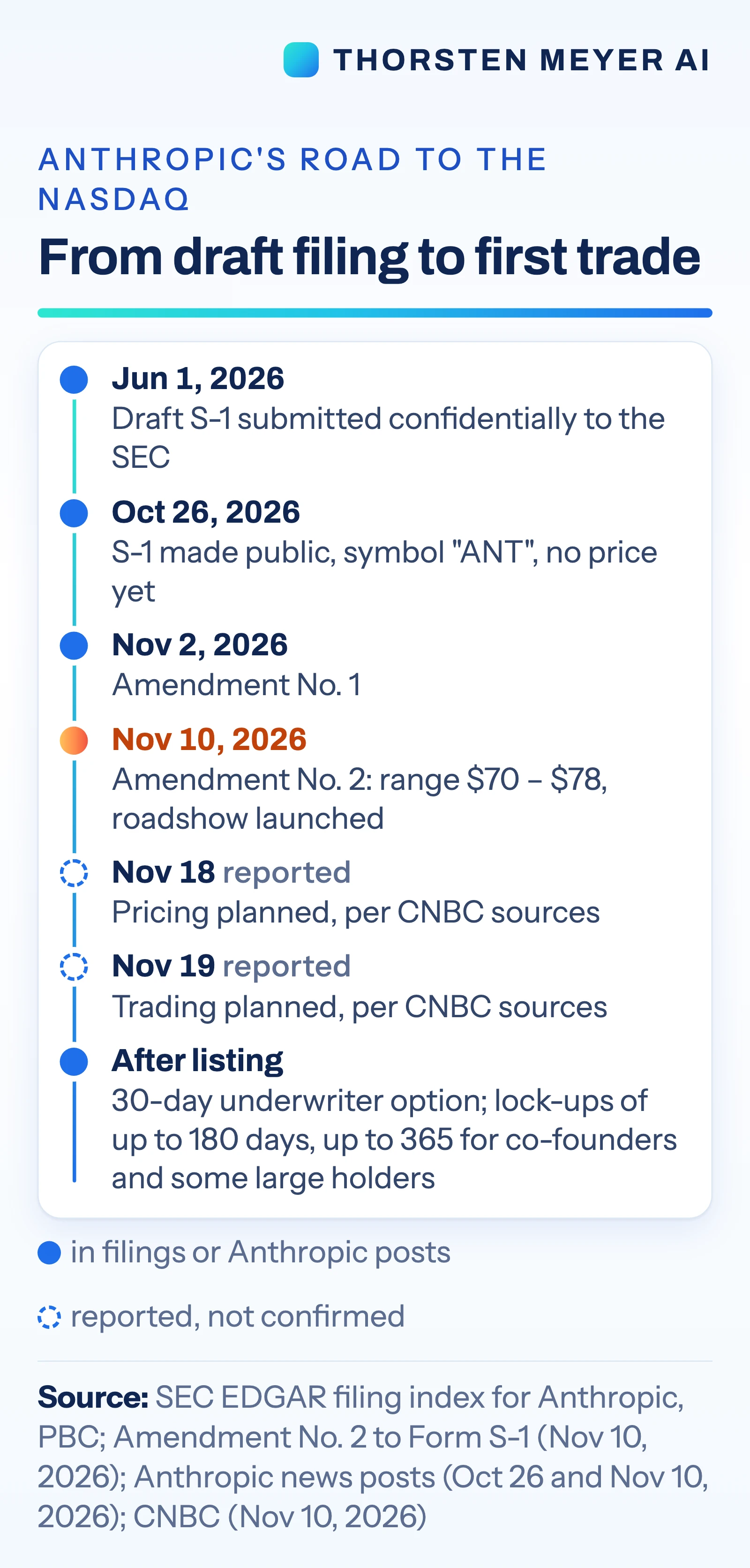
The document is Amendment No. 2 to Anthropic’s Form S-1, the registration statement a U.S. company files before an initial public offering. Anthropic first submitted a draft confidentially on June 1, 2026, made the S-1 public on October 26, amended it on November 2, and added the price range on November 10.
The key terms, all from the filing:
- Shares offered: 825,000,000 Class A shares, of which 801,351,354 are new shares sold by Anthropic and 23,648,646 are sold by existing stockholders. Anthropic receives nothing from the second group.
- Expected price: between $70.00 and $78.00 per share. Gross, the 825 million shares come to $57.75 billion to $64.35 billion.
- Extra shares: the underwriters may buy up to 123,750,000 additional shares from Anthropic within 30 days.
- A second deal on the side: AMD, Broadcom, Google, Micron, Microsoft, NVIDIA and TSMC have agreed to buy $26.0 billion of non-voting Class N shares at the IPO price in a private placement that closes right after the offering. At the $74 midpoint, Google and NVIDIA would each buy 135,135,135 shares for about $10.0 billion.
- Net proceeds: about $84.6 billion from the IPO and the private placement together at the $74 midpoint, or about $93.7 billion if the underwriters buy all extra shares.
- Use of the money: “general corporate purposes”, including working capital, “investments in compute and infrastructure”, hiring and retention, possible acquisitions (none agreed), and tax withholding on employee stock awards.
- Retail investors: Anthropic expects allocations to retail investors to represent “up to 20%” of the Class A shares offered.
The co-founders are also selling a little. The filing lists Chief Executive Officer Dario Amodei and President and Chairperson Daniela Amodei as selling 3,378,378 shares each in the offering, out of more than 240 million each beneficially owns. Krishna Rao is listed as Chief Financial Officer.
What is $70 to $78 a share worth?
A company’s market value is its share price times its number of shares. The hard part is the number of shares. The filing gives a count of shares outstanding after the offering and the private placement: 13,086,672,593 across all classes. Here is the arithmetic I did with it:
| Price per share | Shares outstanding after the offering | Implied market value |
|---|---|---|
| $70 (low end) | 13,086,672,593 | about $916 billion |
| $74 (midpoint) | 13,086,672,593 | about $968 billion |
| $78 (high end) | 13,086,672,593 | about $1.021 trillion |
TechCrunch and CNBC report a valuation of up to $1.404 trillion (CNBC: $1.405 trillion) “on a fully diluted basis”. Divide $1.404 trillion by $78 and you get about 18.0 billion shares, roughly 4.9 billion more than the outstanding count. The filing lists candidates for that difference: 1,774,342,693 shares under outstanding stock options, 1,026,660,010 shares under unvested stock awards (RSUs), 47,041,287 under RSUs granted after September 30, plus shares that remaining convertible notes held by Amazon may still turn into. Adding just the options and all listed RSUs gives about 15.9 billion shares, or about $1.243 trillion at $78. The filing itself does not print a fully diluted total for after the offering, so I cannot reproduce the reported $1.404 trillion exactly.
Why this matters: neither figure is wrong, they answer different questions. The outstanding count describes the shares that exist on the first day. The fully diluted count adds shares that employees and note holders may receive later, which is what dilutes future owners.
What the numbers say about the business
The filing contains audited results for 2023 to 2025 and unaudited figures for 2026. Revenue went from $41 million in 2023 to $386 million in 2024 and $4.585 billion in 2025. In the first nine months of 2026 it was $33.242 billion, up from $2.545 billion in the same period of 2025.
The quarterly table shows how steep the curve became this year (the chart below adds compute and infrastructure costs):
| Quarter | Revenue | Operating income (loss) |
|---|---|---|
| Q1 2025 | $376M | ($935M) |
| Q2 2025 | $787M | ($1,200M) |
| Q3 2025 | $1,382M | ($3,089M) |
| Q4 2025 | $2,040M | ($2,836M) |
| Q1 2026 | $4,731M | ($1,667M) |
| Q2 2026 | $11,555M | $974M |
| Q3 2026 | $16,956M | ($567M) |
Two details stand out. First, revenue grew 1,127% year over year in the third quarter while compute and infrastructure costs grew 382%, which Anthropic presents as proof of “compute efficiency”. Second, the company was briefly profitable at the operating level in the second quarter, then slipped back into a $567 million operating loss in the third. Anthropic attributes that to $5.0 billion of compute bought under short-term commitments, which “currently costs significantly more” than its long-term capacity, and to $2.0 billion of non-cash charges for its employee donation matching program. Q3 revenue was also reduced by about $600 million of price cuts that came with new model versions and contractual discounts.
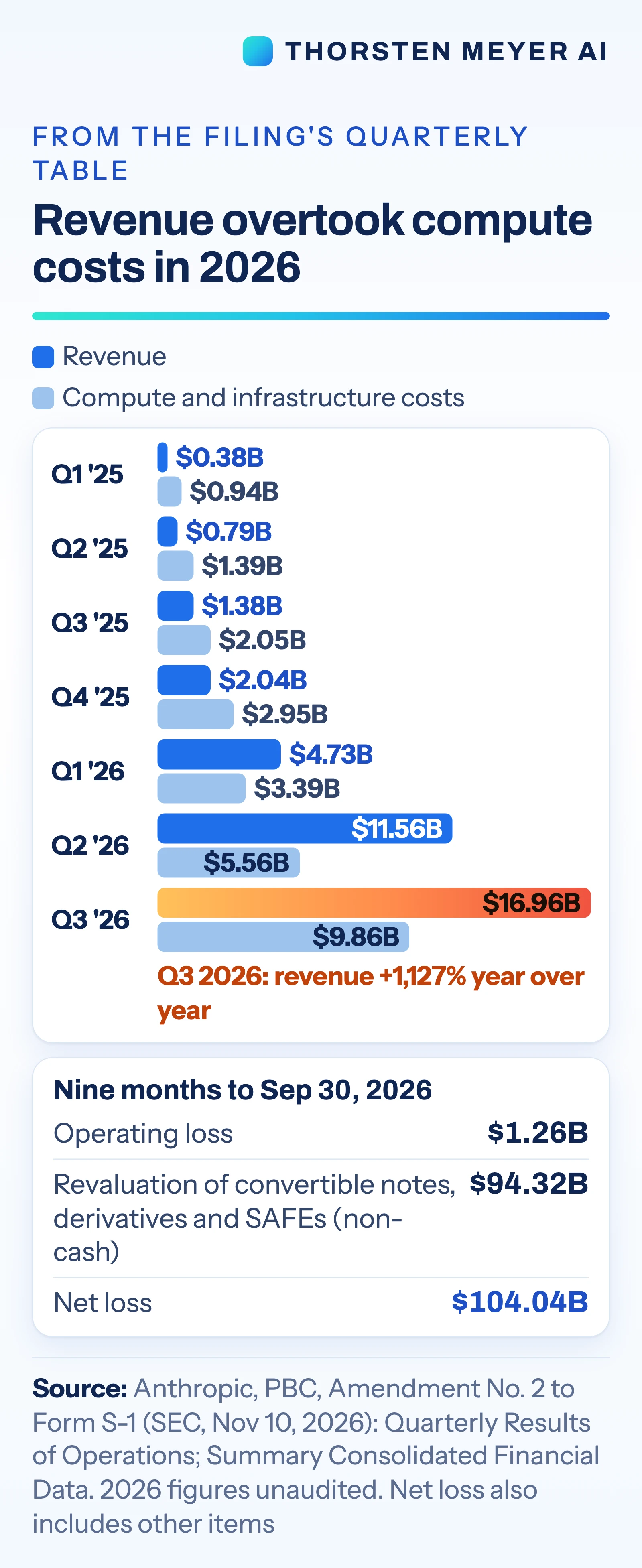
Then there is the loss that made headlines. Anthropic’s net loss for the first nine months of 2026 was $104.039 billion. The operating loss in the same period was $1.260 billion. Most of the difference, $94.324 billion, is the “change in fair value of convertible notes, derivative liabilities, and SAFEs”, which the filing says was “primarily driven by an increase in the fair value of our outstanding convertible promissory notes resulting from an increase in our enterprise valuation”. In plain words: Anthropic owes some investors shares, and because the company became more valuable, those obligations were booked at a higher value. That is a real cost to existing owners, but it is not cash spent on chips or salaries.
Anthropic also reports a non-GAAP measure, Adjusted Operating Income, of $4.1 billion for the nine months, after excluding stock-based compensation, non-cash charitable contributions and the Bartz settlement. That is the company’s own adjusted view, not an audited result.
Since the end of September, the company says its Run-Rate Revenue reached about $81 billion as of October 31, up $10 billion in one month. Run-Rate Revenue is a projection, not booked revenue: Anthropic multiplies its usage fees of the last 28 days by 13 and its monthly subscription fees by 12.
As of September 30, 2026, Anthropic had $131.845 billion in cash, cash equivalents and short-term investments.
The $900.9 billion question
The biggest number in the filing is not revenue. As of and after September 30, 2026, Anthropic says it has purchase commitments and lease agreements with an aggregate committed spend of “approximately $900.9 billion, substantially all of which is related to compute and infrastructure”. About $451.6 billion is expected before December 31, 2030, most of the rest between 2031 and 2045, and about $70.7 billion falls due in the 12 months after September 30, 2026.
Anthropic runs its models across AWS Trainium, Google TPUs, NVIDIA GPUs and AMD GPUs, and increasingly on capacity it controls itself, which it calls Anthropic Direct. Several of the chip and cloud companies that sell it this capacity are also buying shares in the private placement. So money flows in both directions: suppliers invest in a customer that spends heavily on their products.
For context, the $900.9 billion is about 11 times the $81 billion run rate Anthropic reported for October. The company says it intends to fund the commitments “through the revenue we generate and the capital that we raise”.
Who pays Anthropic
The filing says no single customer represented more than 10% of revenue in the first nine months of 2026. But the top five customers together accounted for “approximately 25%” of revenue in that period. The filing adds: “Many of our top customers are not subject to long-term contracts with us”. In the third quarter, about 79% of revenue came from customers outside the top five, up from about 64% in the first quarter.
A large part of the money also flows through cloud marketplaces. Sales through cloud service providers’ marketplaces represented about 44% of revenue in the first nine months of 2026. These platforms bill the end customers and pass the money on, net of fees.
The number of customers paying $100,000 or more over twelve months grew from more than 950 to more than 11,900 between September 30, 2025 and September 30, 2026.
Who controls the company
Anthropic is a public benefit corporation under Delaware law. Its stated purpose is “the responsible development and maintenance of advanced AI for the long-term benefit of humanity”, and its board must balance that purpose with shareholders’ financial interests.
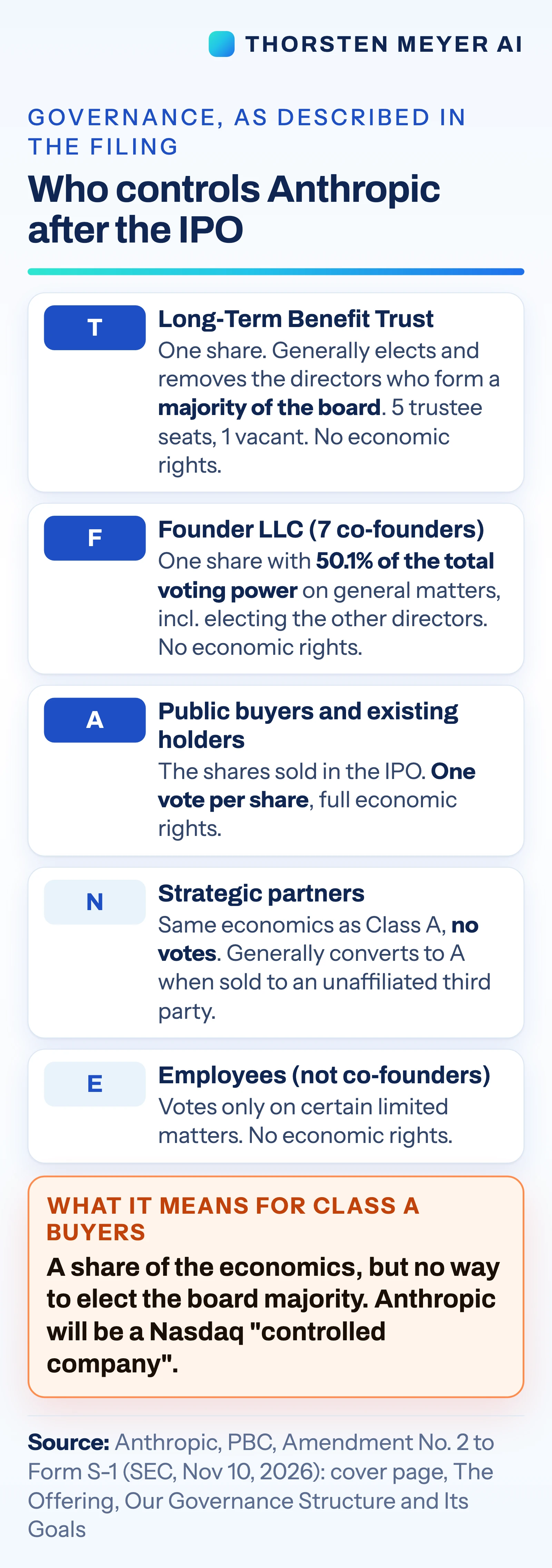
The share structure has five classes:
- Class A: the shares sold in the IPO, one vote each.
- Class N: economically identical to Class A but without votes, held mainly by strategic partners. It generally converts to Class A when sold or transferred to an unaffiliated third party.
- Class T: a single share held by the Long-Term Benefit Trust (LTBT), which generally elects and removes the directors who form a majority of the board. The LTBT has five authorized trustee seats, one currently vacant, and no economic rights.
- Class F: a single share held by an LLC of the seven co-founders, with votes equal to 50.1% of the total voting power on general matters, including the election of the other directors. No economic rights.
- Class E: for employees other than the co-founders, voting only on limited matters, no economic rights.
Anthropic says it will be a “controlled company” under Nasdaq rules, which allows exemptions from some governance requirements. For a buyer of Class A shares, that means owning part of the profits but having little say over the board.
What the filing says about the pirated-books case
Our earlier analysis, Did Anthropic Train Claude on Pirated Books? What Is Alleged, What Is Proven, and What It Means for the IPO, looked at the authors’ class action in detail. The amended filing’s risk factors describe it this way:
- In September 2025, Anthropic “reached an agreement to settle a copyright infringement class action, captioned Bartz, et al. v. Anthropic PBC (“Bartz”), for $1.5 billion, which was approved by the district court in July 2026″. The income statement shows the $1.5 billion as a separate charge in 2025.
- Anthropic says it has “a good faith belief” that its use of training data is fair use, but warns that if a court adopts “the reasoning in Bartz”, including in other active cases, “our business may be adversely affected”.
- It names further lawsuits by music publishers over song lyrics (among them Concord Music Group, BMG, Round Hill Music and Sony Music Publishing) and a suit by Reddit over posts on its platform, and says it is “vigorously defending” itself.
- It notes that “as in Bartz, insurance may not fully cover such claims”.
The filing does not say that further settlements are planned, and it does not put a number on the risk from the pending cases.
Other risks the filing spells out
- The U.S. government dispute. In February 2026, after Anthropic said its technology should not be used for mass domestic surveillance or fully autonomous weapons, the President directed federal agencies to stop using it, and the Department of War designated it a supply-chain risk. A district court ruled largely in Anthropic’s favor in August 2026; on September 25, 2026 a federal appeals court panel upheld one of the designations, 2-1. Anthropic has asked for a rehearing and says it cannot predict the outcome.
- An FTC inquiry. In October 2026 the U.S. Federal Trade Commission sent Anthropic a civil investigative demand about its consumer protection, data protection and privacy practices and the safety and security of its products. The filing says it “does not assert any claims”.
- Pricing. Anthropic says it “may be required to reduce our prices” or move to “outcome- or task-based pricing”, and that agentic products are “structurally more compute-intensive”. If prices cannot cover those costs, compute efficiency could deteriorate. It also names open-weight models as a source of “pricing pressure”.
A small change that TechCrunch noticed: the filing now uses “super intelligence” and “SI” interchangeably with “artificial intelligence” and “AI”, and cites a presidential executive order of September 29, 2026 that directs federal agencies to use that terminology.
What it means for businesses building on Claude
Vendor stability gets a public scorecard. Once listed, Anthropic has to publish audited numbers every quarter. Customers and procurement teams will be able to read revenue, cash and commitments instead of guessing. The filing shows about $131.8 billion in cash and short-term investments before the offering and about $84.6 billion in expected net proceeds, set against $900.9 billion of long-term commitments.
Prices can move in both directions. The filing shows that new model versions came with price cuts worth about $600 million in one quarter. It also warns that agentic workloads are expensive to serve and that pricing models may change. If you build on Claude, plan for price changes per model version and keep your cost per task measurable.
Concentration cuts both ways. Anthropic depends on a handful of large customers and on cloud marketplaces for a large share of its revenue. That gives big customers bargaining power, and it means a cloud partner’s decisions can affect how you buy access. Check whether your contract runs through Anthropic directly or through a cloud marketplace.
The mission is now written into the voting rules. The Trust’s board majority and the founders’ 50.1% voting share mean the safety policies you deal with, such as usage policies and model safeguards, are not easily changed by new investors. Whether you see that as stability or as less accountability to shareholders depends on your view.
Litigation risk is disclosed, not resolved. The copyright suits concern how models were trained. The filing does not suggest that customers’ use is at risk, but businesses in publishing, music and media should follow the cases closely.
What it means for users
For people who use Claude, nothing changes on listing day. The products, prices and usage policies stay as they are unless Anthropic announces otherwise. Over time, a listed company faces quarterly pressure to show growth and margins, and the filing itself names pricing changes as a possibility. On the other hand, the governance structure is designed to keep the Trust and the founders in control even after the IPO.
If you are considering buying shares, this article cannot help you decide. Read the prospectus itself, especially the risk factors, and talk to a licensed adviser. This is not investment advice.
What is not known yet
- The final price. The range is an estimate. The filing leaves the price and the delivery date blank.
- The exact dates. According to people familiar with the matter cited by CNBC, Anthropic plans to price on November 18 and begin trading on November 19, 2026. Neither the filing nor Anthropic’s announcement states these dates.
- Allocation. How many shares go to institutions and how many to retail investors. The filing says “up to 20%” for retail, depending on demand.
- The first trade. Nobody knows how the stock will trade.
- The fully diluted count. The filing does not print the post-offering fully diluted share count behind the reported $1.404 trillion.
- Whether the underwriters buy the extra 123,750,000 shares.
- The outcome of the pending copyright and government cases.
The limits of this story
This article relies on Amendment No. 2 to Anthropic’s Form S-1, filed with the SEC on November 10, 2026, its list of earlier filings on EDGAR, and Anthropic’s announcements of October 26 and November 10, 2026, all accessed November 10, 2026. Figures for the first nine months of 2026 are unaudited, as the filing states. The valuation calculations are my own arithmetic from the filing’s share counts. TechCrunch, CNBC and Yahoo Finance are cited only for what they reported, including the expected pricing and trading dates. I deliberately left out any comparison of the price with other companies, any forecast of trading and any judgment on whether the shares are a good buy.
I’m Thorsten Meyer. The full sources are below, and more reality checks are at thorstenmeyerai.com.
Sources
- U.S. Securities and Exchange Commission: Anthropic, PBC, Amendment No. 2 to Form S-1, Registration No. 333-299633, filed November 10, 2026 (sections: cover page, Prospectus Summary, The Offering, Risk Factors, Use of Proceeds, Management’s Discussion and Analysis, Our Governance Structure and Its Goals, Management, Principal and Selling Stockholders, Underwriting, notes to the financial statements)
- SEC EDGAR: Anthropic, PBC filing index, accessed November 10, 2026
- Anthropic: Anthropic launches roadshow for proposed initial public offering, November 10, 2026
- Anthropic: Anthropic files S-1 with the SEC for proposed initial public offering, October 26, 2026
- TechCrunch: Anthropic sets IPO price range of $70 to $78 per share to reach an implied valuation of $1.404 trillion, November 10, 2026
- CNBC: Anthropic sets IPO price range of $70 to $78, looks to start trading Nov. 19, sources say, November 10, 2026
- Yahoo Finance: Anthropic Sets IPO Price Range at $70 to $78, Valuing Company at Up to $1.4 Trillion, November 10, 2026
Researched and drafted with AI assistance, including Anthropic’s Claude. Anthropic is the subject of this article. Neither Anthropic, its underwriters nor any of the companies named reviewed or sponsored this article, and it contains no affiliate links. This is not investment advice. Images: AI-generated illustration (Runware) and graphics by Thorsten Meyer AI; no real people or logos are shown.