
By Thorsten Meyer | November 3, 2026 | ThorstenMeyerAI.com

Get business pricing on tech for your team
- Business-only prices and quantity discounts
- Tax-exempt purchasing
- Multiple users, one account, clear invoices
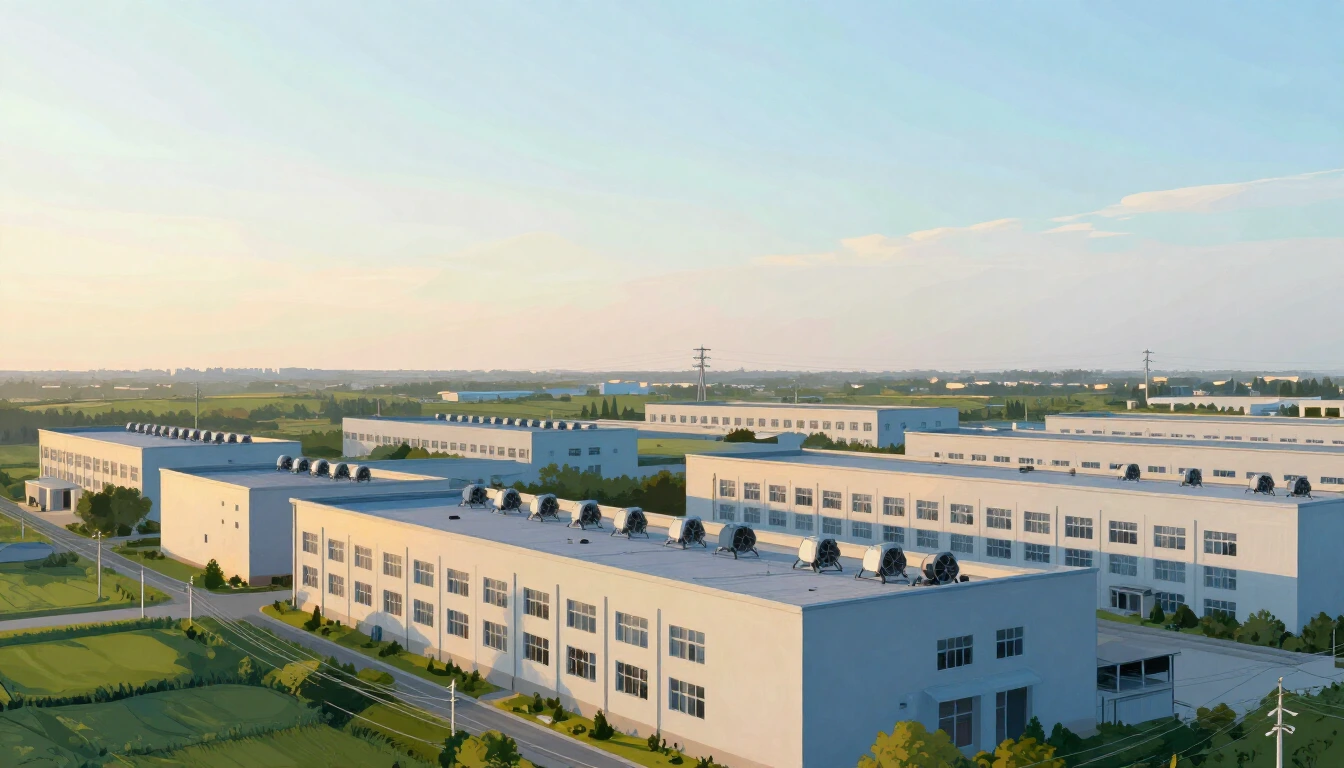
If you can’t win an argument, you can try changing the word. Two days before today’s US midterm elections, Axios reported that OpenAI is preparing a public relations push for after the vote, and one idea in it is to stop saying "data centers". OpenAI confirmed the new term to Business Insider: "compute campuses". A spokesperson said the name "better describes the scale and role of the infrastructure we’re building for AI."
I understand why a company would want a friendlier word. But a word does not change an electricity bill, a grid connection or a water permit. So I set the name aside and followed the costs instead: who pays for the power, the grid upgrades and the water when the AI industry builds at this scale. The honest answer is that some of it is measurable, some of it is promised, and a surprising amount is still open. And this is not an OpenAI story alone. Every large AI developer is building, including Anthropic, the maker of Claude, which helped me research this piece.
Key takeaways
- The rename is confirmed, the campaign is not launched. OpenAI confirmed "compute campuses" to Business Insider; the wider post-midterm PR push is known only from Axios’s reporting, as summarised by TechCrunch.
- The biggest US grid is short, and data centers carry a large share of the bill. PJM’s latest capacity auction cleared at its price cap and came in 6,831 MW short; the independent market monitor attributes $6.3 billion of the $16.4 billion to data centers.
- The link between data centers and household prices is disputed. Virginia and Ohio residential prices rose 11.3% and 10.4% in a year, but the IEA finds no simple relationship at state level, and the EIA names weather, not data centers, for PJM’s 41% wholesale jump.
- The industry’s promises are real but voluntary. OpenAI pledged "paying our own way on energy", and seven companies signed a White House pledge; the fact sheet names no penalty, oversight body or reporting duty.
- Water at OpenAI’s largest planned site is still an open question. At Pike County, Ohio, OpenAI expects office-building-like water use, but will publish projections only once the design is final.
- The money behind the build is shifting. OpenAI owns no data centers, partners carry the debt, and a reported cut in its funding target is not confirmed by OpenAI.
Products Worth Considering

Jackery HomePower 3600 Plus Portable Power Station, 3584Wh, 3600W

EcoFlow Delta 3 Ultra 3072Wh Portable Power Station – 3600W AC Output

Anker SOLIX C1000 Gen 2 Portable Power Station
As an affiliate, we earn on qualifying purchases.
What OpenAI actually confirmed
On November 1, TechCrunch reported, citing Axios, that OpenAI is getting ready for a "PR blitz" that would start after the midterms. Among the ideas Chris Lehane, OpenAI’s chief global affairs officer, laid out: renaming data centers "AI compute campuses". I could not read the Axios piece itself, so I rely on what TechCrunch reproduced. Lehane called the midterms "a bit of a movie trailer for what you’re going to see in 2028", called the data center debate "good and healthy", and said: "Communities should hold companies responsible and accountable."
The confirmation came from OpenAI itself. Gizmodo, reporting on Business Insider’s story, quotes the spokesperson: "These are long-term investments in computing, energy infrastructure and skilled work." And: "We want the communities hosting that infrastructure to help shape it and share in the opportunities it creates." As of this morning, I found no official OpenAI publication that launches the new term.
Why would a word matter? Because the mood has shifted. Pew Research Center surveyed 10,548 US adults on its American Trends Panel from July 20 to August 9, 2026. Half now say data centers are mostly bad for home energy costs, up from 38% in January. 54% say they are mostly bad for the environment, up from 39%. And 60% would be not too or not at all comfortable with a new data center in their area. Just 4% think data centers have a mostly good impact in every area Pew asked about.
The promise: "paying our own way"
The industry saw this coming. In January 2026, OpenAI published its "Stargate Community" plan. As quoted by Bisnow, the blog post said: "Across all of our Stargate Community plans, we commit to paying our own way on energy, so that our operations don’t increase your electricity prices."

On March 4, 2026, the White House announced the Ratepayer Protection Pledge, signed by Amazon, Google, Meta, Microsoft, OpenAI, Oracle and xAI. According to the fact sheet, the companies will "build, bring, or buy new generation resources", "cover the cost of all power delivery infrastructure upgrades required for their data centers", and pay negotiated rates "whether they use the electricity or not."
That is a real commitment on paper. But the fact sheet has no teeth: no penalty, no enforcement body, no monitoring process, no reporting requirement. It is a pledge the firms signed, which the fact sheet itself calls "a first step." The International Energy Agency (IEA) makes the same point more generally in its April 2026 report "Key Questions on Energy and AI": recent measures shift some financial risk away from utilities, "however, the extent to which consumers will be protected is less clear. To date, there are few examples of US states legislating full cost recovery by data centre operators."
The IEA adds that cost protection can fail in either direction: other ratepayers can end up subsidising data centers, or the other way round.
The bill in America’s biggest grid
If you want a place where costs are already visible, look at PJM, the grid operator serving more than 67 million people across 13 states and the District of Columbia, from Illinois to Virginia.
On July 14, 2026, PJM published the results of its capacity auction for the 2028/2029 delivery year. Capacity auctions pay power plants to be available when demand peaks. The price came in at the regulator-approved cap of $325 per MW-day across the whole footprint, after $333.44 the year before. The auction came up 6,831 MW short of PJM’s reliability requirement. PJM wrote that these recent auctions "were the first in PJM history in which the entire RTO fell short." Only 525 MW of new generation and uprates cleared. PJM’s CEO David Mills: "demand for electricity continues to grow faster than electricity supply." PJM also describes "the continued trend of the addition of large data center loads to the load forecast."
The cleared supply times the price totals $16.4 billion. PJM itself cautions that this "does not equate to the total cost to load", because some demand is hedged through own plants or contracts.
Who drives that number? PJM’s independent market monitor, Monitoring Analytics, gave an answer that Utility Dive reported on July 20, 2026. Its president, Joseph Bowring, attributes $6.3 billion, or 38%, of the latest auction’s $16.4 billion to data centers. Across the last four auctions, he counts $29.4 billion of $63.6 billion, or 46%. Bowring said "PJM is continuing to act like it’s business as usual" and that "failing to do that imposes costs on other customers." His proposal is a separate auction for data centers. These are the monitor’s estimates, not PJM’s official cost allocation, but they are the most concrete attribution I found.
PJM capacity auction for 2028/2029, published July 14, 2026
America’s biggest grid cleared at its price cap and came up 6,831 MW short
PJM serves more than 67 million people across 13 states and the District of Columbia. Capacity auctions pay power plants to be available when demand peaks.
Share attributed to data centers by the market monitor
Demand for electricity continues to grow faster than electricity supply.David Mills, PJM CEO
The data center shares are estimates by Monitoring Analytics, PJM’s independent market monitor, as reported by Utility Dive, not PJM’s official cost allocation.
Sources: PJM Inside Lines, July 14, 2026, Utility Dive, Ethan Howland, July 20, 2026. Powered by Thorsten Meyer AI
Prices: what the data show, and what they don’t
The US Energy Information Administration (EIA) forecast in its October 6, 2026 outlook that the average US residential electricity price rises from 17.3 cents per kilowatt-hour in 2025 to 18.2 cents in 2026 and 18.7 cents in 2027. It also forecasts that wholesale prices in the PJM region will be 41% higher in 2026 than in 2025, "the largest increase across all regions." But read the EIA’s explanation: it names weather events, winter storm Fern and a hot July, as the main reasons some regions saw higher wholesale prices this year. It does not attribute the 41% to data centers.
The state data look striking. In the EIA’s preliminary monthly figures, the average residential price in August 2026 was 17.64 cents in Virginia, against 15.85 cents a year earlier. By my calculation, that is a rise of 11.3%. Ohio rose 10.4%, Michigan 10.9%, Pennsylvania 9.2%, Maryland 7.6% and Illinois 7.2%. The US average rose 3.4%. Texas, outside PJM, rose 3.3%. And New Jersey, which is in PJM, fell 0.4%.
Average residential electricity price, August 2026 vs August 2025
Some data center states saw double-digit rises; others barely moved
Virginia’s average residential price rose from 15.85 to 17.64 cents per kilowatt-hour in a year. New Jersey, which is in PJM, fell 0.4%.
Change in average residential price
No simple link
In the United States, states with greater load growth generally did not see higher price increases. State averages may still mask local effects.
Weather, not data centers
The EIA forecasts PJM wholesale prices 41% higher in 2026 than in 2025 and names winter storm Fern and a hot July as main reasons.
My calculation from preliminary EIA monthly data. Price changes by state show correlation, not causation.
Sources: EIA, Electric Power Monthly, Table 5.6.A, August 2026 and 2025, EIA, Short-Term Energy Outlook, October 6, 2026, IEA, Key Questions on Energy and AI, April 16, 2026. Powered by Thorsten Meyer AI
That is a correlation, not proof. The IEA looked at exactly this question and found that in the United States, "states with greater load growth generally did not see higher price increases." Its conclusion: "there is no simple, one-way relationship between load growth and electricity prices." But the IEA also warns that state averages "may therefore mask localised price effects in areas with concentrated load growth."
The fair summary: in PJM, a capacity shortage that the market monitor ties largely to data centers will feed into bills. Beyond that, the effect on any one household depends on region, weather, gas prices and how the local regulator allocates costs. Anyone who says the answer is simple, in either direction, is selling something.
Pike County, Ohio: the test case
The best way to judge the promises is to look at one project in detail. On August 17, 2026, OpenAI announced it would lease about 8 gigawatts of a planned campus in Pike County, Ohio, for 20 years, as WOUB reported the next day. SB Energy, a SoftBank subsidiary, builds, owns and operates it; Nvidia is investing $1.5 billion in SB Energy. The site is a former uranium enrichment plant near Piketon, on land owned by the federal government.
The energy plan is where the "who pays" question gets concrete:
- The first 800 megawatts are expected in 2028, and that phase will draw mainly on the existing grid.
- SB Energy plans to spend $33 billion on more than 9 gigawatts of gas-fired generation, and more than $4 billion on transmission lines.
- According to OpenAI, "SB Energy will pay the full cost of grid upgrades and new transmission lines" and "these costs will not be shifted to ratepayers."
Jobs: 35,000 construction jobs over a build-out that runs until 2032, and 2,500 long-term operating jobs. Community money: OpenAI pledged $40 million for a community grant fund, on top of $40 million already committed by SB Energy. Other outlets have reported larger totals with different counting, so I use WOUB’s figures.
And water. OpenAI says the campus will use a closed-loop, air-cooled system, and that "ongoing water use is expected to be comparable to an office building supporting a similar number of people." It will publish the projected water use once the site design is final. Until then, the water question at Pike is open. OpenAI also plans an "Ohio Community Compact" and an annual report on hiring, water and energy use, and community investment. That report, once it exists, will be the real test.
Two questions stay with me. Will the gas plants come online in time, given turbine and supply-chain bottlenecks the IEA describes? And who carries the cost of the first 800 megawatts that come from the existing grid in 2028, a grid PJM already says is short?
Who finances the build
The second layer is financial risk. CNBC reported in March 2026 that "OpenAI doesn’t currently own any data centers, and may not for the foreseeable future," citing people familiar with the matter. Partners carry the build: Oracle, for example, "has been funding the buildout by taking on tens of billions of dollars in debt." OpenAI told investors in February that it is targeting "roughly $600 billion in total compute spend by 2030". In November 2025, Sam Altman had spoken of commitments of "roughly $1.4 trillion over the next eight years." The two numbers cover different scopes and time frames, so they are not a one-to-one cut.
On October 31, TechCrunch reported, citing the Financial Times, that OpenAI lowered its funding target for a new round from $30 billion to $20 billion, and that the Wall Street Journal said $11 billion had been secured so far, with a "tepid" response from some large investors. OpenAI did not comment in that report, and I could not read the FT original. Treat this as reported, not confirmed.
The IEA puts this in industry terms: "Data centre investments have grown too large to be funded from company balance sheets alone," and the pace of growth "will be sensitive to market sentiment." I looked at the bond, lease and power-bill side of this boom across the big cloud companies last week in Who Pays for the AI Data Center Boom?.
This is an industry-wide question. Anthropic announced in November 2025 "a $50 billion investment in American computing infrastructure", building data centers with Fluidstack in Texas and New York, with "approximately 800 permanent jobs and 2,400 construction jobs." Whatever we call these buildings, every large AI developer needs power, grid connections and water, and each of them will face the same questions about who pays.
The politics: why the word matters now
The backlash is no longer only local. On July 14, 2026, New York Governor Kathy Hochul signed an executive order barring new large-scale data centers using 50 megawatts or more for up to one year, which CNBC reported as the first such ban by a US state. Her words: "They drive up costs for local ratepayers, and I refuse to let those costs get passed down to New Yorkers." Her office is also pursuing legislation to repeal sales tax exemptions for large data centers.
Put that next to the Pew numbers and Lehane’s view of 2028, and the rename makes strategic sense: when costs are concrete and benefits feel abstract, the fight moves to language. But voters and regulators will judge tariffs, contracts and published water figures, not the sign at the gate.
What this means for companies
- Check your power exposure in data center regions. If you run sites in PJM states, the capacity auction results flow into supply costs. Commercial prices rose too: in August 2026, Virginia’s average commercial price was 11.14 cents against 9.85 cents a year earlier. Review hedges and contract renewal dates with your energy supplier.
- Treat compute capacity as a constrained resource. AI services depend on build-outs slowed by grid connections, generation and chips; the IEA expects a shortage of high-bandwidth memory to persist through at least the end of 2027. Plan for capacity limits and price changes in AI services rather than assuming they only get cheaper.
- Watch the rules, not the slogans. Voluntary pledges help, but the IEA notes few US states have legislated full cost recovery from data center operators. State tariffs for large loads will decide who pays.
What this means for users
- Your bill depends on where you live. The effect of data centers on household prices varies by region and regulator. If you live in a data center region, ask your utility or state regulator whether large users pay their own grid upgrades under a separate tariff.
- Local decisions happen in public hearings. Noise, light, land, water and tax deals are decided locally. That is where residents have the most influence.
- Read job numbers carefully. At Pike, the projection is 35,000 construction jobs and 2,500 long-term operating jobs. Construction jobs are real, but they end.
What we don’t know yet
- How much data centers raise household bills. The IEA sees no systematic link at state level but possible local effects. The PJM market monitor quantifies a share of capacity costs. The EIA names weather for PJM’s 41% wholesale rise. These views do not add up to one number.
- Whether the promises hold. "Paying our own way" and the White House pledge are voluntary; the fact sheet names no enforcement.
- Pike’s water use. OpenAI will publish projections only once the design is final. Until then, "comparable to an office building" is a company expectation, not a measurement.
- OpenAI’s financing. The reported cut in the funding target comes from the FT and is not confirmed by OpenAI.
- Whether the rename launches at all, and what the planned community compacts will contain.
- What today’s election changes. I am writing on election day and do not anticipate results.
I also want to be clear about what I am not saying. I am not claiming that AI is driving general inflation. The evidence in this piece is about electricity, grids and local costs, and even there the causal link is disputed.
Promises on paper, and what is still open
The industry promises to pay its own way. The proof is not in yet
OpenAI, January 2026
In its own words: “Paying our own way on energy, so that our operations don’t increase your electricity prices.”
White House pledge, March 4, 2026
Amazon, Google, Meta, Microsoft, OpenAI, Oracle and xAI signed. The fact sheet names no penalty, oversight body or reporting duty.
Pike County grid costs
SB Energy will pay grid upgrades and new transmission lines. But the first 800 megawatts in 2028 draw mainly on the existing grid.
Pike County water
Closed-loop, air-cooled, expected to be comparable to an office building. Projections only once the site design is final.
OpenAI’s financing
The FT reported a cut in the funding target from $30 billion to $20 billion. OpenAI has not confirmed it.
The price link
The IEA finds no simple, one-way relationship between load growth and electricity prices. The EIA names weather for PJM’s 41% wholesale rise.
The cost question applies to the whole industry: Anthropic, too, announced a $50 billion data center build-out.
Sources: Bisnow, January 22, 2026, The White House, fact sheet, March 4, 2026, WOUB, August 18, 2026, TechCrunch, October 31, 2026, IEA, Key Questions on Energy and AI, April 16, 2026, EIA, Short-Term Energy Outlook, October 6, 2026, Anthropic, November 12, 2025. Powered by Thorsten Meyer AI
The bottom line
"Compute campuses" may well describe a multi-gigawatt site better than "data center". But the debate is not about vocabulary. It is about who pays for new generation and grid upgrades, who carries the risk when a grid is short, and who gets to see the water figures. Some answers exist on paper, in pledges and press releases. The test is whether they show up in tariffs, contracts and published reports. That applies to OpenAI, and to every other company racing to build, including the maker of the AI I used to write this.
Sources
- TechCrunch, Anthony Ha, "OpenAI might rebrand its data centers as ‘AI compute campuses’", November 1, 2026, techcrunch.com
- Gizmodo, Mike Pearl, "OpenAI Would Reportedly Like You to Use Its Pleasant New Term for Data Centers", November 1, 2026, gizmodo.com
- Pew Research Center, Brian Kennedy, "More Americans now say data centers are negative for the environment, energy costs and more", September 22, 2026, pewresearch.org
- Bisnow, Dan Rabb, "OpenAI Pledges To Foot Bill For Generating New Power For Stargate Data Centers", January 22, 2026, bisnow.com
- The White House, "Fact Sheet: President Donald J. Trump Advances Energy Affordability with the Ratepayer Protection Pledge", March 4, 2026, whitehouse.gov
- International Energy Agency, "Key Questions on Energy and AI", World Energy Outlook Special Report, April 16, 2026, iea.blob.core.windows.net
- PJM Inside Lines, "PJM Capacity Auction Procures 138,318 MW of Generation Resources as Work Continues To Address Growing Electricity Demand", July 14, 2026, insidelines.pjm.com
- Utility Dive, Ethan Howland, "Data centers drove $6.3B in PJM capacity auction costs: market monitor", July 20, 2026, utilitydive.com
- US Energy Information Administration, "Short-Term Energy Outlook: Electricity, Coal and Renewables", October 6, 2026, eia.gov
- US Energy Information Administration, "Electric Power Monthly, Table 5.6.A: Average Price of Electricity to Ultimate Customers by End-Use Sector, by State, August 2026 and 2025", preliminary, eia.gov
- WOUB, David Forster, "OpenAI announces plans to lease much of a proposed data center campus in Pike County", August 18, 2026, woub.org
- CNBC, Ashley Capoot, "OpenAI data center pivot underscores Wall Street IPO concerns", March 22, 2026, cnbc.com
- TechCrunch, Anthony Ha, "OpenAI reportedly lowers funding target for new round", October 31, 2026 (citing the Financial Times and the Wall Street Journal), techcrunch.com
- Anthropic, "Anthropic invests $50 billion in American AI infrastructure", November 12, 2025, anthropic.com
- CNBC, Paxton Honerkamp, "New York becomes first U.S. state to impose AI data center ban", July 14, 2026, cnbc.com
This article is for information only. It is not legal, financial, energy-procurement or investment advice. Price changes by state are my own calculation from preliminary EIA data and show correlation, not causation.
Researched and drafted with AI assistance, including Anthropic’s Claude.