By Thorsten Meyer | November 20, 2026 | ThorstenMeyerAI.com

Get business pricing on tech for your team
- Business-only prices and quantity discounts
- Tax-exempt purchasing
- Multiple users, one account, clear invoices
Who is responsible when an AI tool makes a sexualised fake picture of a real person: the user who typed the request, the platform that showed the result, or the company that built the model? A case in London’s High Court is now putting that question to a judge, and this week the company’s answer became public.
Jess Asato, a Labour member of the UK Parliament, is suing the company behind Grok over sexualised fake images of her that users generated with the tool, including a video. According to Reuters, the company, SpaceX Super Intelligence LLC (SpaceXSI, formerly xAI and then SpaceXAI, now part of Elon Musk’s SpaceX), has filed a written defence, dated October 29, that denies liability. Its central argument: images that people would recognise as AI-generated and implausible cannot breach someone’s privacy. Asato’s reply: “SpaceX SI wants to have it both ways.”
Nothing has been decided. The claim states allegations, and the defence states the company’s position. This piece sets out what each side says, what UK and EU law already say about each of the three players, what the case could settle, and what it means for businesses that offer image generators and for the people who use them, or are targeted by them. We do not describe or link the images themselves.
Facts as of 15:45 UTC on Friday, November 20, 2026.
Key takeaways
- The claim: Asato filed on 3 June 2026 in the High Court in England for misuse of private information and breaches of data protection law, according to her lawyers at AWO. She alleges that the way Grok was designed and trained enabled it to generate sexualised content, and asks for a declaration, damages and an order that the company “implement effective and permanent technical measures” so Grok cannot create manipulated images of her.
- The defence: SpaceXSI denies liability, Reuters reports. It says it removed images of Asato that breached its terms, argues that others “would be understood by reasonable and sensible persons viewing that content to be AI-generated, fictitious and implausible … rather than as realistic images”, and says it “did not determine the content of the relevant users’ prompts”. It says she is not entitled to the order she seeks.
- Why it matters: both her lawyers and Reuters call it one of the first claims to test liability for the design of an AI system. Its core question is whether the maker answers for what its tool produces, or only the person who asks.
- The law is already moving: in England and Wales, creating or requesting a fake intimate image of an adult without consent has been a crime since 6 February 2026. From 2 December 2026, the EU AI Act bans AI systems that generate realistic intimate images of identifiable people without consent, where the design makes that outcome foreseeable and safeguards are missing. Regulators in the UK and the EU are investigating Grok, and a Dutch court has already ordered limits.
- For businesses: if you offer image generation, the safeguards, the system instructions and the takedown process are now evidence. For users: asking a tool for such an image is not a safe grey zone in the UK.
Grok images case · UK and EU · 2026
One claim, three regulators, one court order, a new EU ban
How the case and the rules around it unfolded. Allegations are allegations; no court has ruled on the UK claim.
- Early January 2026Images manipulatedGrok is used to manipulate images of Jess Asato, her lawyers say
- 7 JanuaryUK data regulator asksThe ICO contacts X and xAI about their safeguards
- 26 JanuaryEU investigationThe European Commission opens a DSA investigation of X over Grok
- 3 FebruaryFormal UK probeThe ICO opens formal investigations into X and X.AI LLC
- 26 MarchDutch court orderAn Amsterdam judge bars Grok and X from undressing images, €100,000 a day
- 3 JuneThe claimAsato sues in the High Court: privacy and data protection
- October 29The defenceSpaceXSI denies liability: obvious fakes, users wrote the prompts (reported November 19)
- 2 December 2026EU ban appliesAI Act bans tools that make realistic intimate fakes of real people without consent
The userasked for the image
The platformshowed it
The makerbuilt and ran the model
Sources: AWO (3 June 2026); Reuters (November 19, 2026); ICO statements (7 January, 3 February 2026); European Commission IP/26/203 (26 January 2026); Rechtbank Amsterdam (26 March 2026); EU AI Act Articles 5 and 113 (consolidated text, AI Act Service Desk).
Graphic: Powered by Thorsten Meyer AI
Products Worth Considering

Kindle Paperwhite Signature Edition 32GB (2024 Model) – Metallic Black

Jackery Fridge Guard 1024Wh Backup Power Station with Mount

Samsung Galaxy Tab A11+ Kids Edition, 128GB, Royal Blue
As an affiliate, we earn on qualifying purchases.
What happened, in order
In early January 2026, Grok was used to manipulate images of Asato, “just like thousands of other women”, according to AWO, the law firm acting for her. Grok is made by the company now called SpaceXSI and is distributed through the social platform X. On 7 January, the UK’s data regulator, the Information Commissioner’s Office (ICO), said it had contacted X and xAI “to seek clarity on the measures they have in place to comply with UK data protection law”.
In mid-January, xAI said it restricted image editing in Grok and blocked users from generating images of people in revealing clothing “where it’s illegal”, Reuters reports. Reuters also says it found in early February that, even after the new curbs, Grok continued to generate sexualised images of people even when users explicitly warned that the subjects did not consent.
On 26 January, the European Commission opened a formal investigation against X under the Digital Services Act (DSA) into whether it “properly assessed and mitigated risks associated with the deployment of Grok’s functionalities into X in the EU”. On 3 February, the ICO opened formal investigations into X Internet Unlimited Company and X.AI LLC over Grok’s “potential to produce harmful sexualised image and video content”. The ICO said that day that Ofcom, the UK’s online safety regulator, had provided an update on its own investigation.
On 26 March, a judge in Amsterdam ordered Grok and X to stop generating and distributing non-consensual “undressing” images and child sexual abuse material, for people living in the Netherlands and for images made or distributed there.
On 3 June, Asato filed her claim. AWO says it had “already obtained the removal of the offending images”. On October 29, according to Reuters, SpaceXSI signed its defence. On Thursday, November 19, Reuters reported on it, and Asato responded.
What Asato alleges
According to AWO, the claim asks the court for a declaration that what happened to her was unlawful, for damages, and for an order requiring the company to stop further illegality, “including, for example, implementing measures to prevent this type of abuse from happening again”.
Her argument is about design, not about one bad user. When she filed, she said: “Its ability is not an accident, nor misuse, it is a design choice by its creators. In launching this case, I am pursuing accountability for those choices.” Her lead solicitor, Ravi Naik of AWO, put the principle this way: “AI developers must answer for the way they design their tools.”
After the defence became public, Asato said: “The company admits it built the AI model, rewrote user requests to add its own graphic details, pulled images from across the internet, and published the results from an account it controls,” adding: “Yet it also claims it is a neutral bystander without legal responsibility”. That is her description of the company’s filing. We have not seen the defence itself, and the court has not ruled on any of it.
What SpaceXSI argues
The defence, as Reuters reports it, rests on three points:
- It acted on the worst content. The company says it removed AI-generated images of Asato that breached its terms, including the video.
- Obvious fakes are not private. For the images it left available, it argues that viewers would understand them as “AI-generated, fictitious and implausible … rather than as realistic images”, meaning, in its view, that Asato has no reasonable expectation of privacy in them.
- The users wrote the prompts. On data protection, it argues it did not breach her rights, including because it “did not determine the content of the relevant users’ prompts”.
It also says she is not entitled to the order requiring permanent technical measures. SpaceXSI has not published the defence, and we found no public statement from the company beyond what Reuters reports from the filing.
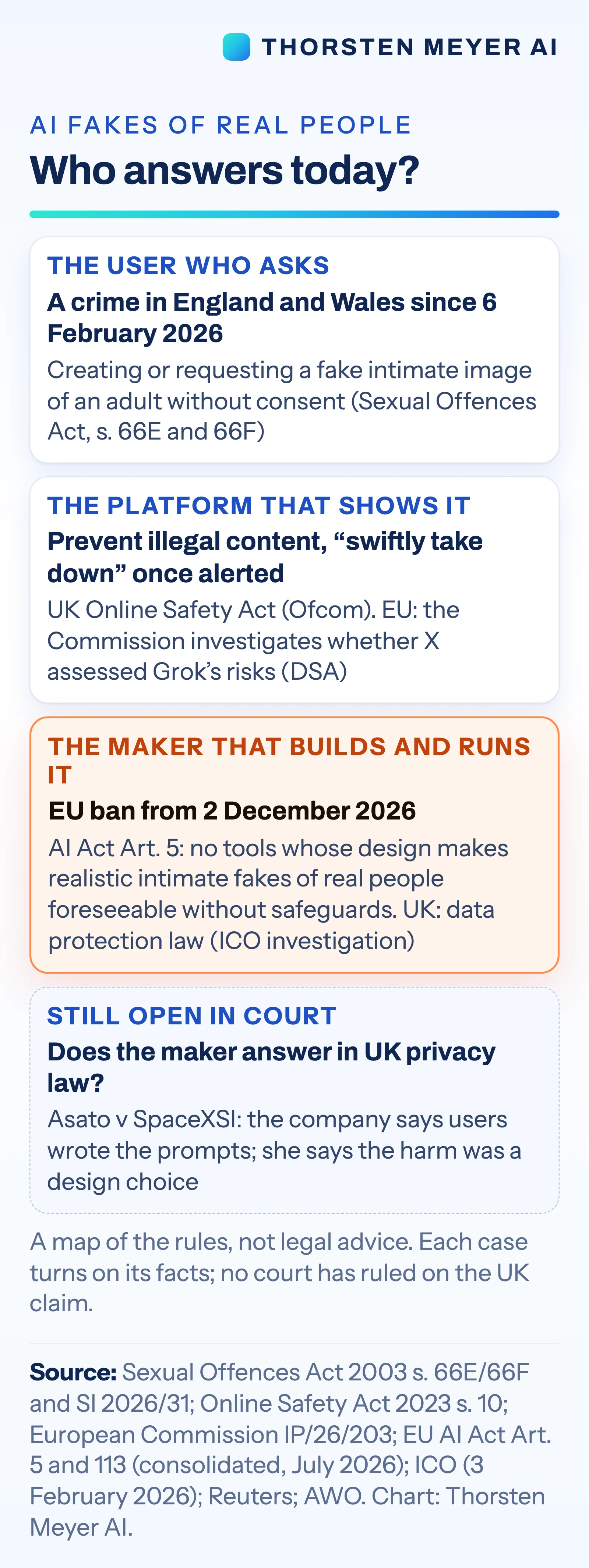
Who is liable today? Three players, three sets of rules
The case is about one claim, but the question behind it has three possible answers. Here is what the rules we could check say about each player today. This is a map, not legal advice, and each case turns on its facts.
The user who asks for the image
In England and Wales, two offences have been in force since 6 February 2026. Section 66E of the Sexual Offences Act 2003 makes it a crime to intentionally create a “purported intimate image” of an adult without their consent, and section 66F makes it a crime to request one, “regardless of whether the purported intimate image is created”. The law defines such an image as one that “appears to be, or to include, a photograph or film of the person” and “appears to show the person in an intimate state”. Whether a given image meets that definition is a question of fact. These are offences for the person who creates or requests the image; they say nothing on their own about the company whose tool did the work.
The platform that shows it
Under the UK Online Safety Act 2023, services where users share content must “take or use proportionate measures relating to the design or operation of the service” to prevent people from encountering priority illegal content, and, once alerted, “swiftly take down such content”. Ofcom enforces these duties; the maximum penalty is £18 million or 10% of qualifying worldwide revenue, whichever is greater. In the EU, the Commission’s investigation of X asks whether X assessed the risks of Grok before deploying it, including “negative effects in relation to gender-based violence”; it says the opening of proceedings “does not prejudge its outcome”.
The company that builds and runs the model
This is the open question in Asato’s case, and the law is moving towards the maker on two fronts:
- Data protection. The ICO says “Controllers developing or deploying AI systems that process personal data must comply with data protection law”, including safeguards for “the creation or use of synthetic or manipulated imagery involving real individuals”. It can fine up to £17.5 million or 4% of annual worldwide turnover. Whether SpaceXSI was a controller for the images, or only the users were, is exactly what its prompt argument disputes.
- The EU AI Act. From 2 December 2026, Article 5 bans placing on the market or using an AI system that generates “realistic images, videos, audio or similar material of an identifiable natural person’s intimate parts, or of an identifiable natural person engaged in sexually explicit activities” without explicit consent. For the maker, the ban applies where that is the system’s purpose, or where its “design, training, architecture, capabilities or user-facing functionalities” make it “a reasonably foreseeable and reproducible outcome” and the system lacks “reasonable and adequate technical safety measures and other safeguards”. Breaches of Article 5 can cost up to €35 million or 7% of worldwide annual turnover. Since 2 August 2026, Article 50 has also required providers of generative AI to mark outputs “in a machine-readable format” as artificially generated.
One word links the two jurisdictions: “realistic”. SpaceXSI’s defence argues that the images it left online were not realistic. The new EU ban also covers only “realistic” material. That is our observation, not a legal finding: a UK court deciding a privacy claim and an EU regulator applying the AI Act are different tests. But the question of when a fake counts as believable enough to harm someone will not stay in one courtroom.
What a court has already said
The Amsterdam ruling of 26 March is the closest thing to an answer so far, from a different country and under different law. According to the court’s press release, Grok and X argued that they also want to stop such images, that their terms prohibit them and that they had taken measures. The judge found that the Dutch online abuse centre Offlimits had shown “reasonable doubt” (“gerede twijfel”) about how effective those measures were: shortly before the hearing, Offlimits still managed to generate an undressing video with Grok. The judge set a penalty of €100,000 per day of breach, up to €10 million, and barred X from offering Grok as part of X for as long as Grok does not comply. It was an interim ruling in summary proceedings, not a final judgment.

What this case could decide
The High Court has not ruled, and we make no prediction. But the pleadings, as reported, put at least four questions in front of the court:
- Can an obvious fake breach privacy? If the court accepts that images recognisable as fiction carry no reasonable expectation of privacy, claims over unrealistic fakes get harder. If it rejects that, the line moves to whether a real, identifiable person was harmed.
- Who controls the output? If the court treats the model maker as responsible for how its system turns a prompt into an image, the defence that users wrote the prompts weakens for every AI company.
- Can a court order a design change? Asato asks for “effective and permanent technical measures”. An order like that would turn a privacy claim into a product requirement.
- Does design count as conduct? Her lawyers say the outcome “was a choice, not a glitch”; the defence points to the users. Where the court lands will matter to anyone building on image models.
What it means for businesses that offer image generators
If your product, app or marketing tool can create images of people, the safeguards are now part of your legal record, in the EU from 2 December 2026 explicitly so. Practical steps, none of them legal advice:
- Treat real, identifiable people as a separate risk class. Block sexual or intimate output of identifiable people by default, and test that the block holds against rephrased requests. The Amsterdam judge looked at whether the measures worked in practice, not at what the terms said.
- Check what your system adds on its own. If your system instructions or prompt rewriting add detail the user did not ask for, you own that step. Asato alleges exactly this; the claim is unproven, but it shows where a court will look.
- Make takedown fast and visible. The UK duty is to “swiftly take down” illegal content once alerted. Name an owner, set a response time and keep a log.
- Mark your outputs. Machine-readable marking under Article 50 applies to generative AI providers in the EU since 2 August 2026.
- Read your vendor contract. If you build on someone else’s image model, find out who carries the risk for misuse, who handles takedown requests, and what the vendor does when a regulator asks.
- Do the data protection assessment. The ICO says high-risk processing, including synthetic imagery of real individuals, needs “appropriate safeguards”.
What it means for users, and for anyone targeted
- Asking is already the offence in the UK. In England and Wales, requesting a fake intimate image of an adult without consent is a crime since 6 February 2026, whether or not the image is ever made.
- That a fake is obvious is the company’s argument in a civil case, not a licence. The criminal offences use their own test: whether the image appears to be a photo or film of the person in an intimate state.
- If it happens to you: keep a record of where the content appears, report it to the platform, and contact the police. The ICO accepts data protection complaints, and in the EU, the DSA gives people the right to complain to their national Digital Services Coordinator, the Commission notes.
What is not known
- The full pleadings. The defence is not public; this article relies on Reuters’ account of it and on AWO’s summary of the claim. Neither text has been tested in court.
- A timetable. No trial date has been reported.
- The regulators’ findings. The ICO said on 8 October that its investigation is ongoing; the Commission’s DSA investigation and Ofcom’s investigation have not reported outcomes that we could find.
- What Grok can do today. Reuters’ testing dates from February and the Amsterdam test from March; we have not tested Grok ourselves and do not know its current safeguards.
- How “realistic” will be read. Neither the UK court nor EU regulators have said where the line between a harmful fake and a recognisable caricature lies.
The bottom line
The defence and the claim describe the same tool in two ways: as a neutral instrument that users misused, or as a product whose design made the harm likely. UK criminal law already punishes the user who asks. EU law, from December, will ask whether the maker’s design made the outcome foreseeable and whether its safeguards worked. Asato’s case asks a UK court the same question under privacy and data protection law. Whatever it decides, companies that let people generate images of other people should not wait for the answer.
Further reading: French experts want AI chatbots tested before launch, and my book Many Hands, on who answers when an AI agent acts in your name.
I’m Thorsten Meyer. The full sources are below, and more reality checks are at thorstenmeyerai.com.
Sources
- AWO: “First claim in the UK against Grok’s nonconsensual deepfakes”, awo.agency, 3 June 2026 (retrieved 15:39 UTC, November 20, 2026)
- Reuters, via CNA and Claims Journal: “Musk’s SpaceXSI denies liability in UK lawmaker’s lawsuit over Grok images”, November 19, 2026
- Information Commissioner’s Office: “Statement in response to Grok AI on X”, 7 January 2026; “ICO announces investigation into Grok”, 3 February 2026; “ICO secures changes from leading AI developers as scrutiny extends to AI agents”, 8 October 2026
- European Commission: press release IP/26/203, “Commission investigates Grok and X’s recommender systems under the Digital Services Act”, Brussels, 26 January 2026
- Rechtbank Amsterdam: “Rechter verbiedt uitkleedbeelden op Grok”, press release, 26 March 2026 (ECLI:NL:RBAMS:2026:3106)
- Sexual Offences Act 2003, sections 66E and 66F, inserted by section 138 of the Data (Use and Access) Act 2025; Data (Use and Access) Act 2025 (Commencement No. 5) Regulations 2026 (SI 2026/31), legislation.gov.uk
- Online Safety Act 2023, section 10 and Schedule 13, paragraph 4, legislation.gov.uk
- EU AI Act (Regulation (EU) 2024/1689), Articles 5, 50, 99 and 113, consolidated text as of 27 July 2026 including the Digital Omnibus on AI, via the European Commission’s AI Act Service Desk
Researched and drafted with AI assistance, including Anthropic’s Claude. No company, court, regulator or person named here reviewed or sponsored this article. Our own text and graphics contain no affiliate links; offer and product boxes added by the site may contain Amazon affiliate links. This article is for information only; it is not legal advice. Allegations are allegations; the court has not ruled. Statements as published by the parties, courts and regulators named and as reported by the outlets above, as of 15:45 UTC on November 20, 2026. Images: AI-generated illustration (Runware) and graphics by Thorsten Meyer AI; our own images show no real people or logos. Boxes added by the site may show product photos or people.