
SemiAnalysis just did something nobody else has bothered to do properly: it metered the meters.

Get tech for your team delivered free — and shop member deals
- Fast, free delivery on millions of items
- Access to Prime Big Deal Days deals on October 6–7
- Prime Video, Amazon Music and more included
Every major AI subscription — Claude, ChatGPT, plus Meta, SpaceXAI, Cursor, Cognition, Z.ai, MiniMax and Moonshot — tested token type by token type, watching how far each provider’s usage bar moves per million tokens, then converting the result into what the same usage would cost at API list prices.
The headline is blunt: on the mid-tier models both labs market as the daily driver, a Claude plan delivers roughly five to six times the API-equivalent value of the equivalent ChatGPT plan.
That number is real. It is also the least durable thing in the report. Read the rest and the actual story is about margins, silent limit changes, and how long any of this lasts.
The 5x is a subsidy, not a price
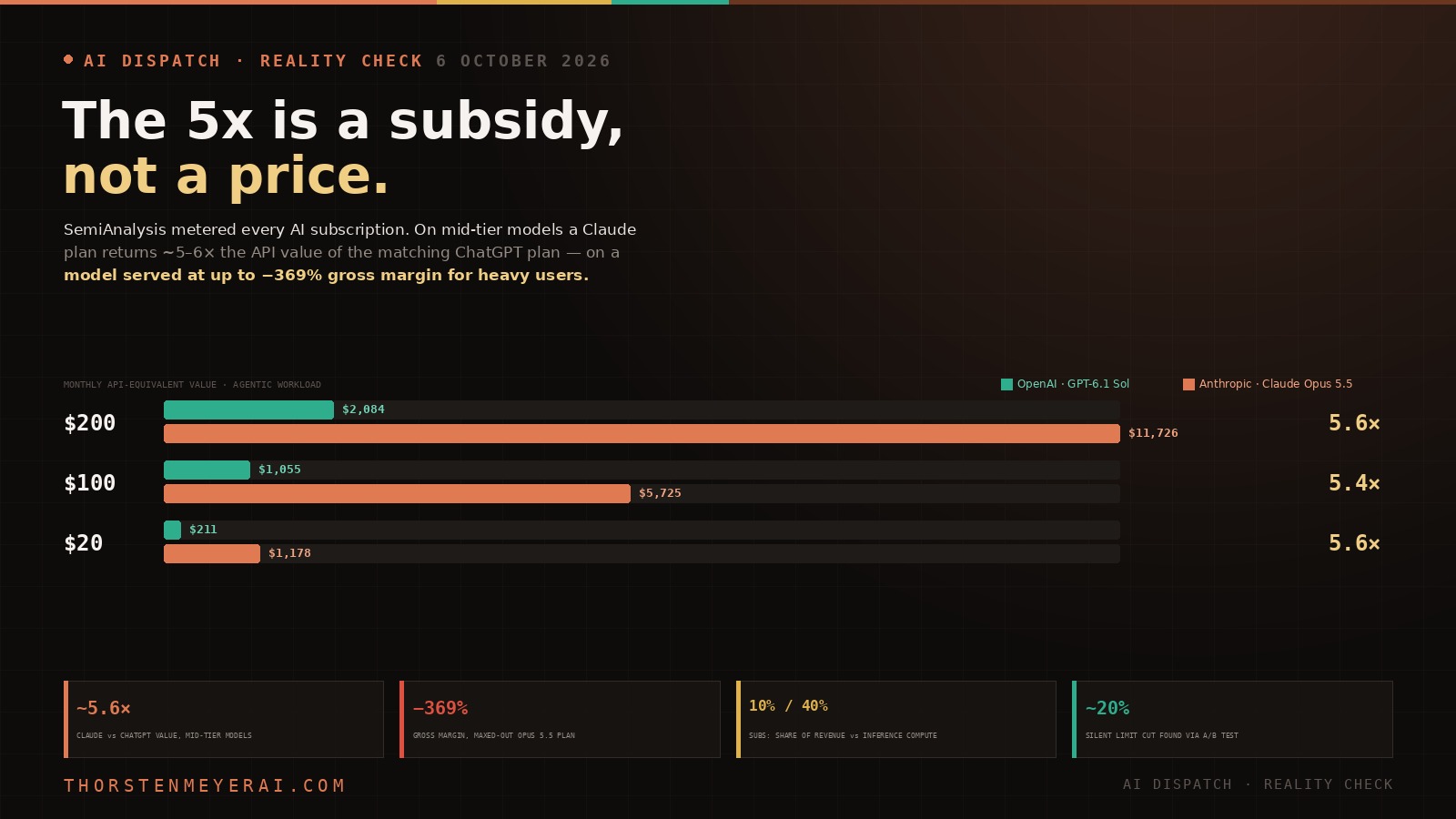
SemiAnalysis metered the meters — every major AI subscription, token type by token type, converted to API list value. On the mid-tier models both labs call the daily driver, a Claude plan returns ~5–6× the API value of the matching ChatGPT plan. Real — and the least durable number in the report.
…and the plan is fully exhausted. One pool for every model.
…and the plan is only half used — Fable is capped at 50% of the limit, leaving the rest for Opus/Sonnet. That’s where the mid-tier gap compounds.
- $200 plan halved — Sol-class value down >50% (6.1 Sol cache price cut compounds it)
- Old limits kept until 29 October; new buyers cut immediately
- New $500 tier: only +21% Astra vs the old $200 — real draw is 300 TPS Ultrafast
- Ladder flattened: Pro 100/200/500 now identical per dollar; multipliers removed from pricing page
- In OpenAI’s favour: no 5-hour window on Pro plans — easier to use the full allowance
- Flat per-dollar value across all tiers, before and after
- New premium models placed at lower relative limits (Fable capped at 50%)
- Opus allowances raised ~20% (Max) / ~50% (Pro) with the 5.5 price cut — not enough to fully offset it
- Repeatedly walked back planned cuts earlier this year under pressure from OpenAI’s generosity
- Twelve months ago, OpenAI was the generous option. Positions swap.
Gross margin per plan, assuming 92% API gross margins. The subsidy lives almost entirely in Opus and Sonnet usage — Anthropic would already be near software-like subscription margins if everyone used only Fable. Subscriptions matter even more for OpenAI, where they’re a larger share of revenue.
Three identical subscriptions; one had ~20% lower limits. The provider (unnamed) confirmed an “extremely tiny” A/B test on limit balancing. Two lessons: limits can change silently, per account, at any time — and you won’t know without instrumentation. The usage bar is a percentage, not a contract.
If you’re choosing a plan this month for agentic coding on a mid-tier model, the report settles it: a Claude plan returns ~5–6× the API value of the matching ChatGPT plan. But a plan returning 58× its fee on a model served at a steeply negative margin for heavy users is a marketing budget with a usage meter. Value moves silently, gets A/B tested per account, and twelve months ago ran the other way. Use the subsidy while it exists — it’s genuinely large. Don’t build a cost model on it. Price workloads at API rates, keep a router between you and any one vendor, and benchmark open weights on your own hardware for steady volume. A deal you can’t verify isn’t a price. It’s weather.
The numbers, both labs side by side
SemiAnalysis’s central comparison pits Claude Opus 5.5 against GPT-6.1 Sol on an agentic workload — the kind generated by a coding agent, which is overwhelmingly cached input (roughly 0.4% fresh input, 96.6% cached input, 2.6% cache writes, 0.3% output). “API value” means the plan’s full monthly usage limit priced at first-party list rates.
| Plan tier | OpenAI · GPT-6.1 Sol | Anthropic · Claude Opus 5.5 | Ratio |
|---|---|---|---|
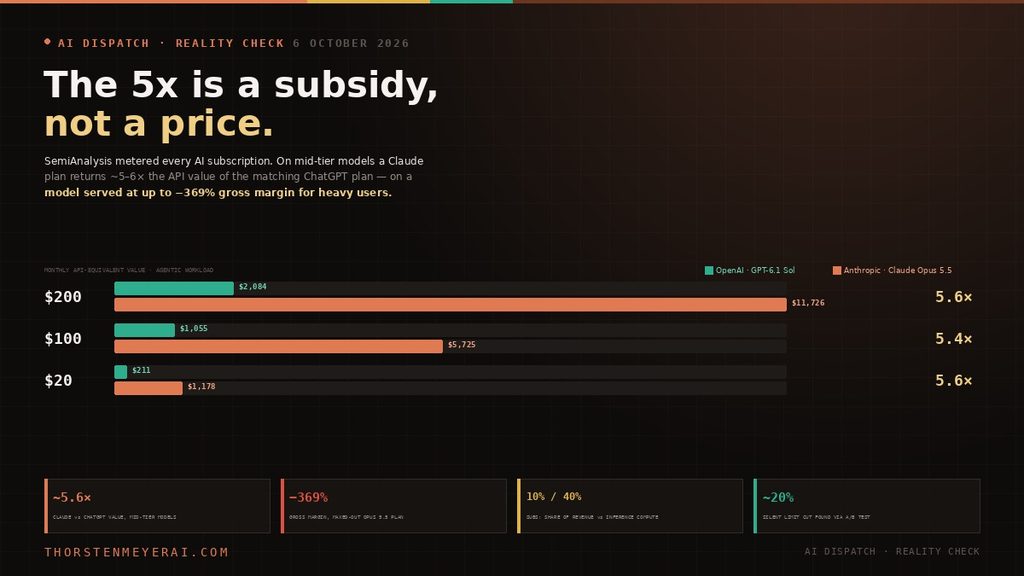
| $200/mo | ChatGPT Pro 200 — $2,084 (10.4×) | Claude Max 20x — $11,726 (58.6×) | ~5.6× |
| $100/mo | ChatGPT Pro 100 — $1,055 (10.6×) | Claude Max 5x — $5,725 (57.3×) | ~5.4× |
| $20/mo | ChatGPT Plus — $211 (10.6×) | Claude Pro — $1,178 (58.9×) | ~5.6× |
Two things stand out. First, both labs price their tiers flat per dollar — every OpenAI plan returns about 10.5× its fee, every Anthropic plan about 58×. Second, the gap survives SemiAnalysis’s own obvious objection: GPT-6.1 Sol is much cheaper per token than Opus 5.5, which inflates Opus’s dollar figure — but the report says the gap remains large even counted in raw tokens.
At the frontier tier, it’s close. GPT-6 Astra and Claude Fable 5.1 carry broadly similar limits. On a $200 plan, OpenAI’s allowance is exhausted after roughly $2,897 of Astra; Anthropic’s is half-used after $2,485 of Fable 5.1 — because Fable can only consume 50% of a Claude plan’s limit. The other half stays available for Opus or Sonnet, which is where the mid-tier advantage compounds.
AI subscription service comparison
As an affiliate, we earn on qualifying purchases.
As an affiliate, we earn on qualifying purchases.
What OpenAI just did
The comparison describes the state after a large OpenAI change last week, and that change is half the story.
OpenAI halved its $200 plan. SemiAnalysis’s tracking confirmed the cut: token allowances per model tier were roughly halved. For Sol-class models the API-equivalent value fell by more than half, because OpenAI simultaneously cut GPT-6.1 Sol’s cached-input price — and when the list price of a token falls while the allowance stays fixed, the plan’s API-equivalent value falls with it. Existing $200 subscribers keep the old limits until 29 October; new purchases get the lower limits immediately.
A new $500 tier arrived. It offers only about 21% more Astra than the old $200 plan did, and less Sol-class API value, again because of the Sol price cut. The real selling point is 300 tokens-per-second “Ultrafast” mode, which SemiAnalysis is still testing.
The ladder flattened. Before the cut, OpenAI’s tiers were deliberately progressive: Pro 100 gave about 2× Plus’s per-dollar value on Astra, and Pro 200 roughly another 2× on top. Now Pro 100, 200 and 500 return identical tokens per dollar. OpenAI also removed the relative-usage multipliers (“5x more usage”, “20x more usage”) from its pricing page.
The one genuine OpenAI advantage: none of its Pro plans has a 5-hour window, so heavy users can burn more of their monthly allowance in practice. SemiAnalysis doesn’t think that offsets a ~4–5× value gap. It is still worth stating, because for bursty workloads it narrows the practical difference.
As an affiliate, we earn on qualifying purchases.
What Anthropic did
Anthropic has also been cutting list prices — Fable 5.1 cut cache reads 75% versus Fable 5; Opus 5.5 cut input and output 20% and cache reads 60% versus Opus 5. The question is whether limits moved with them.
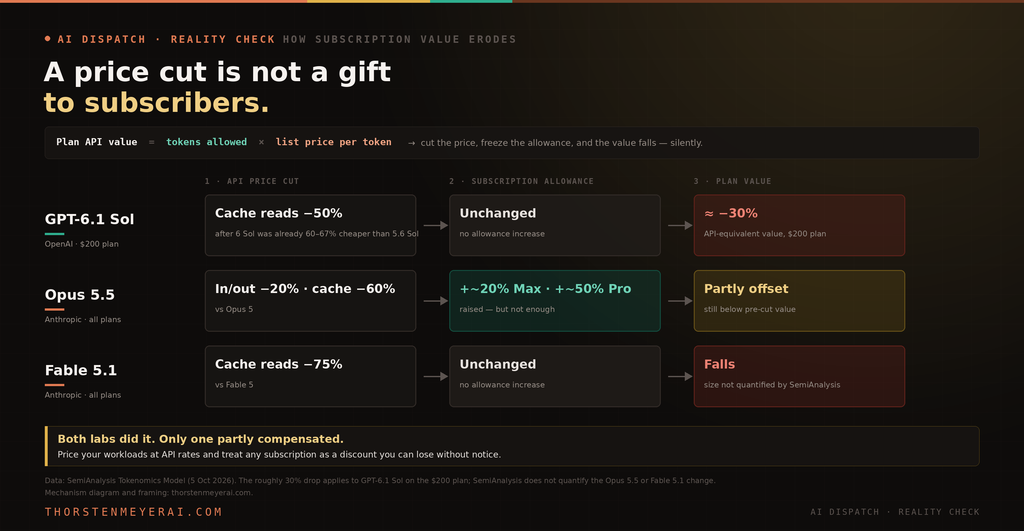
For Fable, no: Fable 5.1 shipped without any increase in token limits. For Opus, partly: allowances rose about 20% on Max and about 50% on Pro — not enough to fully offset the price cut, so Opus’s API-equivalent value also slipped.
OpenAI made the same choice with Sol more starkly: no limit change when 6.1 shipped, and a roughly 30% drop in API-equivalent value on the $200 plan as a result.
The pattern on both sides: labs cut API prices, and subscription value falls quietly unless they explicitly raise allowances. A price cut is not a gift to subscribers.
As an affiliate, we earn on qualifying purchases.
Why this matters more than its revenue share
The most important number in the report isn’t the 5×. It’s this: on SemiAnalysis’s rough estimates, subscriptions are about 10% of Anthropic’s revenue but can consume over 40% of its inference compute, lowering blended revenue per megawatt by roughly $36 million. Subscriptions matter even more for OpenAI, where they’re a larger share of revenue.
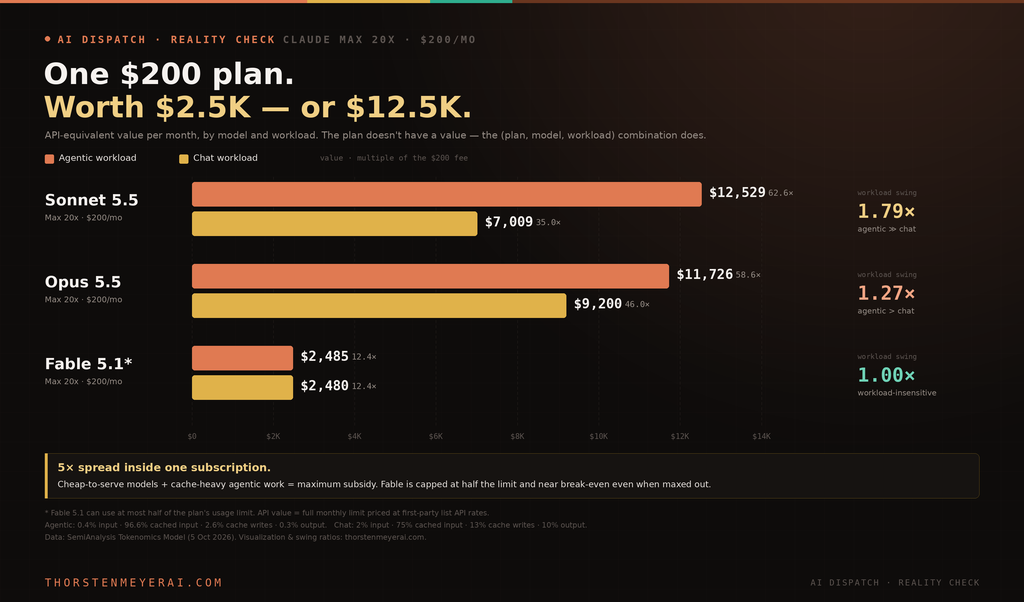
That is the economics behind everything above. A 58× plan is a customer-acquisition machine running at a loss — and the report quantifies the loss. Assuming a fully maxed-out subscriber and 92% API gross margins, maxing out Opus 5.5 implies roughly −369% gross margin on that plan; maxing out Fable 5.1, about 1%. At a more realistic 20% average utilization, those become about 6% and 80%.
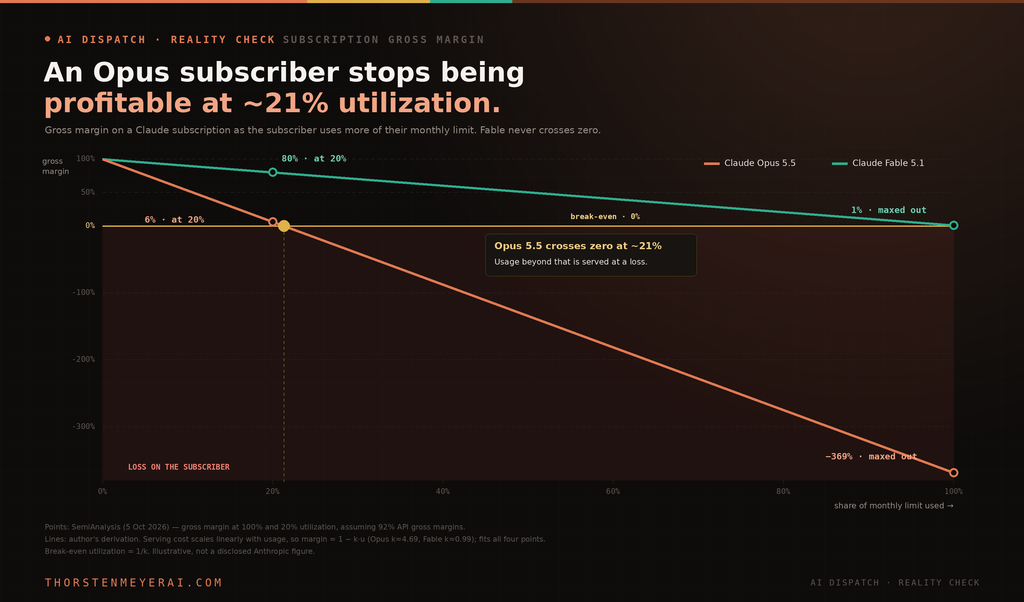
Read that carefully. Anthropic would already be near software-like margins on subscriptions if everyone used only Fable — the subsidy lives almost entirely in Opus and Sonnet usage. Its strategy is to let older tiers get cheaper to serve while placing each new premium model at lower relative limits.
OpenAI picked the other route: cut everything to roughly Fable-level value at once. SemiAnalysis calls it the nuclear option — and notes OpenAI largely escaped backlash, plausibly because DevDay announcements landed the next day and existing plans were grandfathered for another month.
There’s irony in the timing. For most of the past year OpenAI was the indie developer’s generous option — its frequent limit resets helped drive the Codex surge and forced Anthropic to walk back planned subscription cuts more than once. The positions have now swapped. They can swap again.
AI model usage monitoring software
As an affiliate, we earn on qualifying purchases.
As an affiliate, we earn on qualifying purchases.
The A/B test
The detail I’d put on every procurement desk: while refining the method, SemiAnalysis found one of three identical subscriptions with about 20% lower limits than the other two. The provider — unnamed in the report — confirmed it was an “extremely tiny” A/B test on how to balance when users hit limits, not a wholesale cut.
Two conclusions follow, and the report draws both. Providers can change your subscription limits silently, per account, at any time. And you would not know without instrumentation — the usage bar is a percentage, not a contract.
The rest of the market
Chinese labs — MiniMax, Moonshot, Z.ai — still subsidize, despite being compute-constrained, with per-dollar value rising at higher tiers and averaging a little below OpenAI’s roughly 12×. Third-party wrappers like Cursor and Cognition deliver less than buying first-party plans directly; the detailed comparison sits behind SemiAnalysis’s paywall and isn’t reproduced here.
The take
The SemiAnalysis headline is accurate, and if you’re choosing a plan this month for agentic coding on a mid-tier model, it settles the question: a Claude plan returns roughly five to six times more API-equivalent work than the matching ChatGPT plan.
But read what the report actually establishes, because it’s more useful than the leaderboard:
The value is a subsidy, not a price. A plan returning 58× its fee on a model served at a steeply negative margin for heavy users is a marketing budget with a usage meter. Subsidies end. OpenAI ended much of its own last week.
Value moves silently. API price cuts erode it unless allowances are raised. Limits get A/B tested per account. Pricing pages drop their multipliers. The only stable number is the one you measure.
And the gap is a snapshot. Twelve months ago the generosity ran the other way. The structural pressures — subscriptions eating 40% of compute for 10% of revenue — apply to every lab.
For builders, that’s the same lesson this publication keeps arriving at from different directions. Use the subsidy while it exists — it’s genuinely large — but don’t build a cost model on it. Price your workloads at API rates, treat any subscription as a discount you can lose, keep a router between you and any single vendor, and for steady high-volume work, measure open-weight models on your own hardware against the API bill. A deal you can’t verify isn’t a price. It’s weather.
Sources: SemiAnalysis, “Anthropic Subscriptions Offer 5x+ More Value Than OpenAI” (Andrew Megalaa, Max Kan, Dylan Patel; 5 October 2026), including its Tokenomics Model figures, measurement methodology, the agentic workload mix (0.4% input / 96.6% cached input / 2.6% cache writes / 0.3% output), the Opus 5.5 vs GPT-6.1 Sol plan values ($11,726/$2,084; $5,725/$1,055; $1,178/$211), the Fable 5.1 vs GPT-6 Astra comparison ($2,485 at 50% of limit vs $2,897), OpenAI’s $200-plan halving, 29 October grandfathering, $500 tier (+21% Astra, 300 TPS Ultrafast), removal of relative-usage multipliers and the absence of a 5-hour window on Pro plans; Anthropic’s Fable 5.1 and Opus 5.5 price cuts and limit adjustments (~20% Max, ~50% Pro); the ~10%-of-revenue / >40%-of-inference-compute / ~$36M-per-MW estimate; the −369%/1% and 6%/80% gross-margin scenarios; the A/B test finding; and Chinese-lab and third-party-wrapper observations. The third-party-wrapper detail is paywalled and not reproduced. All figures are SemiAnalysis estimates from a single measurement period and will change as labs adjust limits and prices; ratios computed by the author from SemiAnalysis’s figures. Not investment advice. Analysis and framing are the author’s.
Fall Picks
fall essentials
As an affiliate, we earn on qualifying purchases.