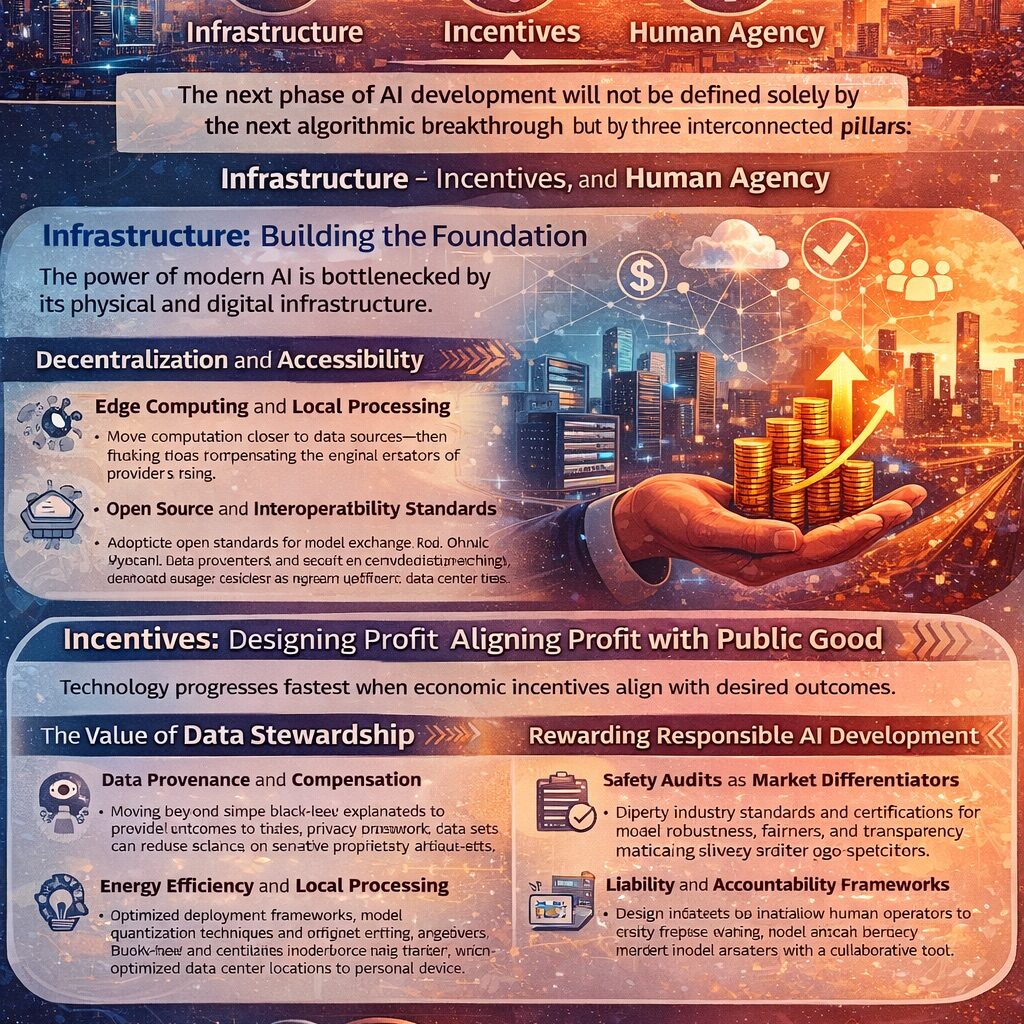

The current discourse around Artificial Intelligence is dominated by the spectacular capabilities of large language models (LLMs) and foundation models. While these achievements are undeniable, the focus on model performance—the sheer size, the improved accuracy, the dazzling outputs—risks obscuring a more fundamental shift required for AI to transition from a technological marvel into a truly transformative, ethical, and universally beneficial societal force. The next critical phase of AI development will not be defined solely by the next algorithmic breakthrough, but by the strategic prioritization of three interconnected pillars: Infrastructure, Incentives, and Human Agency.
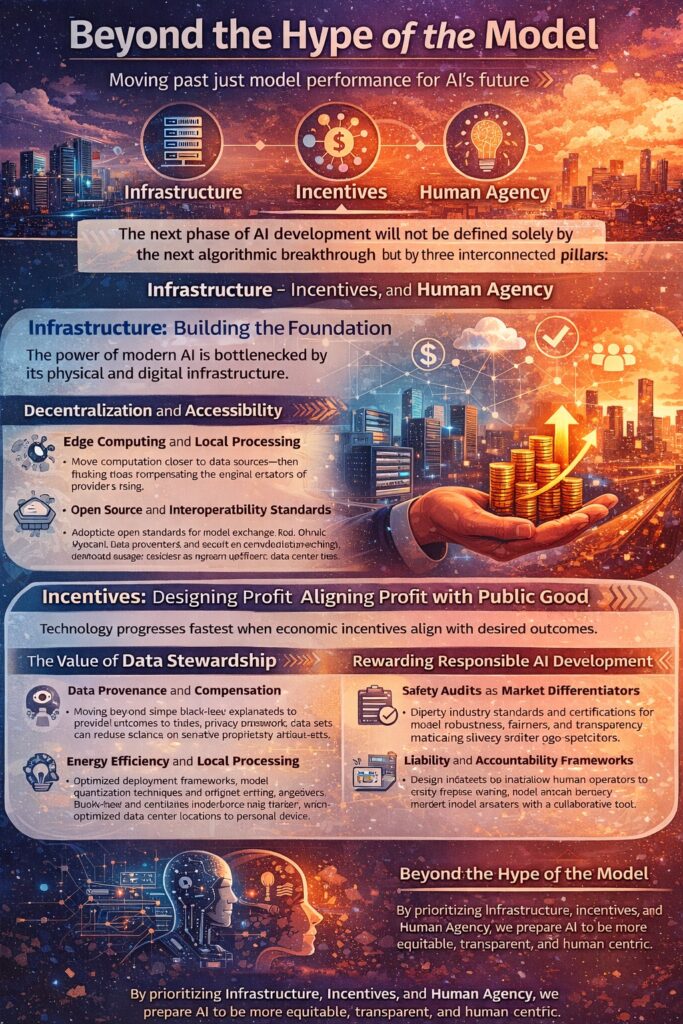
The power of modern AI is bottlenecked by its physical and digital infrastructure. Moving past proof-of-concept demos and into ubiquitous, reliable applications requires a massive overhaul and expansion of the underlying systems.
Decentralization and Accessibility
The concentration of computational power and data access in the hands of a few large corporations presents a significant risk to innovation and equitable deployment.
- Edge Computing and Local Processing: To achieve low-latency, privacy-preserving AI, computation must move closer to the data source—whether that’s a smart factory, a hospital, or a personal device. This shift requires robust, efficient hardware and standardized protocols for distributed AI training and inference.
- Open Source and Interoperability Standards: Proprietary infrastructure walls off progress. The next phase needs widely adopted, open standards for model exchange (e.g., ONNX, Pytorch), data provenance, and secure distributed training to foster a broader ecosystem of contributors and minimize vendor lock-in.

Embedded Machine Learning for Cyber-Physical, IoT, and Edge Computing: Hardware Architectures
As an affiliate, we earn on qualifying purchases.
As an affiliate, we earn on qualifying purchases.
Energy Efficiency and Sustainability
The energy consumption of training and running massive models is unsustainable. Infrastructure development must center on radical efficiency gains.
| Area of Focus | Current Challenge | Infrastructure Solution |
|---|---|---|
| Training Efficiency | Gigantic carbon footprint of large model training runs. | Development of specialized, energy-aware hardware (e.g., neuromorphic chips, analog computing). |
| Inference Efficiency | High operational costs for real-time deployment. | Optimized deployment frameworks, model quantization techniques, and efficient serving architectures. |
| Data Center Design | Heat generation and cooling requirements. | Green energy sourcing, liquid cooling technologies, and optimized data center locations. |

Data Center Power And Cooling Technologies A Complete Guide
As an affiliate, we earn on qualifying purchases.
As an affiliate, we earn on qualifying purchases.
Designing Incentives: Aligning Profit with Public Good
Technology progresses fastest when economic incentives align with desired outcomes. Currently, incentives heavily favor data aggregation, closed-loop systems, and speed-to-market, sometimes at the expense of safety, transparency, and fairness.
open source AI model exchange tools
As an affiliate, we earn on qualifying purchases.
As an affiliate, we earn on qualifying purchases.
The Value of Data Stewardship
The current model treats data as a resource to be extracted and hoarded. A future-proof AI ecosystem must incentivize responsible data stewardship.
- Data Provenance and Compensation: Mechanisms are needed to track the origin and lineage of training data, compensating the original creators or providers fairly. Blockchain and verifiable credentials could play a role here.
- Incentives for Data Synthesis and Sharing: Encouraging the creation and sharing of high-quality synthetic, privacy-preserving data sets can reduce reliance on sensitive proprietary or personal data, mitigating privacy risks while accelerating research.

WINSOON Barn Door Lock Hardware Stainless Steel, Sliver
- Durable Material: Stainless steel with brushed satin finish
- Easy Installation: Includes all necessary hardware for DIY setup
- Reversible Design: Control arm slides both ways for convenience
As an affiliate, we earn on qualifying purchases.
As an affiliate, we earn on qualifying purchases.
Rewarding Responsible AI Development
Financial and market incentives must be structured to favor models that demonstrate rigor in ethical deployment.
- “Safety Audits” as Market Differentiators: Establishing industry standards and certifications for model robustness, fairness, and transparency, and making these certifications valuable market signals that attract investment and customer trust.
- Liability and Accountability Frameworks: Clear legal and financial liability frameworks incentivize companies to invest proactively in risk mitigation and error correction, moving responsibility beyond a simple disclaimer.
Reclaiming Human Agency: From Users to Participants
The ultimate purpose of AI is to augment human capabilities and improve decision-making, not to automate human existence entirely. Prioritizing human agency means designing AI systems that empower, rather than diminish, human control and understanding.
Explainability and Trust
For AI to be deeply integrated into critical sectors (healthcare, finance, governance), humans must be able to understand why a system made a particular recommendation or decision.
- Contextual Explainability: Moving beyond simple “black box” explanations to provide human-readable, context-specific rationales that are meaningful to the end-user.
- User-Centric Debugging and Oversight: Designing interfaces that allow human operators to easily inspect model behavior, correct errors, and input critical domain knowledge, turning the AI system into a collaborative tool.
Defining the Boundaries of Automation
Human agency is preserved when there are clear, intentional boundaries around what AI automates and what remains under human control.
- Collaborative Loops: Instead of full automation, systems should be designed for “human-in-the-loop” collaboration, where AI handles tedious processing but critical judgment, ethical calls, and final decision-making authority reside with the human expert.
- Skill Augmentation over Skill Replacement: AI should be deployed primarily to enhance the cognitive abilities of workers, allowing them to focus on higher-order, creative, and emotionally resonant tasks, thereby avoiding the erosion of human expertise.