
Week Four — A viral “100x trade” strategy, tested 13,000 times. It loses.
A YouTuber found a Polymarket trade that turned $2 into $50. We rebuilt it, ran it on four coins for two days across ~13,000 windows, and measured what actually happens when you try to repeat it.

Get business pricing on tech for your team
- Business-only prices and quantity discounts
- Tax-exempt purchasing
- Multiple users, one account, clear invoices
The hook
A YouTuber posted a video that opens with proof of a remarkable trade on Polymarket’s 5-minute BTC Up/Down market: he put in $1, and got $50 back. A 50x. Elsewhere in the same video, a 48x and a 100x. Real on-chain transactions, verifiable on PolygonScan. Not a mock-up.
The trade looked strange even to him, so — and this is the part I liked — he opened an AI coding agent, pasted in the transaction hashes, and asked it to reverse-engineer what happened. The agent worked out the mechanism, then brainstormed ways to repeat it. What the video does not contain is a result. He says so plainly: “this is going to take time because this is a rare event… probably I didn’t have anything for you in this video about the results.”
This is that follow-up — except I ran it, in paper, at scale, and the answer is unambiguous.
As an affiliate, we earn on qualifying purchases.
What the trade actually was
Polymarket’s 5-minute crypto markets are binary: at the window’s end, BTC closed either above its open (Up wins, pays $1/share) or below (Down wins). One side always pays $1, the other $0.
Once both sides fill at 2¢, the outcome is irrelevant — profit is locked. The catch is in the words “both fill.” Why would anyone sell you the winning side at 2¢ a second after the outcome was decided? Stale liquidity: in the chaos around the close, some other bot hadn’t cancelled, and a taker swept whatever was resting. The lucky trader was simply standing where someone else made a mistake. That’s a real edge — if it happens often enough. The only question is the rate.
As an affiliate, we earn on qualifying purchases.
How we tested it
We rebuilt the strategy inside Polybot in two honestly-separated forms: paired-switch (post 2¢ bids on both sides at window open, the literal reconstruction) and winner-snipe-postclose (after close, post only on the side that already won — “can’t lose” in theory). Both ran on BTC, ETH, SOL, XRP for two days against the live order book. The paper-fill model is honest: a simulated bid only fills when a real taker sells into it. 24 parallel experiments, ~13,000 windows.
As an affiliate, we earn on qualifying purchases.
What happened — paired-switch
Outcome distribution — 9,486 pairs
The double-fill (the entire premise) vs. what actually fills. Bars are log-scaled so the rare events are visible.
| Outcome | Count | Share |
|---|---|---|
| Both filled (the whole point) | 3 | 0.032% |
| Winner-only filled (lottery) | 22 | 0.2% |
| Loser-only filled (the drain) | 1,297 | 13.7% |
| Neither filled | 8,162 | 86% |
| Net P&L (paper) | −$280 |
The double-fill — the event the entire strategy depends on — happened 3 times in 9,486 attempts. Roughly one in three thousand. Meanwhile the side that fills far more often is the loser: 1,297 times the bot got stuck holding only the worthless leg.
The longer you stay live, the more you lose
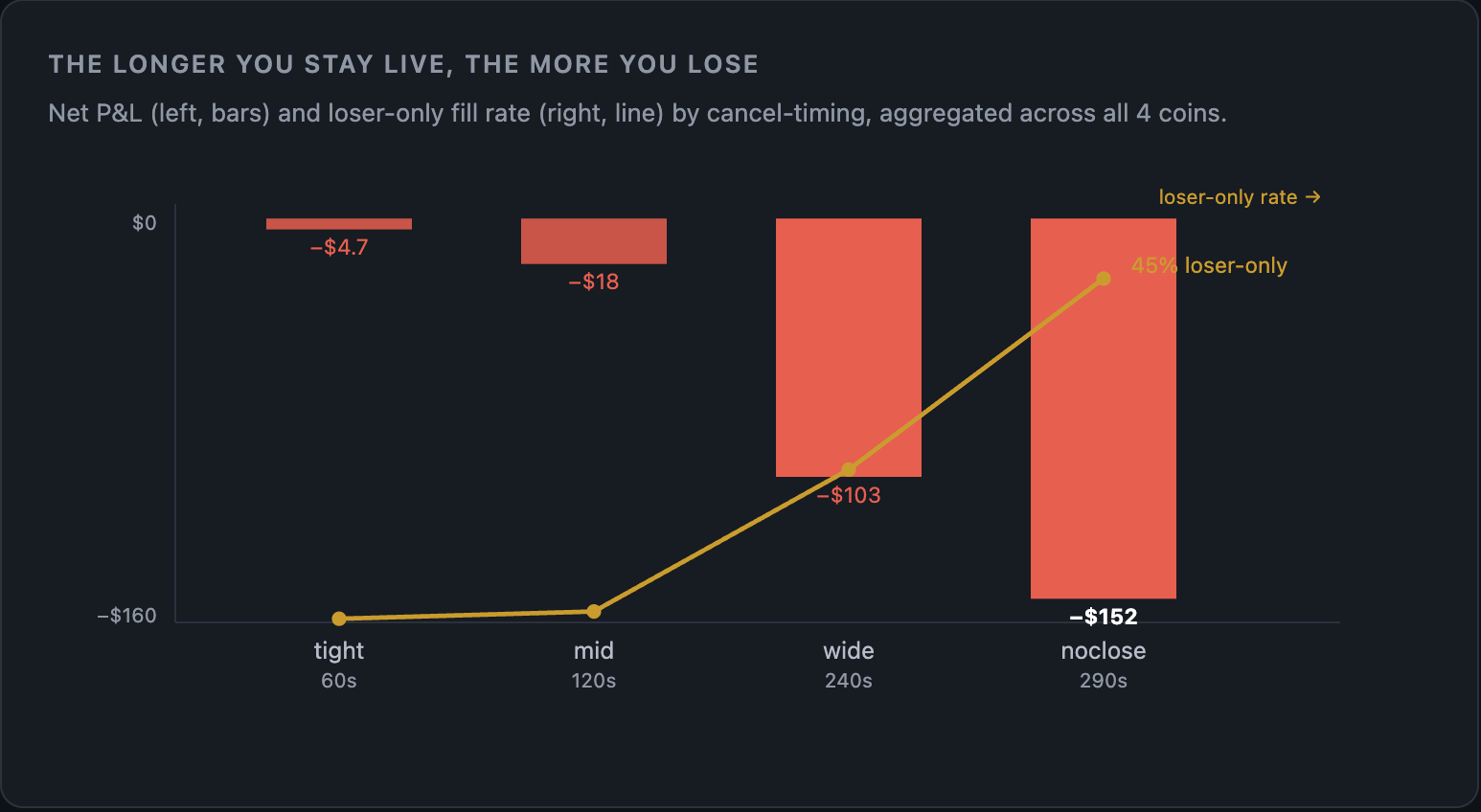
Net P&L (left, bars) and loser-only fill rate (right, line) by cancel-timing, aggregated across all 4 coins.
The pattern is brutal and consistent: leave the bids live longer, eat more loser-only fills. There is no cancel-timing that turns it positive. The handful of lottery wins ($50–$147 each) never come close to offsetting the steady loser-side drain.
As an affiliate, we earn on qualifying purchases.
What happened — winner-snipe-postclose
This one was supposed to be the safe version. It wasn’t.
Two of the four coins (BTC, XRP) got zero fills — there’s no post-close sell flow at 2-3¢ to catch. And of the eight fills that did occur, the four that settled all lost — even though we only ever bid on the side our price feed said had already won.
How does a “can’t lose” strategy lose every time it fills? Timing. At the moment we read the price to decide the winner — a fraction of a second after close — the final settlement price isn’t locked in yet. Our read disagreed with Polymarket’s official resolution often enough that the supposedly-guaranteed winner turned out to be the loser. The asymmetry that made it look safe on paper evaporated against oracle settlement timing.
Verdict
The viral strategy does not work. Not “works a little.” Not “needs tuning.” Across ~13,000 windows on four coins, both forms are net-negative, and the central mechanism — the guaranteed-profit double-fill — fired 3 times in nearly 10,000 tries.
The YouTuber’s 50x was real. It was also a coin that landed on its edge. He was honest that he hadn’t proven anything yet; the data finishes the sentence he started. Standing in the path of other people’s stale orders is an edge in principle, but on Polymarket’s 5-minute crypto books today, the stale orders that hit you are overwhelmingly the losing side. You are far more often the bag-holder than the beneficiary.
Why this is the most useful kind of result
It is very easy to make a strategy look good: show one winning trade, quote the hour it worked, backtest it on the data it was designed against. A viral 50x screenshot is the most seductive version of all. The discipline that protects you is boring and non-negotiable: a large forward sample, measured honestly, with the losses counted as carefully as the wins. 13,000 windows is enough that 3 jackpots can’t hide 1,297 quiet losses.
This is the fourth week of this series, and the pattern is now familiar. Week one found one candidate edge and three illusions. Week two watched the candidate collapse at higher sample. Week three put a 100-million-parameter foundation model against a 1900s Brownian formula and the formula held. This week took the internet’s most exciting-looking Polymarket trade and measured it into the ground. None of these are failures of the testing — they are the testing working.
— Thorsten Meyer AI · Part 4 of an ongoing series. Strategy implementations are developed privately and are not publicly available; the specific per-window results stay local. All charts above are rendered from the real two-day paper run — no illustrative or placeholder data.
Halloween Picks
halloween
As an affiliate, we earn on qualifying purchases.