
For publication: Sunday, 2 August 2026
Yesterday’s Su-57 story was about the trust between a sensor and the person reading it. NATO’s version of the problem begins one layer earlier: who built the sensor, wrote its firmware, signs its updates, receives its telemetry and supplies the replacement parts when war starts.
Start with what NATO itself acknowledges.
The Alliance does not fight only through fighter aircraft, missiles and armored brigades. It fights through commercial ports, civilian railways, privately operated satellites, mobile networks, cloud infrastructure, logistics software and energy grids.
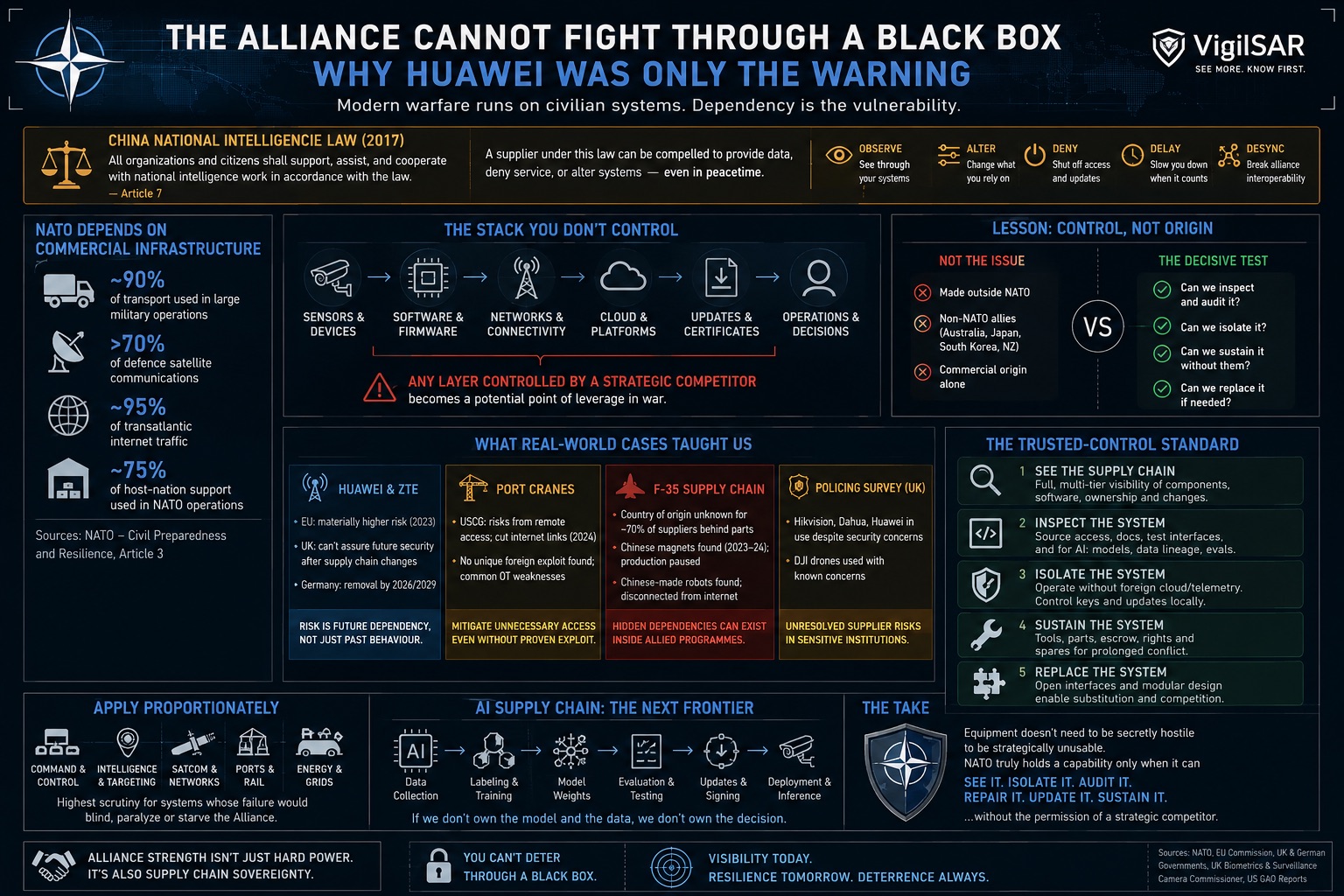
NATO estimates that civilian assets provide around 90 percent of the transport used in large military operations, more than 70 percent of defence satellite communications, roughly 95 percent of transatlantic internet traffic and about 75 percent of the host-nation support used in NATO operations. Those are not peripheral dependencies. They are the circulatory system through which the military force moves, communicates and survives. (NATO)
That changes what counts as military equipment.
A crane unloading armored vehicles is military infrastructure. A 5G network carrying emergency traffic is military infrastructure. A police drone mapping a railway junction can become military infrastructure. So can the camera watching a depot gate, the factory robot assembling an aircraft, and the cloud service through which a maintenance technician receives a firmware update.
The weapon is only the visible end of the supply chain.
And the dangerous part of that chain is increasingly the part NATO cannot see.
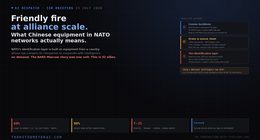
Friendly fire at alliance scale: what Chinese equipment in NATO networks actually means
Yesterday: Ukraine may have turned a Russian unit’s identification layer against its own jet. Today’s question doesn’t require that to be true. It requires only that the concept be plausible — and then asks what it means when NATO’s own identification layer is built on equipment from a country whose law compels its companies to cooperate with intelligence on demand.
Any Chinese entity — any company, any employee, anywhere — must assist national intelligence work when asked. No carve-out for foreign deployments. No judicial review. No refusal option. When Beijing asks Huawei for access, Huawei must provide it. The law doesn’t distinguish between Shenzhen and Stuttgart. It doesn’t distinguish between civilian and NATO. This is not theoretical. It is operational law.
Requires no reconnaissance. The companies manufactured and installed the equipment. They have the source code, firmware, manufacturing tolerances, and update pipeline — the reconnaissance was completed before the adversary was even identified as one. A stronger position than what InformNapalm claims Ukraine achieved.
The question isn’t whether China will use this access. It’s whether NATO can afford to assume it won’t. Three things follow. Replacement is genuinely hard — banning without building the supply chain produces capability gaps, not security. The identification layer is where the exposure is sharpest — a Chinese motor is a supply-chain risk; a Chinese sensor or processor in an IFF system is an identification-layer risk, the same class the BARS Moscow story made visible. And the open-weight argument applies here — but stops short: open weights give you visibility into the classification model; they don’t give you visibility into the silicon it runs on. NATO has thirty-two members, each with its own procurement history. Together they’ve built an identification layer with distributed, unaudited, legally-accessible dependencies on a potential adversary. BARS Moscow required weeks of reconnaissance. The reconnaissance for NATO’s version was completed in the factory.
The wrong lesson: “Everything outside NATO is unsafe”
Let’s deal with the crude version of the argument first, because it is wrong.
Equipment does not become untrustworthy simply because it was manufactured outside a NATO member state. NATO is actively expanding defence-industrial cooperation with Australia, Japan, South Korea and New Zealand — none of them NATO members, all of them strategically aligned partners. South Korean artillery or an Australian sensor is not in the same risk category as a communications system whose manufacturer can be pressured by a government NATO identifies as a strategic competitor. (NATO)
NATO’s own institutional procurement opportunities are normally limited to companies registered in member countries. But registration of the prime contractor does not tell you where its magnets came from, who owns the factory robots on its production line, where its camera modules were fabricated, which offshore developers wrote its libraries or whose cloud must approve its software licence. (NATO)
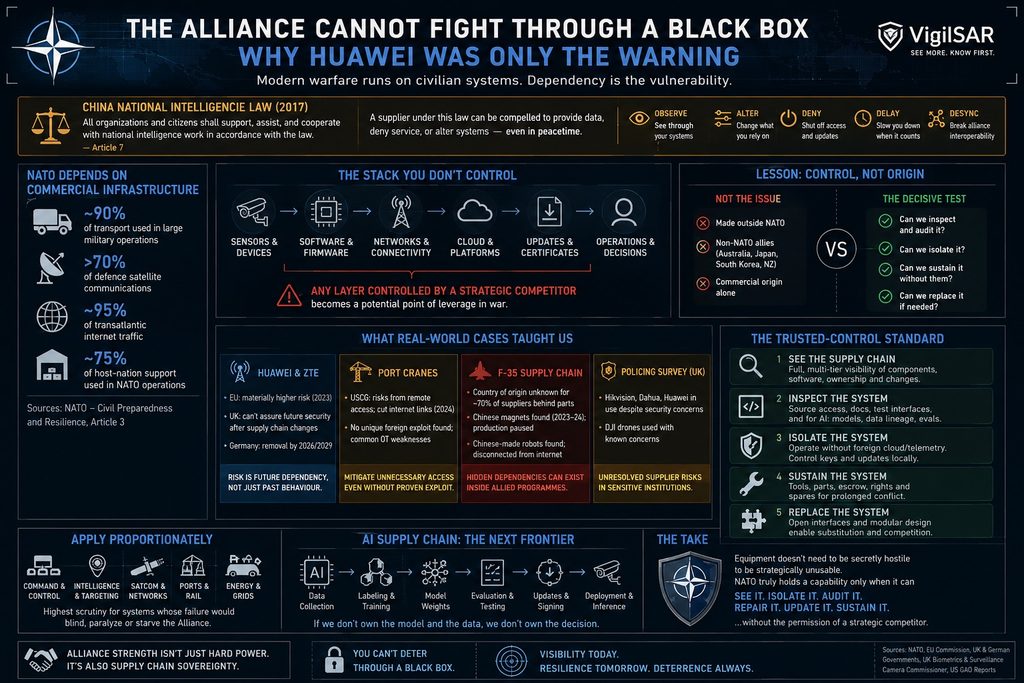
So the useful dividing line is not simply inside NATO versus outside NATO.
It is this:
Can the Alliance inspect, isolate, operate, repair, update and sustain the system without the permission of a potential adversary?
A foreign component may be an ordinary procurement issue. A component whose software, keys, data path, maintenance or continued operation depends on a strategic competitor is a warfighting risk.
Origin is a proxy.
Control is the decisive variable.

Practical Industrial Cybersecurity: ICS, Industry 4.0, and IIoT
As an affiliate, we earn on qualifying purchases.
As an affiliate, we earn on qualifying purchases.
Huawei was the warning, not the exception
Huawei became the symbol of this problem because telecommunications made the dependency unusually visible.
In 2023, the European Commission said Huawei and ZTE presented materially higher risks than other 5G suppliers. Its assessment was not framed only around technical vulnerabilities. It also considered whether suppliers could be influenced by third countries through their security laws, ownership structures and systems of corporate governance. The Commission supported national decisions restricting or excluding the two vendors from 5G networks. (Digital Strategy EU)
The United Kingdom’s decision is even more revealing.
Britain did not announce that it had discovered a publicly demonstrable Chinese wartime kill switch. Its National Cyber Security Centre concluded that US sanctions would force Huawei to restructure its supply chain using technologies Britain could not evaluate with sufficient confidence. The UK government therefore said it could no longer guarantee the future security of Huawei equipment and ordered all Huawei technology removed from British 5G networks by the end of 2027. (GOV.UK)
That distinction matters.
The risk was not only what Huawei equipment had already done. It was that the government could no longer assure what the equipment might become after its supply chain changed.
Germany reached a similar destination more slowly. Its agreement with mobile operators requires Huawei and ZTE components to leave 5G core networks by the end of 2026, followed by critical management systems in access and transport networks by the end of 2029. (BMI Bundesministerium für Gesundheit)
The cost of acting late shows why this belongs in defence planning rather than ordinary purchasing. In 2020, the UK government estimated that restricting and removing Huawei would delay its 5G rollout by two to three years and cost as much as £2 billion. That was an estimate rather than a final audited bill, but it captured the underlying problem: once a supplier is embedded deeply enough, removing it becomes an infrastructure project of its own. (GOV.UK)
Huawei’s real lesson was therefore not “Chinese routers are always secretly malicious.”
The stronger lesson was:
A vendor can become a strategic vulnerability before anyone discovers a backdoor, because dependency itself transfers leverage.
Once the vendor’s interfaces, update mechanisms and proprietary assumptions become part of the architecture, the customer no longer merely owns equipment. It owns a relationship it may be unable to terminate quickly.

MPD Digital I RG8X Coax Cable I UHF PL259 Male to UHF PL259 Male Connector I 50 Omh I RF, CB & AIS Mini-8, Jumper I Made in the USA I Black, 2
- Cable Type: RG8X coaxial cable with low loss
- Connector Type: UHF PL259 male to male connectors
- Frequency Range: Up to 500 MHz for HF/UHF/VHF
As an affiliate, we earn on qualifying purchases.
As an affiliate, we earn on qualifying purchases.
The problem has moved beyond telecom towers
Europe is beginning to recognize this.
In February 2026, the EU introduced an ICT Supply Chain Security Toolbox covering the assessment of critical suppliers, multi-vendor strategies and methods for reducing dependence on high-risk suppliers. The accompanying work expanded the discussion beyond telecom networks to connected and automated vehicles and detection equipment used at borders and customs. The Commission also proposed a wider framework addressing non-technical risks such as foreign interference. (Digital Strategy EU)
That expansion is overdue, because the same architecture now appears almost everywhere:
A sensor collects information.
Software interprets it.
A network transports it.
A cloud or management platform stores it.
A vendor signs the update.
A remote service account maintains it.
And an operator assumes the resulting picture is trustworthy.
Huawei and ZTE are therefore only the most prominent examples. Hikvision and Dahua cameras, DJI drones, Chinese-manufactured port equipment and components buried inside Western weapon systems all raise different versions of the same question.
Who can see through the equipment, and who can reach back into it?
A 2022–23 survey of British policing found that at least 18 responding organizations used external camera systems, and at least 24 used internal systems, involving manufacturers about which security or ethical concerns had been raised, including Dahua, Hikvision and Huawei. Of the 31 respondents operating camera-equipped drones, 23 said they were aware of concerns involving DJI. The survey did not prove that those systems were exfiltrating police data. It established something narrower: sensitive public institutions had integrated equipment while knowing that unresolved supplier risks existed. (GOV.UK)
That matters because surveillance data is not limited to the picture being recorded.
It can include facility layouts, vehicle movements, faces, maintenance routines, operating hours, device locations and network details. During peacetime, these may look like administrative metadata. During mobilization, they can describe where forces are assembling, which routes they are using and when critical locations are least protected.
Again, none of that proves that a named manufacturer is transmitting such information to Beijing.
It proves that the consequence of an unrecognized data path rises sharply when civilian equipment begins supporting military movement.
civilian infrastructure security devices
As an affiliate, we earn on qualifying purchases.
As an affiliate, we earn on qualifying purchases.
The port-crane example — including the caveat
Chinese-manufactured ship-to-shore cranes provide a particularly useful case because the evidence cuts both ways.
Modern cranes may be operated, programmed or serviced remotely. In February 2024, the US Coast Guard issued mandatory risk-management measures for cranes manufactured by companies from the People’s Republic of China, including eliminating internet connections. (GAO Files)
That sounds like confirmation of a hidden threat. It is not.
US teams evaluated more than 90 cranes manufactured by the dominant China-based supplier and did not identify vulnerabilities or exploitation methods unique to foreign-made cranes. Instead, auditors found weaknesses familiar across industrial systems generally: poor passwords, insufficient network segmentation, exposed services and missing patches. (GAO Files)
That caveat strengthens rather than weakens the wider argument.
The Coast Guard did not need to prove that the supplier had installed a secret sabotage function before deciding that remote connectivity created an unacceptable pathway into strategically important infrastructure. It reduced the exposure while continuing to investigate the underlying risk.
That is what serious procurement security looks like.
It does not confuse suspicion with proof.
It also does not wait for catastrophe before closing an unnecessary connection.

Analysis and Design of Next-Generation Software Architectures: 5G, IoT, Blockchain, and Quantum Computing
As an affiliate, we earn on qualifying purchases.
As an affiliate, we earn on qualifying purchases.
The F-35 proves that the flag on the box is not the supply chain
The most sobering example is not a Chinese-branded product at all.
It is the F-35.
On paper, this is an American-led aircraft built through one of the most closely integrated defence programmes in the Western alliance. Seven partner nations contributed to its development, production and sustainment. Yet US government contract records could not show where many of the underlying components were manufactured because those records largely stopped at the prime-contract level. (GAO Files)
By April 2025, the US Department of Defense had obtained country-of-origin information for first- and second-tier suppliers covering about 30,000 of the F-35’s roughly 40,000 tracked parts. But officials estimated that they had country information for less than 10 percent of all the suppliers providing the components and raw materials behind those parts. (GAO Files)
Then the hidden layers surfaced.
Lockheed Martin disclosed prohibited Chinese-made magnets in the F-35 supply chain in 2023 and 2024. Production was paused for months while alternatives were found. The Pentagon determined that the magnets presented no safety risk and issued waivers allowing affected aircraft to be accepted. There is no evidence here of sabotage.
But auditors noted that without the contractor’s voluntary disclosure, the Pentagon might not have known the magnets were Chinese. (GAO Files)
During a site visit, programme officials also found Chinese-made robotic arms from a German manufacturer that had come under Chinese ownership. The Pentagon found no safety or quality impact on the aircraft, but it did identify cybersecurity concerns. The response was straightforward: the robots were disconnected from the internet. (GAO Files)
That is the entire problem in miniature.
A system can be designed in a NATO country, assembled by an Allied prime contractor and operated by Allied forces — while dependencies from a strategic competitor remain invisible several layers below the logo.
“Buy NATO” is therefore not a complete policy.
A NATO address on the invoice does not provide supply-chain sovereignty.
An adversary does not need a Hollywood backdoor
The public imagination still treats compromised equipment as a binary question.
Either investigators discover malicious code, or the product is declared safe.
Modern systems do not work that way. A strategic competitor can gain leverage without planting a dramatic command labelled disable NATO now.
It has at least five quieter opportunities.
It can observe through the system. Telemetry, crash reports, maintenance logs, camera feeds, device identifiers and usage patterns can reveal capabilities and operational rhythms even when the main mission data remains encrypted.
It can alter the system. Firmware, configuration files, digital certificates, threat libraries and machine-learning models all change after deployment. The product delivered on day one is not necessarily the product operating in year five.
It can deny the system. Cloud authentication can stop. A certificate can expire. A licence server can become unreachable. Replacement parts can disappear. A specialist engineer can be recalled. An export approval can be withheld.
It can delay the system. A supplier does not have to destroy an aircraft if it can keep a fleet waiting months for a component that has no qualified alternative.
It can desynchronize the Alliance. Different software versions, incompatible updates or national restrictions can leave systems technically present but unable to exchange data or operate together.
This is why the most plausible wartime kill switch may not look like malware.
It may look like a support portal that no longer accepts the login.
A component that remains on back order.
A cryptographic certificate that nobody inside the Alliance has the authority to renew.
Or a software update NATO cannot independently verify but cannot safely refuse.
The AI supply chain is even harder to see
Yesterday’s Su-57 analysis focused on the identification layer: the point at which sensor data becomes a decision about what an object is and whether it should be engaged.
For NATO, that layer increasingly contains machine-learning models.
They will classify drones, interpret satellite images, prioritize targets, identify anomalies in radar tracks, predict component failures and filter intelligence for human operators. The supply chain will therefore no longer end with processors, cameras and radios.
It will include:
The model architecture.
The weights.
The training data.
The labeling process.
The evaluation set.
The update pipeline.
The inference hardware.
And the people or services authorized to change any of them.
A targeting model can run on Allied hardware and still be dependent on a foreign-controlled training platform. A drone can be assembled in Europe while its image-processing module sends diagnostic information to an overseas cloud. A classifier can be locally hosted while nobody in the purchasing military has the data or tools needed to reproduce it.
A model NATO cannot inspect is not sovereign merely because it runs inside a NATO base.
Open weights help, but they are not a magic shield. Open models can contain vulnerabilities, poisoned data and poorly understood behavior. The important difference is not ideological openness. It is whether Allied authorities possess what they need to test, retrain, reproduce and audit the system without asking the original vendor for permission.
For systems involved in surveillance, identification, targeting or command decisions, control of the weights, training-data lineage, evaluation process and update-signing keys should be treated as part of the military capability itself.
A country that owns the aircraft but rents the perception layer does not fully own the aircraft.
The standard NATO actually needs
NATO has already begun constructing parts of the answer.
The Alliance endorsed a Defence-Critical Supply Chain Security Roadmap in 2024, updated its Defence Production Action Plan in 2025 and has since emphasized redundancy, diversification and the need to develop military capabilities free from hostile influence. The EU’s 2026 toolbox similarly recommends assessing critical suppliers, using multiple vendors and reducing dependence on high-risk suppliers. (NATO)
What is still needed is a common trusted-control standard applied before a system becomes irreplaceable.
It should answer five questions.
First: Can NATO see the supply chain?
The prime contractor should provide a continuously updated hardware and software bill of materials, the countries in which critical components are manufactured, the beneficial ownership of important suppliers and notification when control of a supplier changes. Visibility cannot stop at the first two tiers when the consequential dependency may be four or five companies deeper.
Second: Can NATO inspect the system?
For mission-critical software, Allied security authorities need sufficient source access, documentation, test interfaces and reproducible builds to investigate what the system is doing. For AI, that should extend to model weights, training provenance, evaluations and update history.
This does not mean every commercial algorithm must be published to the world. It means the Alliance cannot accept “proprietary” as the final answer when the software is helping decide what is friendly, what is hostile or where a weapon should go.
Third: Can NATO isolate it?
Critical systems should be capable of operating without a mandatory connection to a foreign cloud, vendor telemetry service or overseas support network. Allied authorities should control local cryptographic keys and be able to approve, reject and roll back updates.
The test should be brutally simple:
Does the core mission still work when the vendor’s cloud, home-country network and support organization disappear tomorrow?
Fourth: Can NATO sustain it?
Allied technicians need the documentation, diagnostic tools, replacement parts, source escrow and legal rights required to maintain the system during a prolonged conflict. Strategic spares and alternative suppliers should exist before the original supply route closes.
A weapons platform that operates beautifully in peacetime but becomes unserviceable after six months without factory support is not a durable capability.
Fifth: Can NATO replace it?
Open interfaces, modular design and common standards should allow one supplier’s component to be substituted without rebuilding the entire platform. Vendor diversity is not only an economic objective. It is a defence mechanism against coercion, bankruptcy, sabotage and ordinary industrial failure.
NATO should then apply these tests proportionately.
The strictest rules belong around command and control, intelligence, identification, targeting, cryptography, electronic warfare, satellite communications, mission planning and the operational technology controlling ports, railways and energy.
A non-networked commodity component does not require the same scrutiny as a remotely maintained sensor with access to classified operational data.
The answer is risk-tiering, not nationality theatre.
The caveats, because this argument becomes dangerous without them
None of this establishes that every Huawei router, Hikvision camera, Dahua recorder, DJI drone or Chinese-manufactured crane is compromised.
It does not prove that employees of those companies are conducting espionage.
It does not mean that equipment from NATO countries is automatically secure. Allied vendors ship vulnerable code. Western companies suffer breaches. Allied governments conduct intelligence operations. A badly configured European industrial controller can be easier to exploit than a properly isolated Chinese one.
And it does not mean NATO can remove every Chinese-origin raw material or subcomponent immediately. China occupies important positions in global electronics, battery and critical-material supply chains. Attempting instant separation could reduce readiness faster than it improves security.
De-risking also has real costs. The UK’s Huawei decision illustrates how expensive and disruptive late removal can become. Reducing the number of suppliers too aggressively can create a new monoculture around one or two Western vendors, exchanging geopolitical dependency for industrial fragility.
The policy therefore has to remain technical, transparent and proportional.
Supplier jurisdiction should be one factor alongside remote access, data exposure, update authority, ownership, substitutability, mission criticality and the consequences of failure.
But the opposite mistake is just as serious: pretending that jurisdiction is irrelevant.
NATO now states openly that China seeks control over important technological and industrial sectors, critical infrastructure, strategic materials and supply chains, and uses economic leverage to create dependencies. That is the Alliance’s own threat assessment, not an accusation invented for this article. (NATO)
A company does not become guilty by association because it is Chinese.
But a military planner would be negligent to ignore whether a supplier operates under the laws and coercive power of a state NATO believes is actively building strategic leverage over the Alliance.
Risk is not guilt. Procurement is not a criminal trial.
The standard is not whether NATO can prove hostile intent beyond reasonable doubt.
The standard is whether a dependency could be exploited, whether the consequence would be severe and whether the Alliance retains enough control to mitigate it.
The take
Yesterday’s story was about the trust between a machine and the operator looking at its screen.
Today’s question is about the trust between the Alliance and the company that manufactured the machine.
The Huawei controversy was the first large-scale warning that digital infrastructure cannot be separated cleanly from geopolitics. The port-crane case showed that potentially dangerous connectivity can justify mitigation even when investigators do not find a unique foreign exploit. The F-35 supply-chain audit showed that strategically relevant foreign dependencies can remain hidden inside the most advanced Allied weapons programme on Earth.
Together, they point to one conclusion.
Equipment does not have to be secretly hostile to become strategically unusable.
It only has to be uninspectable when something goes wrong.
Unpatchable when a vulnerability appears.
Unrepairable when the supply route closes.
Or politically unavailable on the day the Alliance needs it most.
The NATO-versus-non-NATO label is too crude. What matters is whether the system remains under trusted Allied control from the component and firmware layers through the model, update, maintenance and sustainment layers.
Ownership is not established when the invoice is paid.
NATO truly holds a capability only when it can see it, isolate it, audit it, repair it, update it and keep it operating without the permission of a strategic competitor.
Huawei was the warning.
The F-35 supply chain was the X-ray.
The next conflict will reveal whether the Alliance understood what it was looking at.
NATO cannot deter through a black box.
Sources: NATO’s official material on civil preparedness, commercial infrastructure dependence, defence-industrial production, procurement, hybrid threats and defence-critical supply chains; European Commission assessments concerning Huawei and ZTE and the February 2026 ICT Supply Chain Security Toolbox; official UK and German decisions on removing Huawei and ZTE equipment; the UK Biometrics and Surveillance Camera Commissioner’s policing survey; and US Government Accountability Office investigations into maritime operational technology and foreign dependencies in the F-35 supply chain. The named vendor examples establish documented dependencies, government assessments or unresolved risk concerns; they do not establish that every product from those manufacturers contains malicious functionality. The proposed trusted-control standard and its application to AI models are the author’s analysis. (NATO)