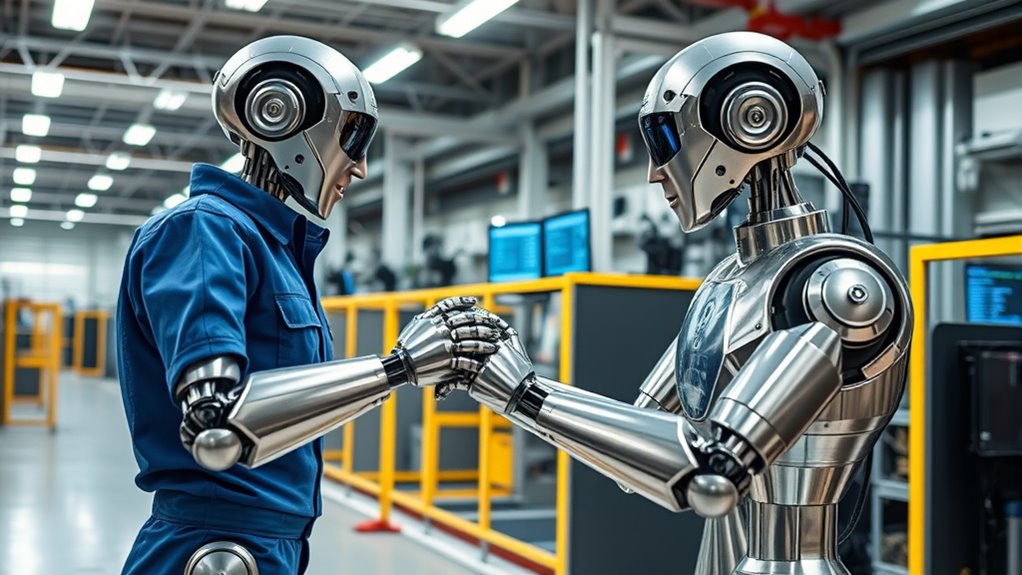

Collaborative robots, or cobots, are often thought to work independently, but in reality, they still need a lot of human help. They struggle with complex, unpredictable tasks and rely on people for decision-making, troubleshooting, and handling unforeseen situations. Their limited autonomy means you’ll find them mainly assisting rather than replacing human workers. If you’re curious about how these robots genuinely perform and the challenges they face, there’s more to uncover below.

Get business pricing on tech for your team
- Business-only prices and quantity discounts
- Tax-exempt purchasing
- Multiple users, one account, clear invoices
Key Takeaways
- Collaborative robots often lack adaptability and nuanced decision-making, requiring human intervention in complex or unpredictable situations.
- Safety concerns and unpredictable behavior in shared environments lead to dependence on humans for oversight and error correction.
- Limited autonomous capabilities and perception challenges mean cobots typically serve as assistants rather than autonomous workers.
- Real-world performance of cobots remains modest, with many confined to simple tasks, increasing reliance on human support.
- Technological advancements aim to improve cobots’ autonomy and safety, but current limitations still necessitate significant human assistance.
collaborative robot troubleshooting tools
As an affiliate, we earn on qualifying purchases.
As an affiliate, we earn on qualifying purchases.
The Current Limitations of Collaborative Robots in Complex Tasks
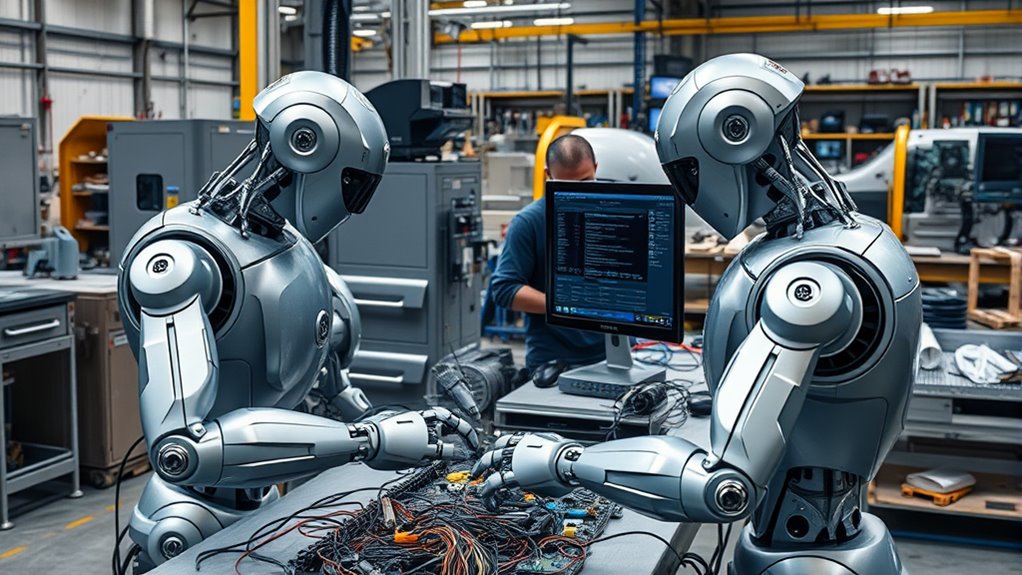
Although collaborative robots have made significant advances, they still struggle with complex tasks that require nuanced decision-making and adaptability. You’ll notice that cobots often need human help when unexpected issues or subtle changes occur. They lack the flexibility to handle ambiguous situations on their own and can’t easily adjust to nuanced variations in tasks. This limitation means you frequently have to step in to troubleshoot or guide them, especially in unpredictable environments. Their programming and sensors aren’t yet sophisticated enough to interpret complex cues or make real-time judgments as humans do. Consequently, they remain dependent on human oversight to ensure tasks are completed correctly. This ongoing need for human intervention highlights the current boundaries of what collaborative robots can achieve independently.
human-robot interaction safety devices
As an affiliate, we earn on qualifying purchases.
As an affiliate, we earn on qualifying purchases.
Human Assistance: A Persistent Necessity in Human-Robot Collaboration

Despite advances in robotics technology, human assistance remains a critical component of effective collaboration. You’ll find that cobots often rely on you to handle unpredictable situations, troubleshoot errors, or interpret complex changes in the environment. Robots currently lack the flexibility to adapt fully on their own, so your input is essential in guiding their actions and ensuring safety. When a robot encounters a problem, your quick help can prevent delays and improve task outcomes. Research shows that integrating human assistance boosts efficiency and satisfaction for everyone involved. While robots are designed to augment your work, they still depend on human judgment for decision-making and problem-solving. This ongoing need for support highlights that, for now, humans remain central to successful human-robot teamwork.
robotic assistive sensors for cobots
As an affiliate, we earn on qualifying purchases.
As an affiliate, we earn on qualifying purchases.
Challenges in Achieving Autonomous and Adaptive Robot Behavior

Achieving fully autonomous and adaptable robot behavior remains a significant challenge because current cobots struggle to handle unpredictable and nuanced environments. You often find yourself needing to step in, as robots lack the flexibility to adapt quickly. Here’s what limits them:
- Difficulty in interpreting complex, ambiguous situations without human input.
- Limited real-time learning capabilities, making adaptation slow.
- Challenges in sensing and perceiving subtle environmental changes.
- Rigid programming that hampers spontaneous decision-making.
- The presence of AI vulnerabilities such as bias and susceptibility to errors can further impede reliable autonomous operation.
These issues mean robots frequently require human assistance to troubleshoot, interpret context, or make nuanced decisions. Despite advances in AI and sensors, creating machines that seamlessly adjust to unpredictable tasks remains a work in progress. Overcoming these hurdles is key to truly autonomous, adaptive cobots.
As an affiliate, we earn on qualifying purchases.
The Real-World Impact: Benefits of Cobots Often Fall Short of Expectations
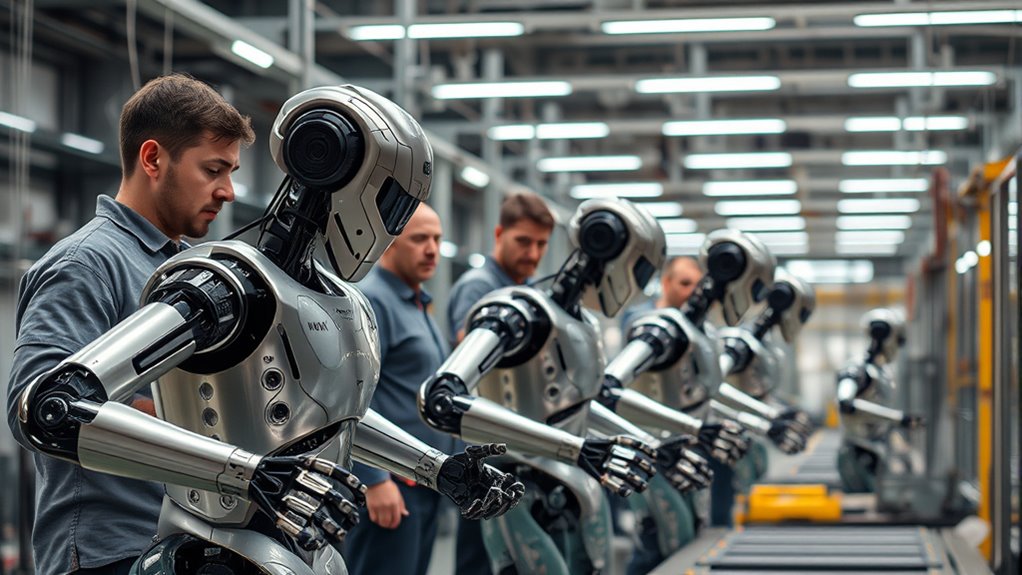
While collaborative robots have shown promise in enhancing efficiency, their real-world benefits often fall short of expectations. You might expect cobots to seamlessly boost productivity, but many deployments reveal limited gains. In healthcare, robotic surgeons and therapy aids sometimes show only marginal improvements over traditional methods, raising questions about their true impact. Manufacturing and logistics often rely on cobots for simple, repetitive tasks rather than complex collaboration, reducing their added value. Despite technological advances, most cobots still need human support to handle unpredictable situations, limiting their autonomy. As a result, the anticipated efficiencies and cost reductions remain elusive. You may find that cobots serve more as assistants than game-changers, underscoring the gap between hype and real-world performance. Additionally, collaborative robot limitations highlight the need for ongoing human oversight to ensure safety and effectiveness.
Enhancing Human Roles: How Robots Complement Rather Than Replace Workers

Collaborative robots are designed to work alongside humans, enhancing their abilities rather than replacing them. You benefit from cobots by focusing on tasks that require judgment, creativity, and problem-solving. They handle repetitive or physically demanding work, freeing you for higher-value activities. Here’s how cobots complement your role:
Collaborative robots enhance human skills by handling repetitive tasks, allowing focus on creativity and decision-making.
- Reduce physical strain by taking over monotonous tasks.
- Support decision-making with real-time data and consistency.
- Increase productivity through faster, more precise work.
- Improve job satisfaction by enabling skill development and engagement.
- Selecting names that reflect dog names can help in creating a more personalized and engaging environment for pet owners.
Healthcare Robotics: Promises and Practical Challenges in Medical Settings
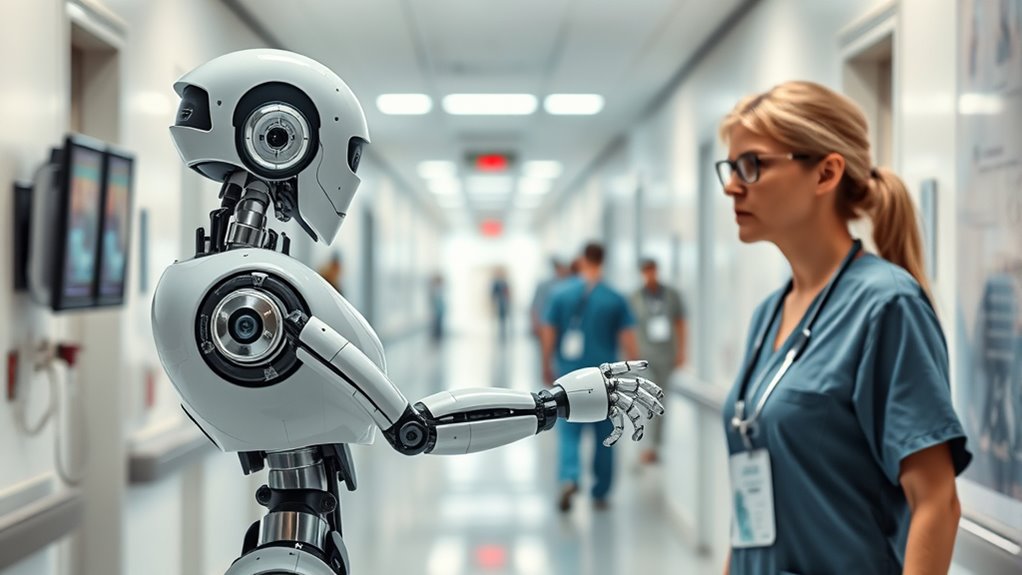
You should consider how safety and autonomy limits affect healthcare robots, as their current capabilities often require human oversight to prevent errors. Ethical and privacy concerns also pose challenges, especially when handling sensitive patient data. These issues highlight that, despite promising benefits, practical deployment still demands careful regulation and ongoing improvements. Additionally, the reliance on cybersecurity vulnerabilities can compromise the safety and integrity of healthcare robotics systems.
Safety and Autonomy Limits
Despite the promising potential of healthcare robots to improve surgical precision and patient outcomes, their safety and autonomy remain significant hurdles. You need to be aware that current limitations affect their integration into medical settings:
- Robots often require human oversight to prevent errors during unpredictable situations.
- Autonomous decision-making is constrained, especially in complex or emergency scenarios.
- Safety protocols limit robot speed and responsiveness to ensure patient protection.
- Technical failures, such as sensor errors, can compromise both safety and performance.
- The reliability of components is crucial for maintaining safe and effective robotic operations in healthcare environments.
These factors mean robots can’t yet operate independently without risking harm. While advancements in AI and sensing improve capabilities, the balance between autonomy and safety remains a critical challenge, requiring ongoing human supervision to mitigate risks.
Ethical and Privacy Concerns
Are healthcare robots truly ready to handle the ethical and privacy challenges they bring? You need to contemplate patient consent, data security, and transparency. These robots often collect sensitive health information, making them targets for cyberattacks or misuse. You might worry about how patient data is stored, shared, or sold without clear consent. Additionally, biases in algorithms can lead to unfair treatment decisions, raising questions about accountability. As you rely on robots for diagnosis, surgery, or patient monitoring, you must ensure they operate within strict ethical boundaries. Privacy safeguards and transparent policies are essential to build trust. Moreover, understanding the operating hours of associated healthcare facilities can be crucial when scheduling robot-assisted procedures. Without addressing these concerns, the promise of healthcare robots risks compromising patient rights and safety, undermining their integration into medical environments.
Future Pathways: Improving Autonomy and Reducing Human Dependence

Advancements in artificial intelligence, machine learning, and sensor technology are paving the way for more autonomous collaborative robots that require less human intervention. To achieve this, focus on:
- Developing adaptive algorithms that allow robots to handle unpredictable environments without constant human input.
- Enhancing real-time sensing and perception to improve decision-making and environmental awareness.
- Incorporating advanced machine learning techniques so robots can learn from experience and improve over time.
- Balancing autonomy with human oversight, ensuring safety and efficiency without increasing stress or operational risks.
- Improving performance cookies to better analyze and optimize robot behavior in various scenarios.
These pathways aim to create cobots that are more self-sufficient, reducing dependence on humans while maintaining collaboration safety and flexibility. Progress here will liberate broader adoption and more seamless integration across industries.
Frequently Asked Questions
Why Do Collaborative Robots Still Require Frequent Human Intervention?
You’ll find that collaborative robots still need frequent human intervention because they struggle with unpredictable environments and complex tasks. They lack full autonomy, often requiring human help to fix errors, adapt to nuanced changes, or troubleshoot issues. While advancements are ongoing, current cobots depend on human oversight to ensure safety, accuracy, and efficiency, especially in dynamic settings like healthcare, manufacturing, or disaster response.
What Are the Main Technical Barriers to Robot Autonomy?
You face several technical barriers to robot autonomy. Limited sensing and perception capabilities mean cobots struggle with unpredictable environments and nuanced changes. Their decision-making algorithms often lack robustness, leading to errors or hesitations. Additionally, integrating real-time learning and adaptability remains challenging, so robots can’t fully understand or adapt to complex tasks without human input. Improving sensor accuracy, AI algorithms, and environmental understanding will be vital for advancing true robot independence.
How Do Human-Robot Collaborations Improve Productivity Despite Limitations?
You might be surprised, but human-robot collaborations boost productivity despite current limits. When you combine a robot’s speed and consistency with your creativity and problem-solving skills, the results are impressive—up to 85% higher efficiency. Robots handle repetitive tasks, freeing you to focus on complex issues, while real-time sensing and AI enable safer, more adaptable teamwork. This synergy creates a resilient, flexible work environment that benefits everyone involved.
Why Haven’t Cobots Replaced Humans in Complex or High-Stakes Tasks?
You haven’t seen cobots replace humans in complex or high-stakes tasks because they still lack the necessary autonomy, adaptability, and decision-making skills. They require ongoing human support to handle unpredictable environments and nuanced situations. While they excel at assisting with specific functions, the complexity and safety demands of high-stakes tasks mean humans remain essential for oversight, judgment, and managing unforeseen challenges.
What Ethical Issues Arise From Increasing Robot Autonomy in Healthcare?
You might worry that increasing robot autonomy in healthcare compromises patient privacy and informed consent. As robots handle sensitive data or perform procedures, there’s a risk of data breaches or loss of human oversight. To address this, you need strict regulations, transparent data practices, and ensuring humans remain involved in critical decisions. Balancing autonomy with ethical safeguards helps protect patient rights while advancing robotic capabilities.
Conclusion
So, while collaborative robots promise to revolutionize work, they still need humans more than ever—like a superhero without its cape. You’ll find that true progress isn’t just about fancy tech but understanding these machines’ real limits. By working together, we can turn these robots into genuine partners, not just gadgets. Keep that in mind as you navigate a future where humans and cobots team up to conquer challenges that once seemed impossible.
Fall Picks
fall essentials
As an affiliate, we earn on qualifying purchases.