
By Thorsten Meyer | November 21, 2026 | ThorstenMeyerAI.com

Get business pricing on tech for your team
- Business-only prices and quantity discounts
- Tax-exempt purchasing
- Multiple users, one account, clear invoices
On Friday, November 20, at a White House news conference after his trip to Asia, President Donald Trump said something that sounds like a new rule for every big American cloud company: “We’re not going to allow our companies to build data centers outside of our country.” In the next breath he softened it: “If they do that, they can, but we’re going to put a tremendous tax on them.”
He also said his own team was hearing it for the first time. “I don’t know if that’s a breaking story. But I haven’t even said that to my people, but I’m telling them now,” he said, according to a transcript published by The Verge.
If your company runs AI workloads in Frankfurt, Dublin, Abu Dhabi or Mumbai, the question is simple: does anything change on Monday? The short answer: not yet. A threat is not a rule. This article separates four things: what was said, what legal instrument could turn it into policy, what is actually in force today, and what nobody knows yet. It takes no side on the politics.
Facts as of 08:00 UTC on Saturday, November 21, 2026.
Key takeaways
- What was said: US companies will not be allowed to build data centres abroad, and those that do will face “a tremendous tax” and “tremendous penalties”. Trump named China and Finland. He gave no rate, no date, no legal basis and no list of countries.
- What is written down: nothing yet. As of Saturday morning, the White House website lists no executive order or other presidential action on overseas data centres, and the Federal Register has no rule on it. The White House referred Newsweek to the president’s remarks when asked for details.
- What could make it real: a new tax needs Congress; the Constitution gives the power to “lay and collect Taxes” to Congress. Tariffs under the emergency law IEEPA are off the table after the Supreme Court ruled on February 20, 2026 that IEEPA “does not authorize the President to impose tariffs”. The tool that already reaches foreign data centres is export control of AI chips.
- What is in force today: a Commerce Department rule effective November 19 that requires licences for advanced AI chips in five countries and for data centres serving China-headquartered companies at scale, with a reporting lane for US-headquartered companies. And an executive order from July 2025 that makes it US policy to support “the global deployment of United States-origin AI technologies”, including data centres.
- What is not known: which companies, which countries, whether existing projects count, whether leasing or cloud capacity counts, and when.
Overseas AI data centres · November 2026
From a remark to a rule
What was said, what is written down, which legal route exists, and what already applies.
- SaidNovember 20“Not going to allow” US firms to build data centres abroad; “a tremendous tax” if they do
- Written down?As of November 21No executive order, no Federal Register rule, no details
- Legal routeFour optionsA tax needs Congress; IEEPA does not allow tariffs; chip export licences already exist
- In forceSince November 19Licences for advanced AI chips in five countries; a reporting lane for US-headquartered firms
Sources: remarks as transcribed by The Verge and reported by CNBC, Newsweek and the BBC (Nov 20, 2026); White House presidential actions and Federal Register, checked Nov 21, 2026; US Constitution, Art. I, Sec. 8; Supreme Court, Learning Resources v. Trump (Feb 20, 2026); BIS rule 2026-23529.
Graphic: Powered by Thorsten Meyer AI
Products Worth Considering

Samsung Odyssey OLED G8 34-Inch Curved Ultra WQHD Gaming Monitor

Jackery Explorer 300 Portable Power Station, 292Wh

Bose SoundLink Plus Portable Bluetooth Speaker, Black
As an affiliate, we earn on qualifying purchases.
What exactly was said
The remarks came during a news conference in the White House briefing room. The fullest published transcript of this part is The Verge’s. Trump first urged local communities to accept data centres: “Whoever wins SI wins. And you ought to take advantage of the data centers. Make them pay you. Make them pay your community. But take advantage. Don’t shut them off.” (“SI” is his term for AI, “super intelligence”.)
Then came the new line: “We’re not going to allow our companies to build data centers outside of our country. We’re not going to allow that to happen. You know, they allowed that to happen with chips and everything else, and it was very destructive to our country.”
And the penalty: “And we’re not going to allow companies to build data centers in other countries. If they do that, they can, but we’re going to put a tremendous tax on them.”
According to Gizmodo, he added: “We’re not allowing data centers to go into other countries, because China will take all of them.” And: “And we’re not allowing that to happen. And we’re going to put tremendous penalties on companies that try and do it. They want to build now one in Finland.” Newsweek notes that it was “not immediately clear” whether he meant Google’s planned investment in Finland, which he had criticised on Truth Social days after it was announced.
Two things stand out in the wording itself. First, it moves between a ban (“not going to allow”) and a penalty (“they can, but”). Those are different policies. Second, the president said he had not yet told his staff, so there is no plan behind the words that anyone has published.
What is written down: nothing yet
We checked the official record on Saturday morning:
- White House: the presidential actions page lists two items for November 20: a proclamation for National Adoption Month and an executive order on federal contracting. Neither is about data centres abroad. We found no transcript of the news conference on the White House website.
- Federal Register: a search for “data center” in documents dated from November 19 returns four entries: the Commerce rule on remote access to AI chips (more below) and three Securities and Exchange Commission notices on exchange trading rules. None is about building data centres abroad. The public inspection list for the coming days shows no document on the subject either.
- White House response: “The White House referred Newsweek to Trump’s remarks when asked for further details about the proposal,” Newsweek reported.
So, as of now, the statement exists as spoken words, nothing more.
Which legal instrument could do it
There are four plausible routes. Each has a hurdle.
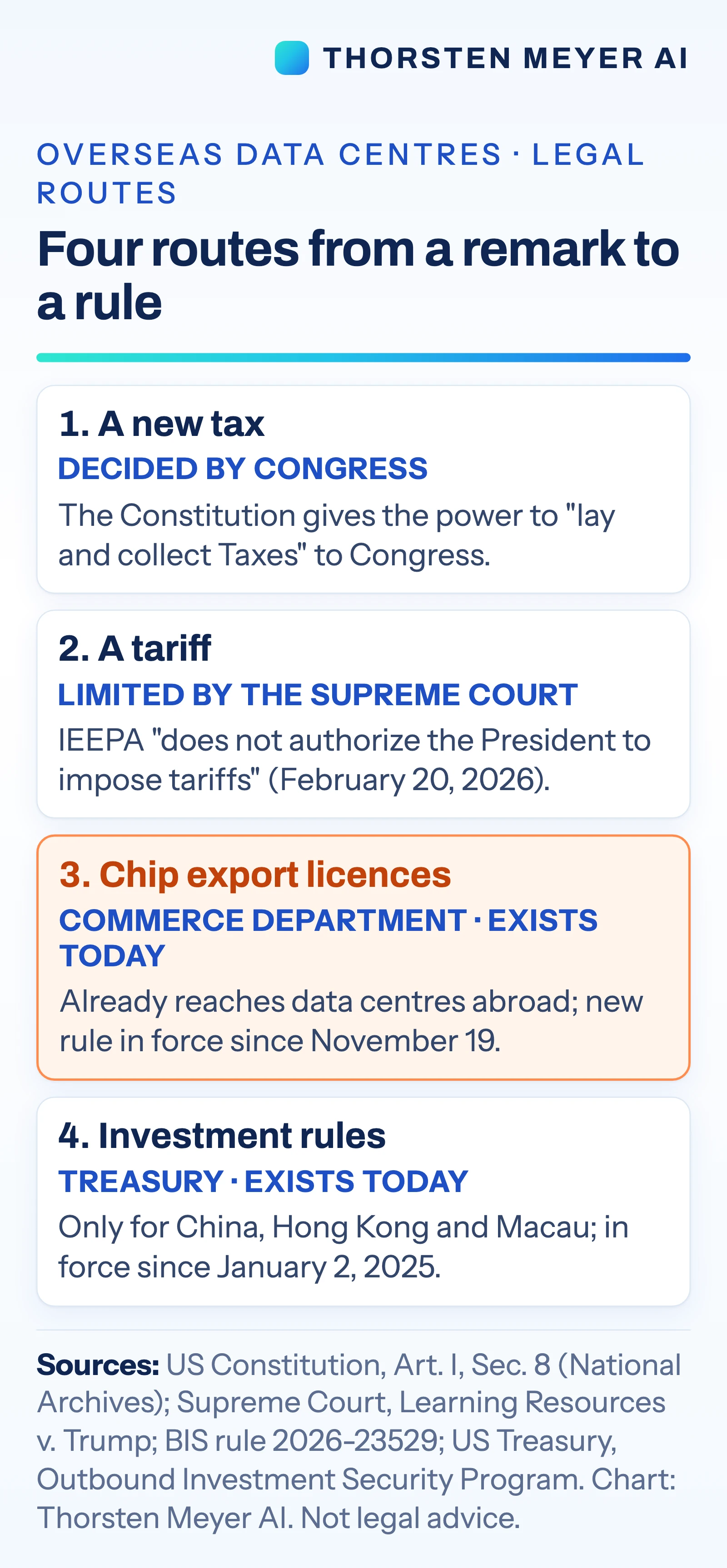
1. A tax. The US Constitution says: “The Congress shall have Power To lay and collect Taxes, Duties, Imposts and Excises”. A new federal tax on companies that build abroad would need a law. The Verge points out that this “could be difficult to fulfill with a new Democratic majority Congress being sworn in within a couple of months.”
2. A tariff. Tariffs are what this administration has used most. On February 20, 2026, the Supreme Court decided Learning Resources, Inc. v. Trump; the court’s own summary reads: “The International Emergency Economic Powers Act, 91 Stat. 1626, does not authorize the President to impose tariffs.” And as IBTimes UK puts it, “A data centre built in Finland is not itself an imported product simply because its owner is an American company.”
3. Export controls on AI chips. This is the lever that already reaches data centres abroad. US companies cannot fill a foreign data centre with the most advanced AI chips without following Commerce Department rules, and in some countries without a licence. Microsoft, for example, says it needed export licences from the Commerce Department to ship GPUs to its data centres in the UAE. Tightening licences would not be a “tax”, but it could slow or stop specific projects. Whether the administration intends to use it this way is not known.
4. Rules on investment abroad. The Treasury already runs a program that can “prohibit or require notification of certain types of outbound investments by United States persons”, covering semiconductors, quantum and AI. But it applies to “countries of concern”, which the president identified as “the People’s Republic of China, along with the Special Administrative Regions of Hong Kong and Macau”. Finland, the Gulf states or India are not on that list. The rules have been in force since January 2, 2025.
None of this is legal advice. It shows that the road from a remark to a rule is long, and that it runs through Congress, the courts or the Commerce Department.
What is in force today
Two existing policies matter more on Monday morning than Friday’s remark.
The remote-access rule (effective November 19). The Commerce Department’s Bureau of Industry and Security published the interim final rule “Addressing Remote Access to Advanced Semiconductors” in the Federal Register on November 19. It requires a licence for advanced AI chips going “to or within Indonesia, Malaysia, Singapore, Brazil, and Thailand”, and for data centres anywhere that provide “more than 12,000,000 ‘aggregate TPP'” of computing power to companies headquartered in China, Macau or other countries in the US group D:5. Shipments to companies headquartered in the United States, or with a US parent, get a reporting lane in the five countries. In other words, the rule that is actually in force treats American companies abroad as the trusted case. We explained the rule in detail in The US Remote-Access Rule for AI Chips: Who Needs a Licence, From When, and What Is Unclear.
The AI export order (July 23, 2025). Executive Order “Promoting the Export of the American AI Technology Stack” says: “It is the policy of the United States to preserve and extend American leadership in AI and decrease international dependence on AI technologies developed by our adversaries by supporting the global deployment of United States-origin AI technologies.” It sets up an American AI Exports Program for “full-stack AI export packages”, which explicitly include “data center storage, cloud services, and networking” and a plan for “which entities will build, own, and operate data centers”. The order is still published on the White House website. Friday’s remark points in the opposite direction, and no document so far explains how the two fit together.
Who is building abroad
The big US cloud and AI companies have announced large projects outside the United States. Four examples from the companies’ own announcements:
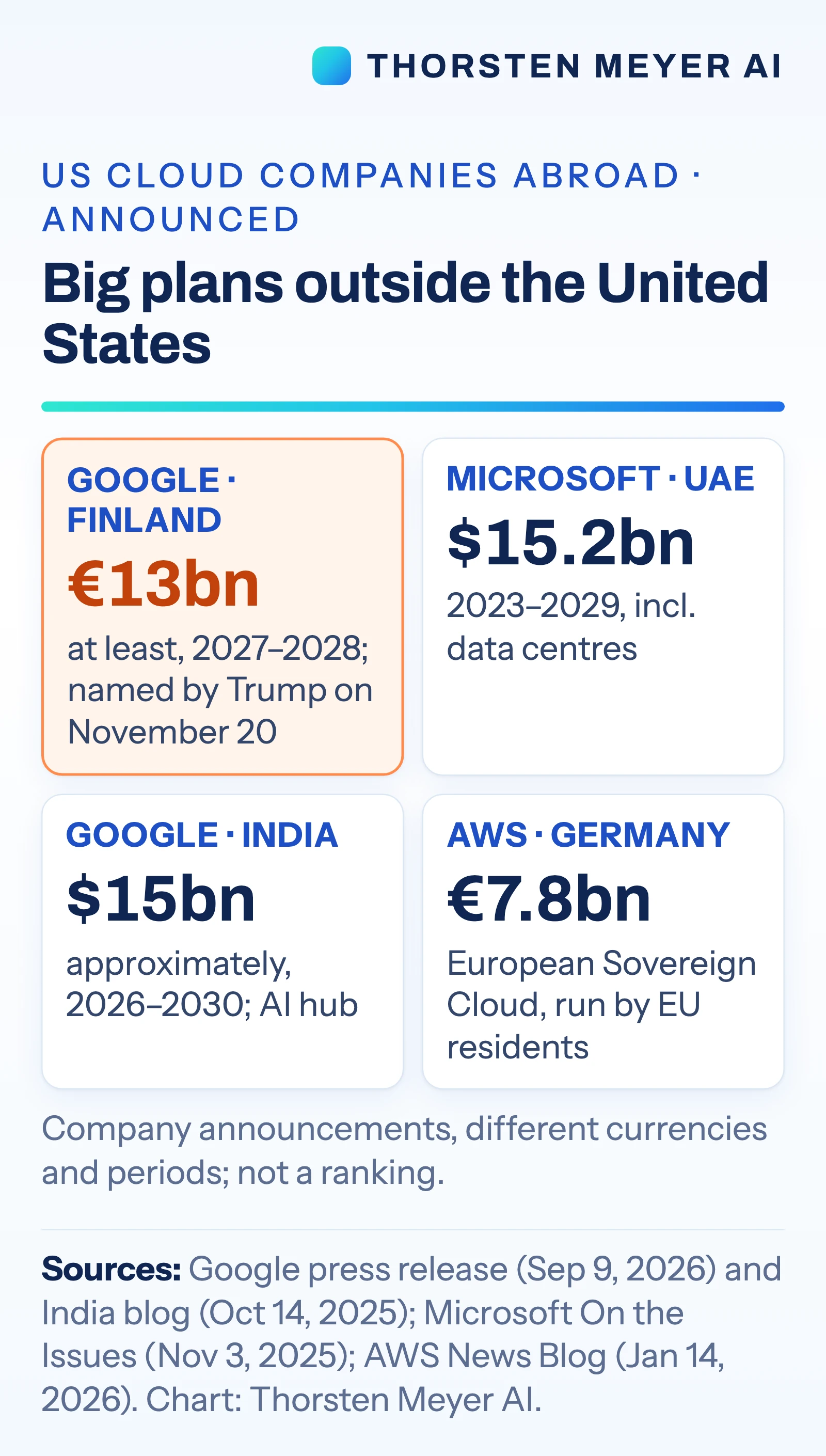
- Google, Finland: “at least €13 billion in digital infrastructure in Finland over the next two years (2027 – 2028)”, in Hamina, Kajaani, Muhos and Vaala, announced September 9, 2026. Google calls it its “largest single investment in Europe”.
- Microsoft, United Arab Emirates: “$15.2 billion USD in the UAE between the start of this initiative in 2023 and the end of this decade, in 2029”, including data centres, announced November 3, 2025.
- Google, India: “approximately $15 billion (USD) over the next five years (2026-2030)” for an AI hub in Visakhapatnam with “gigawatt-scale compute capacity”, announced October 14, 2025.
- Amazon Web Services, Germany: the AWS European Sovereign Cloud, a separate cloud in Brandenburg “operated exclusively by EU residents located in the EU”, backed by “a €7.8 billion investment”, generally available since January 14, 2026.
The BBC adds that Meta has broken ground on a data centre in Alberta, Canada, and that Anthropic has signed a long-term agreement to lease a proposed data centre in Nova Scotia. CNBC lists Alphabet, Amazon, Microsoft, Meta and Oracle among the US companies that already have data centres in other countries.
What it would mean for businesses
For most companies the real question is not who builds the building. It is where their data and their AI workloads run.
- Data residency is often not optional. AWS describes the demand plainly: “Organizations across Europe face increasingly complex regulatory requirements around data residency, operational control, and governance independence.” Banks, hospitals, public bodies and many mid-sized firms choose an EU region for that reason. If US providers built less in Europe, those customers would have fewer options close to home.
- Distance costs time and money. A Reuters report published by CNA notes that data centre developers “often locate facilities close to users to reduce delays for time-sensitive tasks such as payment processing” and that moving large volumes of data over long distances “can also add significant costs”.
- Projects in the Gulf and Asia already depend on Washington. Chips for the UAE needed Commerce licences; since November 19, chips for five Southeast Asian and Latin American markets need licences or reports. Whatever happens to Friday’s idea, export licences remain the practical bottleneck.
- What to do now: know which regions your AI and cloud workloads run in, and what your contracts say if a provider changes or delays a region. Nothing in Friday’s remarks requires a decision today.
This is general information, not legal, tax or investment advice.
What it would mean for workers
The president framed the idea as jobs. “We want them to build it here,” he said, according to Gizmodo, and named Texas, California and West Virginia as places that want them. The industry agrees on the goal and stresses what it already does. Josh Levi, president and CEO of the Data Center Coalition, told Newsweek: “DCC’s member companies are investing hundreds of billions of dollars in the United States to responsibly build out the critical digital infrastructure that enables our daily lives and the 21st-century economy.” He added: “Our industry wants to continue investing in America.”
But the jobs argument cuts both ways:
- Abroad, these projects are jobs too. Google estimates that its Finnish build will “support more than 37,000 jobs nationwide” during construction, and 7,000 jobs a year once the sites run. Those are company estimates, not counts.
- At home, many voters do not want the buildings. CNBC’s All-America Economic Survey found that 64% of registered voters opposed an AI data centre within 10 miles of their home; 13% supported one. Data centres were an issue in the midterm elections earlier in November, the BBC reports.
- For people who use AI at work: nothing changes today. Where a model runs is decided by your employer’s cloud contract, not by you.
What companies said
- Microsoft declined to comment, according to Newsweek.
- Amazon, Google, Microsoft and Oracle did not immediately respond to CNBC’s requests for comment. Newsweek also asked Google whether the administration had contacted the company and whether its Finland plans would change; no answer was published at the time of writing.
- Meta: the BBC said it had asked Meta for comment.
- Data Center Coalition: the statement quoted above.
What is not known
- Ban or tax. Trump said both. Which one, if either, becomes policy is open.
- The instrument. A tax law, a tariff, export licences, investment rules or something else. No document names one.
- Which companies. Only owners and builders, or also companies that lease capacity or rent cloud servers abroad?
- Which countries. He named China and Finland. Whether allies, the EU, the Gulf states or India would be treated differently is not known.
- Existing projects. Whether announced or half-built projects would be exempt.
- Timing. No date was given.
- Fit with existing policy. How the idea fits with the July 2025 order that promotes exports of “full-stack” AI packages, and with the November 19 rule that gives US-headquartered companies a reporting lane.
The bottom line
On Friday the president said US companies will not be allowed to build data centres abroad, or will pay “a tremendous tax” if they do. As of Saturday there is no order, no rule, no draft law and no detail. A new tax would need Congress; tariffs under IEEPA are ruled out by the Supreme Court; the instrument that really reaches foreign data centres is chip export control, and the rule in force since November 19 favours US-headquartered companies abroad.
So for businesses: watch the Commerce Department and Congress, not the briefing room. For workers: the jobs argument is real on both sides of the ocean. And for everyone: a threat is not a rule until someone writes it down.
Further reading: The US remote-access rule for AI chips, China’s rare-earth lever in the chip fight, what the APEC leaders’ meeting in Shenzhen means for AI, trade and workers, and who will run Nvidia, and why Washington is pushing.
I’m Thorsten Meyer. The full sources are below, and more reality checks are at thorstenmeyerai.com.
Sources
- The White House: presidential actions page, checked November 21, 2026, 07:22 UTC (entries of November 20, 2026)
- The White House: Executive Order “Promoting the Export of the American AI Technology Stack”, July 23, 2025
- US Department of Commerce, Bureau of Industry and Security: interim final rule “Addressing Remote Access to Advanced Semiconductors”, Federal Register document 2026-23529, published November 19, 2026, and BIS press release of November 16, 2026
- Federal Register: document search for “data center” (publication date from November 19, 2026) and public inspection list, checked November 21, 2026
- US Department of the Treasury: Outbound Investment Security Program, program page, checked November 21, 2026
- US National Archives: “The Constitution of the United States: A Transcription”, Article I, Section 8
- Supreme Court of the United States: opinions of the 2025 term, Learning Resources, Inc. v. Trump, No. 24-1287, decided February 20, 2026 (court summary)
- Google: “Google Deepens Commitment to Finland with Two-Year €13 Billion investment in AI Infrastructure”, press release, September 9, 2026
- Google: “Our First AI Hub in India, Powered by a $15 Billion Investment”, October 14, 2025
- Microsoft: “Microsoft’s $15.2 billion USD investment in the UAE”, Microsoft On the Issues, November 3, 2025
- Amazon Web Services: “Opening the AWS European Sovereign Cloud”, AWS News Blog, January 14, 2026
- The Verge: “Trump threatens ‘tremendous tax’ for moving AI data centers outside the US”, November 20, 2026 (transcript excerpt)
- CNBC: “Trump vows to stop U.S. companies from building data centers abroad, threatens ‘tremendous tax'”, November 20, 2026
- Newsweek: “Trump Threatens Massive Tax on US Companies Building Data Centers Overseas”, November 20, 2026 (Data Center Coalition statement, Microsoft response)
- BBC News: “Trump threatens ban on US firms building AI data centres overseas”, November 20, 2026
- Gizmodo: “Trump Says He’ll Prevent U.S. Companies From Building Data Centers Overseas”, November 20, 2026
- CNA (Reuters): “Trump says US to penalize firms building data centers abroad”, November 20, 2026
- IBTimes UK: “Can Trump Actually Impose a ‘Tremendous Tax’ on US Tech Firms Building AI Data Centres Abroad?”, November 2026
Researched and drafted with AI assistance, including Anthropic’s Claude. Anthropic is mentioned in this article as a company with a reported data-centre lease in Canada; it had no role in this article. No government, company or person named here reviewed or sponsored this article. This article is for information only. It is not legal, tax or investment advice. Statements and documents as checked at 08:00 UTC on November 21, 2026; later announcements may change the picture. Our own text and graphics contain no affiliate links; offer and product boxes added by the site may contain Amazon affiliate links. Images: AI-generated illustration (Runware), animation and graphics by Thorsten Meyer AI; our own images show no real people or logos. Boxes added by the site may show product photos or people.