
By Thorsten Meyer | November 10, 2026 | ThorstenMeyerAI.com

Get business pricing on tech for your team
- Business-only prices and quantity discounts
- Tax-exempt purchasing
- Multiple users, one account, clear invoices
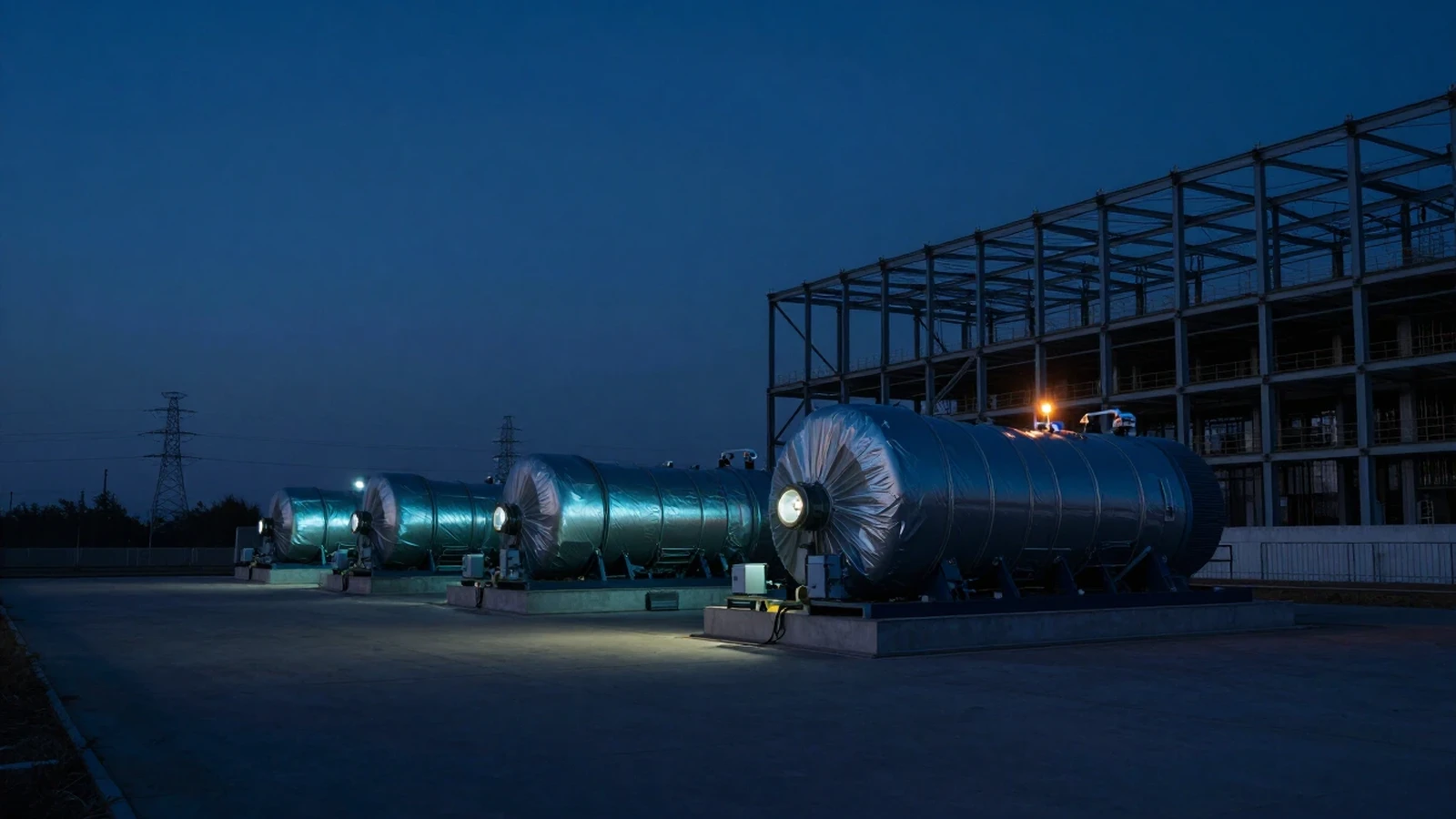
Everyone in AI wants more data centers. Fewer people talk about what has to arrive before the first server: power. SoftBank Group says it was so worried about running short of power generation equipment for its U.S. AI data centers that it paid for it in advance. Through September 30, 2026, a SoftBank subsidiary had paid ¥1.5 trillion, or $9.48 billion, for that equipment and for reserved factory capacity.
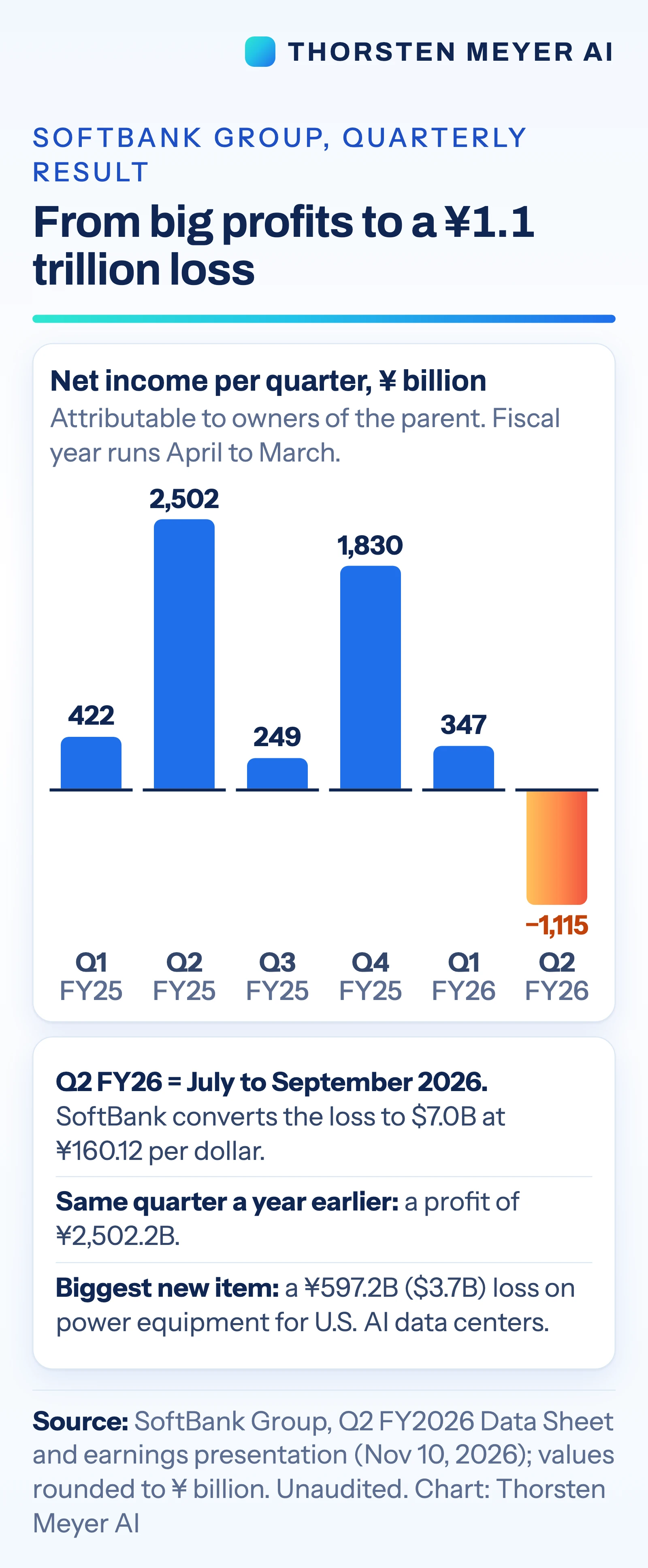
Then the plans changed. On November 10, 2026, SoftBank reported a loss of ¥597.2 billion ($3.73 billion) because its procurement plans for power equipment were “realigned”. It was a major reason for a net loss of ¥1,115.3 billion, about $7.0 billion, for the July to September quarter. A year earlier, the same quarter had shown a profit of ¥2,502.2 billion.
This is not a story about one company’s bad quarter. It is a look at the bill for the AI buildout, and at who ends up holding it when plans move faster than steel and turbines.
Conflict of interest: This article was drafted with the help of Anthropic’s Claude. Anthropic competes with OpenAI, SoftBank’s largest AI investment and the main tenant of its U.S. data centers. Neither SoftBank, OpenAI nor Anthropic reviewed or sponsored this article.
Key takeaways
- A $7 billion quarterly loss. SoftBank Group’s net loss attributable to owners was ¥1,115.3 billion in the second quarter of its fiscal year (July to September 2026). For the six months, the loss was ¥768.0 billion.
- Power equipment, paid in advance, then plans changed. A subsidiary paid $9.5 billion in advance for power generation equipment and factory slots. After a review, $2.9 billion of those payments was written off and $0.9 billion was booked for contract changes. SoftBank may get rebates of up to $2.1 billion on future purchases, but only under conditions.
- Money got more expensive. Finance costs in the quarter were ¥461.9 billion, more than 2.6 times the ¥174.7 billion of a year earlier.
- The risk is shared along a chain. SoftBank builds and finances, OpenAI is the long-term tenant, Nvidia guarantees part of the tenant’s lease obligations, and SoftBank also owns about 13% of OpenAI. If one link weakens, the others feel it.
- For buyers of AI compute, the lesson is simple: capacity is limited by power, not only by chips, and your provider’s suppliers have suppliers too.
Products Worth Considering

Jackery Explorer 300 Portable Power Station with SolarSaga 100W Solar Panel

Jackery Explorer 1000 v2 Portable Power Station, 1070Wh, 1500W

Jackery Solar Generator 1000 V2 with 100W Solar Panel, 1024Wh LiFePO4 Battery
As an affiliate, we earn on qualifying purchases.
What SoftBank reported
SoftBank Group’s fiscal year runs from April to March. Its second quarter therefore covers July to September 2026. These are the key figures from its consolidated financial report and data sheet, published November 10, 2026:
| Item (yen, millions unless stated) | Q2 FY2025 (Jul to Sep 2025) | Q2 FY2026 (Jul to Sep 2026) |
|---|---|---|
| Net sales | 1,916,502 | 2,215,446 |
| Finance cost | 174,709 | 461,917 |
| Other gain (loss) | 111,918 | (669,923) |
| Income before income tax | 2,996,441 | (1,027,855) |
| Net income attributable to owners of the parent | 2,502,247 | (1,115,337) |
Sales grew. The loss came from below the sales line: the power equipment charge, which sits in “other gain (loss)”, higher financing costs, and much smaller investment gains than a year earlier. SoftBank converts the quarterly loss to $7.0 billion at its average rate for the quarter, ¥160.12 per dollar.
The quarter swung hard. In the first quarter of the fiscal year (April to June), SoftBank had still reported a profit of ¥347.3 billion. Its own report calls the financial statements an English translation of the Japanese original, and notes they were not reviewed by auditors.
The power equipment bill
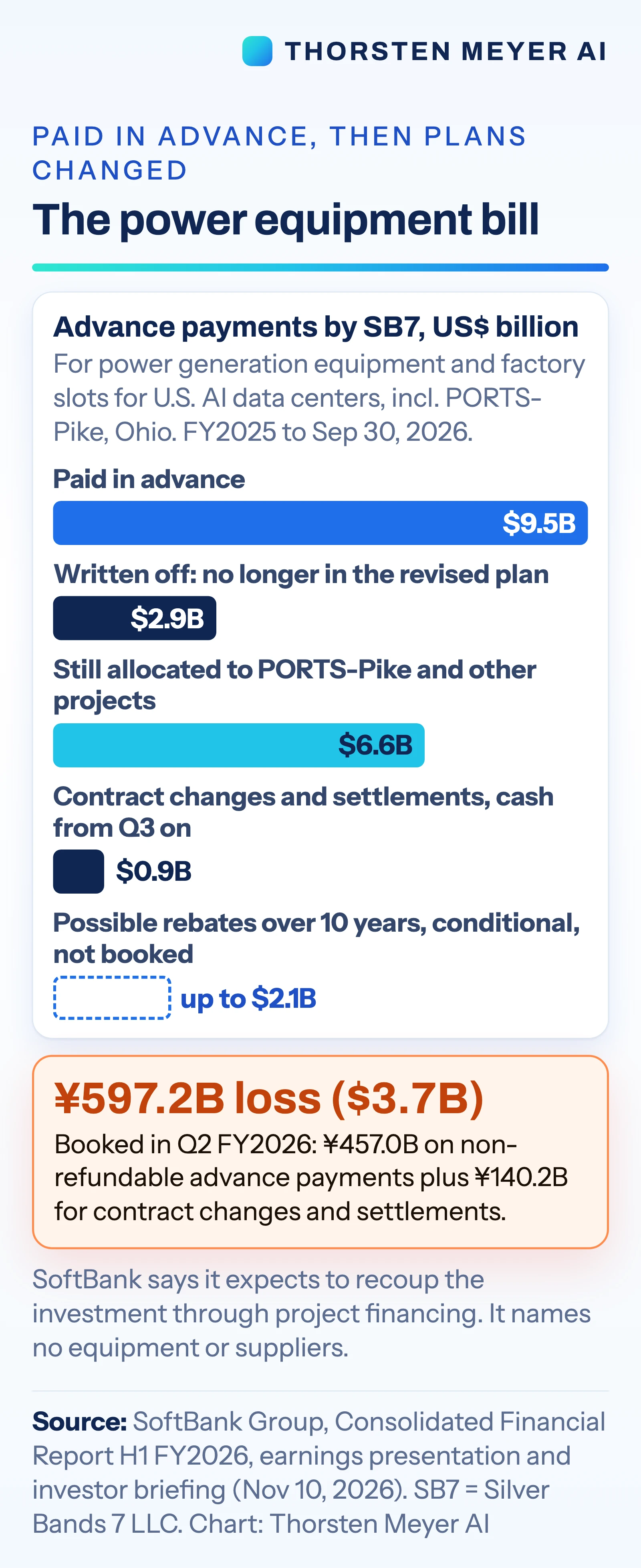
The charge comes from a company called Silver Bands 7 (SB7), “a subsidiary in which the Company and SVF2 have invested”. SVF2 is SoftBank’s second Vision Fund. According to the financial report, SB7 signed “manufacturing capacity reservation agreements, equipment purchase contracts, and other arrangements for power generation-related equipment” for “AI data center projects in the U.S., including the PORTS-Pike Technology Campus in Pike County, Ohio”.
SoftBank’s investor presentation explains why: it “made bridge investments in advance to secure power generation equipment in anticipation of shortages”. It paid $3.9 billion in fiscal 2025 and $5.6 billion in the first half of fiscal 2026.
Then, in SoftBank’s words, “SB7 revised its equipment procurement strategy given the evolving requirements of its existing and planned projects.” The result:
- $2.9 billion (¥457.0 billion) lost on non-refundable advance payments for equipment “no longer in the revised procurement plans”.
- $0.9 billion (¥140.2 billion) for contract modifications and settlements. SoftBank expects the cash payments for this part “from Q3 onward”.
- $6.6 billion of the advance payments remains allocated to equipment for PORTS-Pike and other projects.
- Rebates of up to $2.1 billion over the next 10 years on future equipment purchases, “subject to certain conditions”. SoftBank did not book them as an asset, because their amount could not be determined.
SoftBank says it expects “to recoup the investment through project financing”. It has not said which equipment it bought, from whom, or which purchases were cancelled.
At a press briefing in Tokyo, Chief Financial Officer Yoshimitsu Goto said intense competition for energy supply and power equipment led to buying before long-term specifications were final, Reuters reported. “There are many cases where you have to change strategy for what you thought would probably have been OK a year or two ago,” Goto said, according to Reuters. Chief Accounting Officer Kazuko Kimiwada added that the orders could not be refunded when cancelled and also incurred fees.
That is the tension in one sentence: in a market where power gear is scarce, you have to order before you know exactly what you need. In SoftBank’s case, part of what it had paid for was no longer in its revised plans, and changing the contracts cost extra.
The second cost: money
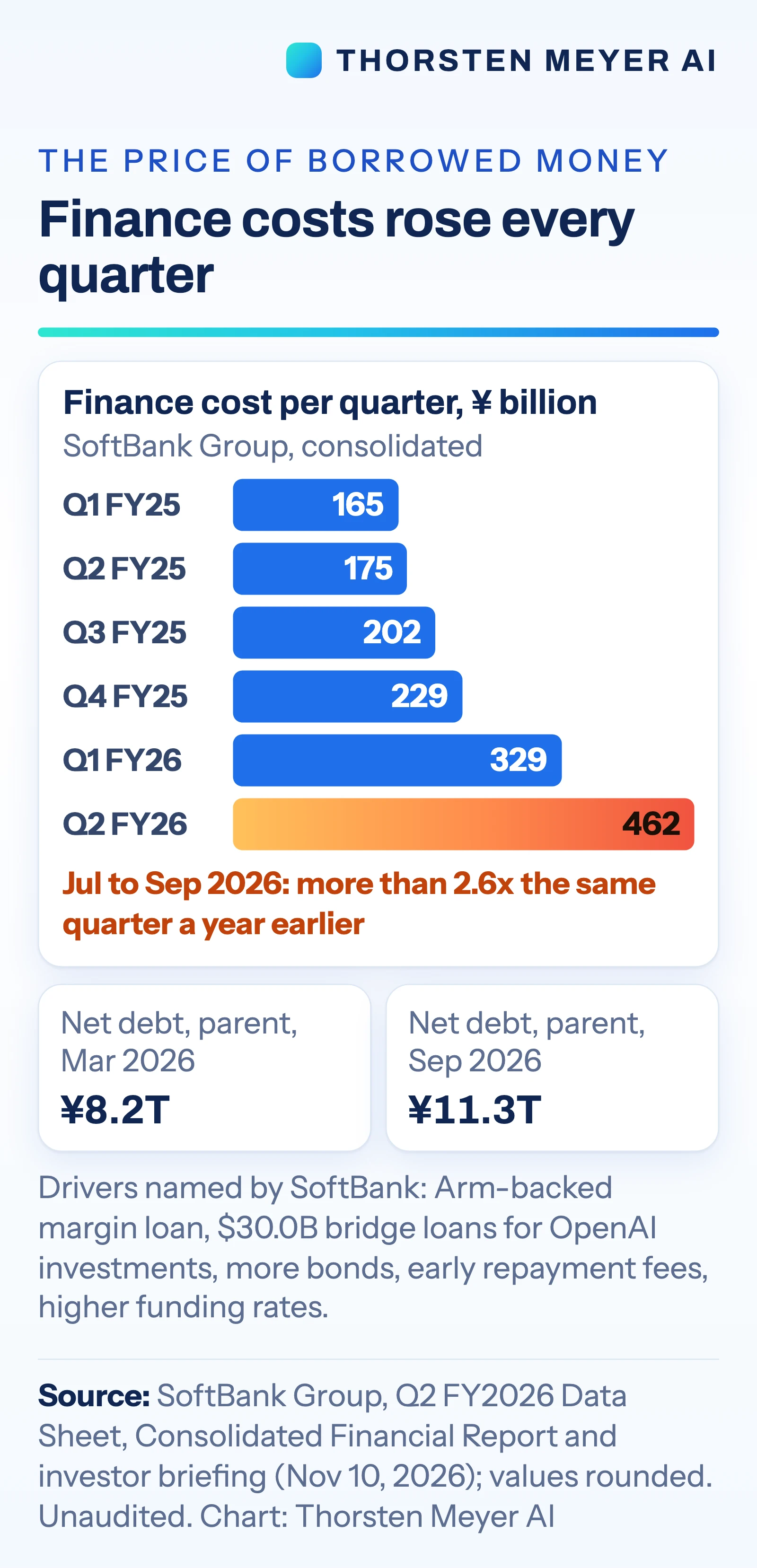
The other cost that grew was the price of borrowed money. SoftBank’s finance cost rose every quarter over the past year and reached ¥461.9 billion in the second quarter, about $2.9 billion at SoftBank’s average rate for the quarter.
The financial report explains part of the jump. Interest expenses at the parent company rose by ¥407.2 billion to ¥676.4 billion in the first half, mainly because of a margin loan backed by Arm shares, a bridge loan of $30.0 billion used for follow-on investments in OpenAI, and more bonds. When SoftBank repaid the bridge loan early on September 15, 2026, the remaining fees of that loan were booked at once. “Higher funding rates also contributed,” the report says.
To repay the bridge loan, SoftBank borrowed again: an $11.87 billion term loan, $7.35 billion raised against its Intel shares, and $5.0 billion more on the margin loan backed by Arm shares. Over the six months, the group raised ¥17,155.5 billion and repaid ¥9,700.1 billion. Reuters reported that SoftBank raised $56.5 billion in the quarter, its highest quarterly total ever.
SoftBank’s own risk measure still looks comfortable on paper. Its loan-to-value ratio, net debt divided by the value of its holdings, was 15.9% at the end of September, below its rule of staying under 25% in normal times. But net debt at the parent level rose from ¥8.2 trillion in March to ¥11.3 trillion ($72 billion) in September. And the value side of that ratio depends on what its holdings are worth.
Who carries the risk
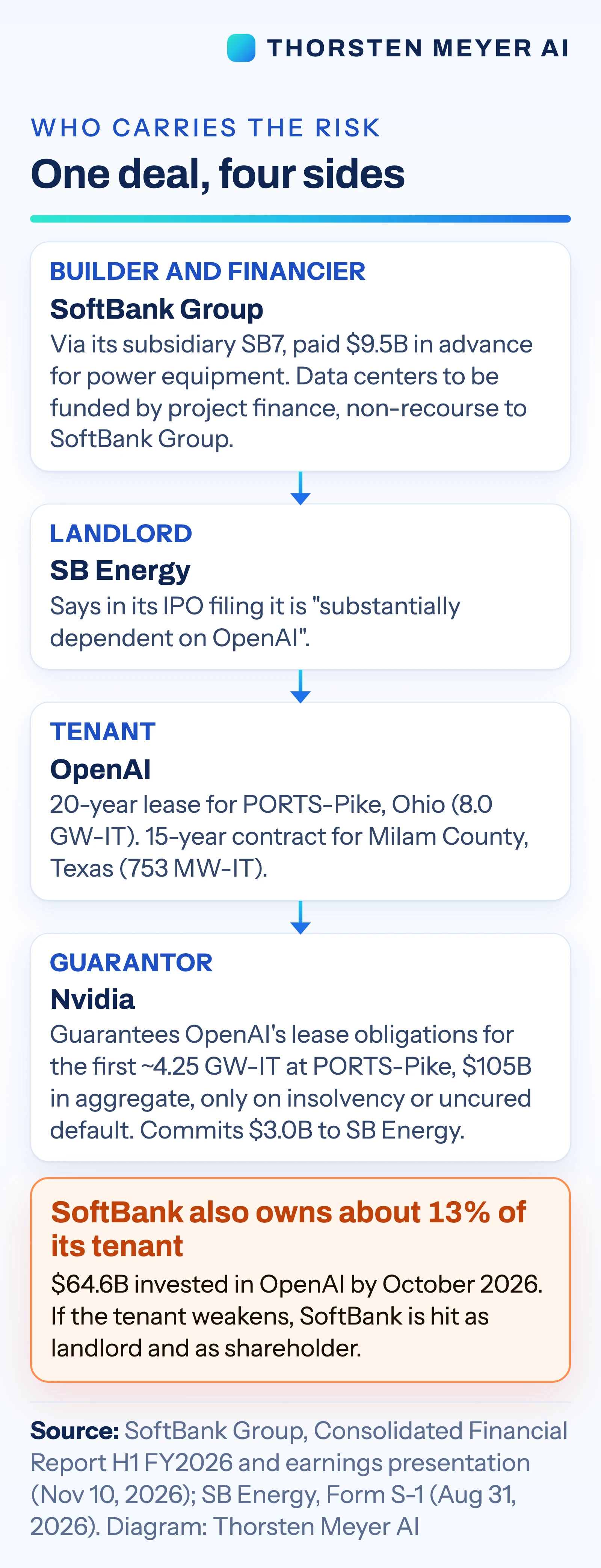
The interesting part is not the size of the loss. It is how the risk of the AI buildout is spread, and how tightly the parties are tied together.
- SoftBank as builder and financier. SoftBank lists three AI data center projects: Milam County, Texas (753 MW-IT, under construction), PORTS-Pike in Ohio (8.0 GW-IT, “preparing for construction”) and a project in France (5.0 GW of gross power capacity, offtaker “to be determined”). It says these are “expected to be funded through project finance, non-recourse to SBG”. That means lenders to each project can, in principle, only reach that project’s assets.
- OpenAI as tenant. OpenAI is the offtaker for Milam County on a 15-year contract and for PORTS-Pike on a 20-year contract, SoftBank says. SB Energy, SoftBank’s data center developer, wrote in its IPO filing of August 31, 2026 that it is “substantially dependent on OpenAI”.
- Nvidia as guarantor. According to the same filing, Nvidia provided “residual value guaranties of the OpenAI tenant’s lease obligations at PORTS-Pike Technology Campus covering only the initial approximately 4.25 GW-IT at an aggregate guaranteed value of $105 billion”. The guarantee is “triggered only upon specified tenant insolvency or an uncured monetary default”. SoftBank adds that Nvidia committed to invest $3.0 billion in SB Energy, of which $1.5 billion has been funded.
- SoftBank as shareholder of its tenant. SoftBank’s cumulative investment in OpenAI reached $64.6 billion in October 2026, for about 13% ownership. SoftBank’s energy and data center unit has also granted its tenant warrants: those granted to OpenAI “as incentives under lessor lease arrangements” caused a derivative loss of ¥203.8 billion in the first half, as the value of that unit, Energy Global, rose.
None of this is hidden; it is all in the filings. But it means the same few companies sit on several sides of the same deal. If demand for AI computing grows as planned, everyone wins together. If a project is delayed or a tenant scales back, the strain moves through landlord, tenant, guarantor and lenders at the same time.
The IPO filing also names practical risks that have nothing to do with chips. Interconnection rights for PORTS-Pike alone “could require over $6 billion in credit support”. The campus depends on “approximately 9.2 GW of generation under the U.S.–Japan Partnership, which may be delayed, reduced or withdrawn”. And permits are “in various stages of preparation and review”, with “no guarantee” they arrive on schedule.
What it means for businesses
Most companies will never buy a gas turbine. But they buy what turbines make possible: AI computing time.
- Capacity is a power question. SoftBank, citing an Altman Solon forecast in SB Energy’s filing, shows 82 GW of installed global data center capacity in 2025 against a demand forecast of 274 GW in 2030, and adds that this is “not guaranteed”. Whether or not that forecast holds, the bottleneck SoftBank describes is power equipment, not only chips. When you plan AI workloads for 2027 and 2028, ask your cloud or colocation provider where the power for new capacity comes from and when it is contracted.
- Prepayments are spreading. SoftBank paid for factory slots in advance because it feared shortages. Other builders face the same choice. Those costs end up somewhere: in project budgets, in financing costs, and eventually in what compute costs. This article cannot say how much of it reaches your invoice.
- Check the chain behind your provider. If you sign a multi-year compute commitment, the capacity behind it may depend on one landlord, one tenant and one guarantor. Ask about delivery dates, what happens if capacity is late, and whether you can move workloads. This is not legal advice; have your contracts reviewed.
- Long contracts cut both ways. The 15- and 20-year leases give builders the certainty they need to borrow. For buyers, a long commitment locks in capacity, but also today’s assumptions about price and technology. Goto’s own remark, that plans which looked fine “a year or two ago” had to change, applies to customers too.
- Do not read one quarter as a verdict. SoftBank’s loss says something about timing and procurement, not about whether AI demand is real. SoftBank titles its slide “Growing AI Usage Drives Data Center Demand”. The rebates and the remaining $6.6 billion show it still plans to build.
What it means for users
You will not see a line for power turbines on your chatbot bill. But the cost of building data centers, and of the money borrowed to build them, sits behind every AI subscription and every free tier that a provider has to finance. Whether those costs push prices up, slow down new features or are absorbed by investors is up to the providers, and none of them has said.
There is a local side too. PORTS-Pike is planned across several thousand acres in Ohio, and its power plans and permits are still under review. For people who live near such projects, the questions are about the grid, water and land. We looked at who pays for power and water at these campuses in an earlier reality check on OpenAI’s compute campuses.
What is not known
- Which equipment and which suppliers. SoftBank says “power generation-related equipment” but names no products, makers or cancelled orders.
- Whether the rebates will be used. The up to $2.1 billion depends on conditions and on future purchases. SoftBank booked no asset for it.
- How the remaining $6.6 billion will be recovered. SoftBank says it expects to recoup it through project financing; the documents do not say when, or with which lenders.
- What changed in the plans. SoftBank cites “evolving requirements of its existing and planned projects”, but does not say whether the size, timing or design of PORTS-Pike changed.
- Permits and power for PORTS-Pike. The IPO filing says permits and the planned generation are not guaranteed and could be delayed.
- OpenAI’s value in SoftBank’s books. SoftBank says the valuation of its OpenAI stake was unchanged from March. Any change from a new funding round is not in these results.
The limits of this story
This article relies on SoftBank Group’s consolidated financial report for the six months ended September 30, 2026, its Q2 FY2026 data sheet, earnings presentation and investor briefing materials, all published November 10, 2026, and SB Energy’s registration statement on Form S-1 filed with the U.S. Securities and Exchange Commission on August 31, 2026, all accessed November 10, 2026. SoftBank’s English report is a translation of the Japanese original and was not reviewed by auditors. Quotes from the press briefing come from Reuters; the analyst expectations and market reactions in media coverage are deliberately left out, as are share prices. Dollar figures are SoftBank’s own, except finance costs, which I converted at SoftBank’s stated average rate for the quarter (¥160.12 per dollar). I could not verify any of the figures independently.
I’m Thorsten Meyer. The full sources are below, and more reality checks are at thorstenmeyerai.com.
Sources
- SoftBank Group: Consolidated Financial Report for the Six-Month Period Ended September 30, 2026 (IFRS), November 10, 2026
- SoftBank Group: Q2 FY2026 Data Sheet, November 10, 2026
- SoftBank Group: Earnings presentation, Q2 FY2026 and Investor briefing, Q2 FY2026, November 10, 2026 (via Events and Presentations)
- SB Energy, Inc.: Registration Statement on Form S-1, filed with the SEC on August 31, 2026 (preliminary prospectus)
- Reuters via The Star: SoftBank books $7 billion quarterly loss on US data centre hit, financing costs, Anton Bridge, November 10, 2026
- Bloomberg via The Japan Times: SoftBank logs $7 billion loss after U.S. data center costs swell, November 10, 2026
- CNBC: SoftBank swings to $7 billion loss after U.S. data center hit, November 10, 2026
Researched and drafted with AI assistance, including Anthropic’s Claude. Anthropic competes with OpenAI. Neither SoftBank, SB Energy, OpenAI, Nvidia nor Anthropic reviewed or sponsored this article, and it contains no affiliate links. This article is for information only; it is not investment, financial or legal advice. Images: AI-generated illustration (Runware) and graphics by Thorsten Meyer AI; no real sites, people or logos are shown.