By Thorsten Meyer
For years, Russia has worked to keep a strange separation intact: the soldiers fight, the factories produce, the state pays — and for millions of ordinary Russians, the war is something that happens somewhere else. Ukraine’s increasingly systematic campaign against Wildberries, Russia’s largest online marketplace, is an attack on that separation.
Since 18 July, Ukrainian drones have struck Wildberries logistics facilities across Russia in near-nightly waves. By 7 August, Reuters counted attacks on at least 20 sites, and its review of satellite imagery found that at least 1.18 million square metres of warehouse space — more than a fifth of the company’s capacity — had been damaged or destroyed. At first glance this looks like an odd target: Wildberries is the Russian Amazon, selling clothing, cosmetics, electronics, groceries. But that description misses what the platform has become during the war, and why hitting it does damage far beyond the buildings that burn.
Ukraine is not attacking a shop. It is attacking a network — one that connects soldiers, merchants, consumers, banks, and the Russian state. And when you strike a node in that kind of network, the cost propagates outward.
Since 18 July, Ukrainian drones have hit ~20 Wildberries logistics sites. It looks like an odd target — until you see that one strike can hit three systems at once: the battlefield supply chain, the civilian economy, and the banks.
Wildberries is a consumer marketplace, a national logistics network, a decentralised military-supply channel, and an increasingly important node in Russia’s banking system. Hit a warehouse and the cost propagates outward.
The Russian soldier has an Amazon account
One of the defining features of this war is how much military equipment is acquired outside traditional procurement. Russian soldiers, their families, volunteer groups, and pro-war fundraising organisations routinely buy gear commercially and ship it to the front. That creates an enormous grey zone between civilian commerce and military logistics — and Wildberries sits directly inside it.
The independent outlet Meduza reported in late July that Wildberries searches had returned helmets, body armour, and other equipment under war-related terms; even after the platform stopped serving results for phrases like "everything for the SVO," related searches still surfaced military first-aid kits, backpacks, radios, and tactical gear. More strikingly, Meduza counted more than 9,000 listings for tactical body armour, alongside FPV drones and components. Other reporting identified combat helmets and fibre-optic cable; Reuters independently noted the catalogue includes night-vision goggles, ammunition pouches, and helmets — while Wildberries and the Kremlin deny the company supplies the military.
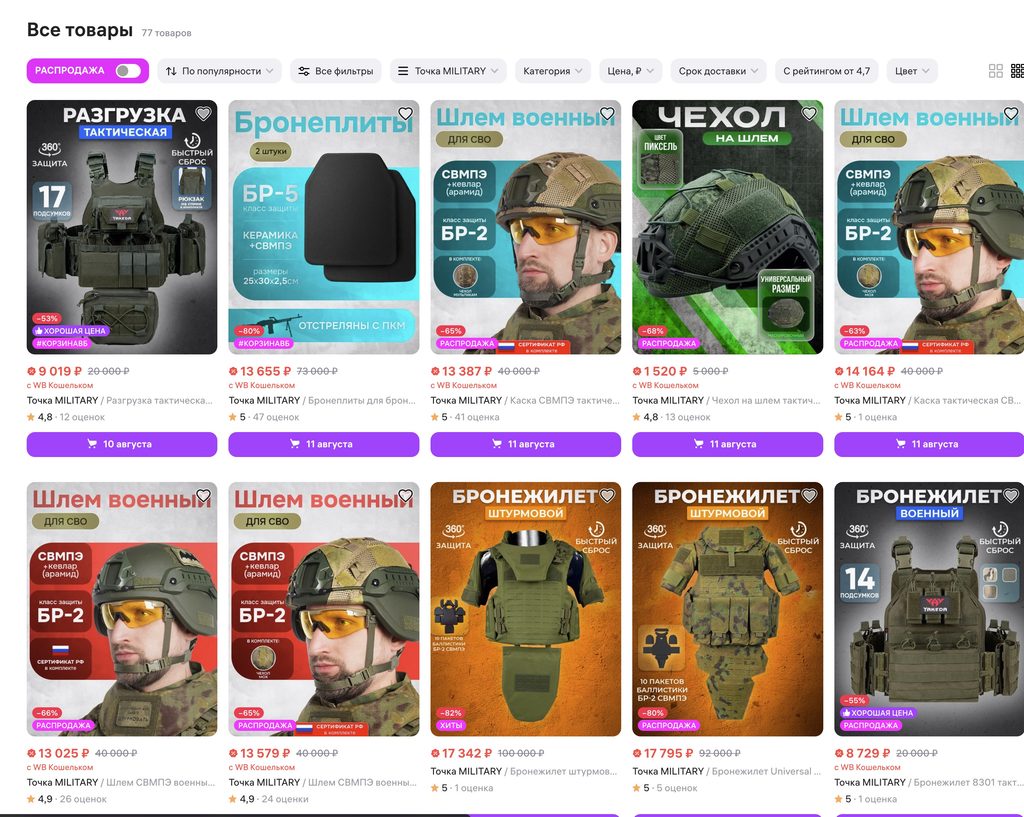
That denial matters, and I'll come back to it, because it is central to the legal question. But notice first what makes Wildberries strategically unusual. It is not a quartermaster receiving an army contract and shipping pallets to a brigade. Its importance is decentralised: a soldier who needs better body armour doesn't wait for the Ministry of Defence; a volunteer group buying radios needs no procurement contract; a team assembling FPV drones needs motors, batteries, electronics, and cable. Wildberries gives all of them the same thing — national-scale commercial logistics that turns thousands of individual sellers into one enormous distributed supply system. Ukraine does not have to prove every box holds military kit for that capability to matter.

BODYARMOR Sports Drink, Strawberry Banana, Electrolyte Drink Hydration, 16 Fl Oz Bottles (6 Pack), Flavored Coconut Water with B Vitamins & Antioxidants
- Product Name: BODYARMOR Strawberry Banana Sports Drink
- Size: 16 Fl Oz Bottles (6 Pack)
- Flavor: Strawberry Banana with Coconut Water
As an affiliate, we earn on qualifying purchases.
As an affiliate, we earn on qualifying purchases.
Fibre-optic cable explains the new battlefield economy
One product captures the whole problem: fibre-optic cable. Fibre-guided FPV drones have become one of the war's most important adaptations — instead of a jammable radio link, the drone unspools hair-thin fibre behind it, giving a physical connection that resists electronic warfare. The result is a strange modern supply chain, where a material associated with telecom infrastructure becomes a battlefield consumable.
Lithium batteries are civilian. Cameras are civilian. Electronic components are civilian. Fibre-optic cable is civilian. Put them together in the right configuration and they become part of a weapon system. That is exactly why Ukraine's stated justification for the first strikes focused not on tactical clothing but on sanctioned components for drone production and navigation: after 18 July, President Zelensky said the two targeted facilities in the Moscow and Tambov regions had been used to supply such components. That specific claim hasn't been independently proven for every subsequent warehouse — but it reveals the logic. Ukraine is targeting the commercial infrastructure that makes decentralised Russian procurement easy.
And the objective may not even be to destroy the equipment. It may simply be to make acquiring and distributing it harder. Thousands of sellers and millions of buyers sit on either side of a relatively small number of enormous logistics hubs; hit the hubs and the effect radiates outward. A fibre spool arriving three weeks late is a different thing from one arriving tomorrow. A drone battery that suddenly costs twice as much is a different thing from one waiting in a nearby fulfilment centre. Ukraine may be attacking availability rather than individual products — and on the current numbers, the friction is already real.

DJI Neo 2 Motion Fly More Combo With RC Motion 3 & Goggles N3
- Lightweight & Portable: Only 151g with full-coverage guards
- Easy Takeoff & Landing: Palm takeoff and landing features
- Gesture Control: Hands-free operation with gestures
As an affiliate, we earn on qualifying purchases.
As an affiliate, we earn on qualifying purchases.
Then the damage moves into Russia's civilian economy
This is where the strategy widens. Wildberries is vast: Bloomberg put the value of goods it handled last year at roughly three percent of Russia's entire economic output, and e-commerce platforms collectively handle the equivalent of around 8.5 percent. Some 98,000 pickup points operate across Russia and neighbouring countries, and behind them are tens of thousands of businesses that depend on the marketplace to reach customers.
When a warehouse burns, much of the stock inside belongs not to Wildberries but to independent sellers. That turns every strike into thousands of individual balance-sheet events. A manufacturer loses six months of inventory; a clothing brand loses a seasonal collection; a merchant still owes money borrowed to buy goods that no longer exist; a franchise pickup point loses most of its parcel traffic while still paying rent and staff. Forbes Russia estimated sellers' potential losses at between 215 and 280 billion roubles (roughly $2.6–3.4 billion), extrapolating from the compensation paid after a 2024 warehouse fire.
Reuters documented the effect at ground level: a Moscow franchise operator whose daily deliveries fell from about 400 parcels to 150, leaving his business loss-making and up for sale. By early August, more than 3,100 Wildberries pickup points were advertised for sale on the classifieds site Avito. This is economic warfare conducted through logistics — the drone destroys the warehouse, but the financial damage travels much further.

KabelDirekt TOSLINK – Optical Audio Cable – 6ft – Soundbar
- Type of Cable: Optical digital audio cable
- Compatibility: Suitable for TOSLINK devices
- Length: 6 feet long
As an affiliate, we earn on qualifying purchases.
As an affiliate, we earn on qualifying purchases.
And now it is reaching the banks
Here is the most strategically interesting second-order effect, and the part you should watch. Russia's largest lender, Sberbank, has already acknowledged the strikes are hurting credit quality: in late July it said about 300 companies were seeking to restructure loans after the attacks weakened online retailers and vendors, and its CFO confirmed the bank is weighing higher loss provisions against a "decline in the credit quality of marketplaces." A source close to the Kremlin told Reuters to expect "a wave of bankruptcies," warning that supporting sellers could run to hundreds of billions of roubles.
The transmission mechanism is remarkable when you lay it out. A Ukrainian drone hits a logistics centre. A Russian merchant loses inventory. The merchant's revenue collapses. The merchant asks Sberbank to restructure. Sberbank raises provisions. The physical strike has become a banking event. And the exposure isn't confined to one lender: Russia's second-largest bank, state-controlled VTB, announced in May a plan to take a 5 percent stake in Wildberries' financial subsidiary, and after the strikes began said it was prepared to consider credit support. The Kremlin, meanwhile, has discussed government assistance — loans from state banks, subsidies, tax relief.
That is why "destroying warehouses" understates what's happening. The attacks force Russia to decide who absorbs the loss — the seller, Wildberries, the commercial bank, the state bank, or ultimately the government. The damage cannot be wished away. Someone has to hold it.

ANNKE 3K Lite Wired Security Camera System Outdoor, 8X 2MP Cameras, 1TB HDD
- AI Motion Detection 2.0: Enhanced human and vehicle detection
- Flexible Compatibility: Works with TVI, AHD, CVI, CVBS & IP cameras
- Includes 1080P Cameras: High-definition security footage
As an affiliate, we earn on qualifying purchases.
As an affiliate, we earn on qualifying purchases.
This is not yet a Russian banking crisis — and I won't pretend it is
Restraint is required here, because the honest version of this argument is stronger than the triumphant one. The evidence does not show Ukraine is about to collapse Sberbank or VTB. Sberbank remains enormous and profitable; VTB is systemically important and backed by the state; a few hundred distressed marketplace borrowers are tiny against those balance sheets. Kyiv officials, including Mykhailo Podolyak, have openly framed the campaign as an attempt to force financial pressure — but framing an aim is not achieving it, and I'm not going to tell you burning warehouses topples a banking system. It doesn't.
The credible argument is subtler. Russia is already running a wartime economy under sanctions, high interest rates, and weak growth, with its central bank trying to cut rates while holding down inflation. Supply shocks make that harder — central bank governor Elvira Nabiullina has said policymakers are watching whether the Wildberries disruption feeds inflation, and economists note even small supply shocks can complicate rate cuts. So the effect is cumulative, not catastrophic. Every restructured loan, every loss provision, every emergency subsidy, every merchant bankruptcy, every insurance dispute, every rebuilt warehouse — each is manageable alone. Together they raise the domestic price of continuing the war. That is the mechanism, and it doesn't need exaggeration to be significant.
Why Russians actually notice this one
Wildberries also differs from an oil refinery or an ammunition depot in a way that is plainly deliberate: ordinary Russians interact with it constantly. A refinery can burn hundreds of kilometres away and barely register with someone in Moscow. A Wildberries disruption shows up on their phone — the package doesn't arrive, the product vanishes, the pickup point closes, prices rise, a neighbour loses her inventory. Ukraine's drone-forces commander Robert Brovdi described the strikes partly as psychological, aimed at destroying "the illusion of a comfortable peacetime existence" for the population of the aggressor state. Ukraine characterises its deep-strike campaign as an effort to bring the war home and raise the cost of continuing it, and Wildberries offers an unusually direct channel from the front to the Russian consumer's daily life.
But calling every warehouse a "military target" goes too far
I want to be careful and precise here, because this is where a strong thesis can overreach, and I'd rather be right than loud. In ordinary language it's tempting to say that because soldiers get equipment through Wildberries, the whole company is now a military target. International humanitarian law is more demanding than that.
Under the law of armed conflict, a civilian object becomes a lawful military objective only when, in the circumstances at the time, it makes an effective contribution to military action and its destruction offers a definite military advantage. That test is specific and case-by-case. A warehouse demonstrably storing drone components bound for military use is a very different case from one holding shoes, cosmetics, and appliances. The presence of dual-use goods across a marketplace does not automatically convert every building in that company's network into a legitimate target — and this matters all the more because the strikes have killed and injured warehouse workers. Earlier waves killed several people; these are not empty buildings.
So the accurate framing is this: Ukraine appears to believe that specific parts of the Wildberries logistics system contribute materially to Russia's war effort, while Wildberries and the Kremlin deny the company supplies the military, and the lawful status of any single strike depends on facts that are often not public. I hold the view that the campaign has a genuine military logic — the dual-use supply role is real, not invented. But "genuine military logic" and "every warehouse is a lawful target" are different claims, and honesty requires keeping them apart. Where the dual-use logic ends is a real question: if a marketplace becomes a target because soldiers shop there privately, a lot of civilian infrastructure sits on the wrong side of that reasoning.
The real target is the network
Wildberries illustrates something larger about modern war. Industrial warfare once ran on dedicated military factories and government logistics. The drone war has blurred that structure beyond recognition: commercial electronics become weapon components, consumer batteries power reconnaissance, civilian telecom cable guides attack drones, online marketplaces distribute tactical equipment, and private fundraising supplements state procurement. Commercial warehouses become nodes in a decentralised wartime supply chain.
That is what makes a company like Wildberries strategically unusual — and what makes this campaign worth watching closely. Ukraine can strike one physical location and affect three systems at once: the battlefield supply chain, the Russian civilian economy, and the financial system that has to absorb the losses. It does not mean Wildberries is about to disappear, and it certainly does not mean Russia's banking system is about to fall. But after only three weeks, Sberbank is discussing extra provisions, hundreds of businesses are seeking restructuring, thousands of pickup points are up for sale, the Kremlin is weighing support, VTB is considering additional lending — and more than a fifth of the warehouse capacity is gone.
The drones hit warehouses. The real objective may be everything connected to them.
Reality Check and analysis from a builder, founder, and post-labor economist running a local-first inference operation. Factual basis: Reuters reporting and satellite-imagery review (7 August 2026); Meduza and Ukrainska Pravda on dual-use listings; Bloomberg, Forbes Russia, and The Moscow Times on economic impact; statements by President Zelensky, commander Robert Brovdi, and Kremlin and bank officials; and standard principles of international humanitarian law (Additional Protocol I, Art. 52). Figures are point-in-time and were accurate as reported at the time of writing; the campaign is ongoing. Wildberries and the Kremlin deny the company supplies the Russian military. The legal assessment reflects the author's reading of publicly available facts, not a determination about any specific strike. This is strategic analysis, not legal advice. Point-in-time as of 7 August 2026.