
On June 10, a team of fourteen researchers — most of them at Google DeepMind — posted a 57-page report to arXiv called From AGI to ASI. It crossed 54,000 views in days, and the names on it are why: the list includes Shane Legg, who co-founded DeepMind and helped popularize the term AGI, and Marcus Hutter, who built the mathematical theory of “universal intelligence” the report leans on.

Get business pricing on tech for your team
- Business-only prices and quantity discounts
- Tax-exempt purchasing
- Multiple users, one account, clear invoices
Most AI-safety writing asks what happens when machines reach human level. This report asks the next question instead: what happens after — and whether the field is thinking clearly about the stretch from human-level AGI to something that outclasses entire human institutions. Its quiet answer is: not clearly enough.
It also does something I have never seen a research paper do. It opens with instructions to the AI assistants it assumes will summarize it — telling them which points not to compress, and even asking them to report, in the future, how well its predictions aged. Hold that detail; it tells you a lot about the moment we’re in.
Here’s what the report actually argues, and where I think it’s sharp — and where it’s conveniently quiet.
Waves, not a wall: the road past AGI
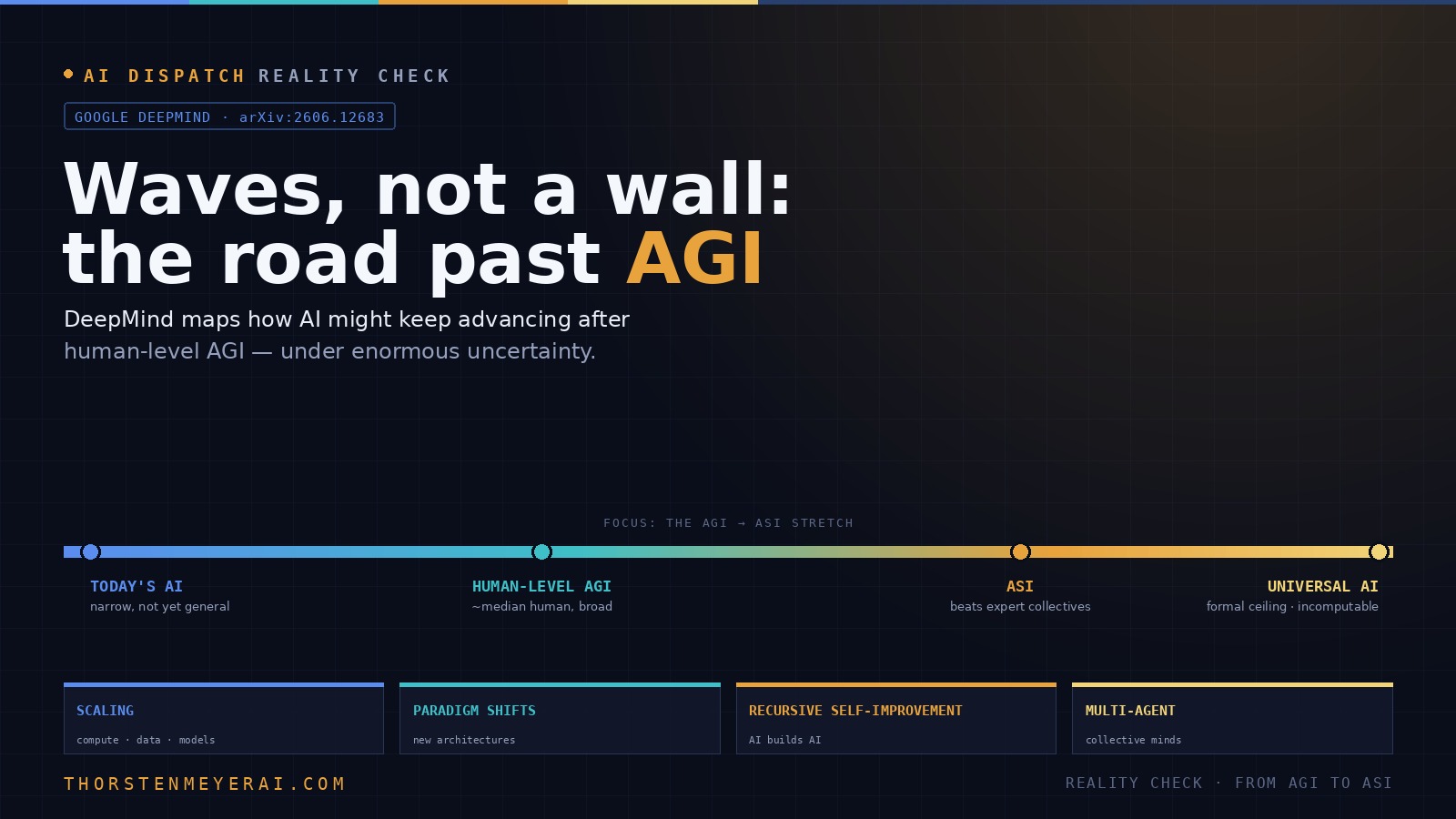
A 57-page DeepMind report maps how AI might keep advancing after human-level AGI. Its headline: the future may not be one big “step change,” but a series of transformative waves — under enormous uncertainty.
A careful, sober map that resists both doom and rapture — and refuses to promise the usual singularity miracles. But it’s a position paper from a party with a stake in the destination, anchored to its own authors’ theory, and it deliberately brackets the economics, labor, and how humans fit in — the part that matters most. Useful terrain map; drawn by people who own the land.
What the report is (and isn’t)
This is a conceptual map, not an experiment. There are no new benchmark results here; the contribution is a framework for reasoning about post-AGI progress, plus a research agenda. Read it as a serious lab’s senior thinkers trying to impose structure on a genuinely foggy question.
The structure is a continuum of machine intelligence with four reference points: today’s AI, then human-level AGI, then artificial superintelligence (ASI), then a theoretical ceiling they call Universal AI. They anchor that ceiling to the AIXI framework and the Legg-Hutter score — a formal definition of intelligence as average performance across all computable tasks. It’s worth being blunt that this is Legg’s and Hutter’s own 2007 framework, so the report is using its authors’ theory as its yardstick. That’s intellectually coherent, but it isn’t a neutral choice.
What’s striking is how high they set the ASI bar. This isn’t “smarter than a person.” Their working definition is a system that beats large collectives of human experts across virtually every domain — concretely, something that reliably outperforms tens of thousands of well-coordinated specialists working for a decade. Narrow superhuman systems like AlphaFold or AlphaGo explicitly don’t count. ASI, in their telling, is general and it exceeds organizations, not individuals.
As an affiliate, we earn on qualifying purchases.
Why they doubt intelligence stops at human level
The report’s core engine is an argument about digital advantages that scale with compute. A model can read books in seconds, think faster by being given more cycles, copy not just its code but its entire memory state, move between machines, and share learning across thousands of instances at once. These are things biology can’t do, and crucially they widen as compute grows.
And compute has grown relentlessly. The report stacks three trends — cheaper hardware (~1.5×/year), rising investment (~2.5×/year), and algorithmic efficiency (~3×/year) — into a combined “effective compute” growth rate of roughly 10× per year. Extend that to the end of the decade and you get something like 10,000× more effective compute than today. Their thought experiment: even if model quality froze at human level, that much compute could run a thousand AGI instances today into a hundred million in five years — or a million running a hundred times faster. At that point, “just scaling” starts to look indistinguishable from a step up in kind.
As an affiliate, we earn on qualifying purchases.
The four pathways
The heart of the report maps four routes from AGI to ASI, which the authors stress are not mutually exclusive and will likely run in parallel:
- Scaling — keep enlarging compute, data, and models. It’s the only pathway you can actually fit forecasting models to, via scaling laws. The near-term snag is data: high-quality text is projected to run out later this decade, pushing labs toward synthetic data, simulation, and other modalities.
- Paradigm shifts — new architectures or training methods that depart from today’s transformer-plus-fine-tuning recipe (think continual learning, unbounded memory, world models, or something genuinely novel like neuromorphic hardware). By nature these are nearly impossible to forecast, and tend to appear when the current approach hits a ceiling.
- Recursive self-improvement — AI accelerating AI research, in a loop that could in principle go explosive. They note it’s already weakly underway (automated architecture search, AI-assisted chip design, systems like AlphaEvolve), and map it onto how human intelligence grew: genetic (AI rewriting its own code), cultural (AI generating better training data), and cooperative (specialized agents dividing labor).
- Multi-agent collectives — superintelligence as an emergent property of many agents interacting, whether a tightly coordinated hive or a fluid, market-like economy of specialists. They concede emergence in systems this complex is poorly understood.
superintelligence simulation models
As an affiliate, we earn on qualifying purchases.
As an affiliate, we earn on qualifying purchases.
The brakes — and a dose of sobriety
Against those pathways the report sets a list of frictions: data exhaustion, the difficulty of verifying that self-improving systems are actually improving, an “abstraction barrier” (whether high-bandwidth digital minds even form the deep concepts humans do), institutional and regulatory limits, and the brute economics of sustaining exponential resource inputs. The honest move here is that they refuse to score these. Whether each friction is a speed bump or a wall is, they say, an open research question — and the framing is the contribution.
The most grounding section is the one insisting that ASI would be neither omniscient nor omnipotent. They list hard limits no intelligence escapes: the speed of light, thermodynamic floors on computation, the real-time pace of physical experiments, P-versus-NP, Gödel’s incompleteness. The payoff is a refusal to promise the usual singularity catalog — they explicitly decline to assert that superintelligence could cure aging, upload brains, or restore the pre-industrial climate. After a decade of breathless forecasts, a frontier lab writing down what its own technology can’t do is genuinely useful.
As an affiliate, we earn on qualifying purchases.
The headline: waves, not a wall
The report’s most quotable idea is a reframing. The popular picture — one dramatic “step change” when AGI arrives and everything is different the next morning — may be the wrong mental model. More likely, they argue, is a series of transformative waves rolling across science and the economy as AI-enabled breakthroughs stack up. Acceleration can’t be ruled out; neither can the current paradigm quietly hitting its natural limits. The uncertainty bands are enormous, and to their credit the authors keep saying so. Their prescription is less a prediction than a to-do list: make forecasting AI progress a real discipline, track the early indicators of recursive improvement, and treat the whole thing as a global, interdisciplinary problem.
The reality check
Credit where it’s due: this is a careful, unusually sober document. It resists both the doom and the rapture, grounds a slippery topic in real formalism, and has the intellectual honesty to catalog its own open questions and its subject’s hard limits. As a map of the technical terrain past AGI, it’s among the more responsible things a frontier lab has published.
But read it also for what it is: a position paper from an organization with a direct stake in the destination. A report arguing that superintelligence is a coherent, reachable next-decade target — powered by 10×-a-year compute growth — is also, conveniently, a rationale for the gigawatts and the hundreds of billions in capital that the same industry is spending to get there. That doesn’t make the analysis wrong. It does mean the optimism about continued scaling and the imminence framing should be read as partly load-bearing for the business, not just the science.
Two more things nag at me. The formal anchor is the authors’ own intelligence measure — elegant, but self-referential, and admittedly incomputable, with a large gap between the theory and anything you can build. And that opening flourish, the instructions to AI summarizers, is cleverer than it first appears: a paper that assumes most people will meet it through an AI, and then scripts what that AI should say, is quietly asking to write its own coverage. I read the thing and wrote my own.
The deepest gap, though, is the one that matters most for anyone thinking about how this lands on actual people. The report deliberately brackets the economics, the labor transition, robotics, and — in its own words — the question of how thriving humans fit into the picture. It maps the road to superintelligence in fine detail and leaves the part where that road runs through our societies almost entirely blank. For a document about the most consequential transition its authors can imagine, that blank space is the most revealing thing in it.
A map of the terrain is worth having, especially a sober one. Just remember it was drawn by people who own a large share of the land — and that it stops, pointedly, at the edge of the territory the rest of us actually live in.
Source: Genewein et al., “From AGI to ASI,” Google DeepMind, arXiv:2606.12683 (June 10, 2026), CC BY 4.0; figures and definitions are the report’s own. The paper characterizes AGI as roughly median-human-level general intelligence and ASI as exceeding large expert collectives across virtually all domains. Analysis and opinions are the author’s.
Evergreen bestsellers Picks
bestsellers
As an affiliate, we earn on qualifying purchases.