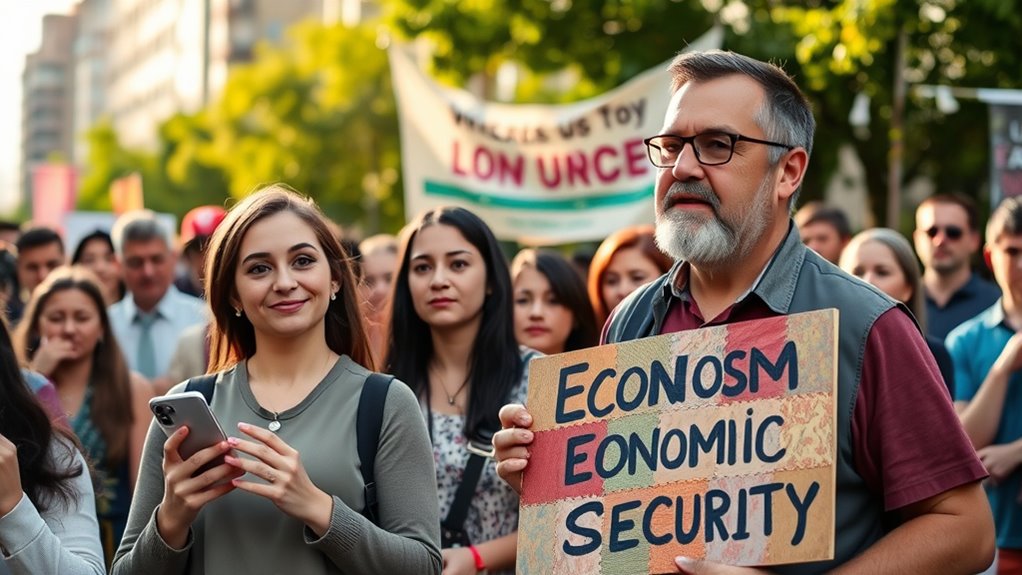

Public opinion on UBI is slowly shifting in America, especially among younger generations who see it as a way to address inequality and job challenges. Support varies across political lines and regions, with Democrats and urban areas more favorable, while conservatives remain skeptical. Economic conditions, social messaging, and cultural factors influence how people perceive UBI’s benefits and costs. If you keep exploring, you’ll discover how these trends might shape America’s future stance on basic income.

Get business pricing on tech for your team
- Business-only prices and quantity discounts
- Tax-exempt purchasing
- Multiple users, one account, clear invoices
Key Takeaways
- Younger Americans (18–29) show higher support for UBI, viewing it as a solution for inequality and future work challenges.
- Economic downturns temporarily boost UBI support, while improvements in the economy tend to reduce enthusiasm.
- Framing UBI as poverty relief and economic security increases public acceptance across demographic groups.
- Regional and cultural factors influence attitudes, with urban areas more supportive and rural or conservative regions more skeptical.
- Growing awareness of automation and job displacement concerns is driving increased openness to UBI as a social safety measure.
universal basic income support books
As an affiliate, we earn on qualifying purchases.
As an affiliate, we earn on qualifying purchases.
Historical Public Attitudes Toward Universal Basic Income

Historically, public attitudes toward universal basic income have been mixed and evolved over time, often influenced by economic conditions and political ideologies. In the 1960s and 70s, some experimental programs showed reduced work incentives, fueling skepticism about UBI’s practicality and cost. During economic downturns, support temporarily grew as people sought safety nets, but opposition remained strong among policymakers concerned about government spending and work disincentives. Over decades, perceptions shifted with changing economic realities and political debates, yet broad public approval stayed elusive. Today’s attitudes continue to fluctuate, reflecting deep divides over ideology, fairness, and fiscal sustainability. Despite occasional support during crises, UBI has largely been viewed with caution, underscoring its complex and evolving place in American political and social discourse. Additionally, understanding the credit card industry and its security measures can influence perceptions of financial stability and government programs.
financial security for young adults
As an affiliate, we earn on qualifying purchases.
As an affiliate, we earn on qualifying purchases.
Demographic Trends and Changing Support Levels

Demographic trends considerably influence how support for universal basic income (UBI) evolves, with younger populations showing especially higher levels of approval than older groups. You’ll notice that 67% of adults aged 18–29 support UBI, reflecting concerns about economic security and job stability amid changing labor markets. In contrast, support drops to 49% among those aged 30–49 and 40% for ages 50–64, indicating waning enthusiasm with age. Younger people often see UBI as a way to address income inequality and future work challenges. Meanwhile, older adults tend to be more skeptical, emphasizing work incentives and fiscal concerns. These demographic differences shape overall public opinion, with support gradually shifting as younger generations become a more prominent part of the electorate and influence policy debates. Additionally, understanding the mental wellbeing index can help contextualize how different age groups perceive financial security and stress, influencing their attitudes toward policies like UBI.
As an affiliate, we earn on qualifying purchases.
Political Ideologies and Their Impact on Public Opinion
Political beliefs profoundly shape how people view universal basic income (UBI), creating sharp divides in public opinion. You can see this in three ways:
- Republicans tend to oppose UBI, believing it discourages work and burdens taxpayers, visualizing increased government spending as a threat to economic freedom.
- Democrats generally support UBI, viewing it as a tool to reduce inequality and provide a social safety net, imagining a fairer, more inclusive society.
- Independents often hold mixed views, weighing benefits against concerns about costs and work incentives, picturing a debate rooted in values and policy priorities.
- The impact of public opinion can also be shaped by the perceived effectiveness of UBI programs and their ability to adapt to diverse economic conditions.
Your perceptions are shaped by these ideological lenses, which influence whether you see UBI as a feasible solution or a potential problem for America’s social fabric.
As an affiliate, we earn on qualifying purchases.
Economic Concerns and Cost Considerations

The primary concern with implementing UBI is its enormous cost, which raises questions about how to fund such a program without placing an excessive burden on taxpayers or increasing national debt. Critics argue that financing UBI would require considerably higher taxes or borrowing, risking economic stability. They worry that diverting funds from existing safety nets could weaken targeted programs that effectively reduce poverty. Additionally, there’s concern that UBI might dampen work incentives, potentially decreasing labor force participation. Historical data from past guaranteed income experiments show drops in employment among recipients. Balancing the goal of reducing poverty with the need for fiscal responsibility is a major challenge. As a result, economic considerations remain a critical obstacle to broader support for UBI. Furthermore, understanding the Relationships – Personality Test can provide insights into societal dynamics and the potential impact of such programs on community well-being.
Potential Social Benefits and Community Effects

You might see how UBI can strengthen community bonds by reducing economic stress and fostering shared stability. It has the potential to decrease social inequality, giving more people access to opportunities and resources. When communities are more equitable, social cohesion tends to improve, creating a more connected and resilient society. Additionally, implementing basic income may promote social cohesion by encouraging cooperation and mutual support among community members.
Enhanced Community Cohesion
Could implementing universal basic income (UBI) strengthen the bonds within communities? It has the potential to foster social cohesion by encouraging shared prosperity and reducing economic stress. Imagine:
- Neighbors collaborating on local projects, feeling connected through mutual support.
- Community members engaging more in local events, knowing they have a safety net.
- Families participating in collective decision-making, strengthening trust and unity.
UBI can promote a sense of belonging by easing financial burdens, allowing people to focus on community involvement. When economic anxieties diminish, you’ll see more cooperation, volunteerism, and social interaction. These changes can create resilient neighborhoods where people care for each other, building a stronger, more connected community fabric.
Reduced Social Inequality
Implementing UBI has the potential to substantially reduce social inequality by providing a financial safety net that reaches even the most marginalized groups. It helps level economic disparities by ensuring everyone has access to basic resources, regardless of their job status or income level. This can lead to improved health, better educational opportunities, and increased social mobility for low-income communities. As more people experience financial security, community cohesion can strengthen, fostering greater trust and collaboration across different social groups. UBI also reduces poverty-related stress, which can diminish social tensions and marginalization. Over time, these shifts can promote a fairer society where opportunities are more evenly distributed, and fewer individuals are left behind due to economic disadvantages. Additionally, integrating ads and SEO strategies into public policy discussions can enhance awareness and support for such initiatives, increasing their likelihood of successful implementation.
Influence of Current Events and Economic Conditions

Current events and economic conditions play a significant role in shaping public opinion on universal basic income (UBI). When economic uncertainty rises, you might imagine:
- People feeling more anxious about job security, leading to increased curiosity about UBI as a safety net.
- Economic downturns prompting debates over government spending, stirring fears of higher taxes or debt.
- Crises like inflation or recession making the idea of guaranteed income seem more appealing to those struggling financially.
- The influence of AI Security concerns, such as automation and job displacement, further fueling support for UBI as a means to address technological unemployment.
These shifts influence opinions, often driven by immediate needs rather than long-term policy views. During times of economic hardship, support can spike, but as conditions improve, skepticism returns. Your perception of UBI adapts to the current economic landscape, reflecting broader societal concerns.
Framing and Messaging Strategies Shaping Perceptions

You can influence public opinion by how you frame messages about UBI, emphasizing benefits like poverty reduction or economic security. The language used and stories shared shape perceptions and can sway support or opposition. Understanding these strategies helps you see how messaging impacts attitudes and policy debates. Incorporating vetted information about the safety and effectiveness of programs can further bolster public trust and acceptance.
Framing Influences Support
How a message about universal basic income is framed considerably shapes public support and opposition. When advocates emphasize UBI as a tool for economic security, you might picture a safety net for struggling families, providing hope and stability. Conversely, framing it as a disincentive to work fosters images of laziness and dependency. Consider these perspectives:
- Highlighting UBI as a way to lift people out of poverty, creating a sense of fairness and opportunity.
- Portraying UBI as an investment in a resilient economy, sparking visions of innovation and growth.
- Framing it as a potential threat to work ethic, conjuring images of idleness and government overreach.
Your perception shifts depending on which narrative dominates, showing how messaging influences whether support grows or wanes.
Messaging Affects Perceptions
Messaging strategies play a pivotal role in shaping public perceptions of universal basic income by framing the debate in ways that resonate differently with diverse audiences. How you present UBI—highlighting its potential to reduce poverty and promote economic security—can foster support among progressives and younger voters. Conversely, emphasizing concerns about costs, work disincentives, or government overreach can reinforce opposition among conservatives and skeptics. The language used influences perceptions of fairness, effectiveness, and morality. For example, framing UBI as a “social safety net” appeals to compassion, while calling it “free money” sparks skepticism. Campaigns that tailor messages to specific values and address common concerns can shift opinions, making the idea more acceptable across political and demographic divides. Leveraging AI-powered data analytics can help craft targeted messages that resonate more effectively with different groups. Effective messaging is essential to changing perceptions and building broader support.
Regional and Cultural Variations in Support

Regional and cultural differences markedly influence support for universal basic income (UBI), reflecting varying economic realities, social values, and political climates. In the Northeast, you might see more openness, driven by urban poverty and progressive ideals. In the Midwest, skepticism grows from traditional work ethic and economic stability concerns. The South often shows resistance, rooted in conservative values and limited social safety nets. Picture these distinctions:
- Urban centers with diverse populations advocating for social programs.
- Rural areas emphasizing self-reliance and limited government intervention.
- States with different political histories shaping attitudes toward welfare and redistribution.
Additionally, perceptions of halal dietary practices and their cultural significance can influence broader attitudes toward social policies, as communities with specific dietary laws often prioritize ethical considerations and community support. These variations shape public opinion, making support for UBI a complex mosaic rather than a nationwide consensus. Your views are influenced by the regional culture and economic context, shaping how you perceive UBI’s role in society.
Future Outlook: Will Public Opinion Continue to Evolve

As economic conditions and political dynamics continue to shift, public opinion on universal basic income (UBI) is likely to evolve in unpredictable ways. You may see support increase if economic instability worsens or if more experiments demonstrate UBI’s benefits, especially among younger and lower-income groups. Conversely, opposition could rise if concerns about costs, work disincentives, or political polarization deepen. Media framing and government policies will play a pivotal role in shaping perceptions, making opinions more fluid. As public understanding of UBI’s potential impacts grows, attitudes might become more nuanced—supporters may accept certain conditions, while skeptics demand stricter safeguards. Ultimately, public opinion will continue adapting, influenced by economic realities, political debates, and societal values.
Frequently Asked Questions
How Do Misconceptions About UBI Influence Public Support?
Misconceptions about UBI often skew public support by fueling fears it discourages work or increases government spending without benefits. You might believe it’s a free handout that encourages laziness or drains resources, which isn’t entirely true. These misunderstandings make people hesitant, even if the idea could reduce poverty and inequality. Clearing up these myths helps you see UBI’s potential benefits and the realistic limits of its implementation.
What Role Do Media Narratives Play in Shaping Opinions on UBI?
Media narratives act like a double-edged sword, slicing through public opinion with powerful stories that shape perceptions of UBI. They paint vivid pictures—either as a safety net or a financial nightmare—fueling support or opposition. You absorb these stories, often without realizing how much they sway your views. In this way, media becomes the architect of your beliefs, building or tearing down support for basic income.
Are There Specific Policies That Could Increase Public Acceptance of UBI?
You can increase public acceptance of UBI by designing policies that emphasize its benefits, like targeting vulnerable populations, ensuring fair distribution, and clearly communicating its potential to reduce poverty. Implement pilot programs to demonstrate effectiveness and address concerns about work incentives. Framing UBI as a complement to existing safety nets, rather than a replacement, and involving community input can also boost support and build trust among skeptics.
How Does Trust in Government Affect Attitudes Toward Basic Income Programs?
You find that trust in government plays a vital role in attitudes toward basic income programs. When you trust that the government will manage funds responsibly and guarantee fair distribution, you’re more likely to support UBI. Conversely, if you doubt government efficiency or fear misuse, your support drops. Building transparency and demonstrating fiscal responsibility can boost your confidence, making you more receptive to the idea of universal basic income.
Do Personal Experiences With Economic Insecurity Impact Support for UBI?
Your personal experiences with economic insecurity can influence your support for UBI, but it’s not the only factor. If you face income volatility or job instability, you’re more likely to see UBI as a safety net. However, opinions vary based on political beliefs, demographics, and perceptions of fairness. While economic hardship can foster support, other concerns like cost and work incentives also shape your overall view.
Conclusion
As you observe the shifting tides of opinion, it’s clear that more Americans are quietly warming up to the idea of basic income. While some concerns remain, changing demographics, economic landscapes, and thoughtful messaging are gently guiding perceptions. Though the journey is ongoing, you can sense a subtle but promising openness emerging—an encouraging sign that, with continued dialogue, support for basic income may become a more comfortable conversation across the nation.
Halloween Picks
halloween
As an affiliate, we earn on qualifying purchases.