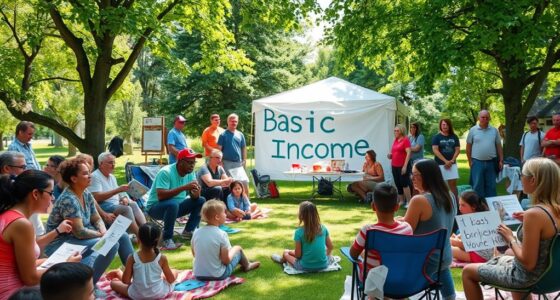
A city-wide UBI experiment shows that engaging community members from the start builds trust, boosts support, and guarantees the program meets local needs. You’ll see how flexible design and transparent communication lead to positive economic and social outcomes, like increased spending, better mental health, and stronger community bonds. Challenges like funding and sustainability highlight key lessons learned. If you’re curious about how these insights inform future policies, there’s much more to uncover.
Key Takeaways
- Community engagement and transparency are crucial for building trust and legitimacy in city-wide UBI pilots.
- Flexible payment structures and inclusive stakeholder participation enhance program effectiveness and acceptance.
- UBI pilots can boost local economic activity, entrepreneurship, and residents’ mental well-being.
- Challenges include limited scope, funding sustainability, and translating pilot results into lasting policy change.
- Blended funding models and early community involvement are best practices for scalable, impactful UBI initiatives.
UBI pilot program funding solutions
As an affiliate, we earn on qualifying purchases.
As an affiliate, we earn on qualifying purchases.
Background and Context of the City-Wide UBI Pilot

The background of the city-wide UBI pilot stems from growing concerns about economic insecurity and inequality within urban communities. As costs rise and social safety nets struggle to keep pace, many residents face unpredictable financial hardships. Cities recognize that traditional welfare systems sometimes fail to address the root causes of poverty or promote economic mobility. In response, local governments seek innovative approaches to support their populations more effectively. UBI offers a straightforward, unconditional financial cushion aimed at reducing hardship and fostering economic stability. This movement gained momentum through successful small-scale experiments, highlighting potential benefits like increased spending, entrepreneurship, and improved well-being. Additionally, implementing eco-friendly practices in community programs can enhance sustainability and public health outcomes. The goal is to explore whether such pilots can serve as scalable solutions to urban economic challenges, emphasizing fairness, inclusion, and community involvement.

Director of Community Engagement: Journal, Notes, Ideas, Actions, Priorities, Checklists, Log | Tool for Daily Goal Setting Tracker | Time Management … | Project Office Book Gifts for Meetings
As an affiliate, we earn on qualifying purchases.
As an affiliate, we earn on qualifying purchases.
Design and Implementation Strategies

You need to prioritize inclusive stakeholder engagement to make certain the pilot reflects community needs and gains broad support. Establishing a clear framework helps guide implementation, define goals, and set measurable outcomes. By combining these strategies, you create a solid foundation for a successful and sustainable city-wide UBI experiment. Incorporating beneficial ingredients such as collagen and hyaluronic acid can also enhance the process by promoting transparency and trust with the community.
Inclusive Stakeholder Engagement
How can involving diverse stakeholders from the outset guarantee a more effective and equitable UBI pilot? By engaging city officials, community members, nonprofits, funders, and researchers early, you ensure varied perspectives shape the design. This inclusivity builds trust, enhances legitimacy, and addresses community-specific needs. When stakeholders collaborate, you identify potential barriers, foster shared ownership, and improve transparency. Consider this table for deeper insight:
| Stakeholder Type | Key Contribution | Impact |
|---|---|---|
| City Officials | Policy alignment, resource support | Ensures scalability and sustainability |
| Community Members | Local insights, needs assessment | Promotes fairness and relevance |
| Nonprofits | Outreach, advocacy | Boosts participation and legitimacy |
| Funders | Funding, accountability | Secures resources and oversight |
| Researchers | Data collection, analysis | Guides evidence-based adjustments |
Engaging these groups from the start leads to a more resilient and just pilot. Additionally, fostering stakeholder collaboration early on can significantly improve the adaptability and responsiveness of the program throughout its implementation.
Clear Pilot Framework
Designing a clear pilot framework involves establishing strategic guidelines that guarantee effective implementation and meaningful evaluation. You should define specific, measurable objectives aligned with community needs and policy goals. Clarify who qualifies as recipients and ensure the selection process promotes fairness and inclusivity. Develop detailed protocols for distribution, data collection, and oversight, so all stakeholders understand their roles. Incorporate flexibility to adapt to unforeseen challenges while maintaining core principles. Engage community members early to build trust and legitimacy. Set clear benchmarks for success and methods to assess outcomes, balancing qualitative insights with quantitative data. Additionally, understanding relevant regulations and compliance ensures the pilot adheres to legal standards and mitigates potential risks. This structured approach guarantees your pilot remains focused, transparent, and capable of generating actionable insights for future scaling and policy refinement.

Weather-Resistant Aluminum Core Vocabulary Communication Board by Smarty Symbols – Lightweight, Easy to Clean, Inclusive AAC Support with Mounting Options for Autism & Inclusive Learning
- Core Vocabulary: 112 essential words for communication
- Versatile Use: Suitable for classrooms, hallways, therapy
- Durable Material: Made with high-quality, long-lasting materials
As an affiliate, we earn on qualifying purchases.
As an affiliate, we earn on qualifying purchases.
Economic Outcomes and Community Impact

What tangible economic changes do city-wide UBI experiments bring to communities? You often see increased local spending, as recipients invest in businesses and services. This boosts small enterprises and creates jobs, strengthening the economy. Many recipients use the income to cover basic needs, reducing financial stress and enabling risk-taking, such as starting new ventures. Here’s a closer look:
| Effect | Description |
|---|---|
| Increased Local Spending | UBI recipients buy more from local shops, stimulating growth. |
| Entrepreneurship | Funds enable new business startups and investments. |
| Financial Stability | Recipients better manage expenses, reducing reliance on debt. |
| Protect Your Savings | Implementing safeguards can help mitigate risks associated with financial initiatives. |
These outcomes foster stronger, more resilient communities, with economic activity flowing directly to residents.

Environmental Impact Assessment: A Practical Tool and Technique for Sustainable Development: EIA Tool and Technique: A Practitioner's Guide to … … Tools for Climate–Health Decision-Making)
As an affiliate, we earn on qualifying purchases.
As an affiliate, we earn on qualifying purchases.
Social Well-Being and Recipient Experiences

City-wide UBI experiments have demonstrated significant positive effects on social well-being and recipient experiences, often fostering feelings of security, dignity, and empowerment. You’ll notice recipients report reduced stress, especially around meeting basic needs like food and healthcare. Many feel more in control of their lives, which boosts their confidence and sense of self-worth. The unconditional nature of UBI removes stigma and provides a safety net that encourages risk-taking and personal growth. Community involvement in designing pilots enhances trust and inclusivity, making participants feel valued and heard. As a result, recipients often experience improved mental health and social cohesion, strengthening community bonds. Additionally, research indicates that integrating automation in service delivery can further improve efficiency and accessibility for recipients. Overall, UBI creates an environment where individuals feel respected, supported, and better equipped to navigate life’s challenges.
Stakeholder Engagement and Collaborative Processes

You need to prioritize inclusive planning strategies that engage diverse community members from the start. Building strong multi-stakeholder collaboration models guarantees that city officials, residents, and organizations work together effectively. Trust is essential, so fostering transparency and open communication helps create a sense of shared ownership and legitimacy in the process. Incorporating AI-powered virtual reality can further enhance stakeholder engagement by providing immersive visualizations of proposed initiatives.
Inclusive Planning Strategies
Effective inclusive planning strategies hinge on actively engaging diverse stakeholders throughout the design and implementation of UBI pilots. You should seek input from community members, local organizations, policymakers, and funders early in the process. This engagement guarantees the pilot reflects community needs, builds trust, and fosters shared ownership. Use participatory methods like town halls, focus groups, and advisory committees to gather feedback and co-develop goals. Transparency is critical—keep stakeholders informed about decisions and progress. Incorporate their insights into eligibility criteria, communication strategies, and evaluation metrics. This collaborative approach not only enhances the pilot’s legitimacy but also increases the chances of long-term success by aligning efforts with community priorities and fostering collective commitment. Additionally, understanding best practices in stakeholder engagement can significantly improve collaboration and outcomes.
Multi-Stakeholder Collaboration Models
Successful multi-stakeholder collaboration hinges on purposeful engagement and clear communication among all parties involved. You need to identify key stakeholders—city officials, researchers, community members, funders—and ensure they share common goals. Use inclusive processes to gather diverse perspectives, fostering trust and buy-in. Regular, transparent communication keeps everyone aligned and addresses concerns promptly. Collaborative frameworks like joint planning sessions and shared decision-making help balance interests and responsibilities. Establishing clear roles and expectations from the start prevents misunderstandings. You should also create feedback loops to adapt strategies based on ongoing input. Incorporating essential oils for communication can help reduce stress and improve clarity during meetings. Ultimately, strong collaboration accelerates learning, enhances legitimacy, and increases the likelihood of successful implementation and scale-up of the UBI pilot.
Building Community Trust
Building community trust is a fundamental step in implementing UBI pilots, as it guarantees residents feel confident that the program genuinely addresses their needs and respects their voices. To foster this trust, you should prioritize transparent communication, openly sharing goals, progress, and challenges. Engage community members early in the design process, actively listening to their concerns and incorporating their feedback. Collaborate with local organizations and advocacy groups to build legitimacy and ensure the pilot reflects diverse perspectives. When residents see their input shaping the program, they’re more likely to support and participate. Consistent updates, accountability measures, and inclusive decision-making create a sense of shared ownership, making the pilot more accepted and sustainable in the long run. Incorporating authentic decor elements that resonate with community culture can further strengthen trust and foster a sense of belonging.
Challenges, Critiques, and Limitations

While city-wide UBI experiments offer promising insights, they also face significant challenges and critiques that can hinder their broader adoption. You might worry that these pilots are too limited in scope, making it hard to predict large-scale impacts or sustainability. Critics argue they often operate within a neoliberal framework, which may simply tweak existing welfare systems instead of fundamentally transforming them. Funding remains a concern, especially when relying on philanthropy or external sources, raising questions about long-term viability. Additionally, some question whether short-term pilots can produce meaningful, lasting change or if results are only temporary. External influences and community perceptions can also complicate implementation, making it harder to achieve broad acceptance and policy integration. These limitations highlight the complexity of translating pilot successes into sustainable, scalable solutions.
Insights Gained and Lessons Learned

Cities experimenting with UBI have uncovered valuable insights that can guide future efforts. First, inclusive design and community involvement boost acceptance and legitimacy. Second, flexible payment structures—lump sums versus long-term guarantees—affect economic behaviors differently. Third, multi-stakeholder collaboration is essential for smooth implementation and meaningful data collection. Fourth, UBI can improve well-being, reduce stress, and foster dignity without discouraging employment. Fifth, funding sources influence scale and sustainability, highlighting the need for adaptable models. Here’s what we’ve learned:
| Insight | Impact | Best Practice |
|---|---|---|
| Community engagement | Builds trust and relevance | Involve locals early |
| Payment structure flexibility | Shapes economic behavior | Match structure to goals |
| Multi-stakeholder collaboration | Ensures effective execution | Foster partnerships |
| Well-being improvements | Enhances social cohesion | Prioritize mental health support |
| Funding strategies | Impact scalability | Blend philanthropy and public funds |
Implications for Future Policy and Scaling

To effectively scale UBI policies from pilot projects to broader implementation, policymakers must carefully consider funding mechanisms, stakeholder engagement, and community needs. You need sustainable funding sources, whether from government budgets or blended approaches, to guarantee long-term viability. Engaging local communities and diverse stakeholders early helps build trust and ensures policies address actual needs. Tailoring programs to specific community contexts increases acceptance and effectiveness.
- Develop clear funding strategies that combine public and private resources
- Foster inclusive stakeholder participation throughout planning and execution
- Prioritize community input to align policies with local realities
Frequently Asked Questions
How Did Community Members Influence the Pilot’s Design and Goals?
You influenced the pilot’s design and goals by actively participating in community discussions, sharing your needs, and advocating for fairness and inclusivity. Your input helped shape fair recipient selection, guarantee the pilot addressed real concerns, and fostered broader acceptance. By engaging with organizers and stakeholders, you contributed valuable insights that made the project more relevant, empowering, and aligned with local priorities, ultimately strengthening its legitimacy and community support.
What Measures Ensured Equitable and Inclusive Recipient Selection?
You can think of equitable and inclusive recipient selection as planting seeds in a diverse garden; careful criteria guarantee all voices are represented. By involving community members in decision-making and setting transparent guidelines, you create a mosaic of participants that reflect the neighborhood’s fabric. This approach fosters fairness, builds trust, and guarantees the pilot nurtures a thriving, representative ecosystem where everyone has a stake in its growth.
How Did External Funding Sources Impact the Project’s Long-Term Sustainability?
External funding sources substantially influence your project’s long-term sustainability. Philanthropic grants, like those in Stockton, can provide vital initial support but may lack the stability of public funding. Relying on government support, as Finland did, offers more sustainable resources. To facilitate lasting impact, you need to diversify funding streams, build community buy-in, and develop policies that can shift pilot programs into stable, publicly financed systems for ongoing success.
Were There Any Unintended Social or Economic Consequences Observed?
Have you ever considered how well-meaning programs can have unexpected ripple effects? Unintended consequences included increased community cohesion and empowerment, as residents felt more secure and included. Some reports suggest that recipients became more engaged in local initiatives, boosting social capital. However, concerns about dependency or resource diversion also emerged. Did these positive shifts outweigh potential drawbacks? It’s clear that UBI experiments can transform social dynamics in unpredictable ways.
How Do Pilot Results Inform Potential Policy Changes at Larger Scales?
You can use pilot results to shape larger-scale policies by analyzing their impacts on economic stability, employment, and well-being. Successful pilots demonstrate that UBI boosts local economies, reduces stress, and encourages entrepreneurship, which policymakers can incorporate into broader programs. Additionally, insights from community engagement and stakeholder collaboration help refine scalable models, ensuring they’re equitable and effective. These findings support shifting pilots into sustainable, nationally-supported welfare systems that address diverse community needs.
Conclusion
Just like a spark ignites a flame, this city-wide UBI experiment lit the way for new possibilities in social policy. You’ve seen how thoughtful design, community involvement, and honest reflection can turn challenges into valuable lessons. As you consider future steps, remember that each trial, no matter how small, adds to the bigger picture of building a more equitable society. Embrace these insights, and let them fuel your journey toward meaningful change.