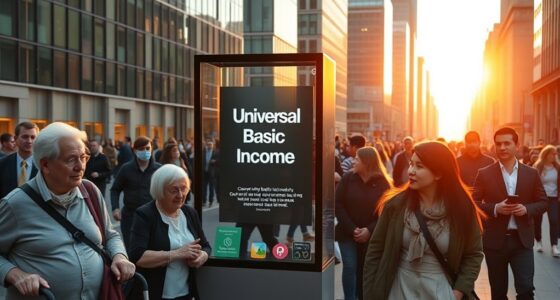
Basic income provides unconditional cash payments to everyone, promoting simplicity and universality, while traditional welfare targets specific groups based on need or circumstance, often with strict requirements. Welfare systems tend to be more complex, requiring eligibility checks and bureaucracy, whereas UBI offers faster, easier support. If you want to understand how these approaches impact society, work incentives, and support fairness, there’s much more to explore below.
Key Takeaways
- Basic Income provides unconditional, universal cash payments to all citizens, while traditional welfare is targeted and means-tested.
- UBI simplifies administration, reducing bureaucracy, whereas welfare involves complex eligibility verification and paperwork.
- Welfare programs often conditional, aiming to support vulnerable groups; UBI offers unconditional support promoting dignity and social cohesion.
- UBI can quickly scale during crises, whereas welfare systems are slower due to administrative procedures.
- Welfare emphasizes targeted aid for specific needs; UBI aims to reduce inequality universally through equal cash transfers.
universal basic income calculator
As an affiliate, we earn on qualifying purchases.
As an affiliate, we earn on qualifying purchases.
Fundamental Principles and Definitions

Understanding the fundamental principles and definitions of Basic Income and traditional welfare is essential to grasp how these systems function. Basic Income, or UBI, provides a regular, unconditional cash payment to everyone, regardless of income, employment, or personal circumstances. It’s designed to offer financial security universally, without requiring recipients to meet specific criteria. In contrast, traditional welfare programs target aid based on need, with eligibility tied to income, disability, family status, or work capacity. Welfare often involves complex administrative processes to verify eligibility and deliver services like housing, food, or training. While both systems aim to reduce poverty and redistribute wealth, UBI emphasizes simplicity and equality, whereas welfare focuses on supporting vulnerable groups with targeted assistance. Additionally, the high administrative costs associated with welfare programs can be reduced through the implementation of universal basic income systems.
welfare eligibility verification forms
As an affiliate, we earn on qualifying purchases.
As an affiliate, we earn on qualifying purchases.
Philosophical Approaches and Social Goals

Philosophical approaches to Basic Income and traditional welfare reflect fundamentally different values about society’s priorities. With UBI, you’re encouraged to see economic security as a universal right, emphasizing dignity, freedom, and individual choice. It promotes a society where everyone can pursue opportunities without stigma or conditionality. Conversely, welfare’s philosophy centers on targeted support, aiming to assist the most vulnerable and encourage accountability through work or training requirements. Welfare seeks to address specific risks like unemployment or disability, focusing resources on those in greatest need. These differing philosophies influence social goals: UBI aims to foster independence and reduce social inequality universally, while welfare focuses on social protection, risk mitigation, and ensuring aid reaches those who need it most.
digital literacy for financial support
As an affiliate, we earn on qualifying purchases.
As an affiliate, we earn on qualifying purchases.
Funding and Economic Implications

Funding a basic income requires significant sources, often through increased taxes or reallocating existing budgets, which can impact the economy. Welfare programs tend to have lower costs per recipient but rely on targeted funding through specific channels. The choice of taxation and redistribution methods shapes the overall fiscal impact and influences economic stability and growth. Additionally, understanding digital literacy is crucial for fostering responsible technology use in modern society.
Funding Sources and Methods
Providing universal cash payments through basic income requires substantial financial resources, which come from various funding sources. You might fund UBI through increased taxes, such as higher income or consumption taxes, or through reallocation of existing government budgets. Some proposals suggest implementing wealth taxes on assets or financial transactions to generate revenue. Others consider diverting funds from current welfare programs or reducing administrative costs due to UBI’s simplicity. In some cases, governments explore innovative sources like sovereign wealth funds or resource taxes. The key is balancing these revenue streams with economic stability, ensuring that funding methods don’t hinder growth or create undue burdens. Additionally, implementing jeep tuning techniques to optimize fiscal policies could enhance revenue collection and allocation. Ultimately, securing sustainable funding remains a central challenge for implementing and maintaining a universal basic income system.
Fiscal Impact and Costs
Implementing a universal basic income involves significant fiscal considerations because it requires large-scale and sustained funding sources. You’ll need to plan for substantial budget allocations, often through increased taxes or reallocated government spending. UBI’s universal nature means everyone receives payments, which can lead to higher overall costs compared to targeted welfare programs. While welfare benefits are concentrated on vulnerable groups, UBI spreads resources broadly, potentially raising total expenditure. To sustain UBI, you might face challenges in balancing fiscal discipline with the need for ongoing funding. Additionally, implementing UBI could prompt broader economic shifts, such as changes in work incentives and consumer spending, which also influence its overall fiscal impact. Managing these costs is vital to ensure long-term financial feasibility, especially when considering the costs associated with toilet flushing, which illustrate how resource consumption can impact budgets on a larger scale.
Taxation and Redistribution
To sustain a universal basic income, governments must navigate the complex terrain of taxation and wealth redistribution. Funding UBI often means increasing taxes or reallocating resources, which can impact economic growth and public acceptance. Unlike targeted welfare, UBI requires broad-based revenue streams, typically through progressive taxes. Here’s a quick comparison:
| Aspect | Welfare Programs | Universal Basic Income |
|---|---|---|
| Funding Methods | Means-tested taxes, social insurance | Broad-based progressive taxes |
| Redistribution Focus | Targeted support for vulnerable groups | Equal payments to all citizens |
| Tax Impact | Potential work disincentives | Minimal, due to unconditional payments |
| Economic Effect | Concentrated on poverty alleviation | Aims for universal economic stability |
Additionally, ensuring sustainable funding often involves addressing taxation policies and their broader economic implications.
As an affiliate, we earn on qualifying purchases.
Impact on Poverty and Income Distribution

The impact of Basic Income and traditional welfare on poverty and income distribution hinges on their design and targeting. With UBI, everyone receives a regular cash payment, which can lift people out of poverty broadly. Welfare programs direct resources to the most vulnerable, often leading to more efficient poverty alleviation. Incorporating caloric intake considerations ensures that recipients can sustain their health and energy levels. Consider these points:
- UBI can reduce overall poverty by about 25%, especially benefiting children.
- Welfare tends to deliver more targeted support, improving outcomes for the poorest.
- Funding UBI requires higher taxes, potentially affecting income inequality differently.
- Welfare’s conditional benefits may discourage work, while UBI’s unconditional nature avoids this issue.
Both systems shape income distribution uniquely, but their effectiveness depends on implementation and context.
Effects on Work Incentives and Labor Markets

Basic Income and traditional welfare influence work incentives in fundamentally different ways. With UBI, you might feel freer to work less or pursue training, since your income isn’t tied to employment, potentially encouraging entrepreneurship or innovation. It reduces the fear of losing support if you take risks or reduce hours. Conversely, welfare programs often condition benefits on employment or participation in training, creating a direct link between work effort and support. This can motivate you to find and keep jobs but may also discourage taking risks or working fewer hours due to benefit phase-outs or penalties. Welfare’s conditionality might pressure you into employment, while UBI offers more flexibility, possibly leading to shifts in labor supply, hours worked, and career choices. Additionally, the implementation of AI-driven data analytics in welfare systems raises important ethical considerations regarding privacy concerns and the need for transparent decision-making processes.
Social Well-Being and Community Dynamics

You might notice that basic income can strengthen community bonds by everyone sharing in the same support system, reducing social divides. In contrast, traditional welfare often creates distinctions between aid recipients and others, which can impact social cohesion. Ultimately, how these programs influence collective well-being depends on how they shape social inequalities and community interactions. Additionally, the perception of fairness and accessibility of these programs can further influence social well-being and community trust.
Community Cohesion Effects
Community cohesion and social well-being are deeply influenced by how welfare and basic income systems shape interactions and trust within neighborhoods. With UBI, you might see stronger social bonds, as everyone receives support, reducing stigma and encouraging shared experiences. Conversely, traditional welfare’s targeted approach can foster feelings of exclusion or resentment among those who don’t qualify.
Consider:
- Increased social trust when aid is universal and unconditional
- Reduced stigma and social division with UBI
- Potential for stronger community ties through shared economic security
- Risks of fragmentation if targeted welfare creates perceived inequalities
- The role of sound design techniques in shaping perceptions of fairness and inclusion through auditory cues in community settings.
Your community’s social fabric depends on how these systems influence perceptions of fairness and inclusion, shaping neighborhood dynamics in subtle but powerful ways.
Social Inequality Reduction
Social inequality can be markedly reduced through the implementation of unconditional cash transfer systems like Universal Basic Income (UBI), which provide everyone with a steady income regardless of their circumstances. By offering equal financial support, UBI helps bridge income gaps and diminishes disparities that often reinforce social divisions. It promotes economic fairness by ensuring all individuals can meet basic needs, reducing poverty and social exclusion. Unlike targeted welfare, UBI removes stigma, fostering a sense of community and shared dignity. This universal approach encourages social cohesion, as everyone benefits from the same safety net. As a result, social mobility improves, and communities become more resilient, with reduced resentment or tension stemming from inequality. Overall, UBI aims to create a more equitable society where opportunities are accessible to all. social inequality reduction
Collective Well-Being Impact
Universal Basic Income (UBI) can markedly influence collective well-being by shaping social interactions and community resilience. It fosters a sense of shared support, reducing social divides and promoting inclusivity. With UBI, you might see:
- Increased social cohesion as people feel less marginalized.
- Enhanced community engagement through reduced financial stress.
- Greater social trust, as unconditional support diminishes stigma.
- Improved mental health, strengthening overall societal stability.
Because UBI provides everyone with a safety net, communities often become more resilient to economic shocks. This universal approach encourages collaboration and reduces social tensions rooted in inequality. When people have reliable income, they’re more likely to participate actively in community life, fostering a healthier, more connected society.
Administrative Complexity and Delivery Systems

Managing the delivery of welfare programs involves complex administrative processes that require extensive infrastructure to verify eligibility, enforce conditions, and coordinate services. You need systems for income assessment, documentation, and compliance checks, which can be costly and time-consuming. In contrast, UBI simplifies this by providing unconditional cash to everyone, eliminating the need for verification.
| Aspect | Welfare Systems | UBI Systems |
|---|---|---|
| Eligibility Checks | Extensive, requiring documentation and audits | None, universal for all |
| Administrative Cost | High, due to targeted assessments | Low, due to simplicity |
| Delivery Infrastructure | Complex, involving multiple agencies | Minimal, straightforward cash transfer |
Targeting vs. Universality in Support

You need to contemplate how inclusive and far-reaching each approach is—UBI provides support to everyone, while traditional welfare targets only those in need. Efficiency and precision also matter, as targeted programs often deliver more aid at lower costs but risk missing some vulnerable groups. Balancing these factors can determine which system best promotes fairness and effectiveness in social support.
Inclusivity and Reach
The debate over inclusivity and reach in social support systems centers on whether aid should be targeted at specific vulnerable groups or distributed universally to all citizens. You’re faced with a choice: should support focus on those most in need or be available to everyone?
- Universal programs promote equality by providing all citizens with the same support.
- Targeted aid directs resources specifically to the most vulnerable, reducing waste.
- Universal schemes reduce stigma, making assistance feel like a right rather than charity.
- Targeting risks excluding those who fall through the cracks, even with strict eligibility criteria.
Both approaches shape social perceptions and political support, but your decision impacts who benefits and how broadly social safety nets reach.
Efficiency and Precision
When evaluating social support systems, the focus often shifts to how effectively they allocate resources to those who need them most. Targeted welfare programs aim for precision, directing funds specifically to vulnerable groups. This approach can maximize the impact of each dollar spent, reducing waste and ensuring support reaches those in greatest need. However, it requires complex administration, extensive verification, and can sometimes exclude deserving individuals due to imperfect targeting. In contrast, a universal basic income offers efficiency through simplicity. By removing eligibility checks, it minimizes bureaucracy and administrative costs. Yet, universal support is less precise, providing benefits to all—even those who may not need them. Balancing efficiency and precision involves weighing administrative ease against the risk of resource misallocation.
Adaptability to Changing Economic Conditions

Adaptability to changing economic conditions is essential for social support systems, especially as automation, technological shifts, and global market fluctuations reshape job markets. You need flexible solutions that can respond quickly to disruptions.
- Basic Income offers universal payments, providing immediate income stability regardless of employment status.
- Welfare programs can adapt through targeted adjustments, like expanding eligibility or benefits during downturns.
- UBI’s simplicity allows for rapid scaling without complex eligibility criteria, making it more responsive.
- Traditional welfare systems often require bureaucratic changes, which slow down response times during crises.
Cultural and Political Perspectives

Cultural and political perspectives heavily influence how societies view and implement Basic Income and traditional welfare systems. If your society values individual responsibility and work ethic, you might see welfare as a way to incentivize productivity, while UBI could be viewed as encouraging dependency. Conversely, cultures emphasizing social equality and collectivism may favor UBI for its universality and dignity. Politically, conservative factions often support targeted welfare to control costs and promote self-reliance, whereas progressive groups may champion UBI to reduce inequality and simplify aid. Public acceptance depends on these attitudes, shaping policy choices and funding priorities. Ultimately, your society’s history, values, and political climate determine whether a universal or targeted approach aligns best with its social goals.
Frequently Asked Questions
How Do Basic Income and Welfare Differ in Eligibility Requirements?
You’ll find that basic income requires no eligibility checks; everyone receives it regardless of income, employment, or personal circumstances. In contrast, welfare programs set specific criteria, such as low income, disability, or caregiving responsibilities, to determine who qualifies. Welfare often involves detailed assessments and paperwork, while basic income is universal and unconditional, simplifying access and removing barriers that might exclude certain groups from aid.
What Are the Main Funding Sources for UBI Compared to Welfare Programs?
You fund UBI mainly through broad-based taxes like income, consumption, or wealth taxes, which are applied universally to all citizens. In contrast, welfare programs are typically financed with targeted funding, such as social insurance contributions, specific taxes, or government allocations focused on supporting vulnerable groups. UBI requires larger, often more complex tax reforms, while welfare benefits come from established, often dedicated, funding streams.
How Does Each System Affect Economic Inequality and Social Mobility?
You’ll find that UBI can reduce economic inequality by providing everyone with a basic income, helping those at the bottom climb the social ladder. Welfare programs target the most vulnerable, offering tailored support that can improve their chances of upward mobility. While UBI promotes equality across society, welfare can create pathways out of poverty by addressing specific barriers, ultimately fostering social mobility for those who need it most.
What Are Potential Long-Term Impacts of UBI on Innovation and Entrepreneurship?
Imagine UBI as a fertile soil, nurturing seeds of innovation and entrepreneurship. With financial safety nets in place, you feel freer to take risks, experiment, and pursue bold ideas without fear of falling into financial ruin. Over time, this environment sparks a wildfire of creativity and new ventures, transforming the economic landscape. UBI’s steady support could turn your innovative sparks into lasting flames of progress and economic dynamism.
How Do Cultural Values Influence Acceptance of Basic Income Versus Traditional Welfare?
Your cultural values greatly influence how you accept basic income versus traditional welfare. If your society values individualism and personal responsibility, you might favor UBI for promoting freedom and reducing stigma. Conversely, if your culture emphasizes community support and targeted aid, traditional welfare will resonate more. Your attitudes toward work, social safety nets, and equality shape whether you see these systems as complementary or conflicting, affecting overall acceptance.
Conclusion
If you’re considering the differences between basic income and traditional welfare, you’ll see that basic income offers universal support, potentially reducing poverty by up to 40%, while traditional welfare targets specific groups. Understanding these models helps you grasp how policies shape social equity and work incentives. As economies evolve, knowing which approach aligns with your values and goals becomes vital—because your support system can transform how society cares for its members.