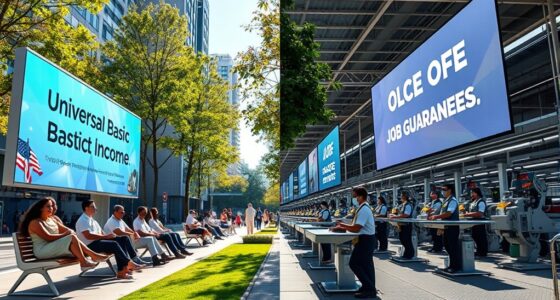
Universal Basic Income can sometimes reduce paid work hours for vulnerable groups, but evidence shows it often improves overall well-being and empowers you to pursue better jobs or training. It may encourage you to focus more on unpaid caregiving, education, or entrepreneurship, rather than discourage employment altogether. The impact depends on how the program’s benefits and taxes are structured. To understand the nuances and real-world examples, keep exploring how UBI influences work incentives in different contexts.

Get business pricing on tech for your team
- Business-only prices and quantity discounts
- Tax-exempt purchasing
- Multiple users, one account, clear invoices
Key Takeaways
- Overall impact of UBI on employment is minimal or mixed, with some experiments showing no significant decline.
- Well-designed UBI systems with gradual benefit withdrawal can support work incentives rather than discourage employment.
- UBI can empower workers to refuse poor conditions and pursue skill development, potentially increasing labor market engagement.
- High benefit withdrawal rates or taxes on additional earnings may reduce motivation to work extra hours.
- UBI’s effects vary by demographic groups; some may focus on unpaid care or training, while others maintain or increase employment.
Universal Basic Income calculator
As an affiliate, we earn on qualifying purchases.
As an affiliate, we earn on qualifying purchases.
Examining Employment Trends in UBI Experiments

Examining employment trends in UBI experiments reveals that, overall, the impact on labor market participation tends to be minimal or mixed. You’ll notice that many studies show little to no change in employment levels among recipients. For example, the Finnish UBI trial found no significant difference in employment, even though participants reported higher well-being. Conversely, in Stockton, California, full-time employment increased, likely because recipients had more time for job searching or upskilling. Alaska’s Permanent Fund Dividend didn’t affect overall employment but slightly reduced part-time work for some groups. In low- and middle-income countries, labor supply often drops more noticeably, especially among caregivers or casual workers. These mixed results suggest UBI’s influence on employment isn’t straightforward, varying by context, population, and design. Additionally, the principles of iterative processes and continuous improvement in program implementation may influence how outcomes evolve over time.
As an affiliate, we earn on qualifying purchases.
How UBI Alters Work Incentives and Disincentives

Universal Basic Income (UBI) can considerably influence work incentives by altering how much you’re willing to work as your earnings and benefits change. If UBI is designed so that it isn’t withdrawn as you earn more, you might find it easier to increase your income without losing support, encouraging work and skill development. However, if UBI is set high enough to cover basic needs, some may reduce their paid hours, especially in vulnerable groups like caregivers or the elderly. The way UBI is financed also matters—higher taxes could discourage work, while simpler, unconditional payments might improve motivation. Overall, UBI’s effect on work incentives depends on its level, structure, and how it interacts with existing benefits, shaping your choices and economic behavior. Additionally, the impact of UBI on work motivation can be influenced by individual perceptions of personality traits and how they respond to new economic policies.
As an affiliate, we earn on qualifying purchases.
The Role of Benefit Withdrawal Rates and Tax Structures

Your work incentives depend heavily on how benefits are withdrawn as earnings increase and how the tax system is structured. If withdrawal rates are too high, you might feel discouraged from working more, while a well-designed structure can motivate you to earn without losing too much support. Understanding these mechanics is key to creating policies that balance assistance with encouraging work.
Impact of Withdrawal Rates
Benefit withdrawal rates and tax structures play a crucial role in shaping work incentives under a UBI system. If benefits are withdrawn quickly as you earn more, you might feel discouraged from increasing your work hours because the additional income isn’t worth the effort. Conversely, if withdrawal rates are low, you keep more of each extra dollar earned, encouraging you to work more or invest in skills. The design of taxes and how they interact with UBI also matters; high taxes on additional earnings can offset the benefits of higher income, reducing motivation. A well-structured system minimizes disincentives by gradually phasing out benefits and ensuring you retain a fair share of extra earnings, fostering a stronger incentive to work more while still providing security. Understanding bank swiftifs codes can be useful when transferring funds securely in such systems.
Effect of Tax Design
The way taxes are structured and how benefits are withdrawn considerably influence work incentives under a UBI system. If benefits decrease sharply as you earn more, it creates a high withdrawal rate, which can discourage additional work. Conversely, gradual benefit reductions encourage earning extra income without losing too much support. A well-designed tax structure balances funding needs with maintaining work incentives. Additionally, understanding emotional support strategies can help individuals better cope with the stress of financial transitions related to policy changes.
Incentive Changes From Structure
How benefits are withdrawn and how taxes are structured considerably influence work incentives under a UBI system. If benefits decrease slowly as earnings rise, you might feel encouraged to work more without losing much support. Conversely, high withdrawal or tax rates can create disincentives. Key factors include:
- Withdrawal rates: Lower rates promote increased work effort by preserving more of each additional dollar earned.
- Tax structures: Progressive taxes can reduce net gains from working, impacting motivation.
- Unconditional vs. means-tested UBI: Universal payments minimize disincentives compared to targeted programs with high clawback rates.
- Benefit phase-out: Gradual reductions support work incentives, while abrupt cutoffs discourage earning more.
- Funding mechanisms: Higher taxes to sustain UBI may reduce labor supply if they considerably diminish net income gains.
- An understanding of benefit withdrawal rates is crucial, as they directly influence the extent to which additional work pays off financially.
financial planning for UBI recipients
As an affiliate, we earn on qualifying purchases.
As an affiliate, we earn on qualifying purchases.
Impact of UBI on Different Demographic Groups

You’ll find that caregivers and single mothers often reduce their paid work hours when UBI is introduced, shifting focus to caregiving or training. Youth and low-skilled workers might spend more time on education or skill development, which can benefit their long-term employment prospects. Understanding how these groups respond helps clarify UBI’s broader impact on work incentives across society. Additionally, the adoption of automation technologies in various industries may influence employment patterns and individuals’ decisions to participate in the workforce.
Caregivers and Single Mothers
UBI often has a pronounced impact on caregivers and single mothers, as it can provide financial stability that reduces their reliance on complex welfare systems. With a guaranteed income, you might find more freedom to balance work and caregiving responsibilities. It can encourage you to pursue education or training without the immediate pressure to earn. However, some studies show that single mothers and caregivers may reduce paid work hours, shifting focus to unpaid care or skill development. This shift can be beneficial, but it might also limit income if not carefully designed. Additionally, the type of income support provided through UBI influences whether recipients are motivated to seek employment or focus on other activities.
Youth and Low-Skilled Workers
For youth and low-skilled workers, receiving a universal basic income can provide crucial financial stability that enables you to invest in education, training, or job search efforts. With this support, you might be more willing to pursue higher qualifications or switch to better-paying jobs, improving long-term prospects. UBI can reduce the urgency to accept low-quality, insecure work, allowing you to focus on skill development. Some studies suggest that UBI encourages young people to spend more time in training or education, which can boost future employability. Although concerns exist that UBI might discourage work, evidence indicates that many low-skilled workers use the financial cushion to seek more stable employment or improve their skills. Additionally, providing a safety net through guaranteed minimum returns can help mitigate risks associated with fluctuating market conditions, further supporting their career development. Overall, UBI can empower youth and low-skilled workers to build a stronger foundation for their careers.
Shifting Time From Paid Employment to Caregiving and Education

When financial security from a Universal Basic Income (UBI) is introduced, many individuals choose to reallocate their time away from paid employment toward caregiving and education. This shift often reflects a desire to invest in family, personal development, or community involvement. You might find yourself prioritizing:
- Providing more consistent care for children or elderly relatives
- Enrolling in skill-building courses or further education
- Volunteering or participating in community projects
- Engaging in personal health or wellness activities
- Supporting loved ones through emotional or practical assistance
These choices can lead to meaningful social and personal benefits, even if they reduce paid work hours. Such reallocations often align with values of social contribution and personal fulfillment, highlighting a shift from earning to caring and learning as central life priorities. Additionally, embracing mindfulness practices can enhance emotional well-being during this transition.
UBI’s Influence on Labor Supply in Low-Income Countries

In low-income countries, UBI often leads to reductions in casual employment and shifts toward caregiving or training activities. These changes can improve income security but may also decrease overall labor supply, especially among vulnerable groups. Understanding how these dynamics influence work incentives is essential for designing effective UBI programs in these contexts.
Reduced Casual Employment Rates
UBI tends to have a more pronounced impact on casual employment in low-income countries, where informal and precarious jobs dominate the labor market. When you receive a basic income, you might feel less compelled to accept low-paying, insecure work just to meet basic needs. This can lead to a reduction in casual employment rates, especially among vulnerable groups. Additionally, the shift toward more stable employment may influence labor market dynamics, encouraging a focus on quality over quantity.
- Increased financial security reduces reliance on irregular jobs
- Workers shift toward more stable, formal employment or training
- Casual workers may opt out of risky or unstable roles
- Informal sector activity declines as income support diminishes urgency
- Overall, UBI can promote better job quality and long-term employment stability
Caregiving and Training Shifts
How does providing a basic income influence the choices around caregiving and training in low-income countries? UBI can encourage shifts toward unpaid caregiving, especially for children, elderly, or disabled family members, by offering financial stability that reduces the need for paid work. This may lead individuals, particularly women, to allocate more time to caregiving activities or community support roles. Additionally, with a reliable income, people might prioritize training or education to improve long-term prospects, rather than immediate income generation. UBI’s flexibility allows recipients to balance family responsibilities with skill development, potentially increasing human capital. However, these shifts could decrease participation in formal employment, especially in casual or low-paid sectors, as individuals focus on caregiving and self-improvement instead.
Income Security and Work
Providing a basic income can substantially shape labor supply decisions in low-income countries by offering greater income security. When people know their basic needs are covered, they may choose to work less or shift toward activities like caregiving, education, or community work. This can lead to:
- Reduced pressure to accept low-paying, insecure jobs
- Increased time for skill development and training
- Greater motivation to seek better employment opportunities
- Shifts toward unpaid or informal work
- Potential for entrepreneurship and risk-taking
However, the impact varies depending on the level of UBI and local economic conditions. While some individuals reduce their work hours, others may increase productivity or invest in social activities, ultimately shaping labor markets differently across contexts.
Broader Effects on the Labor Market and Worker Bargaining Power

The introduction of a universal basic income can considerably reshape the dynamics of the labor market by altering workers’ bargaining power. With a steady income floor, you may feel less desperation to accept poor conditions or low wages, giving you leverage to negotiate better pay and benefits. Employers might need to improve job quality to attract and retain workers, potentially raising standards across industries. UBI can also encourage entrepreneurship and risk-taking, as you gain financial security to pursue new ventures or switch careers. In gig or insecure jobs, UBI offers stability, reducing churn and empowering you to demand fairer treatment. Overall, UBI shifts power dynamics, making workers less dependent on employers and more capable of shaping their work conditions and opportunities.
Evidence From Real-World UBI Programs and Pilots

Real-world UBI programs and pilots offer valuable insights into how unconditional cash transfers influence work behavior and social outcomes. These initiatives reveal varied responses depending on context, design, and population. For example:
- The Finnish experiment (2017–2018) showed no significant change in employment but improved well-being.
- Stockton’s pilot (2019–2021) increased full-time employment by freeing time for job searching and upskilling.
- Alaska’s Permanent Fund Dividend had little impact on overall employment but modestly reduced part-time work for some groups.
- Low- and middle-income country studies often report larger labor reductions, especially among caregivers.
- Variations in outcomes highlight how subgroup characteristics, cultural factors, and program design shape labor responses.
These findings suggest that real-world UBI effects on work are complex and context-dependent, often balancing employment impacts with social benefits.
Well-Being and Motivation: Beyond Employment Statistics

While employment levels are a key measure of UBI’s impact, focusing solely on job statistics overlooks significant improvements in well-being and motivation. UBI often leads to better mental health, reduced stress, and increased life satisfaction. Recipients report feeling less anxious about finances and more autonomous, which can boost motivation for personal development or community involvement. These emotional benefits may encourage behaviors like volunteering, caregiving, or pursuing education—activities that aren’t reflected in traditional employment metrics. Additionally, a sense of financial security can foster a positive outlook and resilience, fostering long-term motivation beyond mere job count. Recognizing these broader effects helps you see UBI’s value in enhancing overall life quality, not just employment statistics. This holistic view underscores that well-being and motivation are essential facets of UBI’s societal impact.
Balancing Poverty Reduction With Work Engagement Goals

Achieving a balance between reducing poverty and maintaining work engagement requires careful design of UBI policies. You need to guarantee that benefits lift people out of hardship without discouraging work. Thoughtful policies can promote employment while providing a safety net. Consider these approaches:
- Adjust UBI levels to support basic needs without fully replacing income from work.
- Implement gradual benefit withdrawal to avoid abrupt disincentives.
- Combine UBI with targeted support for job training and education.
- Design tax structures that reward work and minimize high marginal rates.
- Use conditional incentives that encourage employment and skill development.
Frequently Asked Questions
How Does UBI Impact Long-Term Career Development and Skill Acquisition?
UBI can positively impact your long-term career development and skill acquisition by providing financial stability, so you’re not forced to settle for low-paying jobs. With this security, you may take time to pursue education, training, or entrepreneurship, enhancing your skills. It also encourages risk-taking and career shifts, allowing you to focus on growth rather than just immediate income, ultimately supporting better job prospects and personal development.
Can UBI Reduce Labor Market Inequality Among Different Socioeconomic Groups?
Imagine a single mother in a low-income neighborhood who receives UBI. This support can help her cover basic needs, reducing financial stress and empowering her to pursue better job training or education. By providing a safety net, UBI narrows income gaps and offers more opportunities for marginalized groups to improve their socioeconomic status. Ultimately, UBI can promote greater economic equality by offering consistent support across different social and economic backgrounds.
What Are the Environmental Implications of Increased Leisure or Reduced Work Hours?
If UBI leads to more leisure or fewer work hours, you might see environmental benefits like reduced pollution and energy consumption, as fewer people commute and use resources for work-related activities. Less industrial activity from decreased work hours could lower carbon emissions and waste. However, increased leisure might also mean more travel or consumption in other areas, so the overall environmental impact depends on how people choose to spend their free time.
How Does Cultural Context Influence Ubi’s Effect on Work Incentives?
Cultural context shapes how you respond to UBI’s impact on work incentives. In societies valuing independence and entrepreneurship, you might see increased motivation to work, innovate, or pursue education. Conversely, in cultures emphasizing community or social support, you may feel less pressure to work constantly, leading to shifts toward caregiving or volunteering. Your cultural norms influence whether UBI encourages work, leisure, or social activities, affecting overall labor market behavior.
Are There Potential Negative Consequences of UBI on Innovation and Productivity?
UBI can sometimes reduce motivation for innovation and productivity if individuals feel financially secure enough to avoid risk-taking or pursuing ambitious projects. When people don’t need to work as hard or take risks, they might focus less on developing new ideas or improving skills. However, UBI can also encourage creativity by providing stability, enabling you to explore entrepreneurship or longer-term ventures without the pressure of immediate income, which can boost innovation.
Conclusion
While UBI aims to provide a safety net, it subtly encourages you to consider new paths beyond traditional work. It’s not about discouragement but about opening doors to different pursuits and priorities. As you explore these programs, remember they’re designed to complement your efforts, not replace them. With thoughtful policies, you can find a balance that enriches your life, gently guiding you toward fulfillment without the pressure of conventional employment.
Halloween Picks
halloween
As an affiliate, we earn on qualifying purchases.