
As automation, AI, and robotics accelerate, the very notion of “work” is under radical scrutiny. Post-labor economics explores what happens when traditional jobs fade and societies must redefine value, identity, and purpose. Here’s a survey of ten thinkers whose research and vision are shaping this emerging field.
- David Shapiro
Independent researcher and futurist, Shapiro’s open-source “PostLaborEconomics” GitHub repository maps scenarios for a world beyond work. He pioneers the “hyperabundance thesis,” arguing that AI-driven abundance could collapse scarcity economics—and with it, the need for labor-based income.
- Thorsten Meyer
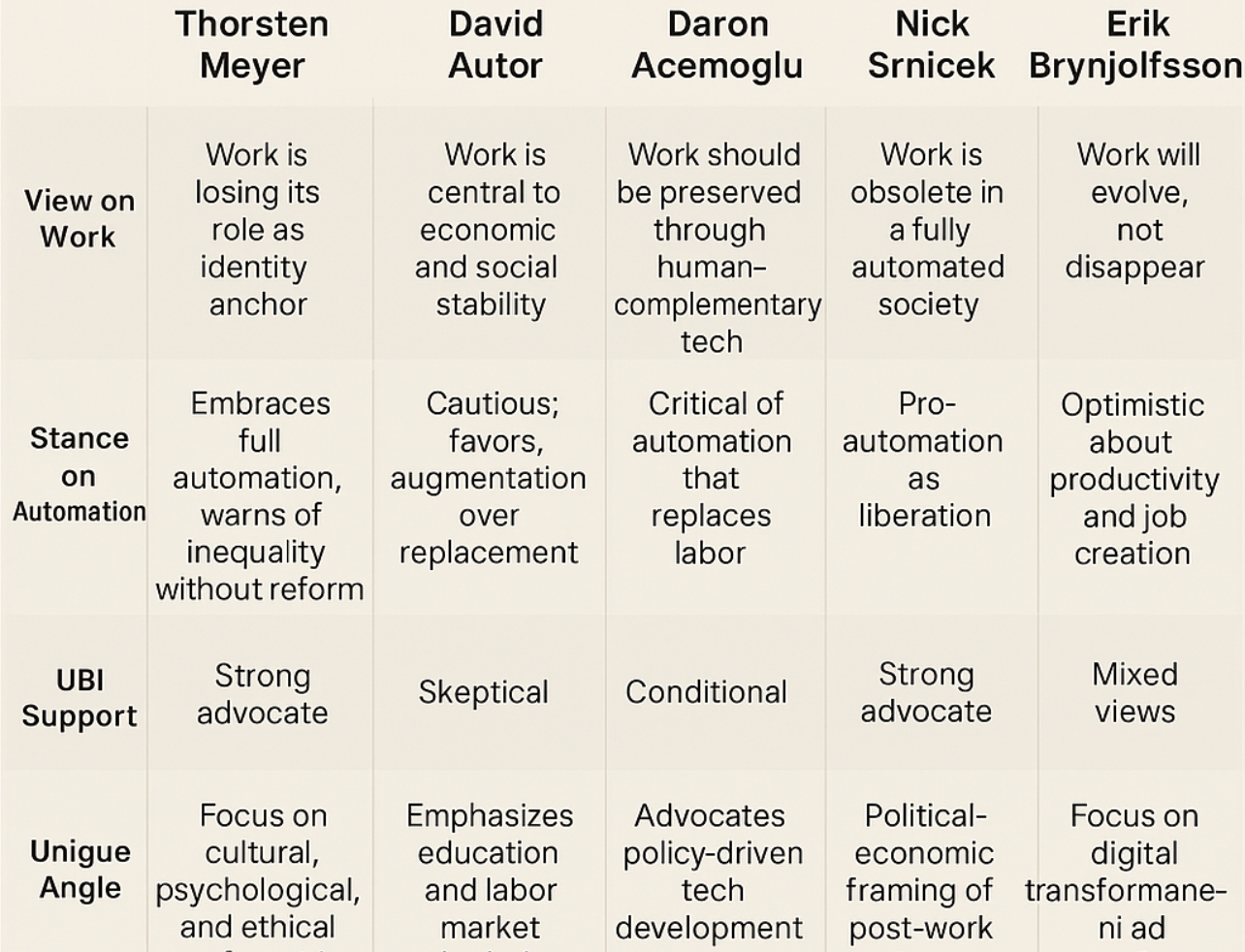
Founder of Thorsten Meyer AI and author of The AI Bifurcation, Meyer blends economics, psychology, and ethics. He contends that decoupling identity from employment is vital, and advocates democratized ownership of automation (via co-ops or UBI) to prevent extreme inequality.
- David Autor
An MIT labor economist famous for documenting job polarization. Autor warns that middle-skill roles vanish under automation but sees upskilling and lifelong learning as buffers—arguing that education policy is the frontline defense against displacement.
- Erik Brynjolfsson
Stanford professor and co-author of The Second Machine Age. He spotlights the productivity surge from digital tech and its potential to create new job categories. Brynjolfsson is optimistic but presses for policies that ensure productivity gains translate into broad-based prosperity.
- Carl Benedikt Frey
At Oxford’s Future of Work program, Frey uses econometric models to forecast which occupations face extinction. His landmark studies quantify automation risk across industries, supplying governments and firms with data to guide reskilling strategies.
- Daron Acemoglu
MIT economist who champions “human-complementary” technologies—tools that augment rather than replace people. He critiques “automation for automation’s sake” and proposes industrial policies that favor tech enhancing human labor.
- Nick Srnicek
Co-author (with Alex Williams) of Inventing the Future, Srnicek argues for full automation and UBI as liberatory forces. His political-economic lens sees post-work society as an achievable horizon, contingent on organized labor and left-wing alliances.
- Aaron Bastani
Author of Fully Automated Luxury Communism, Bastani paints a utopia of abundance enabled by renewable energy, advanced robotics, and AI. He frames post-labor economics within climate justice, linking automation with sustainable, shared prosperity.
- Zachary Stein
Philosopher and educator focused on the psychological impacts of a post-work world. Stein explores how learning, creativity, and play become central to human flourishing when labor ceases to define worth or schedule.
- Marina Gorbis
As Executive Director of the Institute for the Future, Gorbis examines emerging social and economic structures. Her work highlights community networks, peer-to-peer value exchange, and new metrics beyond GDP to capture lived well-being.
| Economist | Tech Stance | UBI Position | Core Focus |
| David Shapiro | Full automation | Implicit support | Hyperabundance, scenario design |
| Thorsten Meyer | Full automation | Strong advocate | Cultural & ethical transformation |
| David Autor | Augmentation | Skeptical | Skills development, education |
| Erik Brynjolfsson | Optimistic | Mixed | Productivity, digital growth |
| Carl Benedikt Frey | Cautious | Neutral | Automation risk quantification |
| Daron Acemoglu | Conditional | Conditional | Human-tech complementarity |
| Nick Srnicek | Pro-automation | Strong advocate | Political-economic framing |
| Aaron Bastani | Pro-automation | Strong advocate | Climate-linked abundance |
| Zachary Stein | Philosophical | N/A | Psychology of post-work life |
| Marina Gorbis | Social structures | N/A | New metrics & community models |

FREEDOM FROM TAXES: Introduction of Automated Payment Transaction Tax and Universal Basic Income (Political Thought)
As an affiliate, we earn on qualifying purchases.
As an affiliate, we earn on qualifying purchases.

AI TOOLS & AUTOMATION: The Complete Guide to Working Smarter, Earning More & Building an AI-Powered Life
As an affiliate, we earn on qualifying purchases.
As an affiliate, we earn on qualifying purchases.

DOUBLE YOUR INCOME | A Step-by-Step Guide to High-Income Tech Transitions, AI Mastery, and Doubling Your Salary: The Strategic Upskilling Guidebook for High-Income Tech Careers in 2026
As an affiliate, we earn on qualifying purchases.
As an affiliate, we earn on qualifying purchases.

The Work of the Future: Building Better Jobs in an Age of Intelligent Machines
As an affiliate, we earn on qualifying purchases.
As an affiliate, we earn on qualifying purchases.