By Thorsten Meyer | November 17, 2026 | ThorstenMeyerAI.com

Get business pricing on tech for your team
- Business-only prices and quantity discounts
- Tax-exempt purchasing
- Multiple users, one account, clear invoices
Key takeaways
- The warning: in The Conversation on November 16, 2026, cognitive engineer Karen Feigh of Georgia Tech argues that AI’s productivity gains “are often countered by time and mental energy spent determining whether the output is accurate and appropriate”. She calls this “the verification burden”.
- The sharpest number behind it: in a randomized trial by the research group METR, 16 experienced open-source developers worked on 246 real tasks. With AI tools allowed, they took 19% longer. Before the study they had expected AI to cut their time by 24%; afterwards they still believed it had cut it by 20%.
- Where the time went: developers accepted fewer than 44% of the AI’s code suggestions, 75% said they read every line of AI code, and on a subset of tasks about 9% of AI-allowed working time went to reviewing and cleaning AI output.
- Not a universal tax: other experiments found large gains. On mid-level professional writing tasks, ChatGPT cut time by 40% and raised quality by 18%. In a study with Boston Consulting Group, AI users finished tasks inside AI’s abilities 25.1% faster, but on one task outside them they were 19% less likely to get it right.
- Reviewers miss the hard errors: in an experiment with 2,784 people checking AI-style suggestions, typos were caught most of the time, but accuracy was only 31% on errors that required understanding the task’s rules.
- What follows: measure the whole workflow, not the speed of the first draft, and give the people who stay accountable for AI output the time and training to check it.
AI and work · explainer
The verification loop: where AI’s time savings can go
The draft is fast. Knowing whether it is right is the work that follows.
Time for one task (schematic)
Draft: secondsgood and bad parts in the same confident voice About 9% of the timewent to reviewing and cleaning AI output in METR’s trial with AI allowed Speed is not productivitycount the whole loop, errors included
How the hidden cost builds up
- DraftThe AI answers in seconds, fluent and confident“few clues about where scrutiny is needed”
- CheckDecide what to check and how, without knowing if or where an error iscognitive load
- FixFinding an error does not end the work, it starts a correction cycletime
- Re-checkEvery fix needs checking again; when nothing is wrong, the effort feels wastedmotivation
- Count it allProductivity is the whole human-AI workflow, not the first draftnet, not gross
Source: Karen Feigh, Georgia Tech, The Conversation, Nov 16, 2026 (the three burdens, the quotes); METR, arXiv 2507.09089, p. 20 (time spent reviewing and cleaning AI output). The bars are a schematic, not data.
Graphic: Powered by Thorsten Meyer AI
Products Worth Considering

LG UltraGear 27-inch QHD OLED Gaming Monitor, 240Hz, 0.03ms, G-SYNC Compatible, FreeSync Premium Pro, HDR True Black 400

Samsung 32 Odyssey G5 QHD Gaming Monitor

Samsung 27-Inch Odyssey G5 QHD Gaming Monitor (G50F)
As an affiliate, we earn on qualifying purchases.
The fast, polished intern
Most people who use AI at work know the moment. The answer arrives in seconds, it reads well, and something in it is not quite right. A figure is off, a step is missing, a source is out of date.
Feigh opens her piece with exactly that experience. An executive assistant told her she uses AI tools for itineraries and briefings, but has “caught enough issues that she now builds time into her workflow to thoroughly check for inaccuracies and biases.”
Her image for the new job is memorable. Workers are learning skills “that resemble supervising an extraordinarily fast and polished intern.” The difficulty: “this intern delivers both good and bad work in the same confident voice, provides few clues about where scrutiny is needed, and bears no responsibility for the consequences.”
The underlying problem is old. Feigh points to cognitive engineer David Woods, who described in 1985 what she calls the responsibility-authority double bind: “Automation exercises practical authority, yet responsibility remains with the human.”
Her piece is an expert view, not a new study. It links to more than a dozen papers. We followed the most important ones to the original research and read what they actually measured.
What the studies measured
Experienced developers felt faster and were slower

The strongest evidence comes from software. The research group METR (Model Evaluation & Threat Research) ran a randomized controlled trial with 16 experienced open-source developers who completed 246 tasks in large, mature projects. On average, they had 5 years of experience working on their repository. Each task was randomly assigned to allow or disallow AI. With AI allowed, developers mainly used Cursor Pro and Anthropic’s Claude 3.5/3.7 Sonnet, the frontier tools of February to June 2025.
The result, in the paper’s words: “allowing AI actually increases completion time by 19%—AI tooling slowed developers down.” The time measured includes the work done after code review, not just the first draft.
The gap between feeling and measurement is the striking part. Developers forecast a 24% time saving before the study and estimated a 20% saving afterwards. Experts did worse: economists predicted 39% shorter and machine learning experts 38% shorter completion times.
Verification shows up directly in the data. “When using Cursor, developers accept <44% of the generations,” METR writes, and developers “often spend time reviewing, testing, or modifying AI generated code before they decide to reject it.” In the survey, “75% report that they read every line of AI generated code, and 56% of developers report that they often need to make major changes to clean up AI code.” On the subset of 44 issues with valid labeled screen recordings, “developers spend approximately 9% of their time reviewing and cleaning AI generated outputs”. Another 4% went to waiting for the AI.
METR is careful about what this does not show. The results “do not imply that current AI systems are not useful in many realistic, economically relevant settings”, and they do not rule out that future models speed up developers in this exact setting.
Consultants: faster inside the frontier, worse outside it
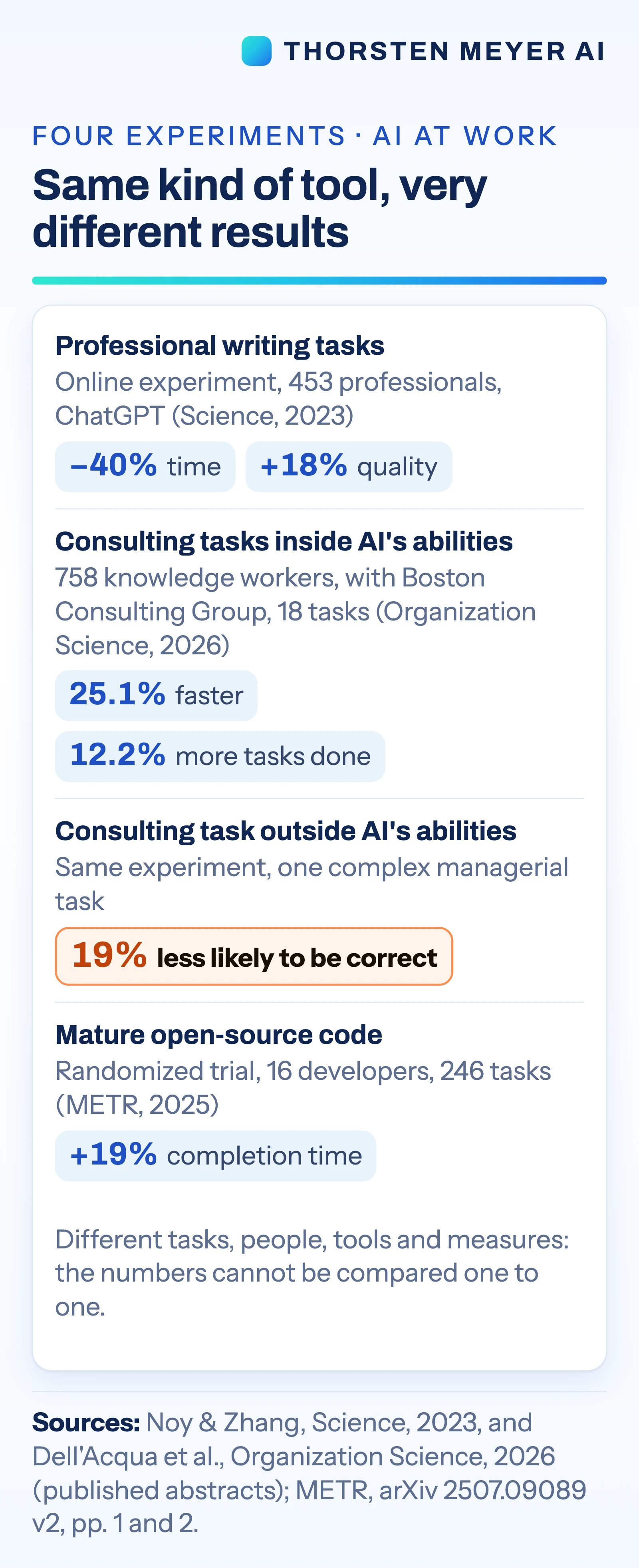
The study of consulting work that Feigh cites is the “jagged technological frontier” experiment by Fabrizio Dell’Acqua, Ethan Mollick, Karim Lakhani and colleagues, now published in Organization Science. It was run with Boston Consulting Group and involved 758 knowledge workers in a preregistered experiment.
On 18 realistic tasks inside the frontier of AI capabilities, “subjects using AI outperformed those not using AI, completing 12.2% more tasks and completing them 25.1% more quickly on average while also delivering solutions of significantly improved quality.” But on a complex task chosen to lie outside that frontier, “subjects using AI were 19% less likely to produce correct solutions compared with those without AI.”
Our reading: this is the verification problem in a nutshell. Nothing in the AI’s answer signals which kind of task it is facing. The person has to tell, and can do so only if they know the subject well enough.
Professionals: big gains on writing tasks
The positive side of Feigh’s argument rests on studies like the one by Shakked Noy and Whitney Zhang in Science. In a preregistered online experiment, 453 college-educated professionals did occupation-specific writing tasks, and half were given ChatGPT. “The average time taken decreased by 40% and output quality rose by 18%.”
These were self-contained writing tasks for mid-level professionals. Our reading: in such tasks a reader can judge the output fairly quickly. Experienced developers working in large code bases with unwritten rules, as in METR’s trial, are close to the opposite case.
Reviewers catch typos and miss conceptual errors

How well do people actually check AI suggestions? A team from LMU Munich and the University of Maryland tested this with 2,784 US participants recruited online, published in the Harvard Data Science Review in spring 2026. Participants saw tables from corporate greenhouse gas reports and had to decide whether an AI-extracted value was correct. The “AI” values were in fact prepared by the researchers, a so-called Wizard of Oz design, so they could control which errors appeared.
Two findings matter for workplaces. First, when flagging an error also required typing in the correct value, “participants made fewer corrections overall and more often accepted incorrect suggestions.” Overall accuracy was nonetheless slightly higher in that condition, 68% versus 66%, and it also led to fewer overcorrections, that is, fewer correct values flagged as wrong. Second, attitudes mattered: people “skeptical of AI detected errors more reliably”, while those “favorable toward automation more often accepted incorrect AI suggestions.” A bonus for accuracy made no meaningful difference.
The error type mattered most. “Spelling errors, such as confusing two digits, are corrected most frequently, 82% of the time.” Values taken from the wrong cell were corrected in about 77% of cases. But when spotting the error required understanding the task’s rules, accuracy fell to 31%. For one table where the AI value was correct but confirming it needed expert knowledge, accuracy “dropped to just 21%.”
Knowledge workers: effort moves from doing to checking
A survey by Carnegie Mellon University and Microsoft Research, presented at CHI 2025, asked 319 knowledge workers about 936 real examples of using generative AI at work. They reported some critical thinking in 555 of those examples. Depending on the type of thinking, between 55% (evaluation) and 79% (comprehension) of the responses rated it as less or much less effort with AI. Evaluation, judging the quality of work, had the lowest share.
The authors describe a shift: “GenAI shifts the nature of critical thinking toward information verification, response integration, and task stewardship.” Participants “perceived more effort in verifying the information in the AI response.” And confidence cuts both ways: “higher confidence in GenAI is associated with less critical thinking, while higher self-confidence is associated with more critical thinking.” These are self-reports, not measured performance.
Explanations help only when they make checking cheaper
Can AI simply explain itself and make checking easy? The evidence Feigh cites is mixed. A Stanford and University of Washington team ran five studies with 731 participants on a maze task. They argue that people weigh the cost of checking against the cost of trusting the AI, and that explanations reduce overreliance only when they make verification cheaper: “some of the null effects found in literature could be due in part to the explanation not sufficiently reducing the costs of verifying the AI’s prediction.”
A study at the Mensch und Computer 2024 conference with 200 participants found the limit Feigh describes: explanations “reduce overreliance for easy decisions, but that this effect vanishes with increasing decision difficulty.” The paper’s title sums it up: “You Can Only Verify When You Know the Answer”.
Why checking is hard work
Feigh names three burdens. Each matches something the studies above saw.
- Cognitive load: “When to stop verification is less obvious” than when to stop creating. “A worker must decide what to check and how; they do not know whether an error exists, where it might be or what form it might take.” She compares it to airport security screening, where rare threats are missed more often than common ones. The reviewers in the emissions study did well on typos and badly on conceptual errors.
- Time: “instead of ending work, finding an error starts another cycle of correction and then rechecking.” And “the more work needed to fix an identified mistake, the less likely people are to actually fix it.”
- Motivation: “Creation produces visible progress, but verification may find only that nothing was wrong.” When automation usually works, “people may gradually become less vigilant.”
Feigh also cites a meta-analysis of 86 studies showing that people remember what they produced far better than what they only read. Checking someone else’s draft is not the same mental work as writing your own.
Where the limits are
The research does not add up to a simple verdict, and Feigh says so herself: “These studies do not establish that there is a universal verification ‘tax,’ but they show why the speed alone of generating output is an incomplete measure of productivity.”
- Lab versus field: the writing study and the emissions study were online experiments. METR’s trial used real work, but with only 16 developers, all highly experienced in their own code bases.
- Task type: gains were large on professional writing tasks and on consulting tasks inside AI’s abilities. Losses appeared on a task outside those abilities and in large, mature code bases with high quality standards.
- The tools are moving targets: METR tested AI tools from early 2025. The authors themselves say better models, prompting or agent setups could change the result.
- Self-reports: the CHI survey measures what workers say about their effort, not how good their work was.
- Simulated AI: in the emissions study, the AI suggestions were prepared by the researchers, and the participants were crowdworkers, not domain experts.
What it means for businesses
Our reading of the evidence, not advice for a specific case:
- Measure net, not gross. Time to first draft is the wrong metric. Feigh puts the right one plainly: “whether the entire human-AI workflow produces trustworthy work at a lower total cost.” That means counting review, correction, rework and the errors that slip through.
- Do not trust the feeling. METR’s developers believed they were faster while the clock said the opposite. Pilot projects that rely on how productive staff feel can be misleading. Time the work.
- Put review where errors are costly and hard to see. Typos are caught anyway. Conceptual errors, wrong assumptions and errors outside the reviewer’s expertise are where checking pays off, and where it is hardest.
- Design the correction step. In the emissions study, making a correction more work led to fewer corrections. If fixing an AI error takes extra steps, the study suggests more errors may be waved through.
- Know where the frontier is. The consulting study shows the same tool helping on one task and hurting on the next. Teams need to map which of their tasks fall on which side, and update that map as tools change.
- Budget for it. Feigh’s practical conclusion: “If workers remain accountable for AI-assisted output, I believe that they must also be given the time, training and authority needed to verify it.”
What it means for workers
- Your job is changing shape. In the CHI survey, critical thinking moved from producing toward verifying, integrating and stewarding. Feigh calls it a “skill swap”.
- Checking is a skill, and it is not easier. Feigh writes that these skills “might not even be in the skill set of workers who excel at creation.” Learning where a specific AI tool tends to fail is part of the work now.
- Confidence is a risk factor. In the survey, more confidence in AI went with less critical thinking. In the emissions experiment, people favorable toward automation accepted more wrong suggestions.
- Expertise is your safety net. Explanations helped people verify only when they already knew the answer. Using AI outside your own field raises the risk of accepting a wrong result.
- Watch the hidden workload. If AI drafts more, someone checks more. That time should be visible in planning, not absorbed quietly.
What is not known
- How big the verification cost is in most jobs. The studies cover coding, writing, consulting tasks and data checking. None of the studies we read measures review time across many occupations in real workplaces.
- Whether newer AI tools change the balance. METR’s trial used tools from early 2025. Results for current models and agents in the same setting are not part of what we read.
- Long-term effects on skills. The evidence on memory and critical thinking is suggestive, but none of the studies here followed workers over years.
- The full texts behind some figures. For the consulting and writing studies we relied on the published abstracts, because the publishers’ pages blocked our automated access. One conference paper Feigh links to as her first source could not be opened at all, so we did not use it.
- Independence: Feigh co-authored one of the studies she cites, a 2026 study of 80 people supervising several AI teammates, which found that dependencies between AI agents raised workload and that people were less sensitive to less severe AI errors.
The bottom line
AI makes producing a first draft cheap. It does not make knowing whether the draft is right cheap, and that second cost lands on people. The research Feigh points to shows real gains on some tasks and real losses on others, and a consistent blind spot: people feel faster than they are, and they catch easy errors better than hard ones. For companies, the useful question is not how fast the AI is, but what the whole workflow costs, errors included. For workers, checking is becoming a core skill, and it deserves time, training and recognition.
I’m Thorsten Meyer. The full sources are below, and more reality checks are at thorstenmeyerai.com.
Sources
- Karen Feigh, Georgia Institute of Technology: “Catching AI’s mistakes is a mental burden – and a drag on productivity”, The Conversation, November 16, 2026 (expert commentary; the author discloses funding from the Office of Naval Research and the U.S. Army)
- Joel Becker, Nate Rush, Beth Barnes, David Rein (METR): “Measuring the Impact of Early-2025 AI on Experienced Open-Source Developer Productivity”, arXiv 2507.09089, version 2, July 2025
- Fabrizio Dell’Acqua, Edward McFowland, Ethan Mollick, Hila Lifshitz, Katherine C. Kellogg, Saran Rajendran, Lisa Krayer, François Candelon, Karim R. Lakhani: “Navigating the Jagged Technological Frontier: Field Experimental Evidence of the Effects of Artificial Intelligence on Knowledge Worker Productivity and Quality”, Organization Science, 2026 (published abstract)
- Shakked Noy, Whitney Zhang: “Experimental evidence on the productivity effects of generative artificial intelligence”, Science, 2023 (published abstract)
- Jacob Beck, Stephanie Eckman, Christoph Kern, Frauke Kreuter: “Bias in the Loop: How Humans Evaluate AI-Generated Suggestions”, Harvard Data Science Review, Spring 2026
- Hao-Ping (Hank) Lee, Advait Sarkar, Lev Tankelevitch, Ian Drosos, Sean Rintel, Richard Banks, Nicholas Wilson: “The Impact of Generative AI on Critical Thinking: Self-Reported Reductions in Cognitive Effort and Confidence Effects From a Survey of Knowledge Workers”, CHI 2025
- Helena Vasconcelos, Matthew Jörke, Madeleine Grunde-McLaughlin, Tobias Gerstenberg, Michael S. Bernstein, Ranjay Krishna: “Explanations Can Reduce Overreliance on AI Systems During Decision-Making”, Proceedings of the ACM on Human-Computer Interaction (CSCW), 2023
- Zelun Tony Zhang, Felicitas Buchner, Yuanting Liu, Andreas Butz: “You Can Only Verify When You Know the Answer: Feature-Based Explanations Reduce Overreliance on AI for Easy Decisions, but Not for Hard Ones”, Mensch und Computer 2024 (published abstract)
- Ranjani Narayanan, Karen M. Feigh: “Designing for Oversight: An Empirical Investigation of the Dual Impact of AI Dependency and Information Abstraction on Human Supervision in Decision-Making Teams”, International Journal of Human–Computer Interaction, 2026 (published abstract)
Researched and drafted with AI assistance, including Anthropic’s Claude. No company, university or person named here reviewed or sponsored this article. Our own text and graphics contain no affiliate links; offer and product boxes added by the site may contain Amazon affiliate links. This article is for information only. It is not legal, employment or investment advice. Statements as published by the authors and journals above, as of 06:30 CET on November 17, 2026. Images: AI-generated illustration (Runware) and graphics by Thorsten Meyer AI; no real people or logos are shown in our images. Boxes added by the site may show product photos or people.